Persistence
Vol. 25 No. 2 (2019)
Extinction
Vol. 25 No. 1 (2019)
This volume is dedicated to the memory of Deborah Bird Rose.
Trouble
Vol. 24 No. 2 (2018)
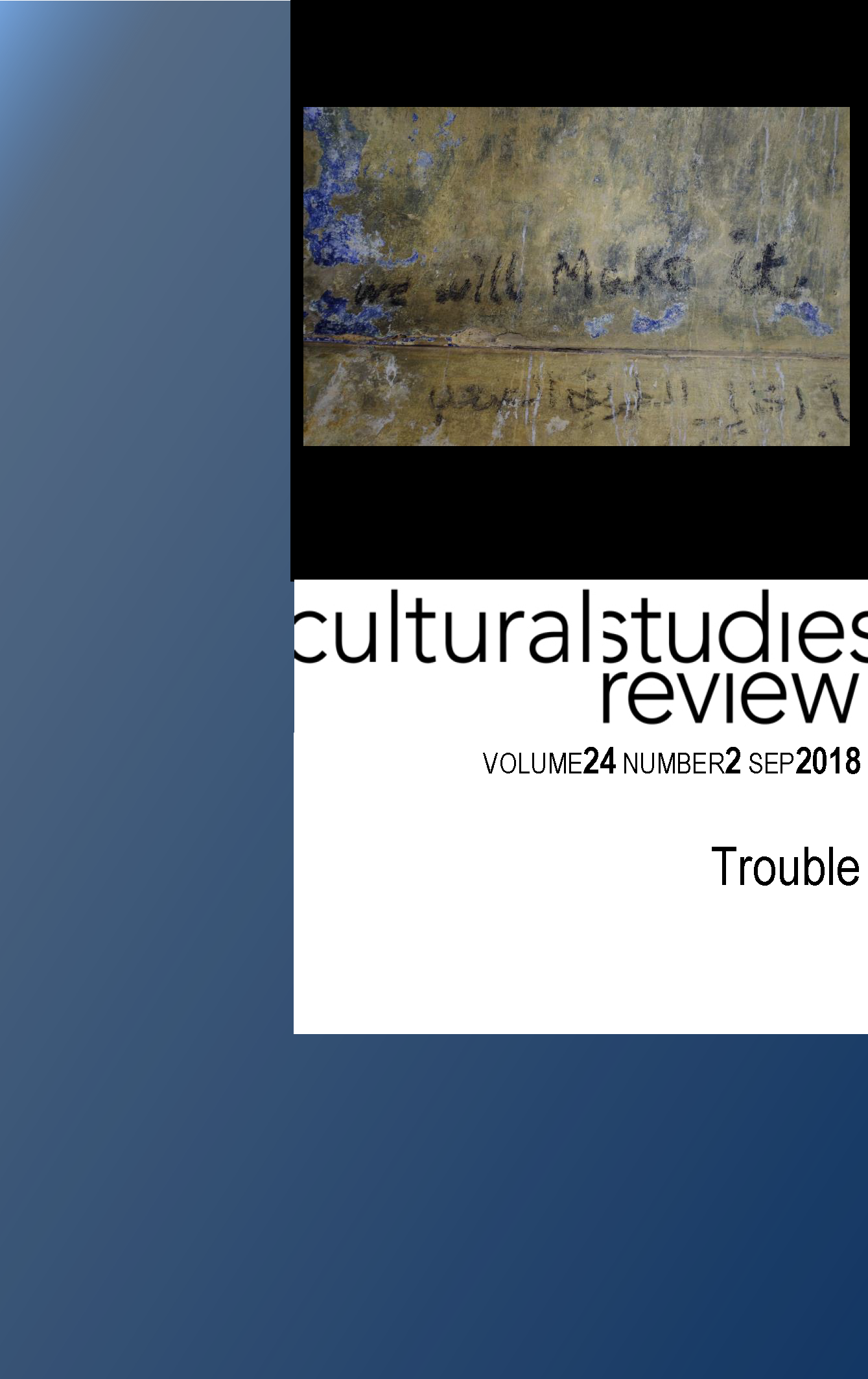
This edition of Cultural Studies Review trials some less-than-conventional scholarly responses to a diverse array of troubling cultural moments. Tara Brabazon, Steve Redhead and Runyararo Chivaura raise the possibility of ‘Trump Studies’ in a polemic that seems both mimetic and supplementary. Their persistent attention to race, and whiteness in particular, as a point of connection between Brexit and Trump usefully reminds us of the enduring historical dimensions of these times while not ignoring the unpredictable effects of Trump’s transformation of conventional alliances.
Our special section, ‘The Ethics of Troubled Images’ showcases critical work on ‘troubling’ images and we thank its Guest Editors, Bruce Buchan, Margaret Gibson and Amanda Howell, and the authors of the essays within; Grant Bollmer, Katherine Guinness, Larissa Hjorth, Kathleen M Cumiskey, Wendy Keyes, Barbara Pini and Anna Reading. As this section explores, troubled images are those that provocatively depict violence, marginality, dehumanisation, public death and mourning but these ubiquitous images are also troubling in their invitation to accept, normalise, or legitimate violence, suffering and victimisation.
Meaghan
Vol. 24 No. 1 (2018)
Reprise
Vol. 23 No. 2 (2017)
Elsewhere in this issue are two essays focused on question of language and culture. Michael Richardson writes about the complex relationships between political speechwriters and speechmakers, while Prithvi Varatharajan is concerned with the public utterances of contemporary Chinese-Australian poet Ouyang Yu, broadcast on Australian public radio. In a different register, Nicole De Brabandere explores the rich materiality of ordinary domestic figurines and dinnerware, while a contrasting sense of interiority pervades Vahideh Aboukazemi’s history of revolutionary Iran. And, as always, our reviews will repay your attention.
Mobilities
Vol. 23 No. 1 (2017)
This issue of Cultural Studies Review features three outstanding essays that reveal the exciting diversity of current research in cultural studies. These are Ben Highmore’s future-directed and poetic evocation of a more peripatetic cultural studies, Jessica Kean’s exploration of the ‘texture’ of non-monogamy and Elspeth Probyn’s ‘thought experiment’, which pluralises and relativises fish while maintaining an urgent interest in sustainability.
The issue also contains a special section on ‘Media, Mobilities and Identity in East and Southeast Asia’, guest edited by Dan Edwards, Louis Ho and Seokhun Choi. This section engrossingly addresses gaps in existing mobilities scholarship with an eye not only to physical movement but, more centrally, to the complex interplay of mobile technologies and information on the one hand and rapidly evolving formations of culture and identity on the other. Within the articles, ‘Asia’ is conceptualised as a zone of cultural and political plurality, where in fascinating and often highly volatile ways a vast array of migrations, imaginings, representations and discourses constantly bump up against political and cultural borders.
Migrant
Vol. 22 No. 2 (2016)
This is a general edition of Cultural Studies Review in that it has not been organised around a special themed section. Rather, it is a collection of essays on distinctly different topics, each of which push against our habits of thinking about correction and invention. And yet, a subtle theme emerges from these diverse pieces, of movement from one place to another, whether forced by circumstance, freely chosen or imposed. They are essays, too, that pose questions about the durable and unstable nature of cultural configurations and about the contribution of cultural research to a more sustainable future.
Fashioning
Vol. 22 No. 1 (2016)
New Materialisms
Vol. 21 No. 2 (2015)
Interventions
Vol. 21 No. 1 (2015)
This title of this issue of Cultural Studies Review, ‘Interventions’, was inspired by two different ideas. First, it refers to Grant Farred’s point that ‘interventions’—the drive to intervene and the insufficiency of ‘old’ methods as responses to new political sites and institutional eruptions—has meant that cultural studies has been forced to invent new methods, and cobble together existing methods, to engage contingently with emerging cultures. ‘Interventions’ call on cultural studies to look elsewhere, in what Farred calls ‘the imperative to think out of context’ is reflected diverse ways in the research articles that appear in this issue.
The title was also drawn from ‘Same But Different’, the special section edited by Jennifer Biddle and Lisa Stefanoff that makes up the second half of this issue. The contributions gathered together in the section were not an organised response to the Northern Territory Intervention (officially, the Northern Territory National Emergency Response Act 2007), rather they emerged from forums concerned with experimental and innovative Indigenous arts held in Alice Springs. But as the guest editors suggest, this collection ‘can be understood as itself an intervention in the non-consultative and top-down tendencies of current national policy and debate.’
Locating Memory
Vol. 20 No. 2 (2014)
Locating Memory
co-edited by Martine Hawkes
The 'Locating Memory' section presents interdisciplinary research originally presented at the Historical Justice and Memory Conference, held in Melbourne in February 2012. The articles critically engage with the theme of the ‘place’ of historical injustice and the circulation of memory at these sites.
Many of the 'unthemed' articles in issue also evoke 'space' and 'place' in varied ways, offering a refreshing take on such questions as how, as an experience and a material event, space can produce both another order of politics and another order of being.
Coding Labour
Vol. 20 No. 1 (2014)
Coding Labour
co-edited by Anthony McCosker and Esther Milne
Emotional Geographies
Vol. 19 No. 2 (2013)
That geographical locations inspire and hold orders of emotions is an ordinary belief. That we ‘feel’ something for places we call home or work and that we actively invent orders of being that emerge from sites such as ‘the beach’ and ‘the city’ is the stuff of many a memoir, edited collection and an often uncritical expectation. The essays in this issue of Cultural Studies Review approach these emotional geographies from diverse paths.
The Emotional Geographies of the Uncanny section aims to read transnational spaces constructed and inhabited by Italian migrants and settlers to Australasia as emotional spaces of uncanny perceptions, memories, narratives and identities. Among the general articles, the focus of interest coming to rest upon police buildings, remnants of nature, items in a museum collection, simulated national buildings not entirely lost in translation and trees made over (and even museamised) in human-centred productions because of the mark of a possible ‘explorer’ on its trunk. In other pieces, the authors’ foci is the suburb: in an exploration of class and materiality in the remnants of colonial villas and in a new writing piece that tracks paths of barrows and dogs through a suburb’s streets.
Food Cultures and Amateur Economies
Vol. 19 No. 1 (2013)
Food Cultures, co-edited by Isabelle de Solier and Jean Duruz, explores what cultural studies can offer the study of food through articles that demonstrate the many and varied ways in which food matters to individuals, communities and society, and why it should matter to cultural studies.
Amateur Economies, co-edited by Glen Fuller, Caroline Hamilton and Kirsten Seale, focuses on the shifting composition of relations that develop between and constitute the amateur and the professional. Articles address a wide range of themes, including the movement from the amateur to the professional, the character of opportunities that emerge in creative and social networks and the line between opportunity and exploitation.
On Noise
Vol. 18 No. 3 (2012)
co-edited by Bruce Buchan and David Ellison
For the first time, CSR is producing a third issue for the year. The volume includes the special guest-edited section 'On Noise', which is devoted to the concept of noise and the roles it plays in a range of very different contexts. Together, the essays represent an important attempt to readjust the sensorium through which cultural studies usually imagines the material world and the cultural politics that flows from it.
The issue also features a provocative essay from Marcus Breen, new writing, book reviews and, to mark the final issue of CSR he will be co-editing, a Salute to John Frow, with sample of Frow's latest work on character, with responses from Tony Bennett and Stephen Muecke.
Secular Discomforts and On Mad Men
Vol. 18 No. 2 (2012)
Secular Discomforts: Religion and Cultural Studies is co-edited by Sophie Sunderland and Holly Randell-Moon.
The articles within this section are related through their capacity to unsettle and occupy a position of discomfort, rather than appeasement, in their engagements with cultural studies, secularism and the religious. Critical to this capacity is resistance to the idea that ‘religion’ and ‘cultural studies’ are irreconcilable opposites, or that ‘secularism’ might form the neutral ground upon which to stage debate. Rather, in offering this collection the editors are keen to unsettle the idea that the secular underwrites analyses of the religious and, further, that the secular marks the terrain from which cultural studies is enacted.
On Mad Men is co-edited by Prudence Black and Melissa Hardie.
This collection of essays on the US cable TV series Mad Men shows the ways in which the series, and its viewers, engage with issues that are central disciplinary concerns in cultural studies and which articulate cultural studies’ relationship to other disciplines. Rather than understanding the series to be motivated by a desire to chart sociohistorical changes, an understanding its period stylings have sometimes invited, these essays move in other directions. Their analyses focus on genre, on dynamics of gender and sexuality as they are implicated in the series and in its reception and on the complicated work of representing the making of history. They take seriously the role of creativity and the aesthetic in the putatively ‘low’ cultural domain of advertising. Moving in a variety of disciplinary directions they address questions central to the work of cultural studies.
Motorcycles, Snails, Latour
Vol. 18 No. 1 (2012)
Disciplining Innovation: New Pedagogies in Cultural Studies
Vol. 17 No. 2 (2011)
The themed section of this issue analyses the experience and future of pedagogical innovation in cultural studies, focusing on a variety of questions and issues. Has technological innovation allowed flexibility and an extension of the curriculum, or merely been used to reduce face-to-face teaching hours? Has the consistent demand to plan and report on teaching programs encouraged forward thinking or burdened academics with bureaucratic demands? Have universities truly internationalised their curriculums or merely exploited upwardly mobile international students? Has pedagogical innovation advanced or compromised the university’s ethical commitments: to social justice, equal access, human rights and environmental sustainability? What broader cultural developments does the consistent call to innovate in the classroom reflect?
The rest of the issue contains a wide range of innovative articles, new writing and reviews.
The Death Scene: Perspectives on Mortality
Vol. 17 No. 1 (2011)
co-edited by Bruce Buchan, David Ellison and Margaret Gibson
This issue focuses on the interdisciplinary exploration and analysis of the scene of death, defined both in its privileged sense as the location of the end of life (with its associations of reflection, palliation, and confession) and in broader terms as a space of ethical contest (where ideas of the good death, or even the definition of death itself is open to debate). The varied articles explore how cultures frame the meaning and interpretation of human mortality in terms of representation, memorialisation, and the spacial and temporal location of moments of death.
Critical Proximity
Vol. 16 No. 2 (2010)
Rural Cultural Studies: Research, Practice, Ethics
Vol. 16 No. 1 (2010)
The first section of this issue of Cultural Studies Review has been co-edited with Clifton Evers, Andrew Gorman-Murray and Emily Potter and is based around the theme of Rural Cultural Studies. These articles focus on different aspects of rural cultural research: the diverse scope of ‘rural’ communities in Australia; the discursive and material relationship between the rural and the urban; the under-acknowledged range of everyday cultural practices in rural Australia; and the themes of ethical engagement, power and the mediation of meanings and interests in the practice of research.
The issue also contains poetry, three 'unthemed' essays and book reviews.
Critical Indigenous Theory
Vol. 15 No. 2 (2009)
The September 2009 issue of Cultural Studies Review, co-edited by Aileen Moreton-Robinson, grew out of the Indigenous Studies Research Network, which is located at the Queensland University of Technology in Brisbane, Australia. All the contributors to the Critical Indigenous Theory section of the issue are members of the network and the issue showcases critical theory developed from their respective standpoints and epistemologies. These scholars are politically and intellectually engaged in demonstrating how critical Indigenous studies as a mode of analysis can offer accounts of the contemporary world that centre Indigenous ways of knowing and theorising. The writing is challenging and innovative, engaging theory to questions that concern the writers and their communities. These new conceptual models have grown productively out of the postcolonising world the contributors inhabit. In nation states such as the United States, Canada, Australia and New Zealand, these writers show, colonisation has not ceased to exist—it has only changed in form from that which their ancestors encountered.
The issue also includes some general essays and book reviews.
Homefronts
Vol. 15 No. 1 (2009)
Panic
Vol. 14 No. 2 (2008)
History Experiments
Vol. 14 No. 1 (2008)
Slight Anthropologies
Vol. 13 No. 2 (2007)
Recalling Modernity
Vol. 13 No. 1 (2007)
Engagements
Vol. 12 No. 2 (2006)
Art and Ecology
Vol. 12 No. 1 (2006)
Italian Effects
Vol. 11 No. 2 (2005)
Desecration
Vol. 11 No. 1 (2005)
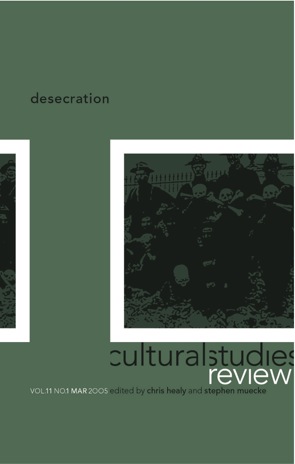
What happens when sacred sites are destroyed? What are the effects of being dispossessed and of having one’s own existence denied? Desecration of the sacred, of land and of self are themes explored in a group of essay co-edited by Deborah Rose and Peter Read. These studies of PNG, Havana, Sarejevo and parts of Australia bring living beings and the dead into a realm in which violence that refuses life confronts life that refuses obliteration. These essays offer rich and resonating thought.
In other essays Marcus Breen ponders cultural criticism and life in the USA, Nicola Evans shows how sensational trials catapult private matters into the public sphere, and Ross Chambers writes a poetic supplement to Peter Cary’s My Life as a Fake. The Provocations section showcases Iain McCalman, making his case for state and popular support for the humanities and social sciences, and Isabelle Stengers on ‘ecology of practices’ as a tool for thinking. In New Writing Jane Messer reflects on the maternal heroine in memoir and fiction.
Haunted
Vol. 10 No. 2 (2004)
Action
Vol. 10 No. 1 (2004)
Charlatans
Vol. 9 No. 2 (2003)