
Vol. 31 (2024)
Commenced in 1992 under the auspices of the Professional Historians Association of New South Wales and, from 1999, the Australian Centre for Public History, Public History Review is now in its 32nd and, I must report with some regret, final year of publication. Paper-based until 2005, and digitally published by UTS ePress at the University of Technology Sydney from the following year, PHR has published over 300 articles as well as many more reviews and reports from the field. As per its original mission, the journal has published the work of historians and other professionals at various career stages – from the eminent to the emerging. This was always a key part of its mission. And it was the reason that the journal received a cultural grant from the New South Wales Ministry for the Arts during most of the 1990s.
The journal, with its tiny resource base, closes with an impressive digital record. It has 2,814 readers in over 50 countries; 366 registered reviewers; averages around 2,500 abstract views per month (12,000 in February 2018 given a strong interest in articles on public history in India and South Africa); and its most viewed/downloaded article – Meg Foster’s ‘Online and Plugged in?: Public History and Historians in the Digital Age’ – has had 6,405 abstract views, 7,236 file views and 2,927 pdf and 4,309 html downloads, all of which continue to rise week-by-week.
Many thanks to our authors, reviewers, readers and other supporters. And special thanks to the brilliant UTS ePress team at the University of Technology Sydney. The journal will be archived and available through the ePress.
Paul Ashton
[Cover Image: Memorial to Michael John Hind, 15.6.1946–13.4.2008, Luna Park, Sydney, 2017]


Public History in Aotearoa New Zealand
Vol. 29 (2022)
This special issue of Public History Review has been edited by Fiona McKergow, Geoff Watson, David Littlewood, and Carol Neill.

Statue Wars: Protest, Public Histories and Problematic Plinths
Vol. 28 (2021)
This special issue of Public History Review has been edited by Kiera Lindsey and Mariko Smith. Through a collection of refereed articles and invited commentaries it investigates the 2020 statue wars and their aftermath in the context of the Black Lives Matter Movement.
The cover image for this special issue is Travis De Vries 'Tear it Down (Cook Falling)' (travisdevries.com), 2019, a print of which was acquired by the Australian Museum for the Unsettled exhibition (2021). The work is reproduced with permission.
Vol. 27 (2020)
Welcome to volume 27 of Public History Review. From this year the journal will open the annual volume at the beginning of the year and publish into it as articles are finalised. The online journal system will notify users when articles become available.
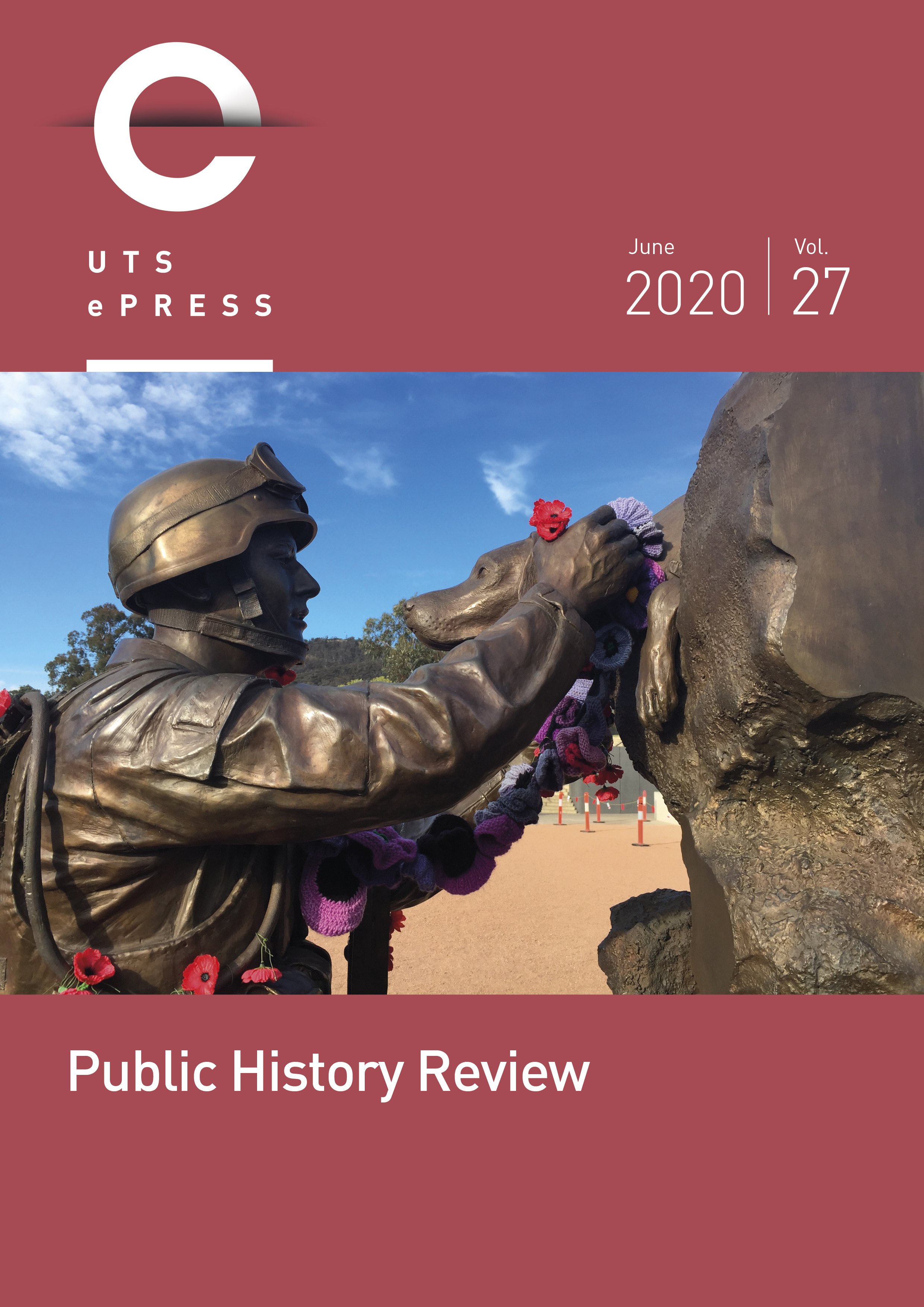
Cover image: monument to Australian Army working dogs, Australian War Memorial. Working dogs were first used by the Royal Australian Engineers in 1918 (photograph Paul Ashton).
Vol. 26 (2019)
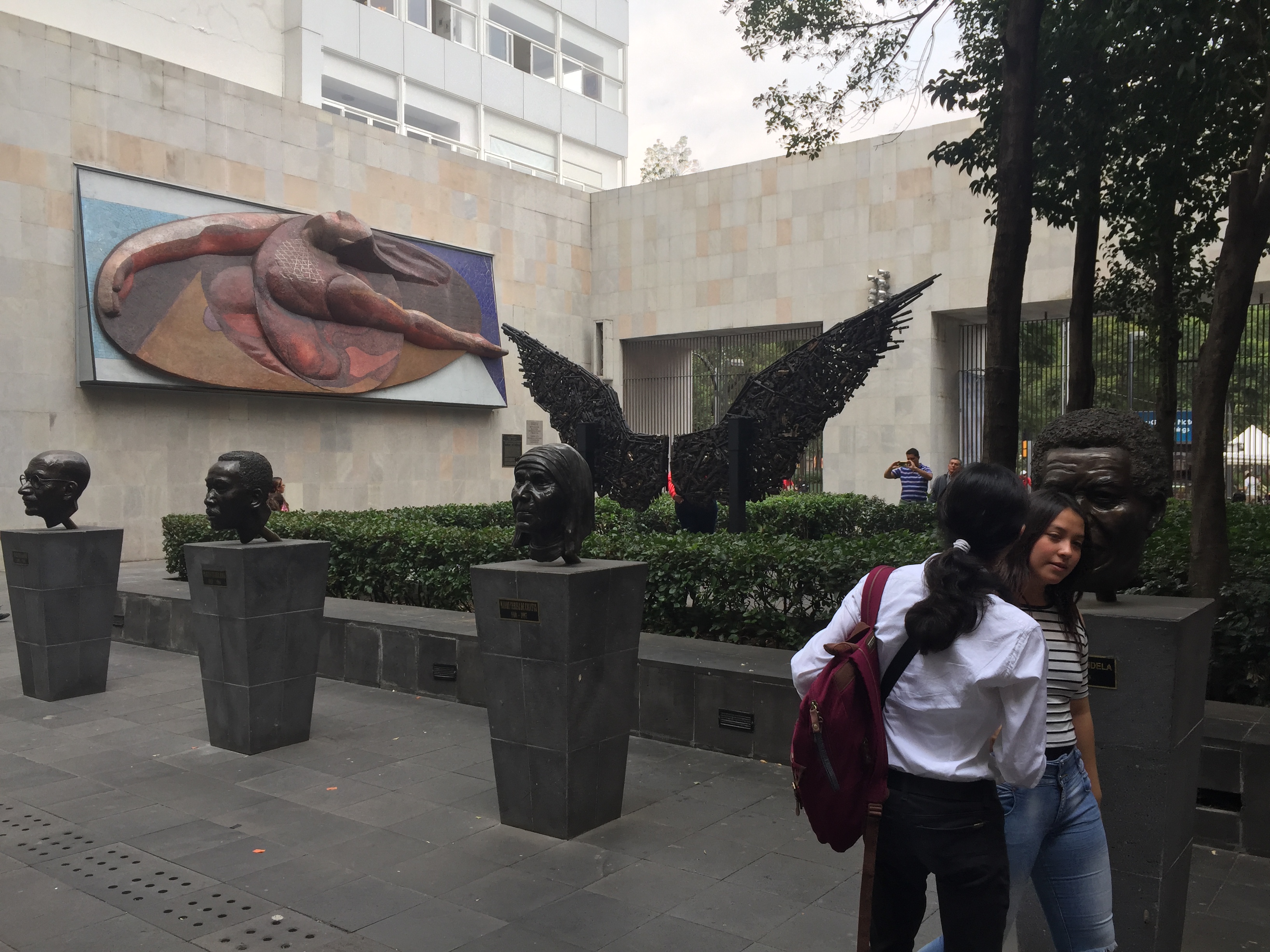
Welcome to volume 26 of Public Histoy Review. The cover shows the front of the Museum of Memory and Tolerance in Mexico City.
Vol. 25 (2018)
Welcome to volume 25 of Public History Review. Recently the long-term impact of the journal has been recognised by the republication, starting from this year, of key articles in a new Chinese journal, Public History: A National Journal on Public History, published by Zhejing University Press.
Vol. 24 (2017)
Materialities of Memory and Identity
Vol. 23 (2016)
Vol. 22 (2015)
Vol. 21 (2014)
Vol. 20 (2013)
Vol. 19 (2012)
Vol. 18 (2011)
Vol. 17 (2010)
Places of the Heart: Memorials in Australia
Vol. 15 (2008)
War memorials have captured both the popular imagination for generations and the attention of academic and other observers. Collectively they are a striking feature of the Australian landscape. Non-war memorials have also proliferated, especially in recent decades. But the study of them has been slow to develop. Significant work on these types of memorials – ranging from traditional forms to roadside memorials, public art and graffiti – commenced in the 1980s. The field, however, has not attracted sustained attention. This is reflected in a number of ways including their general absence on official heritage listings which are dominated by memorials to wars and organised religion. Further, most memorial studies provide little historical context to memorials or to how their meanings can change over time. There is more than a history of memorials as objects; there is a history of memory and commemoration and of evolving meaning. These contexts are critical to understanding the cultural significance of memorials. The articles presented in this volume explore these contexts from a range of perspectives.
We would like here to acknowledge Dr Rose Searby's contribution to the publication of this volume.
Paul Ashton and Paula Hamilton
Vol. 14 (2007)
Paul Ashton and Paula Hamilton
Conflicted Heritage
Vol. 13 (2006)
Welcome to the second electronic volume of Public History Review entitled ‘Conflicted Heritage’. Edited by Dr Alexander Trapeznik, this special issue emerged from an international symposium held at Otago University in mid 2005 which addressed conflict in cultural heritage and its management. We look forward to publishing more special issues on public history related themes in the future.
Paul Ashton and Paula Hamilton
Vol. 12 (2006)
Editorial Welcome
Welcome to the first electronic volume of Public History Review (PHR). PHR has been published annually since 1992. In that year, we hoped in the editorial that:
‘Public History Review functions, metaphorically speaking, at the point where all rivers meet; that is, it provides firstly a forum for historians working in heritage, government departments, radio, television, schools, museums, freelance and any other area of the culture, who wish to pursue some issues relating to their work in greater depth, reflect on some issue of practice, comment on other historical representations or extend our knowledge of public history as a field of study. Secondly we welcome contributions from others such as conservation architects, archaeologists and… [others] who wish to comment on history-related matters. And finally we aim to engage academic historians more fully with the concerns of the public, and public history work; to inform and challenge, to articulate the creative tensions between theory and practice.’
The field of public history has grown and diversified over the last thirty years. In Australia there are now as many, if not more, public or freelance historians than academic historians. Institutionally, in the USA, the field, which has been established there longer than elsewhere, has been recognised in a number of ways including the establishment of the National Council on Public History in 1979. Public history is also on the rise in the UK, though it has been present in the culture for decades under other guises. The first international public history conference in Britain was held in September 2005 at Ruskin College, Oxford, where eminent ‘public’ historian Raphael Samuel taught for most of his life.
Over the years that we have been editing PHR new technologies have emerged for the communication of historical work. We have chosen to join the digital revolution in this format to facilitate the global exchange of ideas. In the last decades of the twentieth century history has become more democratic and this has been reflected in and encouraged by the public history movement.
Public history is flourishing in and across countries and cultures in various modes. This is apparent in the number and diversity of popular, accessible historical activities and productions located outside the academy. History is on the airwaves, the internet, on film and television, in newspapers and in classrooms; it is represented in museums and public rituals. The past is actively pursued in the present by a range of people and groups, such as family and local history societies, for a variety of purposes. Social movements represent themselves historically for political legitimacy. These and other developments have led to an academic interest in historical consciousness. Public history can also be linked to the rise of the nation state. The past, indeed, has always had many uses in the present.
Public history is a broad field. It also has a particular concern with audience. We look forward to furthering the journal’s original aims and objectives.
Paul Ashton and Paula Hamilton