Editorial
Jurgen Schulte
SciMERIT
School of Mathematical and Physical Sciences
P.O. Box 123, Broadway NSW 2007
E-Mail: Jurgen.Schulte@uts.edu.au
DOI: http://dx.doi.org/10.5130/pamr.v3i0.1421
This is the third issue of PAM Review, the peer-reviewed, subject specific student research journal of the School of Mathematical and Physical Sciences at the University of Technology Sydney. The student journal was first introduced into the third semester subject Energy Science and Technology (68412) in 2014 to allow for a practical student centered, authentic learning experience that is exciting and challenging and helps to facilitate desired graduate attributes. Energy, Science and Technology is a one-semester subject (class) that covers the thermodynamics of macroscopic and microscopic processes in the context of energy production, energy saving and related applications. This third semester subject is open to students in science as well as engineering.
The compilation of this research journal provides students with an authentic, practical learning experience in applying scientific methods to produce a meta-study, peer-reviewed original research paper that reaches beyond a mere literature review. The research work in small teams has been designed to create an environment similar to the creation of a real scientific publication, including: gaining expertise in a range of scientific fields of science previously not encountered in the course; consulting professional scientific databases; studying peer-reviewed scientific papers; synthesizing relevant information; formulating a research objective for the meta-study; writing a scientific paper for professionally published indexed journal; working in a research team with a range of expertise; managing research and paper writing workloads within a team; acting as a peer-reviewer for other team papers; assessing papers according prescribed peer-review guidelines; completing the meta-study paper and its submission and the peer-review process within the journal’s publication timeline.
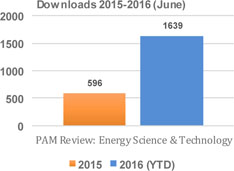
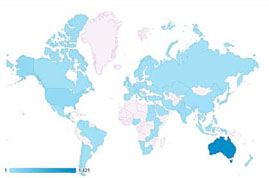
The journal moved to the ePRESS peer-reviewed open access publishing format in 2015. This made the students’ research accessible to a much lager audience. The quality research stroke an immediate interest world wide. Within the same year, the journal received almost 600 unique (non-robot) downloads which within the half-year prior to publishing this issue more than doubled again (Fig. 1). It has been a rewarding experience for students to see that their research work attracted a truly worldwide interest as illustrated in the journal download heat diagram (Fig. 2) and to see the outcome of their work now producing an impact well beyond their graduation.

©2016 by the authors. This article is distributed under the terms and conditions of the Creative Commons Attribution 4.0 International License (http://creativecommons.org/licenses/by/4.0/).