Fusion-From Stars to Power Sockets
Carla Fleisher-Petersen1, Shane Keen2, Liam Martin3 and Blake Regan4*
1 University of Technology Sydney, E-mail: Carla.S.Fleisher-Petersen@student.uts.edu.au
2 University of Technology Sydney, E-mail: Shane.R.Keen@student.uts.edu.au
3 University of Technology Sydney, E-mail: Liam.Martin@student.uts.edu.au
4 University of Technology Sydney, E-mail: Blake.Regan@student.uts
* Author to whom correspondence should be addressed; Blake.Regan@student.uts
Received: 25/5/2015 / Accepted: 29/5/2015 / 1/6/2015:
Abstract: Fusion energy is one of the promising energy sources of the future, with a practically limitless abundance of hydrogen in the universe and earth, it has the potential to replace current energy technologies being theoretically superior in efficiency with minimal environmental impact. A systematic review and meta-analysis of its thermodynamic properties, including the examination of the efficiency of underlying technologies and fusion causing techniques was conducted to examine the potential of this technology as a viable energy source. Through these methods we obtained thermodynamic data relating to to the efficiency of fusion engines, such as the Tokamak, Direct Pulse, Z-Pinch and Fusor style fusion engines, and the underlying technologies relating to conduction and radiation losses in a fusion engine in order to assess current and projected thermodynamic efficiencies and hypothesise potential research requirements to make fusion technology viable. From this research it is concluded that the main flaw in fusion technology is the inability to properly address radiation and conduction losses which minimise the power output of any fusion reactor.
Furthermore, while it is necessary to develop these technologies for the development of working fusion technology, their applications to other energy industries, such as solar and nuclear fission, would be more beneficial to the clean energy near future than to the long term goal of fusion technology.
Keywords: Fusion; Thermodynamics; Plasma; Laser; Containment; Radiation; Conduction; Materials Energy; Science; Physics; Technology; Meta-Study.
Copyright: © 2015 by the authors. This article is distributed under the terms and conditions of the Creative Commons Attribution license (https://creativecommons.org/licenses/by/4.0/).
DOI: http://dx.doi.org/10.5130/pamr.v2i0.1398
1. Introduction
Thermonuclear fusion is dependent on the highly energetic collisions of hydrogen isotopes with the ultimate goal to undergo fusion to produce energy. Forming high temperature plasma with a functionally 100% ionisation is the basis of this process, requiring heating up the plasma to temperatures of the order of 108K [21]. Fusion occurs when two hydrogen isotopes, usually heavy, ones such as deuterium [1], merge or “fuse” together to produce Helium and energy. This energy comes from the discrepancy in masses between the mass of hydrogen and helium. The simplest equation for this fusion reaction is as follows:

The energy provided is the energy conversion from the mass difference equated by E=mc2. Helium’s mass is 4.001505 atomic mass units (amu) [2], however the mass of the individual 2 neutrons and 2 protons comes to 4.031882 amu, the mass discrepancy of 0.030377 amu. One amu is 1.661 x 10⁻²⁷ kg, converting this into E=mc2, we see that one amu is 931.3 eV. Hence, the mass discrepancy of 0.030377 amu equates to 28.3 eV per atom of helium fused. If one mole of helium was to be produced, being only 4 grams, this would produce 1.9 x 1025 eV.
Fusion is the power source of stars, and hence to create fusion technology on earth, we must replicate the conditions of a star, such as our sun, which has a central pressure of 2.477 x 10¹¹ bar and a central temperature of 1.571 x 10⁷ K [3]. This presents three main areas of research. Firstly is how to produce such conditions safely in an industrial setting, secondly is containment, that is to confine the hydrogen isotope plasma fuel at the required temperature and pressure for enough time for nuclear reactions to occur, while preventing leakage of heat to surroundings. Lastly is the analysis and maximising of the thermodynamic efficiency of each component of this technology in terms of energy output to input. Through this Meta study, we will assess the thermodynamic properties and efficiencies of multiple different methods to produce fusion energy, and the properties of individual components, hence assessing the technology and its capacity to create energy from power station to power plug.
Fusion is currently not a viable energy technology. It has the fundamental problem of not being able to produce more energy than it requires to maintain a stable fusion reaction. While engines such as the Tokamak can produce a somewhat stable fusion reaction, it is in the failings of the components that build the engine that these energy losses can be found. In this Meta study, we will show the current standard of fusion technologies, highlight their flaws, and recommend possible direction that research has to go in the future.
2. Methods
To construct a basis on which to start the Meta study a preliminary investigation was undertaken to gain a better understanding of fusion reactors, the processes involved and types of fusion reactors. This was accomplished by looking at a variety of online sources and scientific papers, without time constraints on publishing year, involving fusion technology, fusion reactors and the thermodynamic processes involved in the fusion reaction. Once this research was completed it was decided to focus our research into the Tokamak, Direct Pulse, Z-Pinch and Fusor style fusion engines and hypothesis potential research requirements to make fusion technology viable.
A Meta study was then conducted on a number of different scientific papers from a variety of databases (Science Direct, SCOPUS, and Web of Science Core Collection). The database searches were restricted to papers within the last 20 years to maintain validity in current technologies and focused on papers relating to the keywords above. After looking through these databases’ scientific papers from a number of different journals were found and analysed. Other papers involving coal, fission, solar and wind energy systems were also analysed to provide a comparison of fusion with other energy sources.
This paper is split into three sections; the first section proves the reader with a description of each fusion reactor stated above and states the theoretical data that is like to occur if the reactor was constructed, the next discusses the materials used and construction methods used in the construction of a fusion reactor and the final section is a comparison of fusion with other energy sources.
3. Results and Discussion
The Lawson criterion [8] written in 1957 states that to make an effective fusion power generator, several fields must be addressed, the efficiency of the device, the power output of the fusion, and the losses deriving from radiation and conduction from the plasma itself. This consideration in summarised in the following equation:
Net Power = Efficiency × (Fusion – Radiation Loss – Conduction Loss)
The energy maximisation from fusion is dependent on how much hydrogen any reactor can fuse at any one time and, as suggested above, the minimisation of radiation and conduction losses. In order for ample energy maximisation for feasible energy production, the technologies surrounding management of these components must be further researched and advanced.
Efficiency
The power potential of any fusion reactor is dependent on the design of the individual engine in terms of efficiency and capacity. In this section, a brief description, figures and values on the efficiency of four types of fusion reactors, the Z-Pinch, Tokamak, Internal Confinement Fusion and Fusor will be demonstrated, compared and implications described. Projected efficiencies will then be presented and a conclusion made on the feasibility of the design of this technology.
Z-Pinch – Magnetic Pinch
Zeta pinch [26] uses the concept of the Lorentz force to increase pressure of plasma as the ions and electrons within become closer due to the external force caused by their velocity in the same direction and overcome electrostatic repulsion. The increased pressure and thus temperature is intended as the sole interaction initiator. This differs to the Tokamak as flux is used to maintain positioning and rotation of the plasma, but ignition is begun by lasers [7].
A major flaw in Zeta Pinch Fusion is the periodicity in power generation as the rotational plasma must be maintained mono-directionally. Flux is required to induce an increasing rotation and thus pressure which is singularly possible through a continual increase in magnetic force which imposes constraint as the superconductors have an upper limit of magnetic force suppliable. This characteristic is the cause of the reinitiation and thus periodicity of the process.
Tokamak-Magnetic Confinement
[27] Tokamak technology stemmed from the Zeta Pinch Fusion reactors, instead, utilizing the thermodynamic properties of electromagnetic waves in the form of lasers as a source of energy to initiate ignition of plasma and thus start the process of fusion. A significant distinction between the Tokamaks worldwide and the Zeta Pinchers is the constant and variable toroidal plasma paths, respectively. As the Tokamak relies on energy from the lasers, the force of magnetic confinement mustn’t be so large and thus makes it easier to maintain.
Tokamak fusion technology is the leading contender in fusion technology, boasting current record holding fusion output of 16MW at 70% (output from input) efficiency [4] at the Joint European Torus (JET) facility based in the United Kingdom, furthermore the International Thermonuclear Experimental Reactor (ITER) based in France is the largest and most ambitious undertaking in fusion technology to date, boasting a potential output of 500MW for 1000 seconds at a 50MW input [4]. The design of the Tokamak is based on the fact we have no solid material that could withstand the immense temperatures that the fusion plasma produces, hence it relies on keeping these particles in a magnetic suspension. The immense temperatures can also be achieved by Ohmic heating [6], where due to the conductive properties of plasmas, which are already used for magnetic suspension, are further used to introduce the immense temperatures of up to 20-30 million degrees. The remaining temperature required must be achieved in some other way, for example Magnetic pinch, derived from the zeta pinch technology [7], which would exploit the relationship between pressure and temperature, and the existing magnetic field in place for containment to cause immense increase in temperature and hence fusion. Both these processes however are hugely power dependent, and due to limitations in this individual components efficiency, the engine as a whole is not efficient.
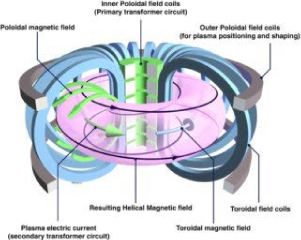
Figure 1. Tokamak basic design showing magnetic confinement of plasma in a toroidal field. [5]
Internal Confinement Fusion (ICF) – Direct drive
Differing from both the Tokamak and the Fusor, Internal Confinement Fusion, also called Direct drive, [28] uses a spherical plasma which is bombarded from all sides uniformly, with lasers. The heated outside layer explodes and from its force, drives together the core material.
The shock wave from the explosion causes extremely high density; 100 times that of lead [29]. This density is not sufficient to maintain fusion but the shockwave of the explosion is enough to cause higher density which; in correct conditions, releases alpha particles. The alpha particles are quickly absorbed by the dense fuel surrounding the source and release their energy in the form of heat. This increase in heat initiates a chain of reaction, repeatedly releasing alpha particles and becoming self-sustaining ignition from the centre, outward.
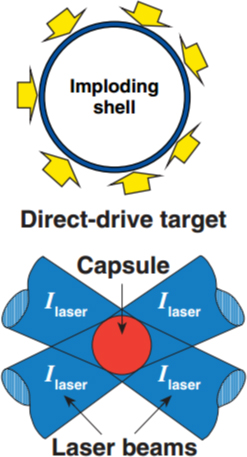
Left: [32] Visual representation of the uniform implosion of plasma. Right: [32] Visual representation of the uniform laser exposure required to induce implosion.
Fusor - Inertial Electrostatic Confinement
Similarly to the Direct drive, a spherical plasma is used; the basis is bombarding the ions directly using two cages; one within the other with a voltage across the two to create a potential difference and bombard the ions together in the centre. Ions of ±1 charge rise in temperature of 11,604 kelvins for every volt of potential difference. The combination of Kinetic and thermal energy induces the fusion reaction.
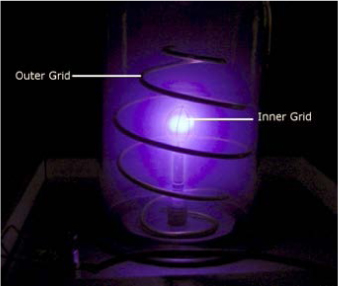
[20] The outer grid and inner grid are maintained at high potential difference as the plasma is accelerated towards the centre of the chamber.
The figure on the left demonstrates the evacuated tube containing the inner and outer grid which simultaneously envelop target the plasma ball.
Many approaches have been utilized in order to understand and secure optimal energy output using fusion. The impressive advances from ‘Backyard’ fusion using the Fusor to the more developed, more highly funded and favoured Tokamak is aspired to become advanced enough to become the next generation, clean energy generator.
Comparisons between these four engines show Tokamak to be the most promising engine. However its efficiency, while high, still does not break even to date [4]. Looking at Appendix 1 table 1 and table 2, seeing the power plant conceptual study results, we see that average efficiencies of 4 industrial standard Fusion plants can range from 30-60%. Designs A and B are “fast tracked” fusion designs which give the data of reactors which could be built commercially in the near future, designs C and D have been designed to illustrate more advanced power plant potentials. This data shows how by greatly reducing the losses from radiation and conduction, an opportunity for minimisation in size of fusion technology becomes possible, and that fusion technology research is economically acceptable when considering cost of power (Approximately 0.001 cent/kWh)[12]. Each of these engines efficiencies are however also limited by the method to which useful energy will be extracted. Carnot cycle heat engines for example would further limit this efficiency to a maximum of approximately 35% [9]. Direct conversion engines would be limited to efficiencies anywhere between 90% to 60% [10], however this technology is still in development and has yet to be applied on any industrial scale.
Radiation and Conduction
To maximise the net power of any fusion generator, it must minimise the radiation and conduction losses as the energy from fusion itself is almost a constant. As such, the technology surrounding minimising losses and nullifying risk from radiation and conduction are that which need research focus to make this technology viable.
Building a fusion power plant:
The process of nuclear fusion creates new particles, through which useful energy may be extracted. A variety of particles are created, all with very high energy contents (kinetic, internal, potential, etc), which included photons (x-rays or gamma rays), protons, neutrons and atomic nuclei (a  , a beta particle). For charged particles, including protons, atomic nuclei and ions, magnetic or electric fields can be used to redirect them towards the interior to continue the fusion processes. Though high-strength fields would be needed, often via magnetic fields in the range of 5-15 Tesla produced using nearby superconductors; this is a relatively simple solution to this problem [11, 13]. But for particles without an electrical charge, mainly neutrons, electric or magnetic fields do not exert a force on them, thus other methods must be used for containment. Conventional nuclear fission power plants face a similar problem in slowing down and containing neutrons produced from radioactive decay for power or research purposes [12].
These forms of radiation can be extremely harmful to biological systems and buildings. High-energy electromagnetic radiation (x-rays or gamma rays) can easily penetrate and disrupt normal cell functions, almost always leading to cancer and/or death. These high energy particles can easily penetrate normal shielding in conventional power plants, and cause significant structural damage within via atomic displacement or internal heating [11, 12]. Liquid water surrounds the radioactive source, slowly converting the light-water (where both hydrogen atoms only contain a proton) to heavy-water (where on or both hydrogen atoms contain a neutron next to the proton). The high density of water and the neutron-absorbing properties combine nicely to contain the neutrons. Concrete walls laced with lead balls are also used to directly stop neutrons from escaping. As lead is one of the most dense and stable of elements, it acts as an excellent neutron absorber. With several meters of this shielding, the danger is minimised.
Fusion reactors would operate at far higher temperatures and particle energies around 105 greater than that of conventional fission reactors [21], these solutions are not directly applicable. Instead materials that would function at higher temperatures must be developed and used. Modelling by the EU Materials Assessment Group [11] suggests that fusion reactors would have to withstand neutrons as high as 14 MeV (travelling at 17.26% the speed of light), a neutron fluence greater than 2-5 MW yr m-2, and an atomic displacement rate of 20-50 per annum, all dependant on fusion design and shielding methods used. They suggest various materials to be investigated and developed for us in fusion reactors; include steel alloys, tungsten-copper alloys, silicon-carbon composites and dispersed oxide-steels.
Radiation and conduction issues:
To contain the high-levels (charged) radiation and the high-temperature plasma within the fusion vessel, high strength magnetic fields will be used. To create these fields, superconductors should be used, as they offer the best way to create high-strength fields [13].
However, as the act of fusion is designed to create large amounts of heat (either as EM radiation or as a hot gas), this will impair on the nearby superconductors, as they require to be a very low temperatures to operate.
Thus a high-capacity cooling mechanism will be needed to keep the conductors cool, to produce the magnetic field, to keep the plasma contained and continue fusion. This will incur more costs in money (to make the devices), production (to construct the devices) and energy (to cool the devices) in design.
The potential losses from radiation and conduction are as follows:
Energy of radiation
A list of internal energies of neutrons of different sources (information taken from N.J. Carron);
| Name of energy range | Internal Energy | Internal Energy units | Speed (km/s) | % of light speed | Source or usage |
| Cold | 0.0-0.025 | eV | 0-2.2 | 0-0.00073 | Neutron imaging |
| Thermal | 0.025-0.4 | eV | 2.2-8.7 | 0.00073-0.0029 | Absorbed by U-235 in fission reactors for a |
| Slow | 1-10 | eV | 14-44 | 0.0046-0.015 | Slowed down by a moderator in fission reactors |
| Intermediate | 0.3-1 | MeV | 7600-14000 | 2.5-4.6 | Produced by U-235 decay, must be slowed down to be useful for fission |
| Fast | 1-20 | MeV | 14000-62000 | 4.6-20 | Produced in fusion |
| Relativistic | >20 | MeV | >62000 | >20 | Detected from dense neutron stars |
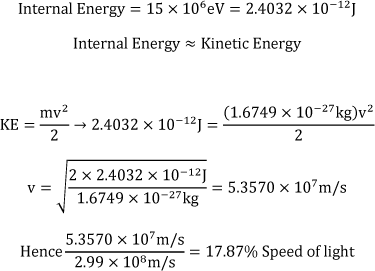
An example calculation to show losses to conversion from internal energy to speed is show for fast neutrons below.
Conversion of the internal energy of a fast neutron (15 MeV, mass = 1.674927351×10⁻²⁷ kg) to its speed:
Material issues:
Several issues arise though when serious consideration is made of the design and construction of a viable fusion power plant in relation to materials used.
Thermal expansion of materials as heat is absorbed from the fusion volume (ie, the plasma). This would cause stress within the structure and may cause significant fracturing. Embrittlement can occur, making the material to not be able to withstand stresses or heating as well as it could have previously [11].
Transmutation of atoms within the material as neutrons are absorbed by nuclei, this could cause significant distortion within the lattice as atoms are converted into larger or smaller atoms and apply stress on the lattice.
Displacement of atoms within the crystal lattice would occur as they absorb enough energy, from kinetic interactions or EMR absorption to move.
All these factors would combine to severely hamper the strength and resistance of the material in its function as a containment vessel, allowing radiation, heat or fuel to escape and cause damage (to organisms or buildings) and reduce the efficiency of the power plant.
Safety issues:
As with all building of high value, particularly with nuclear facilities, safety is a prime concern. Several issues arise when considered from an engineering view of how the construction and operation of a fusion plant can be done best.
If the materials used contain exotic or toxic substances vital to their function (coatings, rare elements, etc.), then strict safety procedures must be enforced to ensure no damages, harm or loss of function during manufacture, installation and operation [20].
While the fusion plant is in operation, it will be vital to be able to monitor the interior and exterior of the containment vessel to ensure that fusion is taking place in a controlled manner, as well as to detect faults and weakness in the structure, in an accurate, detailed and timely manner, all without disruption of the plant.
Disposal issues:
As nothing lasts forever (with possible exception of the entire universe), a clear and detailed guide of how to shut down and decommission any fusion reactor will be needed once the life of the plant is over. Proper concern must be made of the materials of the plant, especially in light of their potential radioactive properties. The question of whether the materials can be re-used or recycled, or will it be simpler to safely dispose of them instead, should be discussed before development begins of any plant.
As radiation of fusion does not have the high-mass particles of fission reactors (neutrons, beta particles and various nuclei of the uranium decay process), the radioactive half-lives of containment materials would be considerably shorter. Thus recycling could be a viable method of reusing these materials, or a relatively short burial time of about 100 years would render them safe for human use again [12, 16].
Development issues:
The field of high-temperature materials is not a large industry, particularly with respects to radiation. Thus there are significant research gaps which must be filled to find engineering methods that are safe, cheap and efficient to be able to make fusion designs as viable as possible in the future [14].
Before any material can be used in a design, it must be tested. For the materials of a fusion plant, this would require subjecting them to high temperatures and high levels of radiation. This would be difficult to test simultaneously and monitor the effects these conditions would have externally and internally, especially over long periods of time as fusion plants would be expected to operate for several years.
For developing alloys or composite materials at high temperatures, concern must be made of their production costs. Though a fusion plant would be a large investment, with significant amounts of money to fulfil the up-front costs, by reducing the initial costs of construction, the overall project can be made more affordable, and thus a more viable venture in relation to building another coal-fired plant.
Possible indirect applications of fusion:
The abundance of neutrons produced by fusion could be used for neutron imaging techniques, in a similar manner as done by ANSTO with their OPAL reactor. The density of this neutron flow and the high energy of the individual particles may pose difficulties in utilising them for us as imaging devices in a safe and accurate manner [30, 31].
It may be possible to extract the isotopes created within the shielding materials. Again, costs of extraction, safety and identification must be weighed against usefulness and ability to source from other areas, such as industrial or research fission reactors.
Comparison of fusion with other energy sources:
This section will compare and highlight several existing technologies such as fossil fuels including oil, coal and gas to Wind, Solar and Fission forms of energy production and they will be summarised to form a conclusion against Fusion. Appendix table 3.
Fossil fuels:
Power generation generated from fossil fuels (oil, coal and gas) provides the earth with 80% of its total energy needs [23]. This method is not only reliable due to its use for so many years, but is relatively cheap compared to the technologies available today. Due to the inert properties of the coal, and it is a relatively simple combustion process with no radioactive wastes, it is considered to be the most short term safe method of power production. Although these positives seem comforting, many crucial negatives stump its sustainability. Not only does mining create immediate environmental destruction of landscapes but it is also a major contributor to long term global warming. Discounting environmental concerns, the fundamental concept of supply and demand is a key issue for fossil fuels as a source of power generation as it is expected that in 150 years, half of the current supply of coal will be available and in 30 years oil extraction will be inconvenient [23]. The non-renewable nature of fossil fuels make perpetual reliance on this source of energy to be impossible.
Wind:
Wind energy is a possible suitable clean and renewable energy contributor due to its free and abundant kinetic source. The large required space with suitable wind conditions places limitations on its practicality [18].
Solar:
Solar power is also a clean and renewable alternative using the free and abundant resource that is light radiation [19]. Expensive manufacturing cause’s hesitation in its value but technology and research is ever making it more affordable. Large spaces are required per unit power [19]. Its power is dependent on direct energy conversion of radiation, a component similar in nature to proposed methods of reducing radiation losses in fusion.
Fission:
Fission accounts for 11% of the world’s energy supply and is the leading source of power in Europe and many Asian countries [37] as it releases little to no carbon emissions. It produces a high output per unit area but can be dangerous and thus expensive due to its radioactive fuel and waste which take between 200-500 thousand years to decay [24]. Fission technology can also however harness it neutrons effectively in research for isotopes, however harnessing neutrons for power generation has not yet been accomplished, and would also assist in fusion technology.
Comparison:
Fusion is the energy of the future and it is estimated to be commercially viable by 2050 [20]. In comparison to other energy sources such as wind and solar power, fusion, similar to fission, is expected to require minimal area per unit energy. An important social concern is the environment and fusions low carbon and low or non-existent radioactive waste [22] supports its potential as an accepted future energy source. The renewable fuel required for fusion reactors comprises of hydrogen isotope gas which is extracted from fresh or seawater [20]. A drawback to fusion reaction technology is the minimum sizing of the chamber in order for a constructive reaction to occur. This is because in order for the fusion reaction to occur extremely high temperatures are required [20]. This can lead to high costs in construction and maintaining a successful fusion reaction. Also current materials are unable to withstand the high temperatures of the fusion reaction. Although fusion may not yet be commercially viable and the need for the fusion chamber to be large to ensure that the high temperatures required for fusion can occur, it is estimated that with further research and investment fusion power will be the energy of the future.
4. Conclusions
Fusion technology is not currently a viable technology. Within each aspect of research into this technology it is evident that there are many years of research ahead until fusion engines are capable of producing economically viable energy on the industrial scale. As shown by the Lawson criterion, fusion technology can be summarised into three categories of technology which are the limiting factors of Fusion. The efficiency of all of the fusion engines currently in use are not yet high enough to produce any substantial net output, regardless of energy losses. The most efficient engine, the Tokamak, has produced only a recorded 70% of output from input. While projects such as ITER are boasting a tenfold increase in output from input, limitations surrounding energy conversions are still an issue. Connecting a fusion reactor to a heat engine in the same way as a fission reactor would limit the efficiency by an estimated 36%. Direct energy conversion hence needs to be developed on the industrial scale, as in theory it boasts a 90% efficiency. However, direct conversion has more immediate applications to other industries. As the radiation emitted from a fusion reactor is the same in nature to the sun, direct conversion technologies stand to give more immediate benefits to the solar energy industry. Due again to Lawson, minimising losses from radiation would drastically affect the net power output potential of a nuclear reactor. To minimise this, a direct conversion energy system, which can harness the range of radiation emitted from fusion reactions, would essentially be an advanced solar panel and could directly aid that industry, while also growing closer to the capacity for applications in fusion technology. The final condition limiting fusion is conduction losses, or how to transfer the kinetic energy from mass loss, mostly due to neutron losses from magnetic confinement. Harnessing neutrons for energy is currently beyond our means, and would require more research to solve this problem for energy, however the use of neutron baths to make radioactive isotopes is a widely practiced field with many applications from industrial to medical [25]. While this alternative does not address the losses to energy, it can address the issue of fusion on the economic scale. However, again this field of neutron harnessing is also applicable to nuclear fission research, and much as radiation to the solar industry, any developments in this field would best immediately be developed in the effort of making the nuclear fission industry more efficient and economic.
The limitations of materials and technologies surrounding efficiency, radiation and conduction losses in the fusion industry are what keeps fusion technology to be efficient and economic in the modern era. Researching these technologies in the fission and solar industries would prove more economic and would yield more positive results in the short term goal of global sustainability and advancement. However, once the technology has had more time to advance, focusing once more on the potential of fusion technology would develop for us a clean, renewable, and near inexhaustible source of energy for the future.
Acknowledgments
We would like to acknowledge the contribution and support of Dr Jurgen Schulte and the University of Technology Sydney.
References and Notes
1. Fusioned.gat.com, (2015). What is Fusion?. [online] Available at: http://fusioned.gat.com/what_is_fusion.html [Accessed 5 May 2015].
2. energy, M. (2015). Mass and energy – mass difference, binding energy, atomic mass unit, fission, fusion. [online] Physicsnet.co.uk. Available at: http://physicsnet.co.uk/a-level-physics-as-a2/nuclear-energy/mass-and-energy/ [Accessed 7 May 2015].
3. Nssdc.gsfc.nasa.gov, (2015). Sun Fact Sheet. [online] Available at: http://nssdc.gsfc.nasa.gov/planetary/factsheet/sunfact.html [Accessed 7 May 2015].
4. ITER, (2015). ITER - the way to new energy. [online] Available at: http://www.iter.org/ [Accessed 17 May 2015].
5. EUROfusion, (2011). Tokamak principle | EUROfusion. [online] Available at: https://www.euro-fusion.org/2011/09/tokamak-principle-2/ [Accessed 17 May 2015].
6. Artsimovitch, L., Mirnov, S. and Strelkov, V. (1964). Investigation of ohmic heating of the plasma in the ?Tokamak-3? toroidal assembly. At Energy, 17(3), pp.886-892.
7. Phillips, James. “Magnetic Fusion.” Los Alamos Science Winter 1983: 64-67
8. Lawson, J. (1957). Some Criteria for a Power Producing Thermonuclear Reactor. Proc. Phys. Soc. B, 70(1), pp.6-10.
9. Curzon, F. (1975). Efficiency of a Carnot engine at maximum power output. American Journal of Physics, 43(1), p.22.
10. Oliphant, T., Ribe, F. and Coultas, T. (1973). Direct conversion of thermonuclear plasma energy by high magnetic compression and expansion. Nucl. Fusion, 13(4), pp.529-532.
11. D. Stork et al. 2014, ‘Developing structural, high-heat flux and plasma facing materials for a near-term DEMO fusion power plant: The EU assessment’, Journal of Nuclear Materials, Volume 455, Issues 1–3, Pages 277-291
12. Maisonnier, D., Cook, I., Pierre, S., Lorenzo, B., Luigi, D., Luciano, G., Prachai, N. and Aldo, P. (2006). DEMO and fusion power plant conceptual studies in Europe. Fusion Engineering and Design, 81(8-14), pp.1123-1130.
13. Flavio Dobran 2012, ‘Fusion energy conversion in magnetically confined plasma reactors’, Progress in Nuclear Energy, Volume 60, Pages 89–116
14. Mazen M. Abu-Khader 2009, ‘Recent advances in nuclear power: A review’, Progress in Nuclear Energy, Volume 51, Issue 2, Pages 225-235
15. Roderick Hyde et al. 2008, ‘Nuclear fission power for 21st century needs: Enabling technologies for large-scale, low-risk, affordable nuclear electricity’, Progress in Nuclear Energy, Volume 50, Issues 2–6, Pages 82–91
16. Steven J. Zinkle & Jeremy T. Busby 2009, ‘Structural materials for fission & fusion energy’, materialstoday, Volume 12, Issue 11, Pages 12-19
17. David Maisonnier et al. 2006, ‘DEMO and fusion power plant conceptual studies in Europe’, Fusion Engineering and Design, Volume 81, Issues 8–14, Pages 1123–1130
18. Energy options: pros and cons. 2015. Energy options: pros and cons. [ONLINE] Available at: http://www.triplepundit.com/series/energy-options-pros-and-cons/. [Accessed 03 May 2015].
19. Solar Energy Pros and Cons - Energy Informative. 2015. Solar Energy Pros and Cons - Energy Informative. [ONLINE] Available at: http://energyinformative.org/solar-energy-pros-and-cons/. [Accessed 03 May 2015].
19. Fusion as an Energy Source: Challenges and Opportunities. 2008. A report prepared for the Institute of Physics by W J Nuttall. [ONLINE] Available at: https://www.iop.org/publications/iop/2008/file_38224.pdf. [Accessed 03 May 2015].
19. H. W. Drawin, C.1981, Atomic Physics and Thermonuclear Fusion Research, Physica Scripta. Vol. 24,622-655,
19. Electricalfun.com,. ‘Building A Fusion Reactor In A Basement Workshop - Workbenchfun.Com’. N.p., 2015. Web. 16 May 2015.
19. generator, metatags. ‘IEA - Coal’. Iea.org. N.p., 2015. Web. 16 May 2015.
19. Focusfusion.org, (2015). Fusion is not Fission. [online] Available at: http://focusfusion.org/index.php/site/article/its_not_fission [Accessed 24 May 2015].
19. Organisation, A. (2015). Radioisotopes - ANSTO. [online] Ansto.gov.au. Available at: http://www.ansto.gov.au/NuclearFacts/AboutNuclearScience/Radioisotopes/ [Accessed 22 May 2015].
19. An Inertial-Fusion Z-Pinch Power Plant Concept. 1st ed.Sandia Labs 2000. Availiable At: 2015. www.sandia.gov/pulsedpower/prog_cap/pub_papers/003132j.pdf [Accessed 10 May 2015]
19. Woods, L. C. (2005) The Quest for Fusion Power, in Theory of Tokamak Transport: New Aspects for Nuclear Fusion Reactor Design, Wiley-VCH Verlag GmbH & Co. KGaA, Weinheim, FRG. doi: 10.1002/3527607978.ch1
19. Quantprinciple.com,. ‘EULERIAN HYDRODYNAMICS MODELING THE INERTIAL CONFINEMNT FUSION RAYLEIGH-TAYLOR INSTABILITY’. N.p., 2015. Web. 23 May 2015.
19. Wikipedia,. ‘Inertial Confinement Fusion’. N.p., 2015. Web. 23 May 2015.
19. T. Ersez, G. Braoudakis, J.C. Osborn 2006, ‘Radiation shielding for neutron guides’, Physica B: Condensed Matter, Volumes 385–386, Part 2, Pages 1268-1270
19. Shane J. Kennedy 2006, ‘Construction of the neutron beam facility at Australia’s OPAL research reactor’, Physica B: Condensed Matter, Volumes 385–386, Part 2, Pages 949-954
19. Fire.pppl.gov, (2015). The FIRE Place. [online] Available at: http://fire.pppl.gov//AAAS_2013_Betti_Direct_Drive.pdf [Accessed 24 Apr. 2015].
19. Nuclear Power Today | Nuclear Energy. 2015. Nuclear Power Today | Nuclear Energy. [ONLINE] Available at: http://www.world-nuclear.org/info/Current-and-Future-Generation/Nuclear-Power-in-the-World-Today/. [Accessed 22 May 2015]