PORTAL Journal of Multidisciplinary International Studies
Vol. 20, No.1/2
December 2024
ESSAYS
Looking Ahead with the New International Studies
Andrew Wright Hurley
University of Technology Sydney
Corresponding author: Associate Professor Andrew Wright Hurley, School of International Studies and Education, Faculty of Arts and Social Sciences, University of Technology Sydney, Australia, Andrew.Hurley@uts.edu.au
DOI: https://doi.org/10.5130/pjmis.v20i1-2.9459
Article History: Received 21/11/2024; Accepted 21/11/2024; Published 26/12/2024
Abstract
The Bachelor of International Studies (BIS) at UTS has evolved to meet contemporary global and local challenges. While initially designed for immersive overseas experiences, the program now embraces a broader vision, integrating shorter travel options, collaborative online international learning (COILs), and community-focused majors. These updates reflect a commitment to fostering cultural intelligence, creativity, and inclusion, with new pathways for low-SES and Indigenous students. Anchored in UTS’s diverse, dynamic precinct near Chinatown and the future National First Nations College, the BIS aims to prepare graduates to address global challenges while engaging meaningfully with local and international communities.
Keywords
International Studies; Global Mobility; First Nations; Heritage Languages; Language and Culture; Cultural Intelligence
As I write this, the world seems to be in a more precarious position than it was 30 years ago, when the Bachelor of Arts in International Studies (BAIS) at the University of Technology Sydney (UTS) was established. In 1994, the Cold War appeared to have come to an end. That year an Accord was signed between Israel and Palestine, and Yasir Arafat, Shimon Peres and Yitzhak Rabin won the Nobel Peace Prize. The discourse around global climate crisis had not yet emerged. The sharpened international geopolitical situation since 1994 cannot be sheeted home to our program, of course. But in 2024 the need for graduates with the skills, insights and cultural intelligence that language and culture learning and an immersive overseas experience gives—that our international studies students possess in spades—has clearly not diminished.
We are a nation of travellers, yet before COVID-19 we started noticing some challenges, including a shortage of options for students who could not afford to travel overseas for a whole year. There was also the insight that an international experience is not something that has to happen overseas: The international starts right here. When COVID-19 hit, we responded by providing students with alternate graduation pathways for those seeking to return, or unable to travel. And we also worked with our team to conceive a rethought Bachelor of International Studies (BIS), including shorter travel options with new work integrated learning, collaborative online international learning (COILs), and an Honours stream. The new BIS program is bouncing back from the shocks to international travel. Just as importantly, we are currently imagining novel forms of International Studies attuned to Sydney’s diverse, multilingual makeup, to UTS’s sector-leading Indigenous Graduate Attribute program—which states that each UTS graduate will be able to work with and for Indigenous Australians—and to the University’s landmark aspiration to build a National First Nations College on the edge of Haymarket. The idea is to enable larger, more diverse groups to connect with and gain credit for International Studies core values. These new International Studies ideas align with the future home of our School, in a new Faculty composed of the Faculties of Arts and Social Sciences and Design, Architecture and Building, charged with spearheading the University’s Creative Industries strategy, and physically perched next to the historic Chinatown.
Between the International and the Local: Opening From Our Creative Precinct Onto the World
The image below is of a mural that Chinese/Indigenous artist, Jason Wing, and Indigenous UTS Animation alumna, Maddie Gibbs, have just finished on Ultimo Road, a stone’s throw from UTS Site 5, the likely home of the new UTS Faculty. Site 5 is nestled between our striking Frank Gehry-designed building, the site of the future National First Nations College, and the thriving, internationally diverse Chinatown, a location that is ‘trans-Asian’, which is home to a great many of UTS’s international students, and which is, in turn, networked both into diverse communities in South Western Sydney and overseas. The mural was commissioned by the Haymarket Alliance and local business-people to reflect on Indigenous/Asian connections and transfers. It is on the wall of Dong Nam A groceries, which has been operated by the same family for three generations. I recently met and spoke with the artists, Jason and Maddie, and took this photo. The mural represents all that is special about ‘Site 5’: The possibilities of creative practice; the winning combination of the local and the international; the buzz of Chinatown and its communities. The mural, its story, and the discussion with its creators also reflects the possibilities of the new Faculty and the key place of the new International Studies within it: immersion, intercultural connection, language, culture, and communication.
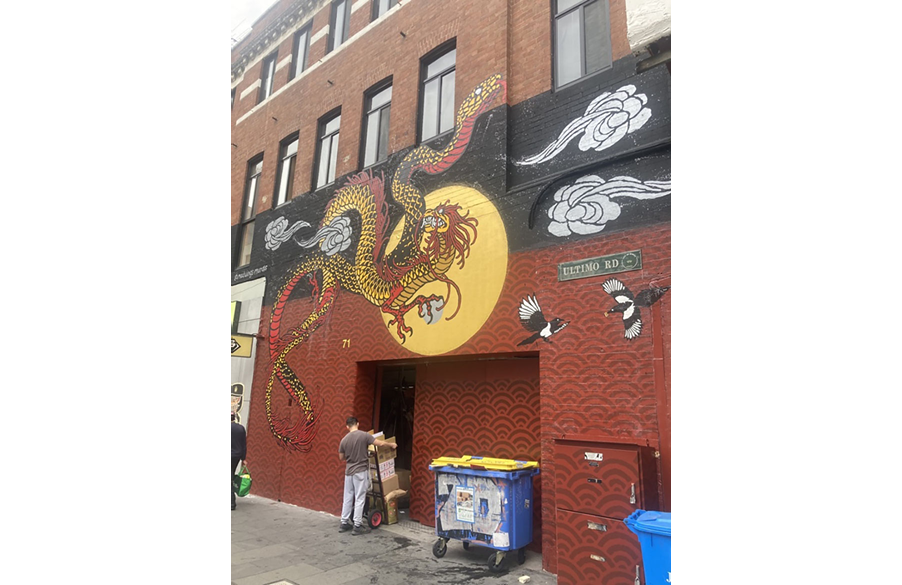
Our International Studies degrees will continue to offer excellent global insights, experiences and connections to our students, including those in the Creative Disciplines: Their experience will be embedded in a unique local precinct, but also engaged with other similar places around the world, via studies at partner universities offering outstanding programs, or via international project work and/or internships, from Shanghai to Tokyo, from Barcelona to Berlin. Cultural Intelligence begets creativity: When individuals see how other cultures approach similar problems, creative solutions emerge.
But that is not all. Under the Australian Higher Education Accord, funded domestic student growth will occur when we help more low-SES and First Nations students commence and complete University studies, an area where our new Faculty will do much heavy lifting. This is about enhancing pathways for students, but it also needs to be about creating appealing degree offerings for these cohorts. We are planning that the new BIS be a distinctive, pan-UTS vehicle for these cohorts. For example, the new ‘Community Leadership’ Major, based on a structured ‘service learning’ approach, is aimed at enabling students to make a difference in their communities and gain academic credit for it. This pathway is expected to appeal strongly to students from low-SES backgrounds, particularly those with heritage language skills, while being open to all.
The Major is being driven with extensive consultation in Western Sydney communities and with the collaboration of UTS’s Centre for Social Justice and Inclusion. A great deal of thought is also being put into an ‘Indigenous’ Major. With strategic input from Jumbunna Institute for Indigenous Education and Research and a new hire, the Indigenous Major will be complementary with the National First Nations College and its philosophy of First Nations ‘hosting’ a broader community of non-Indigenous students. It is anticipated this Major will be attractive to Indigenous and non-Indigenous students alike, including International Students and exchange and study abroad students too. As we look out on the next stage in the life of UTS’s International Studies degrees, we look forward to more students participating, and from more diverse backgrounds; all of them having a life-changing educational experience and all of them equipped to make a difference in a world that is facing as many, if not more, global challenges as our first international studies graduates did in the 1990s.