PORTAL Journal of Multidisciplinary International Studies
Vol. 19, No. 1/2
December 2023
ESSAY
Homecoming: Culinary Memories and Journeys through Kuching, Sarawak
Jacqui Kong
Corresponding author: Jacqui Kong Huiyi, School of Food Studies and Gastronomy, Taylor’s University, Jln Taylors, 47500 Subang Jaya, Selangor, Malaysia, Jacqui.Kong@taylors.edu.my
DOI: https://doi.org/10.5130/pjmis.v19i1-2.8932
Article History: Received 27/11/2023; Accepted 27/11/2023; Published 22/12/2023
Abstract
This article details the author’s journey through her hometown of Kuching, Sarawak, and the multisensorial experience of revisiting familial homes and key culinary heritage sites around the city. The everyday and the mundane are highlighted as key features which hold together the rich mosaic of the culinary traditions and history of Kuching. Kuching has recently been recognised as a UNESCO Creative City of Gastronomy, which acknowledges its unique blend of historical and contemporary culinary practices. This article examines what this means for a city where hawker food culture is the lifeblood of Kuching, but also where a burgeoning gastronomic scene is increasingly drawing attention on the international stage. It argues for a revaluation of the traditional binaries between local food vendors (hawkers) and professional chefs, suggesting that both contribute to the city’s culinary landscape. This approach will help form a comprehensive and inclusive understanding of Kuching as a UNESCO Creative City. It will also guide future efforts to establish sustainable and locally based food supply chains in the city.
Keywords
Home; Memory; Heritage; UNESCO Creative City; Gastronomy
My Grandmother’s House
Home is on 3 ½ Mile, Jalan Penrissen. Home is No. 283 on that long, narrow road.
The simple, double-storey terrace house is the silent, peaceful guardian of my childhood memories. It sits quietly on a worn, gravel road, demanding no attention at all, content with its faded walls and peeling paint.
This house is different from the houses in Kuala Lumpur—those with their large, imposing auto gates that loom forward to swing silently and eerily open for their rich, well-known visitors. There are no air-conditioners in this house, no ornate garden chairs or tables, no sophisticated top-of-the-line security system. There are just two small, old cars parked in the tiny porch.
Here, the air is silent, and a soft breeze makes the swing sway gently forward and backward. That old but wonderful swing is the only thing adorning the bare porch. It is small and has seating room for only two. The paint is peeling off parts of the swing in hard, dry strands, and it is starting to rust on its hinges. It offers one thing, though, that the big city cannot: a view of the midnight sky strewn with a thousand stars.
The delicate, white cotton curtains billow out of the living room’s sliding doors. They seem to beckon in the breeze, blowing out onto the porch, lightly grazing the ground, and then gliding inwards once again. They are light, and soft to the touch, enveloping you as you step into the house and its cool, tiled floors.
The room upstairs is insulated, like a cocoon, shielded from the sounds and movements outside. Like a warm bed with thick, soft covers to protect one from a winter’s cold, it is comforting, and filled with happiness. The door swings shut with a thick, hollow sound, and the wooden panelled floors reverberate with the sound. The room is warm and filled with a lingering scent of medicated balm. The smell of my Ah Ma.
Pictures hang on the walls—tributes to the past, immortalisations of the past. The large, heavy oak wardrobe is ancient, and the bed is hard, and firm, with thick, woolly blankets. Sunshine spills across the room in long, horizontal slivers of light. In the morning, a rooster crows from across the neighbour’s yard, and warm, fresh air gushes in through the panelled windows. Cold water stands in a large, stone basin in the bathroom upstairs. There is no shower, and no heating system. Showers in the early morning come instead in the jolt of pure, ice-cold water running down your spine, with the help of old-fashioned wooden scoop-ladles.
The smell of steaming hot laksa is wafting from bowls that are lined up on the wooden dining table. It is sour, and hot; fragrant, and unmistakably pungent. Thin strands of vermicelli are soaked in the broth which is made of thick prawn paste and rich coconut milk. Sarawak laksa at home is salty and spicy, with the slightest hint of sweetness, and the sharp tang of lemon zest overlaid with aromatic sambal.
The wooden chairs that are part of these experiences at the dining table are made of a light, teak-coloured wood. They are plain wooden chairs but adorned with delicate Chinese motifs carved into the seat—spring flowers, autumn leaves, and winter branches – the quintessential design of the four seasons. My Ah Ma made many simple, yet delicious meals at this table—it was tiny, but somehow hosted all of us during our many family gatherings and was the perfect place for idle conversation whilst watching my grandmother potter around the kitchen, preparing food for us.
Walking into the Past
On a recent trip back to my hometown of Kuching, Sarawak, I decided to eschew the usual mode of transportation which yielded the most comfort, i.e. the air-conditioned car. Instead, I continued on-foot in Padungan Street—locally known as Jalan Padungan—a picturesque tree-lined street filled with old shophouses selling fresh produce, Chinese incense and joss sticks, Chinese pastries, antiques and souvenirs. Nestled in the alleyways of Padungan, one can also find walls with painted murals, trendy bars, as well as coffee shops (or kopitiams in the local slang), with food stalls selling local hawker fare.
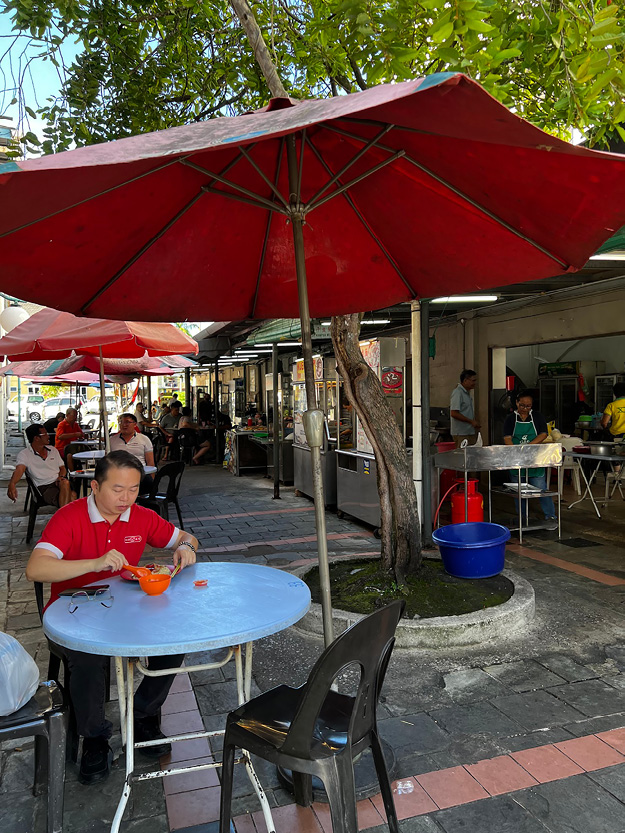
Open-air coffee shop on Jalan Padungan (2023). © Jacqui Kong
At a particular wood furniture store, I chanced upon an almost exact replica of my grandmother’s dining table. My breath caught in my throat, and all my childhood memories came flooding back into my mind. Sara Ahmed’s statement comes to mind: ‘If the contact with an object generates feeling, then emotion and sensation cannot be easily separated’ (2012: 6). I pictured my mother sitting opposite me, my aunt next to me, and my grandmother smiling at us as we inhaled bowls of her homemade mee sua (longevity noodles cooked in a savoury chicken broth), accompanied by kacangma chicken (stewed chicken in ginger, rice wine, and Motherwort herb—Leonurus cardiaca— simmered together to produce a distinctly herby but comforting dish). With all honesty, kacangma chicken and mee sua are not my ultimate comfort food dishes—they are my mother’s. However, in retrospect, after the passing of my maternal grandmother, whom I have described above, I have come to find that the memories of my Ah Ma centre around food, and how she was always preparing something for us to eat. That was the key—not what she prepared. It was the fact that she was always feeding us, and always caring for us by ensuring that we were well-fed.
There was one occasion where my mother and I had just arrived in Kuching, on a late-night flight. There was nothing left to eat because shops in Kuching—in those years—closed early. Ah Ma whipped up a noodle dish for us—the simplest in terms of flavour and presentation, but I remember it to this day: a clear broth tasting faintly of chicken, glistening strands of vermicelli, accompanied by a hardboiled egg. For some reason, I was famished, and I recall just slurping up the soup and vermicelli noodles—it was the most delicious and comforting bowl of noodles I had ever had. It must have been the grandmother touch. I also lovingly remember the simple wooden chopsticks we would eat with, and the tableware with rooster motifs (because my grandmother was a rooster according to the Chinese zodiac).
Looking now at the dining set for sale in the furniture store on Jalan Padungan, it seemed… reconstructed. Not an antique, but a replica. A piece of heritage to be sold, perhaps to travellers like me who are looking to reclaim the past and relive memories of commensality around the family table. I wonder to myself if this particular furniture store and its wares are primarily targeted towards tourists. The shop itself is brightly lit, decorated in a modern style not dissimilar to high-end furniture stores found in shopping malls in Kuala Lumpur, the capital city of Malaysia. The price tags of the furniture in the shop in Jalan Padungan are quite eye-watering, featuring glossy hardwood slabs that can be fashioned as massive, contemporary dining tables. The replica of my grandmother’s dining table seems rather oddly placed amongst such modern, contemporary pieces. Again, the thought crosses my mind that this is ‘staged’ for tourists, an authentic, old-fashioned dining set, upon which the shopkeepers have placed a Chinese tea set, perhaps to add even more to that feeling of purchasing a commodified and fetishised past (MacCannell 1973; Kong 2016; 2019).
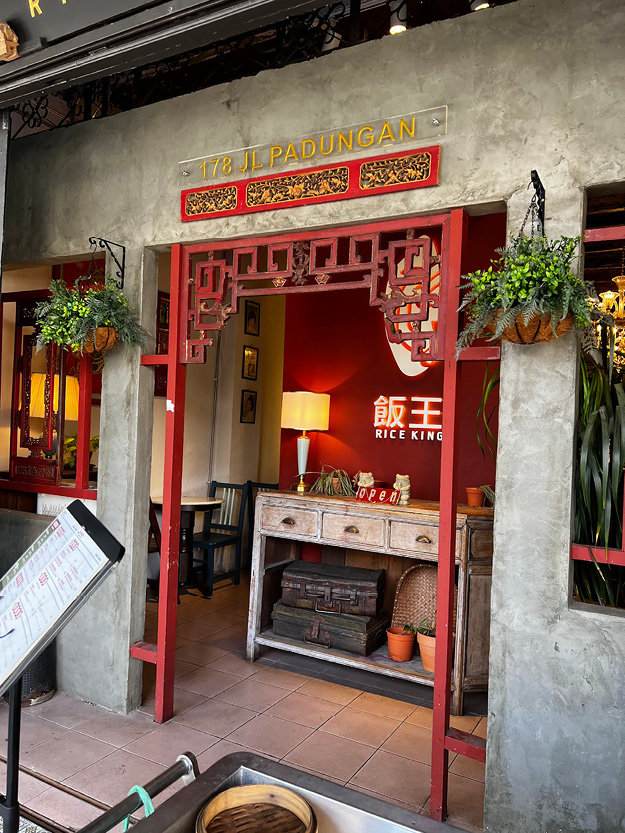
Reconstructed heritage-style café/coffee shop on Jalan Padungan (2023). © Jacqui Kong
Experiencing Heritage on Carpenter Street
Avtar Brah terms ‘home’ as:
the site of everyday lived experience. It is a discourse of locality, the place where feelings of rootedness ensue from the mundane and the unexpected of daily practice. Home here connotes our networks of family, kin, friends, colleagues and various other ‘significant others’. It signifies the social and psychic geography of space that is experienced in terms of a neighbourhood or a home town. That is, a community ‘imagined’ in most part through daily encounter. (1996: 4).
I was born in Kuching, but unfortunately, I did not grow up in Kuching. My family moved to Kuala Lumpur when I was a toddler, but we made frequent trips back to our hometown, almost annually, to visit my grandparents and other relatives, especially during Chinese New Year. My paternal grandparents passed away before I was born, but they live on in the many stories which my aunts and uncles tell, even to this day. I had never thought of Kuching as my ‘home,’ particularly when I was younger, but as I grow older, I have found that one can have many homes, and each one bears its own significance and emotional ties to the memories we have imprinted onto its landscape. As Ahmed has poignantly expressed, ‘[w]hat moves us, what makes us feel, is also that which holds us in place, or gives us a dwelling place’ (2012: 11).
My father’s family grew up in one of the many shophouses along Carpenter Street, a road famous for its Chinese shophouse architecture. These shops are inhabited by generations of families running their trades, selling wares and daily necessities such as Sarawak peppercorns, Chinese pastries, antique furniture, as well as hardware stores, bicycle stores, gold and jewellery stores, and the ubiquitous ‘kopitiam’ (both ‘old’ and ‘new’).
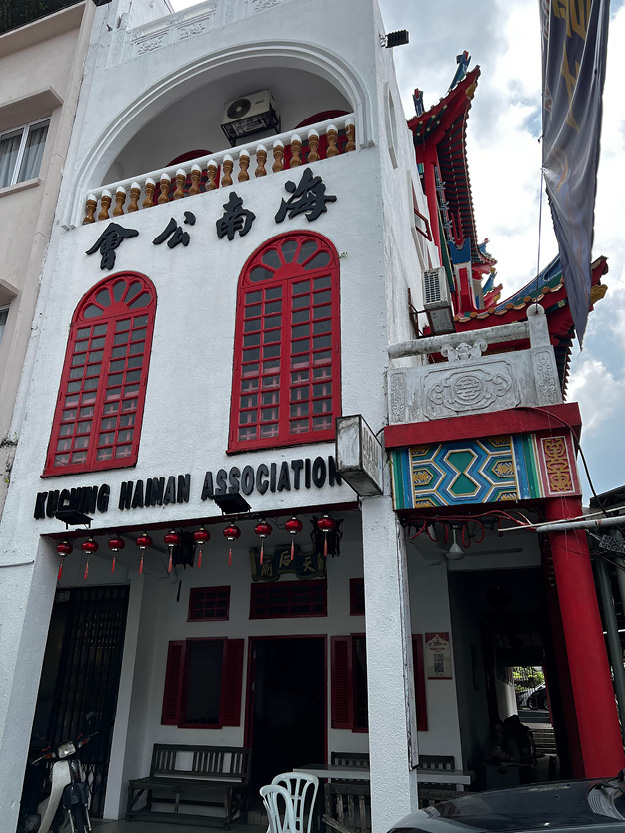
Kuching Hainan Association Building on Carpenter Street (2023). © Jacqui Kong
Carpenter Street also houses Lau Ya Keng (translated from the Teochew dialect as ‘Old Place’), an open-air food court with food stalls selling Sarawak laksa, fishball soup and noodles, satay (meat skewers), kolo mee (a Sarawakian specialty of springy noodles tossed in fried onions, shallots, and minced meat), and kueh chap (silky flat rice noodles served with a rich, hearty soy sauce-y, cinnamon and anise-scented broth, and filled with all cuts of pork of your choice, either lean meat, intestines, pig’s skin, ears, or tongue, and hardboiled eggs). As you can imagine, kueh chap is a textural smorgasbord for the senses, and an absolute must-try Teochew dish when in Kuching.
People of all ages, ethnicities, and walks of life gather to eat in Lau Ya Keng, at all times of the day. Whether young or old, patrons battle the midday heat to enjoy their favourite Sarawakian dishes, most notably the champion of all laksas, Sarawak laksa. Famous chef and food personality Anthony Bourdain termed it ‘the breakfast of champions’ in his food and travel series Parts Unknown—move aside, assam laksa, laksa Johor, Katong laksa, Penang laksa! The food stalls in Lau Ya Keng are run by operators whom I have met since my childhood, who tell us stories about their own children who have now opened up second or third outlets of their food stalls in different parts of Kuching. It is clear that hawker culture is the lifeblood of the culinary scene in Kuching, and keeping food traditions alive is of tantamount importance to the food stall hawkers and operators.
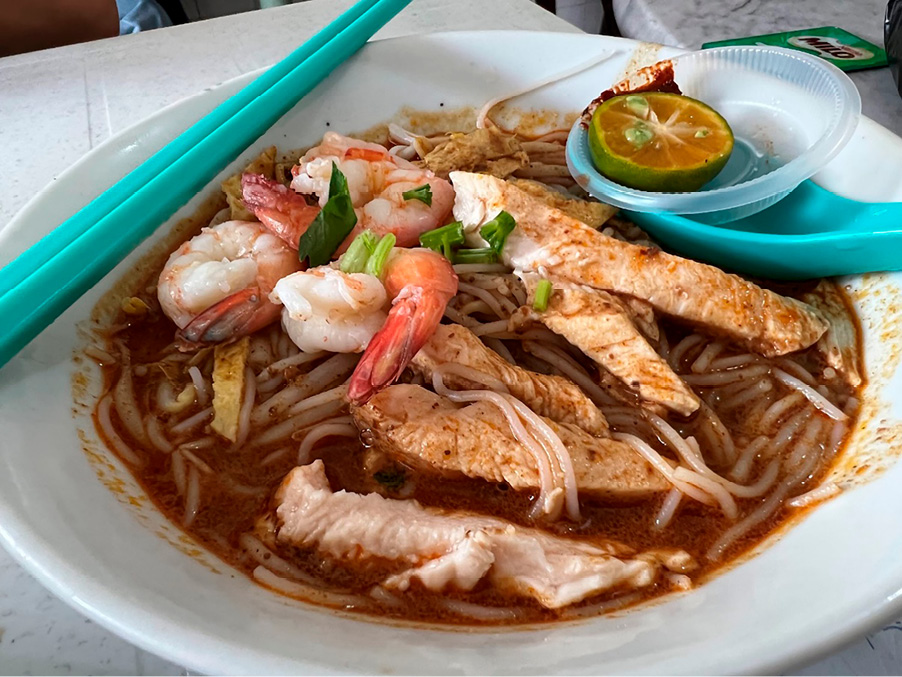
Anthony Bourdain-approved laksa from Choon Hui Café (2023). © Jacqui Kong
Duruz and Khoo’s (2015) conceptualization of the Malaysian kopitiam as a cosmopolitan space in which personal and collective memory, the senses, history, and heritage all converge upon one another is no more evident than in Lau Ya Keng. Seated in front of an old, sealed-off Chinese opera stage, diners look out to the main façade of Carpenter Street, overlooking the beautiful Sang Ti Miao Chinese temple. Diners are heard conversing in the many Chinese dialects of the Chinese ethnic groups found in Sarawak: Hakka, Hokkien, Teochew, Foochow. The servers and food stall operators move seamlessly through the tables, taking orders, delivering dishes, and collecting money. The buzz that fills Lau Ya Keng enriches all the senses, and a culinary experience is turned into a multisensorial journey through time. As Duruz and Khoo have rightfully pointed out, ‘[t]ied to the mobility of memory is the viscerality of sensory experience’
(2015: 19).
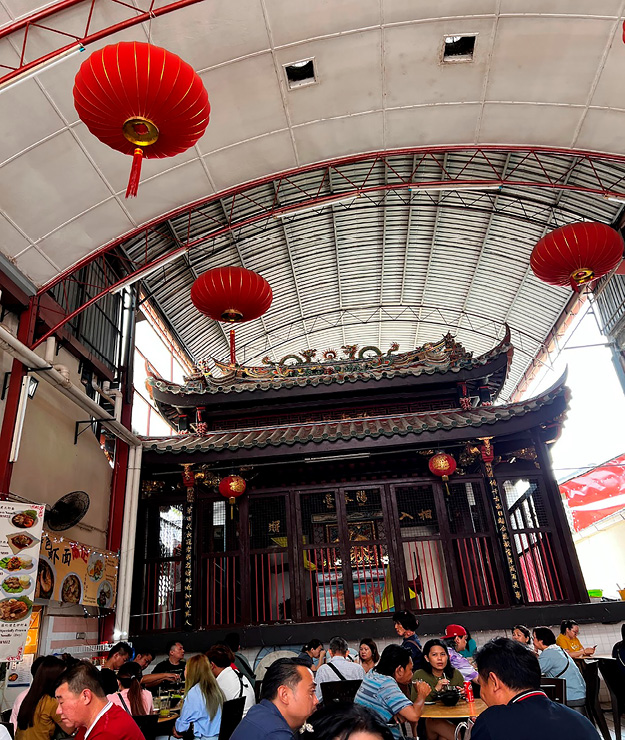
Lau Ya Keng, Carpenter Street (2023). © Jacqui Kong
Similarly, walking through Carpenter Street and observing the shop owners and their trades, one is given a glimpse of the past and these family businesses that have been inherited to this day. Unlike the earlier touristy furniture shop on Padungan Street, the furniture shops on Carpenter Street sell ordinary, unassuming furniture—plastic chairs, stools, and tables, alongside simple wooden pieces such as wardrobes, bed frames, vanities, and metal storage units. When I peek into these shops, the shop owners are often lounging inside the store, either waiting for customers, or going about their daily routine. For example, in one shop, I spotted a mother and her child, sitting together on a sofa, and the mother reading to her child. Goldsmiths are a common sight around Kuching, due to the gold mining town of Bau, almost 40 kilometres west of Kuching.
I also noticed that Third-wave coffee culture had gripped Kuching, in the form of the new, urban, hipster café serving coffee brewed from specialty beans and blends sourced from all over the world. This confluence of old and new was somewhat jarring, but not unexpected, as Kuching is a popular tourist and foodie destination. A new café named Moon and Sun had just opened its doors one or blocks down from Lau Ya Keng on my recent visit—its air-conditioned, bright, modern interior a stark juxtaposition from the artisan, sometimes dark, and dusty shophouses selling hardware, frames and antique furniture. Whilst it was refreshing to be reminded of a modern café in Kuala Lumpur serving flat whites and Western-style patisserie options, I left Carpenter Street wondering if there are any regulations as to how many shops in the area are allowed to be gentrified and modernised, and how many have to adhere to standards of preservation—keeping in mind, however, that being ‘authentic’ does not mean having to be frozen in the past (Heldke 2003; Sutton 2001).
Kuching: Creative City of Gastronomy
In 2021, Kuching was awarded the title of ‘Creative City of Gastronomy,’ by the UNESCO Creative Cities Network (UNESCO.org 2021; Kuching: City of Gastronomy 2023). In the proposition submitted to the UNESCO Creative Cities Network (UCCN) committee, a variety of stakeholders and groups lobbied for Kuching’s gastronomic heritage to be recognised on an international level, from its unique produce such as dabai (an olive-like delicacy native to Sarawak), and midin (a type of fern usually stir-fried and eaten as a vegetable dish), to key products as such Bario rice and salt, gula apong (a type of Nipah sugar syrup), and tuak, a type of rice wine.
When one thinks of Kuching, one does not always think of gastronomy in its commonly thought-of ideals such as sophistication or haute cuisine. Thus, the challenge is for Kuchingites themselves to see Kuching as worthy of gastronomic mention on an international scale, and to recognise the rich and unique produce and products which Kuching’s artisans and food producers are championing on a daily basis. Central to Kuching’s image as a UNESCO Creative City of Gastronomy, is also the dismantling of the binaries of high vs. low, expensive vs. cheap, restaurant vs. hawker, and to acknowledge that hawker culture is pivotal to Kuching culture. The hawkers who carry on the culinary traditions of the Foochow, Hakka, Hokkien, and Teochew ethnic groups, carry out equally valuable and noteworthy work, just as much as the innovative chefs who are rustling up new culinary creations which utilise Kuching’s unique produce and gastronomic products.
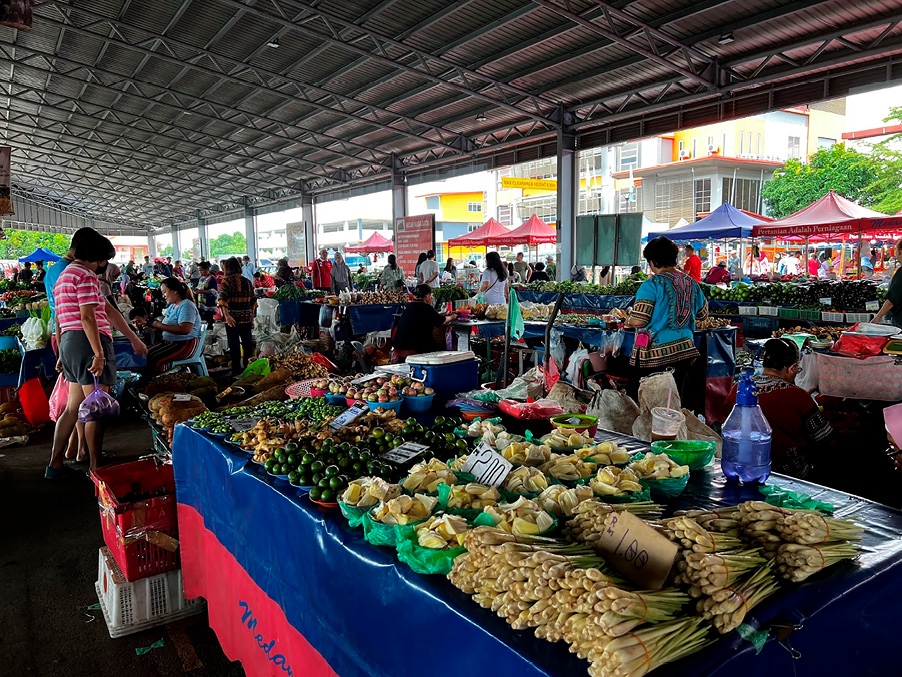
Kubah Ria wet market (2023). © Jacqui Kong
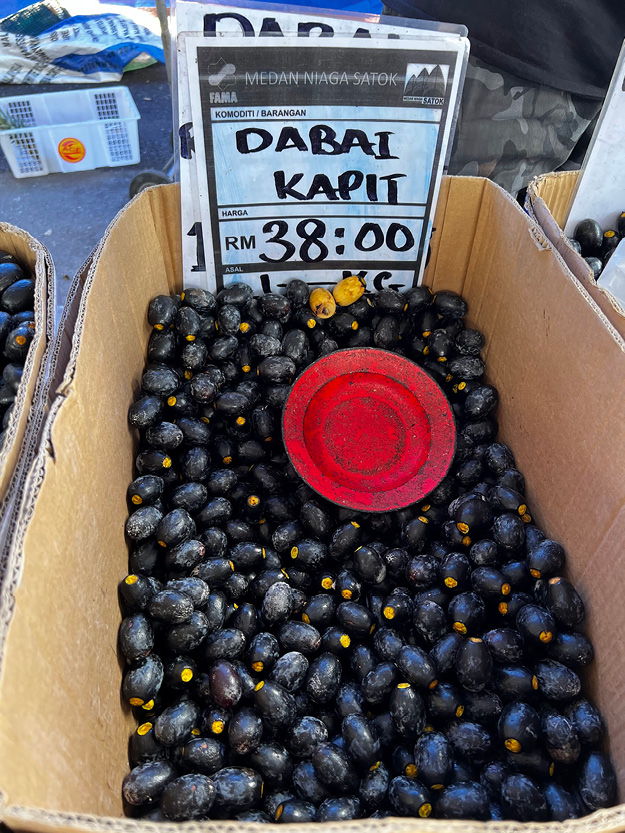
Dabai, a fruit native to Sarawak (2023). © Jacqui Kong
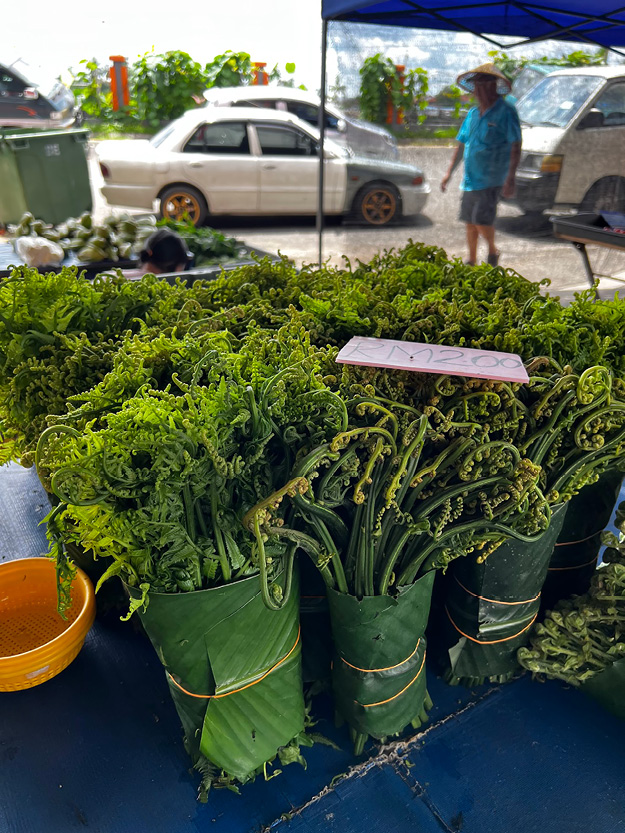
Midin, a type of fern used in cooking (2023). © Jacqui Kong
The Old Kuching Court House is a noteworthy example of heritage efforts by the Sarawak government in order to promote the arts, culture, and culinary heritage of Kuching. Housing several restaurants and cafes, as well as auditoriums for theatre performances and film screenings, and dining spaces for events, the Old Kuching Court House is a reminder that the past can live beside the present, and that the future is promising for Kuching’s culinary heritage and culture.
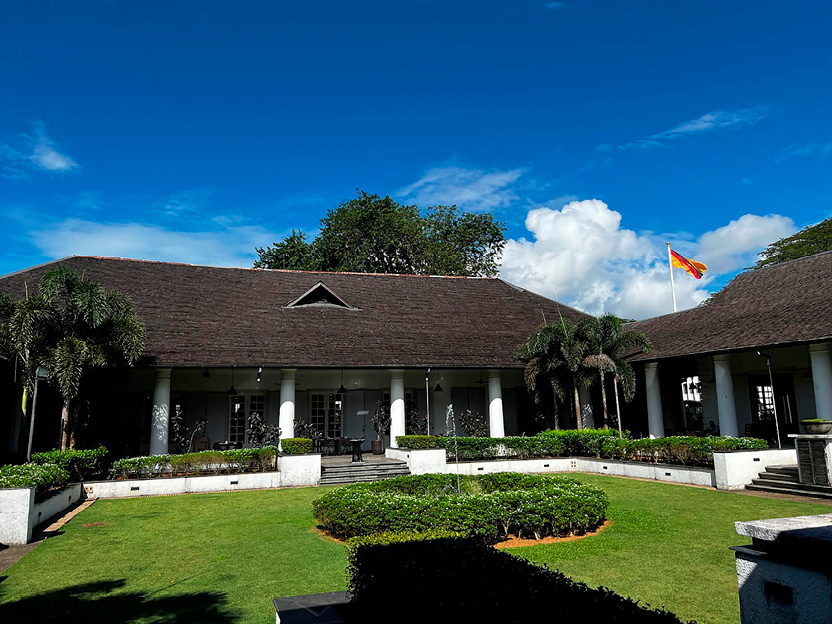
The picturesque inner courtyard of the Old Kuching Court House (2023). © Jacqui Kong
Traversing through Kuching’s many food and cultural points where communal memory is interwoven with personal memories of family and home, I feel like I have barely touched the tip of the iceberg with so many more narratives and familial history of my own to be uncovered. Perhaps it will take a lifetime to journey through Kuching, and to do proper justice to its history, communities, and culture. One can only anticipate with excitement to see what else Kuching will surprise us with in the future.
References
Ahmed, S. 2012, The Cultural Politics of Emotion, Routledge, New York. https://doi.org/10.4324/9780203700372
Brah, A. 1996. Cartographies of Diaspora: Contesting Identities, Routledge, Abingdon, Oxon.
Duruz, J. & Khoo, G.C. 2015, Eating Together: Food, Space, and Identity in Malaysia and Singapore, Rowman & Littlefield, Lanham.
Heldke, L.M. 2003, Exotic Appetites: Ruminations of a Food Adventurer, Routledge, New York.
Kong, J. 2016, ‘Serving Up Chineseness: Myths of Authenticity and Identity in Kylie Kwong’s Cookery Texts,’ Asiatic, vol. 10, no. 1, pp. 226–237. Online, available: https://journals.iium.edu.my/asiatic/index.php/ajell/article/view/756 [Accessed 19 July 2023].
____. 2019, ‘Feasting on ‘the Other’: Performing Authenticity and Commodifying Difference in Celebrity Chefs’ Food and Travel Television Programmes,’ in Routledge Handbook of Food in Asia, (ed.) Cecilia Leong-Salobir, Routledge, Abingdon, Oxon: 207–221. https://doi.org/10.4324/9781315617916-15
Kuching: City of Gastronomy, 2023. Online, available: https://kuchingcreativecity.com/ [Accessed 25 May 2023].
MacCannell, D. 1973, ‘Staged Authenticity: Arrangements of Social Space in Tourist Settings, The American Journal of Sociology, vol. 79, no. 3, pp. 589–603. Online, available: https://www.jstor.org/stable/2776259 [Accessed 3 June 2023]. https://doi.org/10.1086/225585
Sutton, D. 2001, Remembrance of Repasts: An Anthropology of Food and Memory, Berg, Oxford. https://doi.org/10.5040/9781350044883
UNESCO.org 2021, ‘Kuching: Creative Cities Network.’ Online, available: https://en.unesco.org/creative-cities/kuching [Accessed 25 May 2023].