CURATED WORK
Making Black Bloody Rosella Jam
Ili Farhana
Banjar Panglan, Pejeng, Bali
PORTAL Journal of Multidisciplinary International Studies, Vol. 13, No. 2, July 2016.
Designing Futures in Indonesia, Curated Works Special Issue, Curated by Alexandra Crosby.
© 2016 by Ili Farhana. This is an Open Access article distributed under the terms of the Creative Commons Attribution 4.0 Unported (CC BY 4.0) License (https://creativecommons.org/licenses/by/4.0/), allowing third parties to copy and redistribute the material in any medium or format and to remix, transform, and build upon the material for any purpose, even commercially, provided the original work is properly cited and states its license.
Citation: Farhana I. 2016. Making Black Bloody Rosella Jam. PORTAL Journal of Multidisciplinary International Studies, 13:2, 1-4. http://dx.doi.org/10.5130/portal.v13i2.5068
ISSN 1449-2490 | Published by UTS ePRESS | http://portal.epress.lib.uts.edu.au
Corresponding author: Ili Farhana, c/o Bali LitPertokoan Merdeka Corner, Jalan Dewi Madri X no. 1, Kota Denpasar 80235, Bali, Indonesia. Ilifarhana.n@gmail.com
DOI: http://dx.doi.org/10.5130/portal.v13i2.5068
Article History: Received 20/06/2016; Revised 27/06/2016; Accepted 11/07/2016; Published 09/08/2016
Abstract
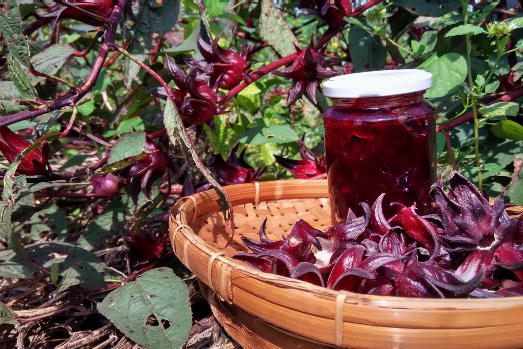
The rosella (or roselle) plant originated in West Africa, but has been cultivated throughout Africa, Asia and Australia. Not only can rosella be used to make teas and jams, but every part of the plant is edible; the young leaves can be eaten raw and make great salads. Rosella is a type of hibiscus, and it has a beautiful pink flower. Although the whole plant is edible, it is the calyx (the bright red fruit) that is used to make syrups, teas or jams. If you eat it fresh, straight off the stalk, it has a sour taste. Inside the calyx is a round seed pod. If it is left to mature, it will turn brown. When dry it provides the mature seeds for the next planting. At Kebun Setaman Pejeng (KSP), our small-scale community farm and learning centre at Banjar Panglan, Pejeng, on the island of Bali, we harvest rosella to make jam.
Keywords
Indonesia; design; rosella jam; rosella jam recipe; rosella jam images; Bali; Indonesia; roselle; foodways; preserving; slow design; permaculture
The rosella (or roselle) plant originated in West Africa, but has been cultivated throughout Africa, Asia and Australia. Not only can rosella be used to make teas and jams, but every part of the plant is edible; the young leaves can be eaten raw and make great salads. Rosella is a type of hibiscus, and it has a beautiful pink flower. Although the whole plant is edible, it is the calyx (the bright red fruit) that is used to make syrups, teas or jams. If you eat it fresh, straight off the stalk, it has a sour taste. Inside the calyx is a round seed pod. If it is left to mature, it will turn brown. When dry it provides the mature seeds for the next planting.
At Kebun Setaman Pejeng (KSP), our small-scale community farm and learning centre at Banjar Panglan, Pejeng, on the island of Bali, we harvest rosella to make jam. This is how:
Harvest the fresh rosella calyces and separate them from their pods.
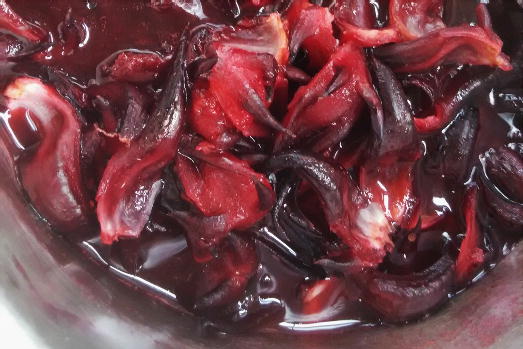
Coarsely chop the calyces and wash them clean.
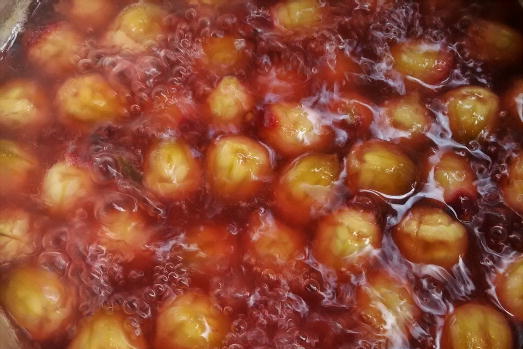
Boil the pods using just enough water to cover them, then reduce the heat to simmer for a few minutes.
From the pods extract the seed mucilage (a thick, gluey substance). This is for adding to the jam; the jam won’t need pectin. Keep simmering the pods until they turn to the consistency of a cloudy syrup, which takes about 30 to 60 minutes. When it’s done, strain the liquid from the pods; that liquid will then be used to boil the calyces.
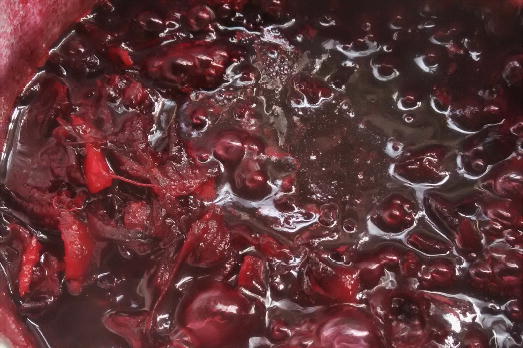
Bring to boil just enough water to cover the chopped calyces and mix in the liquid from the pods, bring to the boil, and once boiled, let the liquid simmer until the calyces break down to a runny pulp. If desired, add spices such as ginger or cinnamon, and a sweetening agent; these additions will be your signature. Here we use gula batu, which translates as ‘rock sugar’ but is actually sugar from the coconut palm, and a slice of lime to bind the taste.
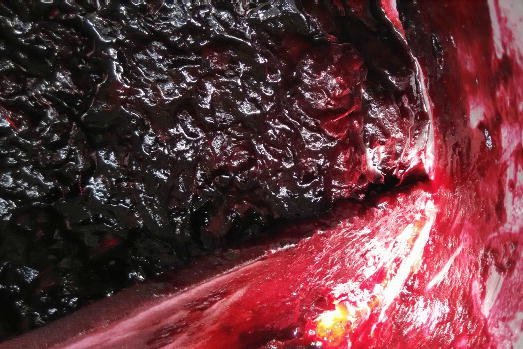
When the liquid starts to thicken, stir it to ensure it does not burn on the bottom. It takes about 60 minutes depending on the quantity of jam you are making.
Once the jam thickens, turn off the heat and let it cool before transferring the jam to clean jars.
DECLARATION OF CONFLICTING INTEREST The author(s) declared no potential conflicts of interest with respect to the research, authorship, and/or publication of this article. FUNDING The author(s) received no financial support for the research, authorship, and/or publication of this article.