CURATED WORK
Designing for Irrelevance
Will Owen Scott-Kemmis
PORTAL Journal of Multidisciplinary International Studies, Vol. 13, No. 2, July 2016.
Designing Futures in Indonesia, Curated Works Special Issue, Curated by Alexandra Crosby.
© 2016 by Will Owen Scott-Kemmis. This is an Open Access article distributed under the terms of the Creative Commons Attribution 4.0 Unported (CC BY 4.0) License (https://creativecommons.org/licenses/by/4.0/), allowing third parties to copy and redistribute the material in any medium or format and to remix, transform, and build upon the material for any purpose, even commercially, provided the original work is properly cited and states its license.
Citation: Scott-Kemmis, W. O. 2016. Designing for Irrelevance. PORTAL Journal of Multidisciplinary International Studies, 13:2, 1-5. http://dx.doi.org/10.5130/portal.v13i2.5031
ISSN 1449-2490 | Published by UTS ePRESS | http://portal.epress.lib.uts.edu.au
Corresponding author: Will Owen Scott-Kemmis, Second Road, Level 23, 45 Clarence Street, Sydney NSW Australia 2000. http://www.secondroad.com.au/contact-us/will.scott.kemmis@gmail.com
DOI: http://dx.doi.org/10.5130/portal.v13i2.5031
Article History: Received 20/06/2016; Revised 27/06/2016; Accepted 11/07/2016; Published 09/08/2016
Abstract
My job title is ‘designer’ but I’m reluctant to describe myself as a designer for a number of reasons: first, because the practice has a lot to answer for; and second, because I don’t do a whole lot of design. I help groups of people to collaborate and converse their way through problems towards solutions—activating a latent capability for design in people as they think and work differently, together. The sense of agency that accompanies this is intoxicating. This work can produce strategies, systems, and services, as well as spaces, objects, and graphics. The awareness that design can shape both our (intangible) experiences and our (tangible) environments—and that, as a mode of thinking, it can be accessible, inclusive, and participatory—shifts it from a practice to a stance. In this sense, is design a choice that we make to perceive and move through the world in a contextual and intentional way? What does this mean for the practice of design?
I respod to these questions by reflecting on my experience of participating in the Indonesia Australia Design Futures project.
Keywords
design thinking; participatory design; Indonesia; co-design; sketching
My job title is ‘designer’ but I’m reluctant to describe myself as a designer for a number of reasons: first, because the practice has a lot to answer for; and second, because I don’t do a whole lot of design. I help groups of people to collaborate and converse their way through problems towards solutions—activating a latent capability for design in people as they think and work differently, together. The sense of agency that accompanies this is intoxicating. This work can produce strategies, systems, and services, as well as spaces, objects, and graphics. The awareness that design can shape both our (intangible) experiences and our (tangible) environments—and that, as a mode of thinking, it can be accessible, inclusive, and participatory—shifts it from a practice to a stance. In this sense, is design a choice that we make to perceive and move through the world in a contextual and intentional way? What does this mean for the practice of design?
When I was young we moved to Indonesia. I spent my most formative years in Jakarta, but just before the New Order regime collapsed in 1998 we left. I didn’t return for almost twenty years. Finding myself back there as a part of the Indonesia Australia Design Futures project was exhilarating. I had an opportunity to retrace my steps—awakening dormant dreams, to wrap myself in a simultaneously foreign and familiar tongue, and to learn from an inspiring collection of people that embody design, as both practice and stance. Their context is unstable—their environment capable of indifference, idolatry, and violent opposition. In our movement towards change (be it activism or collaborative design) we always navigate adversarial forces—immune systems opposed to change—but in Australia these are ripples in the face of the waves that our neighbours sail.
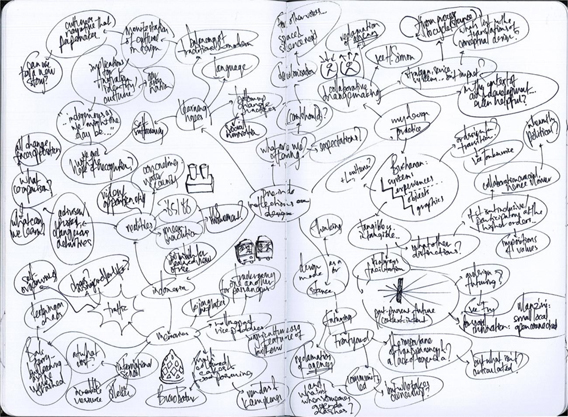
My relationship with design has changed dramatically and continuously over the last ten years. This evolution has been so intertwined with my personal growth that I feel defined by it. The impact is in how I relate to the world around me, to others, and to myself. I’ve found myself using the chapters of this evolving relationship as measures of time, as reference points, and anchors in flux.
Arriving in Yogyakarta marked a transition to a new chapter. This is a reflection on (and from) a transitory state. Snaking through the arteries of that heaving concrete mass, with an unrelenting stream of indifferent forms weaving around us with only millimetres to spare, the futility of design (as a practice) seemed overwhelming. This feeling of irrelevance was recurrent, and far from being defeating, it was a source of great excitement. Free from expectation we can ask open questions: In the face of the complexity that characterises our social, cultural, political, and economic systems what can be offered by design? When these systems have grown organically (rather than intentionally) over time, and are self-organising, adaptive, and mutually-reinforcing, what should be offered by design?

Studying design at university I was underwhelmed by the lack of attention paid to the responsibility of designers. As students, we were rarely asked to consider the potential impacts of our work. If design is (in one sense) the contextual and intentional practice of bringing ideas into existence—making them felt in time and space—are we not obligated to explore the past, interrogate the present, and speculate about the possibilities? (What has been done? What is being done? What could be done?) And in the context of the predicaments we face, are we not obligated to question intent? Why this thing and not that? Why do anything at all? (Needless to say, I had strained relationships with many of my design lecturers but got along swimmingly with those in philosophy.)
In Central Java I encountered young Indonesian farmers working deftly with both permacultural principles and traditional farming practices. Through their enterprising approaches to growing and educating they are challenging negative perceptions that have seen the youth distancing themselves from farming, instead pursuing jobs in Java’s sprawling cities. I visited communities of graphic artists, their brutal, yet optimistic work offering audiences a choice between futures—painting stark the realities of the prioritisation of progress, and demanding we acknowledge our complicity. And I found myself enveloped in the resourceful and optimistic projects of designers. Despite their radically different roots, social and environmental awareness was at the heart of all these practices.
In all of their work exploration, interrogation, and speculation were self-evident. This is a common thread between diverse projects. Their activities were necessary and their impacts immediate - even inherent in the activity. They did not seek relevance, or justification from some external locus of control, but instead observed and responded to what they perceived was relevant, and demanded the recognition (or reclamation) of an internal locus of control. Their work is simultaneously deeply contextual and autarkic. What can we learn from this? How can we respond to, and make demands of, the context in which we design? And how can we be demanding without being dependent?
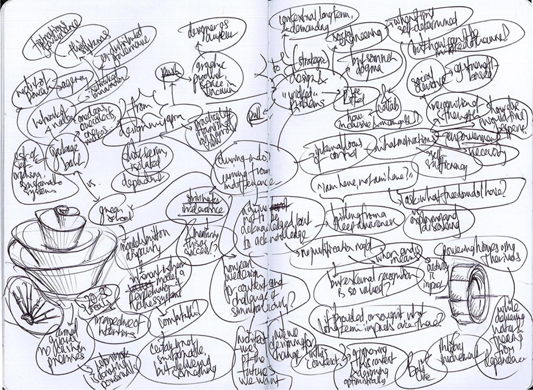
My frustration with the practice of design found me seeking to append it to another more rigorous practice, as though this might justify the activity. In the absence of this, to design felt like making hubris tangible. This found me pursuing philosophy and sociology, and distancing myself from design. But the further I moved away from design, the more I felt it had to offer. The practices of design that have shaped our environment have long suffered from myopia, and disregarded the intangible, so our experiences—and the systems within which these unfold—have rarely been objects of design. This is being enthusiastically acknowledged, and so those engaging in this practice of design are enjoying relevance. This is great for me, and those like myself, who are employed on account of this. For many of us who have struggled with design, this work feels justifiable—it is purposeful and necessary. It is also positively impacting people’s lives. That said, I think we ought to be wary. The problems we work on are systemic and intractable—they are wicked problems, and by definition do not have solutions. What role are we trying (or hoping) to play? How can we justify this activity, without being righteous or dogmatic? Can it be inclusive and open, and remain manageable?
If we consider design a stance—one in which exploration, interrogation, and speculation are demanded of us—a stance that invites the reclamation of agency—can the efficacy of this idea be measured by its own irrelevance?
DECLARATION OF CONFLICTING INTEREST The author(s) declared no potential conflicts of interest with respect to the research, authorship, and/or publication of this article. FUNDING The author(s) received no financial support for the research, authorship, and/or publication of this article.