Public History Review, Vol. 27, 2020
ISSN 1833-4989 | Published by UTS ePRESS | https://epress.lib.uts.edu.au/journals/index.php/phrj
A History of Now: Historical Responses to COVID-19
Meg Foster, Toni Burton, Mark Finnane, Carolyn Fraser, Peter Hobbins and Hollie Pich
Citation: Foster, M., Burton, T., Finnane, M., Fraser, C., Hobbins, P. and Pich, H. 2020. A History of Now: Historical Responses to COVID-19. Public History Review, 27:2020, 1-18.
© 2020 by the author(s). This is an Open Access article distributed under the terms of the Creative Commons Attribution 4.0 International (CC BY 4.0) License (https://creativecommons.org/licenses/by/4.0/), allowing third parties to copy and redistribute the material in any medium or format and to remix, transform, and build upon the material for any purpose, even commercially, provided the original work is properly cited and states its license.
The connection between history and COVID-19 might appear counter-intuitive. We are used to being told by media outlets and employers, government officials and friends that we are ‘living in unprecedented times’. The COVID-19 pandemic has changed the rhythms of our daily lives, but not every response to COVID-19 has been new. It has also been understood through history.
This article comes from a roundtable discussion that was held as part of NSW History Week on 11 September 2020. Bringing together historians, curators and archivists, this panel explored the way that history has been used to understand COVID-19. Particular attention was paid to attempts to record and archive our experiences through the pandemic, comparisons between COVID-19 and the ‘Spanish’ flu as well as shifting understandings of temporality during the pandemic. Although the COVID-19 pandemic has ruptured our quotidian experience, it is not a moment beyond history. This panel examined how history is being used as an anchor point, a source of inspiration and an educational tool with which to tackle ‘these uncertain times’.
This roundtable was hosted online via Zoom. At the time, 11 September 2020, several COVID-19 vaccines were being developed worldwide. But it was too early to know which of these, if any, would prove effective. Victoria was in the midst of a strict, state-wide lockdown after a hotel quarantine breach led to an outbreak of the virus. The COVID-19 pandemic changes rapidly. It is experienced differently depending on a wide range of factors including geographical location, and so context is crucial. The following is the Australian Federal Government’s COVID-19 briefing for 11 September 2020 to situate the reader in the context in which the presenters were speaking.
As at 3pm on 11 September 2020, a total of 26,565 cases of COVID-19 have been reported in Australia, including 797 deaths, and 23,211 have been reported as recovered from COVID-19. Over the past week, there has been an average of 63 new cases reported each day. Of the newly reported cases, the majority have been from Victoria. COVID-19 cases were reported across all ages. The median age of all cases is 37 years (range: 0 to 106 years). The median age of deaths is 86 years (range: 30 to 106 years). There is a relatively equal ratio of male-to-female cases across most age groups. Following the peak of cases at the end of March, there have been a relatively low number of new cases reported daily between mid-April and early-June 2020. Cases have increased since mid-June. Since mid-August 2020, the number of newly reported cases has begun to decrease, but high numbers continue to be reported. Of cases with a reported place of acquisition, 80% were locally acquired. The overall proportion of cases under investigation in each state and territory is relatively low, indicating that public health actions, including case identification and contact tracing, is occurring in a timely manner. To date, over 6,928,000 tests have been conducted nationally. Of those tests conducted 0.4% have been positive.1
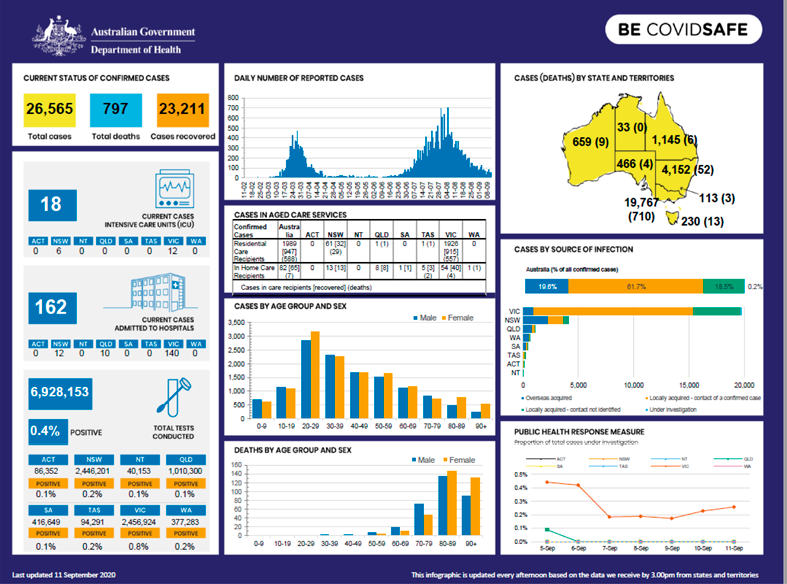
Fig 1 Australian Department of Health Summary of COVID-19 in the country on 11 September 20202
Panellists
Dr Meg Foster is a historian of bushranging, banditry, settler colonial and public history, the Mary Bateson Fellow at Newnham College, University of Cambridge, and a visiting research fellow at the University of New South Wales. Meg is currently investigating the connections between British highway robbery and the origins of Australian bushranging. She is an intersectional historian who has experience working across race, class and gender histories as well as imperial, colonial, ethnographic and public histories. Meg has published widely, contributing articles to Rethinking History and Public History Review as well as Australian Historical Studies, where her most recent piece won the Aboriginal History Award from the History Council of New South Wales. Meg has also contributed book chapters to publications by Routledge and Bloomsbury Academic. Combined with reviews, newspaper articles and blog posts, Meg has a breadth of experience writing for academic and public audiences and a passion for making connections between history and the contemporary world.
Dr Peter Hobbins is a historian of science, technology and medicine, and a Principal at Artefact Heritage Services. His first degrees were in English literature and biomedical science and he worked as a professional medical writer before pursuing his love of history. Passionate about public history, in 2018–19 Peter coordinated a project to encourage community historians to research the local impact of the 1918–19 pneumonic influenza pandemic. Throughout 2020 he has been involved in many media queries about the role of history in facing the current pandemic. Peter also encouraged informal archiving of its impact on social media via the #CovidStreetArchive hashtag.
Professor Mark Finnane is a historian at Griffith University where he is Director of the Prosecution Project and also Director of the Harry Gentle Resource Centre. His historical research focusses on the history of policing and punishment, a legacy of his original work on the history of mental hospitals and lunacy incarceration. Over the last decade he has undertaken a series of studies in the history of security in Australia, including the policing of migrants and borders as well as terrorism and political violence. During 2020 he has been investigating the history of the 1918-19 influenza pandemic in the context of these longer histories of policing, law and government in Australia.
Toni Burton is the Collection Curation and Engagement Manager at State Library Victoria and oversees the development of the State Collection, with a focus on rare and original material collections. Managing a team of specialist Librarians, whose daily work involves hands on engagement with the collection, donors, researchers and the community, Toni’s work has looked very different over the past 6 months [the 6 months prior to September 2020] whilst the Library has been closed. With a pause placed on assessing collections for potential acquisition, much of the team’s focus has been on how the Library might collect, record and document the experiences of Victorians living through the pandemic. The State Library of Victoria has employed a number of projects that look at creating a documentary archive of this global event, including Memory Bank and Photographing the Pandemic.
Carolyn Fraser is Senior Curator at the State Library of Victoria. She has published widely on social history topics, with a particular focus on the history of craft practices. In 2019, she curated Velvet, Iron, Ashes, the inaugural exhibition in the State Library of Victoria’s new Victoria Gallery. In March 2020, she led the development of the Memory Bank, the Library’s collective memory project responding to the COVID-19 crisis in Victoria.
Dr Hollie Pich is a historian and writer who lives and works on the unceded land of the Gadigal people of the Eora nation. Her academic research focuses on the intersections of race, gender and the law in the United States. Hollie has written about Australian efforts to create a COVID-19 archive and is more broadly interested in how individuals and institutions are working to create a record of this ‘historic moment.’
The Panel Session
MF I’d like to start the discussion by picking up on the end of Hollie’s introduction. What do we mean when we say we’re ‘living through a historic moment’? What do we mean when we say we’re living through history? From a historian’s perspective, we’re constantly creating history. We’re always moving forward in time. So, what do we think makes this moment different?
TB I think for the pandemic, what’s different about this moment in history is that pretty much everyone on the planet is experiencing it to a degree. It’s not only happening to a certain part of the world, or a certain part of the country, or certain sections of the community. Although we’re all experiencing it differently, everybody is experiencing this at global, national and local levels. And for me that’s what makes this different from other events in history that we might look to document.
HP Historians are always looking for moments of rupture and disruption, where we can see the way that things normally are, and then this changes rapidly. That’s what’s happened in the context of COVID and that’s how we know or suspect that people in the future are going to be really interested in the pandemic. That’s what makes this a ‘historic moment’ – even though this is a label that historians are pretty leery about applying in a present-tense situation.
CF I would add, though, that many events create a sudden rupture and one of the things that I think is really interesting about this experience is how it’s unfolding in a kind of slow-motion way in some respects… or rather, that the temporal nature of it is changing so some things seem to happen very suddenly and other things seem to stretch out. Despite all of the work that we do as historians looking at past experiences of pandemics, there’s no way to be certain about how this pandemic will end and what that resolution will be. I think that is another aspect which is really drawing people’s attention to this moment of time: that they’re living through it in a way that people – most people, other than historians – don’t normally do.
MF I just want to pick up on that point that you made, Carolyn, about time. Some people are casting this pandemic as a rupture in time, but there are obviously some continuities. While there are people on Twitter arguing that time can be carved up to into BC – before corona, and after – there are also people arguing that these ‘ruptures’ we are experiencing are not actually ruptures at all. The pandemic is just bringing the fault lines of our societies into stark relief in a way that we wouldn’t normally be aware of in our daily lives. Time is experienced subjectively as well. Carolyn and Toni, you’re currently in Melbourne, and I imagine time feels quite different for you there compared to someone like me, in Sydney, with a bit more freedom. So, I was wondering if you could speak to idea of temporality? What do we think about the notion of time in this pandemic?
PH I think one of the interesting things that we’ve seen is the sense that there is a suspension of time and there’s also this real feeling that this is almost redefining an epoch. For many of us the last time we felt that was this day nineteen years ago – September 11, 2001.
I also remember just back in April as things slowed down in Sydney, I was saying to some of my work colleagues: ‘You know the last time I remember Sydney being like this was in 2000 during the Olympics, when people were by and large leaving the city – except of course for all the tourists who were coming.’ In that case there was also a weird sense of time. The world was converging on Sydney but the rest of us were actually leaving and so the streets behind the main tourist areas were almost as dead as they were this year. In these instances we have these sort of strange loops of time going on. But there’s certainly a sense that this is a time apart and perhaps things have slowed down for us while we face the enormity of what’s going on.
HP I think it’s this simultaneous sense that time slowed down but the year is also going really fast. We see a lot people asking: ‘Are we on day 300 of March?’ Because March felt like it went for so long as we entered this new routine of ‘sameness’. Now you look around and go: ‘Oh is it getting warm again already? Are we really going into summer? Where has the year gone?’ People are thinking about this as a lost year and we see this expressed a lot on social media. There are so many memes about this specific sensation. Time is always kind of meaningless but it feels very meaningless this year.
TB I think without the normal structures of society, life and community – the ebbs and flows of celebrations and events – it feels that there is no structure to time and that every day is the same. If you compare it to the natural world, we’ve gone into some form of hibernation over what is our winter and our autumn and hopefully we’re going to re-emerge in spring and summer. It feels to me very much akin to the natural world where there are cycles of growth and cycles of when things die away.
MFin Toni’s comment really points out the importance of understanding the variety of experience not only within our country but across the world. So for some, as in 1919 during the outbreak of ‘Spanish’ influenza, this is a very intense experience of prolonged incarceration and harm. For others it’s just a little bit disruptive. That distinction is really important, particularly in terms of how this will be remembered as a moment in time.
MF Following on from this point, can you see any connections between the COVID-19 pandemic and other historical events? Mark brought up the ‘Spanish’ influenza pandemic. There are many comparisons being made in the media between the current pandemic and the ‘Spanish’ influenza outbreak. But there was a huge gap in historical memory. The ‘Spanish’ flu after World War I hasn’t really been in global consciousness until our current moment. Did people at the time feel that they were living through history in the ‘Spanish’ influenza pandemic or during any other period of crisis or rupture that we’re familiar with? Can we think of any sources where historical actors framed their experience in that way?
MFin I think the extraordinary thing about the absence of material from 1919 is that it came at the end of a war during which people did take the trouble to record their lives at length. We have massive archives from wartime of how people recorded their emotions and feelings in communications with their family and with others and that’s a really striking difference for me between the Great War and 1919.
PH I’d be happy to affirm that point. If you do go and read the diaries of Australian soldiers and nurses who were serving overseas in 1918, for many of them keeping a diary or writing letters home was part of that great – I hate to use the word ‘adventure’ – but that great time out of their normal lives, and so they often folded their experiences of the ‘Spanish’ flu into their diaries and letters home. But for many of them when they came back – when the ship pulled into Sydney Harbour or to Point Nepean or Fremantle – they stopped keeping the diary or they stopped writing the letters. That’s a pattern that goes well back through the nineteenth century as well. Their journey ended when they came back to their home territory. So we have a weird dichotomy between some very well-recorded histories of living through the influenza pandemic overseas by people who then stopped keeping personal records when they returned home. Certainly there’s a great absence of records of the impact of the pneumonic influenza pandemic on ordinary people in Australia.
The other point I would make relates to my project working with local communities. When I was digging into local council archives of 1919 you can actually see the system breaking down there. You can see correspondence tailing off. You can see infectious diseases registers that were listing cases of other diseases like scarlet fever or diphtheria in the community and then you see pneumonic influenza cases tumbling into the records. From that point onwards the records just jumble out of order and in fact break down in cases. So you can actually feel that process happening as you work through a chronological archive. It had quite a powerful impact on me. It was a real eye-opener looking at local council archives for the first time in my career.
MF Is there also a sense that there’s an element of human agency in wartime? War is obviously something entered into by individuals. There are declarations of war, there’s a sense that this is a man-made crisis or ‘adventure’ if you want to couch it that way. But something like a virus is relatively invisible. Although there were attempts to contain it and prevent it from moving certain places – I know Mark’s written on quarantine in particular – there’s a sense that disease is something beyond the scope of human agency. Do you think that influenced how people wrote about pneumonic influenza? How did people reconcile the fact that the World War was over with the sense that they were now facing an invisible enemy?
PH I think there’s certainly a sense of that and you see it with other epidemics and pandemics as well – the sense that it is an invisible and inscrutable agent that you never quite know. We’re all feeling that now. We still don’t know if the door handle that we just touched is infected. Are we going to pick up something by going out and getting a coffee? You certainly get that feeling from archival collections from 1919 but also from the bubonic plague of 1900 in places such as Sydney, or even going back to some of the smallpox epidemics that affected some of the major cities in the nineteenth century. Nobody really knew where it might strike or how it might reach them.
That makes the disease ubiquitous and different from military experience which obviously involves training and then being posted to a combat zone where you know you’re putting yourself in a particular form of danger. One of my thoughts coming out of 1919 was that it was the very ubiquity of the disease that meant that they didn’t need to mark it. Nothing that stood out about it. It was a communal experience unlike the sacrifice of those who had served during the war.
CF In a pandemic there’s no identifiable hero. In a battle there often is. In wartime there can be narratives that can kind of coalesce around figures – humans who become superhuman in some way. In the history of pandemics those figures don’t really exist.
In the case of Victoria during this pandemic, very early on there was quite a lot of real interest in Brett Sutton, the Chief Health Officer and I wondered whether he might rise to have a kind of hero-like role. Things have not gone quite as well in Victoria as might have been necessary for that to happen, but it’s interesting to think about in relation to how events are remembered or forgotten.
MF Following on from that point, Carolyn and Toni, can you comment on the archive that you’re involved in at the State Library of Victoria? Can you walk us through the creation of the archive, the type of material you’re trying to attract and if there are any comparisons you can see between your archive and that of the ‘Spanish’ flu?
TB One thing to point out is that during the COVID-19 pandemic we’ve had repeated requests from journalists and media agencies to provide documentary evidence – for example, photographs of people wearing face coverings during ‘Spanish’ influenza. But we don’t actually have a huge amount of original material relating to that. This has been interesting in terms of our collections, because you can almost use that lens of what the journalists, researchers and writers of today are looking for to link 1919 with 2020. In 100 years’ time, it’s feasible that the journalists of the future are going to want similar information. So that’s provided a perspective through which we can think of our current collecting initiatives.
One of the things we did quite quickly, when the Library closed and staff were sent home, was come up with a series of think tank projects. One of them was Photographing the Pandemic. This project involved redeploying our staff across the organization to capture their local communities’ response to COVID-19. We’ve collected probably about a thousand images to date as well as their associated, descriptive metadata documenting these six months. This initiative acts on a very local and suburban level, capturing stories of how businesses have been affected, how public space has been impacted, how communities have become resilient and what they have done to find joy in small, daily interactions. We’re just about to extend that to an oral history project as well to document some of those story-based practices.
The other thing we did quite early on, which was inspired by the State Library of Queensland, was to engage a number of photographers living in rural and regional Victoria to capture the experiences of those communities. From a horrific bushfire season into the COVID pandemic, it was particularly important to respectfully capture the unique experiences of people living in rural and regional Victoria. We find it very easy to collect metro Melbourne, but we’re a Library for Victoria and capturing those other experiences is really important to us.
CF I can talk a little bit about the Memory Bank project. This project involved taking the work that Toni and her team do already and creating a public face that could exist digitally, because that would be the way that people would be interacting with the Library when we were closed. The Memory Bank was developed in two stages. The first stage of the project was a stage in which a group of us were drawn together from around the Library to issue a prompt every week on social media for people to create content in response. Each prompt aimed to address something that seemed particularly momentous to that week. This approach was inspired by the work that was done by the Mass Observation project in the UK which began in 1937.
I was thinking of the Memory Bank project selfishly, on behalf of the person who will be in my role 100 years from now. We really wanted to stress to people how important the everyday, ordinary experiences of this pandemic are. Historians and governments are going to have records of some of the bigger aspects of this experience, but we should also document the experience of individuals, of so-called ‘ordinary people’. For me, it was really important that the prompts that we issued shifted between those very small, domestic, local concerns and bigger questions about the experience itself. We also aimed to create a loop with our collection so we were looking at items in the collection that had some relevance or perhaps would provide a visual prompt to people. We are constantly collecting material and so I was really keen that the project both have a function in terms of driving potential acquisitions for us and also an educational aspect. People would understand that the collection is vast and that it’s not comprised simply of works of great art or important manuscripts but that it’s extremely broad. So that was the beginning of the project. In the latter part of the project it really shifted much more into a social media campaign.
TB It’s been interesting to see the Memory Bank develop as it switched from a collecting priority to being an engagement priority for the Library. People have formed connections within its Facebook group and are supporting and providing advice to each other based on what they’re posting. Or they might be providing emotional support or suggestions for recipes – for example how to make their sourdough starter more effective. So that’s been an interesting community outcome. I think that we have built up to 2000 people around that concept of a Memory Bank.
MF It sounds like the project challenges our idea of an archive as well. We usually think of archives as quite static, but this is an ongoing process of connection and engagement. The Memory Bank is obviously constantly unfolding so that in itself is quite remarkable too.
MFin I agree with you totally Meg. And this really highlights the difference again between 1919 and now. The archive of 1919 is in some ways an accidental archive. It’s a by-product of other purposes, mostly of government. We didn’t have the cultural institutions in 1919 of the scope that we have now, particularly with dedicated staff who are taking their own role in informing communities of memory through this. One of the questions that I think arises in relation to the enormous volume of information that’s available now is the difference between the sort of work that these public memory custodians are doing and that which is present in the world of social media. Facebook and Twitter are producing massive quantities of information which people are harvesting in various ways. I recently attended a presentation by my criminology colleagues at Griffith University who’ve been conducting surveys of people’s responses to lockdown using the Facebook community as the community of interest, so there are all sorts of inquiries going on. The whole area of social media is going to produce its own challenging questions about how that relates to the picture of memory of this year that we’ll get through institutional collections at the State Library of Victoria and many other institutions.
MF I’d like to ask a broader question about digital archives versus material archives. I know that elsewhere Peter has written about challenges presented by digital connectivity. Although it is so much a part of our lives – and it’s keeping us sane! – it is also relatively ephemeral. How do we capture digital material and use it in a meaningful way? And how are we doing this alongside gathering tangible, archival evidence?
TB I think the Victorian State Library collection relating to COVID is going to be predominantly ‘born digital’ as most of the submissions are coming through our digital base. We’re keeping emails as a form of correspondence in the same way we would have kept letters from when people corresponded that way. Although there are physical elements of the collection around ephemera it is predominantly a ‘born digital’ collection or a collection of websites through ‘Pandora’. I think that’s going to be useful for the archivist or the researcher or the historian of the future in that its intangible nature is very different to things that we often perceive of as being an archive or a museum-style collection.
MF Are there unique challenges in terms of securing digital information? Even for this presentation I was trying to look back through tweets that I’d liked and it was hard. You really need to consciously keep track of what you’re seeing and what you think is important. Especially when scrolling through a social media feed you’ll see something that might resonate but then going back to find it is difficult on many digital platforms.
TB Archiving social media has its own challenges which we have not necessarily come up with a solution for. I think that’s pretty common across cultural institutions. How do we collect Facebook commentary? How do we collect Instagram? We’re fortunate in that one of our collecting tools at the Library is something called ‘Pandora’ and that harvests websites and makes them digitally available as an archive. Twitter can also be harvested that way and through hashtags. For prominent figures we might want to collect their whole Twitter feed. I’m sure there’re ethical considerations around how that information is made available into the future. This is certainly important when archiving things like Facebook and Instagram where the intention of those posters was not necessarily to have that information collected in perpetuity by any organization.
I think preserving digital media is a challenge. But there’s a lot of work that’s been done on digital preservation. We have a tool to preserve ‘born digital’ content in its intact nature so that it doesn’t diminish over time in the same way that we will preserve a physical artifact in the Library.
HP One of the things that I’ve been thinking about a lot is the difference between the prompted archives and the unprompted archives. What we’re seeing are institutions reaching out to people and saying: ‘This is a historic moment. We want to hear from you.’ This isn’t just something that’s happening in Australia. If you look at international archiving efforts in the US, the UK and Japan it’s remarkably consistent in terms of what institutions are saying. They’re saying: ‘We want your experience as an individual. We want the details of everyday life. We want you to keep a diary.’ As a historian the first thing I think is that the things that you collect or the things that you write down when you’re prompted – and you’re writing them in the context that you think a historian might read them 100 years in the future – are very different to you sitting down writing your unmediated thoughts. The question in these circumstances such as these is always: ‘What are you not saying if you think that people are going to come back and look at this?’
CF As one of the organisers who’s been asking people to do these kinds of things, I felt an enormous obligation to respond to our prompts myself. A couple of the prompts that we issued as part of the Memory Bank took me weeks! When we asked people to inventory their pantries, I had no idea that it would take me months to really do it properly. In regard to a diary, I found myself in a situation where I kept three diaries and it became very complicated. I really feel like we ought to be offering some kind of service to teach people about the idea of audience because it is a very confusing form, particularly for people new to the genre.
MF I’d like us to think through the idea of inequality in terms of the voices that are being represented in the archive that we’re currently creating. On one hand this is a unique opportunity because we have a social history archive that’s being developed in real time, where people get to contribute things that they think are important. But there are certain voices that aren’t being represented in these initiatives. For example, essential workers who are on the front line don’t have the same time to write diaries. People from different socio-economic backgrounds don’t necessarily have the same access to technologies or want to engage in institutional platforms. Can we think of how we might tackle this issue in the creation of COVID archives?
TB That’s something Carolyn and I really wrangled with in terms of the Memory Bank project because it’s predominantly a digital engagement platform. Although they can choose to do things a bit more manually, the way people are going to find out about that project is through social media channels. Some people make a choice to stay away from that kind of media and don’t access these platforms. So, this was something that we talked about at length but didn’t really come up with a solution. It was definitely in our minds that we were going to be able to reach a certain section of the community through this call out for information and I think it caused quite a lot of discord, internally, around the competing demands of whether this was primarily a collecting project or whether it was an audience engagement project. Where it finally landed was that it was primarily an audience engagement project and that was the moment where the responsibility for the project shifted entirely to another team within the Library. Whilst I certainly understand that from a resourcing position, I do think it severely limited the way in which we were able to do outreach and the kind of outreach that we had initially designed for the project.
MF Peter, could you speak about the community archiving projects that you’ve been involved in and whether they intersect with these institutional projects or are in fact quite different?
PH I used to work at the National Archives of Australia so I had some sense of the proactive collection policies that are always in place with statutory authorities, whether it’s the National Archives, state archives or public records offices. It’s their job to go out and to capture and assess and then ‘ingest’ the records of government. There are organizations that sometimes don’t call themselves ‘cultural institutions’ but do go out and actively seek information. They’ve had to deal for a long time with this problem of the transition to digital records and all the issues that come with them: around platforms, the readability of data and the interlinks across multiple platforms. So I came to this pandemic primed to think about this when I started seeing, for instance, local historical societies and particularly local councils creating these sorts of archiving projects. I laud them for their initiative and I support what they’re doing. But I’m concerned that maybe there’s not going to be digital longevity planned into these programs in the way that we see at our state libraries and our major state and the National Archives.
We always see that problem. I had the same problem looking at council archives from 1919. Over the last hundred years many councils have merged or they’ve chucked out their archives. One of those things that worries me is an ongoing equity issue. A lot of small-scale local initiatives – let alone the ones that play out informally on social media – may disappear over time because the basic digital infrastructure isn’t there. Then there’s the bigger issue of what’s driving some of these collections. Who’s capturing the algorithms that are actually helping make these decisions? Who’s capturing the way in which the COVIDSafe app works and tracks data, not just the information, but actually the algorithm itself? Who is thinking about how that was programmed, the choices that were made in it, the machine learning that went into that and how we’re going to be able to interpret that 100 years from now, let alone the diary left by an individual after a prompt on a State Library website?
MFin I just want to follow up on the question of inequality. It’s quite a complex issue because there are some ways in which a population’s experience of a pandemic as it’s preserved for us in historical memory is inevitably a biased legacy. I have a lot of interest in policing and what police do during events like the pandemic, but that in itself produces a very skewed picture of what the pandemic is about. We all know the story of Karen from Bunnings and that may represent a particular type of experience of the pandemic, but it’s not a majority experience. All archives have these inbuilt biases that are the product of various kinds of historical factors. I think that’s a really important thing to remember when we come to write the histories of these kinds of events. I’m also interested in what I referred to earlier as the ‘accidental archive’. I’ve discovered a couple of extraordinary, completely forgotten but quite important constitutional issues in the National Archives of Australia which have been ignored in Australian political history. Even the very survival of these memos is an accident of history. These are really important things for us to consider when we try to understand or approach an archive and interpret it.
HP If we’re talking about the types of archives that are being produced, I can’t help but think we’re going to have a ‘front heavy archive’ especially if we’re talking about individuals’ experiences. As we said earlier, this pandemic was originally experienced as a rupture, but it’s now been going for a pretty long time. At the beginning a lot of people were writing in their diaries and taking photos when they went out thinking: ‘This is really different. I have to record everything.’ But it feels sort of normal now. If you go out you keep a bit of space between yourself and others. Seeing people in masks isn’t really throwing anyone anymore and we’re not recording that. The lack of a record is telling in and of itself and future historians will talk about that. But I can’t help but think there’s going to be a drop-off point for future historians. There’s going to be such an abundance of material for March and April in Australia. Then once the first wave is over, people are either acting as if COVID is done and they don’t want to think about it anymore, or they’re just exhausted by it: the novelty has worn off. Thinking about that in terms of the archive is really interesting.
CF Your experience of COVID is very much dependent on where you are. The experience in Victoria and particularly in metropolitan Melbourne at the moment is quite different from the rest of the country. One of the things that I’m really conscious of is that it’s a very particular kind of archive when the people that you’re asking to do the work – to collect and make observations – are shut in at home. I would really like to see what it’s like in the city after curfew but due to the nature of curfew you can’t go into the city. There are people in an official capacity who are able to document that experience, but I do think that the domestic nature of many people’s experience poses interesting questions about what is worth recording. The idea of ‘the home’ as a particular form of space comes to bear on this question as well.
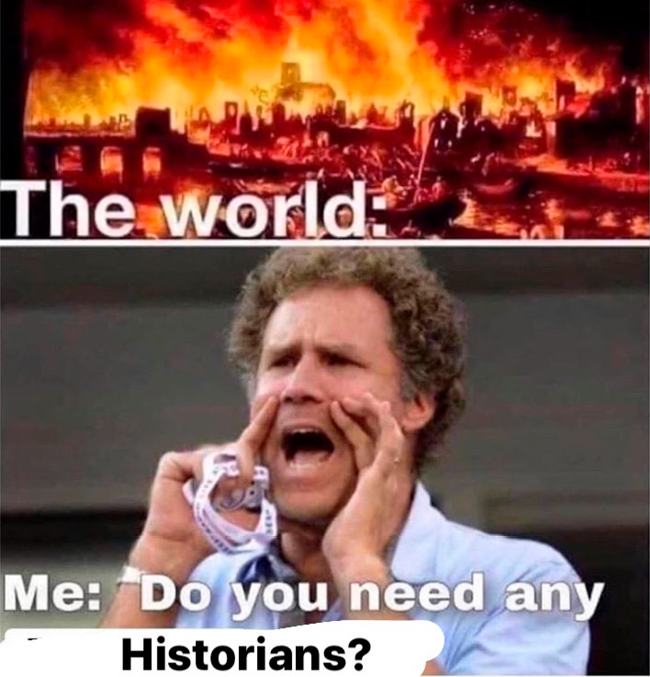
MF I want to move us from ‘citizen archivists’ – as Carolyn has called these everyday people contributing to the archive – to historians. If we’re looking at an archive that’s being created by everyday people what is the role of historians? I think this meme encapsulates the issue (see figure 2). What can historians do in this moment of catastrophe? What can we bring to the table? What’s our unique contribution to this moment?
HP One of the things that the vast majority of people have felt at certain points during this year is uncertainty and loneliness. History for me is a type of empathy; looking to the past and seeing that people had similar experiences. I think that the role of history and historians in this moment is to say: ‘Yes, this is unprecedented in a lot of ways but it doesn’t stand alone, out of time.’ There is comfort in reading the experiences of people who went through the ‘Spanish’ flu and realising that is a bookended event. Historians aren’t fond of the phrase: ‘those who can’t remember the past are doomed to repeat it’ because history doesn’t repeat. But I do think there are themes that emerge when we look at the past. As historians we can sometimes draw on those to help people feel a little less confused and a little less alone.
MFin Empathy is what historians struggle to achieve when they approach the past and especially when the past may be quite distant. Empathising with victims of the Black Plague is quite a different challenge to empathising with victims of 1919. It is even difficult for historians working in one place to understand the experience of people in far distant places or even distant places within our own country. For example, we know little about the fact that Aboriginal people in 1919 in Queensland probably had the worst mortality rate from pneumonic influenza per head of population.
As Hollie suggested, historians hate the idea that we can learn lessons from the past. But for me, particularly in thinking about law and politics, what historians can do is to show the way in which the past is actually in the present. Nothing illustrates this better than the struggle between the Commonwealth and the states; between the Prime Minister and the state Premiers; and the mechanisms that are used to try and get past those blockages. This is entirely a product of a particular arrangement entered into in the 1890s. For people to understand that better is also an act of empathy. A very important function of history at a time like this is to think through what bits of our past have conditioned our present. All histories are about the present. They’re not about the past. That’s why history – the way it’s written and the way we talk about it – constantly changes.
PH This certainly has been a year for contemplating meta-historical questions about the function and process of history. But more broadly, what surprised me very early in March, when I started to receive more and more media calls about 1919, was how it tied in with today. I realised pretty quickly that I had a moral imperative. I had to decide what story I was going to tell and how I was going to relate it so that audiences today – who didn’t know what happened 100 years ago – actually felt some meaning coming out of it. I was pleased in one sense that I was able to genuinely draw upon the messages I delivered last year when I was doing centenary projects with ‘Spanish’ flu to say: ‘Look, my take-home message from 1919 was our community came together. They had no effective vaccine. They had no effective treatment. Public order did run the risk of breaking down because of the sheer rate of infection and the incredibly high mortality. And yet by and large we saw communities trying to do the right thing, trying to follow their measures, looking after each other at a very local level: neighbours, neighbourhoods, small towns and suburbs and so on.’
The other message that I didn’t foreground as much, though I was aware of it, was that if you go back to the 1880s or 1900s there were much more potent racial overtones to the way that disease was understood, particularly in the ‘White Australia’ moment. Epidemics in the past have been used to stigmatize groups but I’ve been really proud of the way that in 2020, we’ve rarely seen particular racial or socio-economic groups associated with COVID-19. We’re not calling it the ‘Wuhan Virus’. We’re still calling it COVID. That was a very deliberate policy on behalf of the World Health Organization but it also hasn’t lapsed into any informal blame-shifting in Australia. Of course, there are commentators all around who will point the finger. But broadly as a community we have seen this as a communal challenge in the way that we did in 1919. I see it as part of my moral duty to emphasize that and to reiterate that there’s value in looking after each other because that did help our ancestors exactly 100 years ago.
CF I’d like to respond to one of the comments that is already up on the chat. We haven’t acknowledged the HIV/AIDS pandemic. The way in which the HIV/AIDS pandemic has been incorporated into our culture or into our histories is very different because of stigmatization. The COVID pandemic is a situation in which the trauma is being shared across all groups – not equally – but perhaps that shared experience does change the way that people understand what’s going on. I think that Paul Van Reyk, who’s made this comment, is also stressing the trauma of the HIV/AIDS pandemic and how it has taken a long time for that trauma to be incorporated into our collective consciousness and responded to. It’s only now that some of those accounts of HIV/AIDS are appearing.
PH Although I have never particularly researched HIV I do agree that it was another period where a community did come together, often in the face of extraordinary stigmatization. Citizens and particular lobby groups and support groups did make fundamental changes to the way that our health system worked, to the way that drug development and trials were managed globally and to the way that we saw people with different sexualities. I do sometimes make that point that HIV is a pandemic and that we have tended to forget about that because it is largely treatable in Australia as opposed to other parts of the world. There is no vaccine for HIV and this is also something we may have to face with COVID. This is not necessarily a vaccine solvable situation. Maybe COVID will be with us for decades to come. We haven’t really thought about how that’s affecting us as a society.
MF Our next question from the audience comes from Alan Phillips. He asks: ‘How long after the pandemic subsides can we make a truly objective historical evaluation of COVID’s impact? How do we make sure we have harvested all the necessary data inputs?’
HP The answer to this question is a little like the saying: ‘How long is a piece of string?’ It depends what kind of history you’re doing. For example, there are some historians who are doing histories of the carceral state in the US and are looking at things in the 2000s. Now some people would say that’s too soon, that you need a bigger time span to be able to tell that history. But it depends on the type of historical project. I think we could see people writing histories of this in a decade’s time and in a century’s time, but they’ll be different projects working with different archival materials.
In terms of objectivity, that’s something we strive towards but I don’t know that it’s really possible. I think historians are going to write their own spin on this history, starting whenever they want and going for as long as they want and picking materials as they go.
MFin One of the most valuable historical accounts of 1919 in Australia was produced by the NSW Public Health Department in 1919-20, very close to the events of the pneumonic influenza pandemic. It is really a very good historical account of what it’s like to work through a pandemic at a medical and government level and the challenges of that time. The fact that we can now write about 1919 is dependent on those kinds of accounts. But Hollie’s also completely right. What history is for and who needs it at a particular time is so crucial. One of the other things about 1919 is that it was forgotten as a history and it has been recovered at various points in the last thirty years. What history gets written is a product of the questions that people want to ask.
CF This is an interesting question in relation to exhibition making. As a curator, it’s something that I am often thinking about in terms of exhibitions that are designed to address social movements or issues that are really important to people in the present day. At the beginning of the Memory Bank project there was an excitement within the Library that perhaps when we reopened that we’d be able to have an exhibition of materials that had been gathered through this mechanism. This was something that I felt a lot of alarm about straight away in part because of a concern around what was potentially going to be a traumatic experience. I think that the COVID-19 pandemic is a traumatic experience for many and we don’t really know the breadth or depth of that yet. There is a history within institutions of mounting exhibitions around events of this kind and I think it’s instructive to look at how they were done at different places in different times. For example, the Natural History Museum in New York mounted an exhibition during the polio epidemic in New York City. It was both a historical documentation of pandemics until that point but also a public education program in terms of trying to spread information about ways that people could protect themselves from polio. In the same way that books will be written about this moment, I imagine there’ll also be exhibitions of different kinds and scale and with different focuses and it will be valuable to see how they’re received.
TB There will be exhibitions in the future and there will be written accounts and other kinds of documentary accounts of this pandemic. But for collecting institutions such as the State Library, one of our primary goals is to make the collection as accessible and discoverable to our community as soon as we possibly can. Although some of this COVID related material might have restrictions on it due to privacy or copyright or other kind of negotiated embargoes, we intend to make it available via our catalogue and retrievable to the public that come into our reading rooms as soon as we can, so people will be able to start drawing their own narratives and their own connections to this experience through the material that we have collected.
MF The next audience question is also about future histories. How useful do we think COVID archives will be for broader histories of everyday life in the early twenty first century? Will this be a case of routines being most thoroughly documented when they break down?
PH A lot of my work as a historian has been around dramas and tragedies. I sometimes accuse myself of being a rather ghoulish historian! But the reason that I focus on these calamities is not for the salacious details, but because those events – whether aircraft accidents, pandemics, quarantine episodes or shipwrecks – all of these sorts of events cut across everyday life. I see that some of the other comments in the chat made this point as well. It’s in intersecting with everyday life – and taking a slice out of it – that we often find out how normality looked. If you look, for instance, at Royal Commission proceedings or Commissions of Inquiry, you’ll often find that they’re the places where it took something to go wrong for people to explain how things normally work. That’s one of the main reasons that I’m interested in those sorts of disastrous events in addition to understanding the pathos that goes around some of them.
HP As a social historian, the thing I find the most exciting about the COVID archives is their documentation of everyday life. I can just see a future historian giddy with joy over lists of pantry items – which will be incorporated into food histories – or photos of suburbia – which will be used in histories of architecture and domestic spaces. People are thinking about these documents in the context of COVID but there’re intersections with other crises. Future historians are also going to be talking about this archive in terms of Climate Change and Black Lives Matter and a million other things that we haven’t even thought of yet.
CF I have a colleague, Des Cowley, at the State Library who describes this as ‘evidential detritus’. It’s a wonderful phrase because it encapsulates how a lot of archival material begins on the edges. Their creators often had no intent of them meaning what that they now mean to us.
MF Our next audience question is on the issue of digital verses material archives. Will historians and archivists be inclined to give written accounts from this period more weight than technological accounts? Does the ease and spread of technological perspectives during this period lessen the weight of the digital account when compared with written ones?
MFin The challenge for digital archives is the question of interpretation and the fact that they are often more accessible than written accounts. This makes them very attractive to historians but there are challenges to dealing with potentially billions of Twitter messages. We’re yet to develop analytic tools to write the kinds of histories we might imagine in the future.
TB We can’t yet imagine how the technology of the future will enable historians or researchers to interpret and use digital material. As a curator and someone who has a museum background, I think there’s always something special in the tangible, the material culture, something that is ‘real’ and you can see, touch, smell. But with material culture you actually have to be with the object to have that experience. With digital resources it’s so much easier to have this kind of a quality of experience because they’re available through an interface. You can interact with them from wherever you are in the world. You’re not getting a digitized version of the real; you are actually getting the real thing which was born in a digital way. There can be more equity of use in the future with digital archives and digital material.
CF I totally agree with Toni. As a curator I want to know: ‘How big is it? What colour is it? Is it an object has a kind of presence in an exhibition space?’ It’s not always the most important thing in the history of an event but it might be appealing in some way that’s going to draw people in and allow you to tell a story because that object has an aura about it. I think that the aura of an object is something that we’re very attuned to in this moment and with the kind of education that many of us have had. I feel very concerned about moving to a time in which most things exist in the digital realm and they’re born digital. I worry about whether we will have lost something if there is no longer an ‘object’. But as Toni says, not only will people have different tools; they also will have had a very different experience and relationship to that kind of material. The aura that I imbue an object with is a product of me at this moment in time and that somebody in the future – my kind of curatorial counterpart 100 years from now – might have that same feeling toward digital materials. The way in which digital material can be shared can only be a good thing in terms of the distribution of stories and access to them.
PH A lot of it comes down to who the historians of the future are going to be and their cultural backgrounds, as well as the things that intrigue them. So many kids these days have far fewer toys or material possessions and their existence is much more online – whether it’s learning or gaming or interacting. So for them, that will be the sphere that they imagine is the most important way to analyse the world.
Back in the 1960s one of the dominant modes of telling history was through economic history – crunching large amounts of economic data in order to discern larger patterns and to tell stories out of that. That mode of history fell out of favour through the 1970s and 1980s, but it was a predominant mode in history writing for a long time. There are, and have always been, different ways that we can tell history from the records.
This ties in with one of the other questions that’s come up on the chat: how do we get at the histories of marginalised and underrepresented groups who don’t necessarily leave their own message? These groups often leave traces in other sorts of records – health, police or Centrelink records. It may be through these sources that we find ways to give voice to those people’s experiences, even though they weren’t consciously trying to leave an account for us through their interactions with those agencies.
MF The next question from the chat is about the place of science in pandemics. Graeme Woodrow asks whether there was a general acceptance of the medical science underpinning pneumonic influenza in 1919-20 and how does that compare to today?
PH In 1918 in Australia, two major vaccines were being developed against pneumonic influenza. It was basically created by scooping the gunk out of the lungs of people at the Point Nepean Quarantine Station in Melbourne, which was where the Commonwealth Government was based at the time, and also the North Head Quarantine Station in Sydney. Vaccines were created from this gunk – which was basically a mixture of various bacteria including one that was Haemophilus influenzae. This was believed to be possibly responsible for the ‘Spanish’ flu. The Commonwealth offered up about three million doses of it and in New South Wales we offered up nearly a million doses. About 440 000 people, or a quarter of the state’s population, agreed to receive this vaccine. It took two doses – a mild lower dose and then a booster dose – and yet it didn’t work. There are a couple of reasons for that. Primarily it was because the vaccine was created against bacteria and the ‘Spanish’ flu was caused by a virus. In 1919 you couldn’t prove that a virus existed. The microscopes weren’t powerful enough. In terms of the power accorded to modern medicine in 1919, the fact that a quarter of the population willingly accepted these vaccines, without any proof of their efficacy and really with almost no testing of their safety, gives you a sense the desperation of the population for some sort of intervention and their trust in modern medicine. Medicine also had an extraordinary impact at reducing the number of deaths due to infectious diseases through World War One. It was the first major conflict where the number of deaths on the battlefield exceeded those due to infectious diseases, so it was another reason for confidence. That confidence suffered a knock as 1919 played out.
MF Our final question comes from Mary Sheen. Will the COVID-19 pandemic be forgotten in public memory as it was in 1919? Is this moment in time any different politically than in 1919 especially with the imperative to realign the economy?
HP t’s a bit too early to tell as it depends on what happens. Will we have a COVID vaccine? How long is this pandemic going to go on? I think these questions play a really big role because, if we think about public memory more broadly, our public memories tend to feed into our national narrative, into who we are as Australians and how we make sense of the world. If you don’t need an event to help you make sense of the world in some concrete way, then you don’t really need to remember it in your day-to-day life. So it depends on what happens from here.
PH I was really influenced by Frank Bongiorno in the way I looked at this year’s pandemic. As a medical historian by training, I was thinking about 1919 and about how that was really an unprecedented pandemic in its impact. But very early on, I think in April if not March, Frank said: ‘We have to think about this in terms of 1929 or 1942.’ He was talking about the Great Depression but more particularly the middle of World War Two when the Commonwealth took on an extraordinary number of powers as well as enormously increasing taxation. In 1942 we were facing the prospect of Japanese invasion and that profoundly realigned our relationship with our government at a state and particularly national level.
MFin To go back to what Hollie said before, it is too early to tell, but there are some important differences between our context and that of 1919. One is that in 1919 Australia had just come out of war; the world had just come out of war. So that was a very different starting point. There’d been a massive impact on mortality with the combined impact of the war as well as the pandemic. I think those couple of things make a very different kind of world for a start. But the other big difference is the interdependence of national economies in a globalised economic system which is obviously a very important consideration now. We’re at a crossroads about whether we can rebuild little national economies. I think not. We’ve gone too far down the road of globalisation. There are many other kinds of other factors as well, but these are important contextual factors that will shape what happens from here.
Endnotes
1. Australian Government, Department of Health, ‘COVID at a glance – 11 September 2020’. Accessed 24 November 2020 via: https://www.health.gov.au/resources/publications/coronavirus-covid-19-at-a-glance-11-september-2020.
2. Australian Government, Department of Health, ‘COVID-19 Snapshot, 11 September 2020’. Accessed 24 September 2020 via: https://www.health.gov.au/sites/default/files/documents/2020/09/coronavirus-covid-19-at-a-glance-11-september-2020.pdf.