Public History Review, Vol. 26, 2019
ISSN 1833-4989 | Published by UTS ePRESS | https://epress.lib.uts.edu.au/journals/index.php/phrj
ARTICLES (PEER REVIEWED)
Building Peace: The Role of Heritage Interpretation
Sue Hodges
Citation: Hodges, S.2019. Building Peace: The Role of Heritage Interpretation. Public History Review, 26, 1-8.
© 2020 by the author(s). This is an Open Access article distributed under the terms of the Creative Commons Attribution 4.0 International (CC BY 4.0) License (https://creativecommons.org/licenses/by/4.0/), allowing third parties to copy and redistribute the material in any medium or format and to remix, transform, and build upon the material for any purpose, even commercially, provided the original work is properly cited and states its license.
Since wars begin in the minds of men, it is in the minds of men that the defences of peace must be constructed.
Preamble to UNESCO’s Constitution, 1945
In 2019, in my capacity as the President of the ICOMOS International Committee on the Interpretation and Presentation of Cultural Heritage Sites (ICIP), the Fondazione Romualdo Del Bianco asked me to give the keynote speech at its conference ‘Heritage as a Builder of Peace’. I chose the topic of how heritage interpretation could be used to build world peace. The Fondazione’s campaign to build peace began in 2006 when it joined with Andrzej Tomaszewski, former President of the ICOMOS International Scientific Committee for the Theory and Philosophy of Conservation and Restoration, to research how World Heritage Sites could find major opportunities to move beyond tourism that was based purely on consumer-driven services to work in the field of intercultural dialogue. This became today’s Life Beyond Tourism movement.1
According to the Fondazione, the Life Beyond Tourism movement aims to transform travellers from ‘hurried tourists’ into ‘temporary residents’2 All participants in the travel chain become builders of peace, especially those working in and for World Heritage Sites. These include travellers, residents, local service providers, cultural institutions, intermediaries, public authorities and administrations, market research institutions, heritage specialists, educational institutions, marketers and planners. The Fondazione states that: ‘All of these players, in contributing to intercultural dialogue, will not only help build peace in the world but also promote their own work in creating peaceful communities’.3
This is a very worthy aim. But I was curious about how this intercultural dialogue worked in practice. What kind of conversations create peace? How do travellers and host communities deal with political and religious differences that may play out not only between themselves, but also at the nation state level? What about sites that have difficult or conflicting histories? These are huge and unexplored topics and I wasn’t sure where to begin. But slowly answers began to form. First of all, I think that these conversations are about linking tangible with intangible heritage, as the Life Beyond Tourism movement does so well with its work at the Via Bottega in Florence. There, through excursions to the shops and workshops dotted through the alleyways and streets of Florence, travellers meet local artisans and producers and get to know life beyond Duomo, the Uffizi and the Ponte Vecchio. Importantly, it is by encountering these local cultural expressions that people from nation states and regions come together in a shared experience of heritage. This encapsulates the aim of Life Beyond Tourism for World Heritage Sites, which is to:
become platforms for global strategies to contribute to peace throughout the world; strategies based not only on economic exchange and trade but also on mutual acquaintance, on the appreciation of traditions and on respect for diversity among fellow human beings who share this planet and the biosphere in which we all live.4
Local cultural expressions are the cornerstone of Life Beyond Tourism’s aim to give travellers an authentic experience of place, one that is furthered through meeting with people from other countries, faiths and political views. Sometimes these experiences will be harmonious. But at other times heritage sites will undoubtedly be places where travellers and host communities engage in spirited debates and even arguments about the past.
The situation becomes more complex when we look at how the meaning of ‘heritage’ has changed since the late twentieth century. Today, heritage is about complex issues and difficult, contested histories as much as about ‘built fabric’—the buildings, artefacts and other kinds of material culture that originally inspired the heritage preservation movement in the nineteenth century. This change is still resisted in some academic and professional quarters. Recently, a colleague posted on my Instagram feed that a former prison that my business was interpreting ‘spoke for itself’ and did not need interpretation. This is an attitude that I believe needs to change. Heritage sites usually speak to the privileged: in many countries the vast majority of heritage tourists are from the educated middle class. Further, a site is composed of many histories, some of which compete with each other. Which histories do we choose to tell?
In 2017, UNESCO drew attention to the fact that the representation of the past could be a powerful political tool. Although World Heritage sites are often equated with dreams and beauty, the organisation stated that:
UNESCO must meet the immense challenge of uniting peoples on an unprecedented scale in order to pave a path towards peace … our common heritage is poignantly revealed in some of the most tragic events of human history … we are working so that World Heritage traces a new map for peace’.5
Peace may be achieved by nations at a diplomatic level. But it is the people of those nations who are powerful agents of social change – for good and bad. The subject of this article is not the grand sweep of heritage, as expressed through legislation, heritage charters and World Heritage listings, but the individual actions each of us can take to further peace. To do so we need to begin with ourselves. When we are dealing with difficult or upsetting topics, or meeting people who have been profoundly affected by war, natural disasters, abuse, violence or other traumatic events, we need to listen attentively.
The very act of bearing witness to someone’s past is political and we, as heritage practitioners, have immense power to change how the past is interpreted through the public work we do. In recognizing this, we also need to be aware of our own affective responses. We all bring ourselves to heritage encounters. In my own case, I’ve brought my own experience of living with a mentally ill mother throughout my childhood to my work as an historian. It was this that shaped my interest in social justice, speaking up for the abused and the power of story to heal. It was only by telling my own story over span of many years, to counsellors, friends and colleagues, that I began to feel peace in my heart.
As UNESCO indicates, many heritage sites are places of pain and suffering. They are also often places of silence rather than of discussion: silence from the oppressed and victimised as well as silence from the visitors as they encounter unspeakable events. Yet the physical fabric of these sites are embedded with memories, feelings, tears, sorrow and suffering. In some cases, traces of human bodies even remain as evidence of past brutality. This the case with the notorious Tuol Sleng Genocide Museum, a former secondary school in Phnom Penh that was used by the Khmer Rouge as a torture and execution centre. There, blood from the victims of the Cambodian genocide has been left on the floor and walls of the buildings as stark evidence of the horrific actions of the Pol Pot regime.
In other cases, painful experiences are implied by the built fabric for people who once inhabited a site. An example of this is the Parramatta Female Factory and Institutions Precinct in Sydney, Australia. This was home to tens of thousands of female convicts, orphaned children and vulnerable girls and women from 1821 until its closure in 2008.6 The site was inscribed on the National Heritage List on 14 November 2017 as ‘a leading example of a site which demonstrates Australia’s social welfare history’.7 But the language of this heritage listing fails to convey the emotions interwoven with the buildings at the site.
Archaeologist Denis Byrne has pioneered our understanding of what living at the Parramatta Female Factory meant for former ‘Parra girls’:
For those who do revisit, their re-encounter with the place and its details – a certain doorway, the smell of a particular room, the unyielding solidity of the perimeter wall – has triggered memories, emotions and bodily responses. They may not seek or want this experience but their history with the place seems to permeate the very fabric of the place, endowing it with the agency to affect them whether they want it to or not.8
Byrne describes his work on the affective meaning of the Paramatta Female Factory as an approach to heritage conservation ‘that preserves places not just as bricks and mortar but as sites with which real people have real histories’.9 His interpretation is based on interviews with former residents and it is through their eyes that we understand the meaning of doors, walls, windows, rooms and all the other physical parts of the building for the girls who once lived there.
Byrne’s approach was in my mind as I was writing this article. While I was on my way to Florence, a major news story broke. Cardinal George Pell, the inaugural Prefect of the Secretariat for the Economy in the Catholic Church, had been convicted on five counts of child sexual abuse by a court in Melbourne. Pell was born in Ballarat, a town about an hour from Melbourne in Victoria, Australia, famous for its gold rush history and international heritage theme park ‘Sovereign Hill’. But Pell’s trial, and later conviction, intersected with the official representation of the town in a powerful way. On 29 April 2019, the New York Times reported that ‘Cardinal Pell’s Hometown Breaks Its Silence About Grim Past of Sexual Abuse’, throwing the historical identity of the town into the shadow of child sexual abuse.
All this centred upon a building that Pell had frequented: St Alipius’ Catholic Church, the earliest Catholic church in Ballarat. On 9 May 2015, the Herald-Sun newspaper stated that ‘From the outside, the red-brick St Alipius Presbytery, with its clean white metalwork and gothic features, looks pretty in the whimsical way many enjoy in historical properties’.10 However, St Alipius’s now has other, much darker, meanings. The Royal Commission into Institutional Responses to Child Sexual Abuse heard that, in 1971, all male teachers at St Alipius’s primary school were molesting children. George Pell was assistant priest at the church at the Ballarat East parish from 1973 to 1983 and, in 1973, shared a house with Gerald Ridsdale, Australia’s most notorious paedophile priest who was later defrocked and jailed for child sex crimes.11 Ridsdale’s former victims told the Royal Commission that they were trapped in the sick bay, in the back of classrooms or in the church pews.12
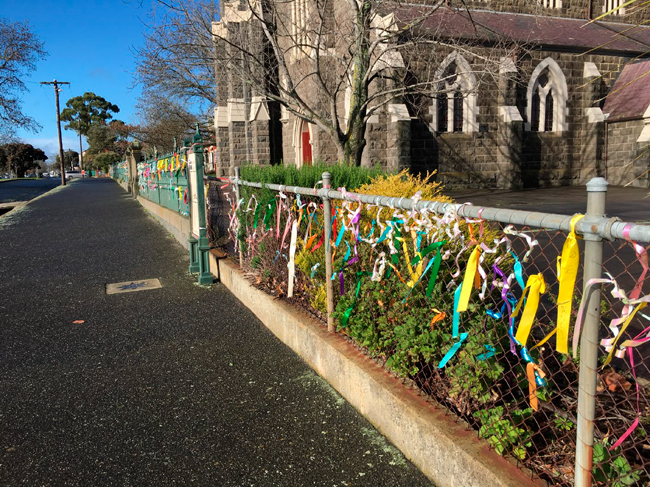
St Alipius’ Church, Ballarat (Photograph Jacqueline Z. Wilson)
If we look at St Alipius’s church again, it ceases to be only beautiful gothic architecture. That’s still there. But so are the stories of the young boys of Ballarat who were abused so terribly. Although this history of suffering is of course invisible, what I did see on my visit to Ballarat was ‘Loud Fences’. The fence of St Alipius’s church is now decorated with colourful ribbons most – if not all – of which have a victim’s name on them.
This vernacular interpretation of the church’s history by those who suffered within its walls is now the most prominent feature of St Alipius’s, as it is in many churches associated with child sexual abuse. Maureen Harcher, one of the initiators of the Loud Fence campaign, described the meaning of the ribbons as follows:
The name ‘loud fence’ denotes the end of the silence around child sexual abuse, while the bright colours were meant to signal a bold protest against the misuse of power and authority. We did have a discussion about ribbon colour, … some have a particular relevance; a survivor may have died or someone may prefer a particular colour; I think the choice of colour is what resonates with the individual.13
This movement is unstoppable. Although the Loud Fence movement officially ended in 2017, whenever Catholic church officials attempt to remove ribbons from a fence anywhere on church property, the ribbons are back the next day.
The words ‘No More Silence’ written on banners were tied to the fence. In my view, this is at the core of what heritage interpretation can and should do to build peace for survivors of abuse and other criminal events – provide space for stories that have not been heard, which have been suppressed or which have been silenced. Peace will probably never be possible for many victims of these terrible crimes: twelve out of the thirty-three boys in Grade 4 who attended St Alipius’s Church in 1973 committed suicide. But providing space for victims who want to tell their story and be heard and seen in public formats is part of what heritage professionals can do to assist with the process of healing. For Dominic Ridsdale, nephew of Gerald Ridsdale, ‘The ribbons mean hope ... hope for the kids. It makes me happy to drive past the fence now.’ 14
Heritage sites like St Alipius’s Church and the Parramatta Female Factory, which are significant for their powerful intangible cultural heritage, are known as ‘Sites of Memory’. Auschwitz Birkenau is perhaps the best known of these. The largest concentration camp established by Nazi Germany, Auschwitz Birkenau was listed by UNESCO in 1979 under World Heritage criterion (vi) as a monument to the deliberate genocide of the Jews and the death of countless others. The listing states that: ‘The site is a key place of memory for the whole of humankind to the Holocaust, racist policies and barbarism; it is a place of collective memory of this dark chapter in the history of humanity, of transmission to younger generations and a sign of warning of the many threats and tragic consequences of extreme ideologies and denial of human dignity’.15 Is this still working forty years later? Perhaps not. In 2019 the Auschwitz Memorial hosted a conference called ‘Auschwitz, Never again! Really?’ which looked at education in the context of preventing genocide and crimes against humanity.
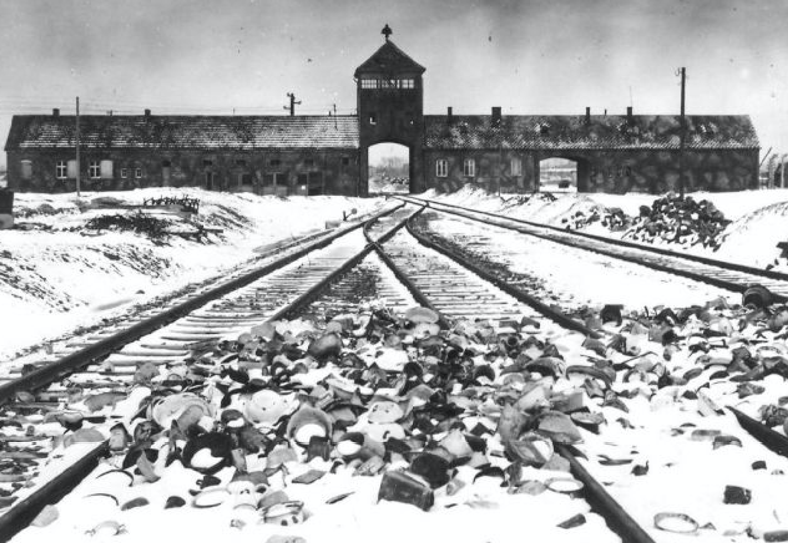
The unloading ramp and the main gate called the ‘Gate of death’ at Birkenau ©Auschwitz-Birkenau Memorial and Museum
When I visited Auschwitz in 2017 with other heritage colleagues, I was struck by the lack of impact the site seemed to have on some of its visitors and staff. Large tour buses let us all out and we crowded into a foyer. We were then taken on a tour which moved us quickly around the site without any time to reflect or take a break. While walking around, I felt physically and emotionally overwhelmed but there was nowhere to debrief or discuss what we had witnessed. Because guided tours are the only way in which the public can visit the site, the visitor experience is left up to the tour guides. Perhaps this is one of the reasons why some people’s responses seem to be glib or unfeeling. At exactly the same time as I was watching a woman pose with a selfie stick on the unloading ramp at Birkenau where victims of the Nazis were led to their deaths, a fellow heritage professional commented that the site had not been as awful for him as the Killing Fields museum in Cambodia.
I see both responses are forms of creating personal distance from the history of the site and the horrors that occurred there. I wondered if the commodification of the site, which is perhaps inevitable given its prominence, combined with the style of interpretation, had left a void for the kinds of conversations about its meaning and the need to prevent genocide and atrocities in future that the ‘Auschwitz, Never Again! Really’? conference aimed to address. This is a missed opportunity and one that will hopefully be remedied if the site realigns itself with its original mission. This is not to disparage the fine work of the Memorial but to suggest that opportunities for discussion, reflection and action to prevent future genocides are included in future programming for the site.
The ‘Loud Fence’ movement is also one example of the way that few heritage sites in the twenty-first century can continue to support only official narratives of the past. Many heritage places are now volatile sites of contestation about the past as very public counter-interpretations push out codified, authorized narratives. Statues to famous men are being knocked down or new statues erected beside them to offer a different viewpoint on the past. Some of the grand stately homes of England, famous for their architectural beauty, are now being revealed as places built on the slave trade. This revision of history has shaken the heritage profession to its core because it demands that heritage professionals cede some, if not all, of their authority to the people who have been deeply affected by the heritage that is being interpreted. Who authors the final interpretation? Whose history is it? What happens when stakeholder views of the past clash? Emotions can be heated. This seems a long way from peace.
New research has recently been undertaken in this area. In 2018, UNESCO commissioned a report on the interpretation of Sites of Memory from the International Coalition of Sites of Conscience.16 An important part of the this report was the recommendation that interpretation should have an inclusive approach and ‘take into consideration the views of communities related in one way or another to the site’.17 Concomitantly, however, the report recognized that groups associated with a place may have differing and even conflicting values and recommended that ‘all groups, not just heritage professionals, should be involved in decisions about what happens to these places.’18
A key area where heritage interpretation can work towards peace is by discussing the evidence behind contested histories. Truth is a malleable concept. But sometimes heritage professionals are called upon to take an active role in determining ‘what really happened’. In early November 2017, again in my role as the President of ICIP, I was asked by Japan UNESCO to visit Japan to discuss the interpretation of the Meiji Heritage sites. This is a joint listing of eleven sites with twenty-three components in eight areas around Japan that are linked to Japan’s Industrial Revolution. The Meiji sites were inscribed on the UNESCO World Heritage list in 2015. But the listing was the subject of heated opposition by Korea UNESCO which instead saw the sites as representative of Japanese oppression and the mistreatment of Koreans during World War Two. In response, Japan conceded to UNESCO that a large number of Koreans had been forced to work under harsh conditions during the Second World War at these sites but that it had implemented its ‘policy of requisition’ after the War.19
Along with two historians of the industrial revolution in Japan, I was involved in a one-day meeting about how to resolve these diametrically opposed views about the significance of the Meiji sites. We were shown Korean videos purporting to feature survivors from the wartime period recounting their suffering at one of the sites, Hashima Island, also known as Gunakanjima or Battleship Island. However, the other historians at the meeting questioned the veracity of these films and produced evidence that the people in the Korean films had not worked at Hashima Island during the war. Another issue was that the Meiji sites were listed because of their role in Japan’s first industrial revolution, so that the World War Two history at Gunkanjima Island lay outside the scope of World Heritage interpretation for the Meiji Industrial sites. This meant that site interpretation at Hashima Island would need clearly to differentiate between the site’s Outstanding Universal Values as an industrial site and its role as a Site of Memory for the labourers who lived there during World War Two. Here, the nature of evidence was crucial. During the discussion it became clear that any claims about Korean forced labour needed to be substantiated either with validated archival and photographic evidence or by conducting a new set of oral histories with former inhabitants and workers from the World War Two period from Korea, Japan and China. Moreover, there was a need for reconciliation in order to heal the past.
The goal of establishing a joint history of the site, which acknowledged that perhaps the ‘truth’ would never be known about the experience of the Koreans during the war, was the lynchpin of the argument I presented. Shortly afterwards, on 28 November 2017, The Center for Historical Truth and Justice, Republic of Korea Network for Fact Finding on Wartime Mobilization and Forced Labor, Japan, issued a joint statement stating that they were both critical of the decision to list the sites and demanded that ‘the sites should also reveal the dark history to be remembered, such as the Japanese wars of aggression, colonization, forced mobilization and forced labour’.20 They commented that: ‘Truth-finding of the dark history, apologies, reparations, commemoration and remembrance for the victims should still be followed through at the same time’.21 I do not know if this followed on from our meeting and whether or not these recommendations will be adopted remains to be seen.
As we have seen in the case above, contested history is highly personal. Sometimes we are not on the right side of history. The work is complex, difficult and personally challenging and at times there is no resolution that will satisfy everyone. However, we must keep trying. After the conference in Florence had finished, another terrible event occurred when an Australian gunman massacred fifty people in two attacks at mosques at Christchurch, New Zealand. This made me more convinced than ever that the movement ‘Heritage for Peace’ is one of the most important recent developments in the heritage sector. The gunman who committed this crime cited a false history of Australia to justify his actions. He was from a small country town in Australia where I suspect education is poor and racism is rife.
We in the heritage sector have a huge responsibility to do two things: to counteract fake histories whenever we encounter them, and to encourage the local cultural expressions that build peace between people of different countries, races and faiths. This needs to happen in the real world as well as in the world of academic theory. If we do these two things together, heritage will matter more than it currently does and have the ability to transform hate into respect, empathy, love and friendship.
Acknowledgement
Views in this article are my own and not the official views of ICOMOS.
Endnotes
1. Fondazione Romualdo Del Bianco, ‘Movimento Life Beyond Tourism’ Appeal to UNESCO ‘Building peace through heritage’, 11 February 2019.
5. UNESCO, ‘World Heritage at the Heart of UNESCO’s Peace Mandate’, http://www.unesco.org/new/en/culture/resources/in-focus-articles/heritage-and-peace/. Accessed 14 April 2019.
6. Australia Government Department of the Environment and Energy, National Heritage List: Paramatta Female Factory and Institutions Precinct, inscription date 14 November 2017.
7. https://www.environment.gov.au/heritage/places/national/parramatta-female-factory-and-institutions-precinct. Accessed 12 April 2019.
8. Denis Byrne, ‘Public history, archaeology and the material turn’, in Paul Ashton and Alex Trapeznik (eds), What is Public History Globally?: Working with the Past in the Present, Bloomsbury, New York, 2019, p173.
10. https://www.heraldsun.com.au/news/law-order/st-alipius-presbytery-in-ballarat-holds-dark-history-of-child-sexual-abuse/news-story/0a1d32cf30d1a729d3f52186dbecab8f. Accessed 12 April 2019.
11. https://www.theguardian.com/australia-news/2019/feb/26/rise-fall-george-pell-timeline. Accessed 12 April 2019.
12. https://www.heraldsun.com.au/news/law-order/st-alipius-presbytery-in-ballarat-holds-dark-history-of-child-sexual-abuse/news-story/0a1d32cf30d1a729d3f52186dbecab8f. Accessed 12 April 2019.
13. https://www.thecourier.com.au/story/5421584/three-years-on-ballarats-ribbon-message-endures/. Accessed 14 April 2019.
15. https://whc.unesco.org/en/list/31. Accessed 12 April 2019.
16. International Coalition of Sites of Conscience, ‘Interpretation of Sites of Memory’, Study Commissioned by the World Heritage Centre of UNESCO and funded by the Permanent Delegation of the Republic of Korea, 31 January 2018.
19. https://www.aljazeera.com/news/2015/07/unesco-lists-controversial-japanese-heritage-sites-150705200847551.html. Accessed 12 April 2019.
20. The Centre for Historical Truth and Justice, Republic of Korea Network for Fact Finding on Wartime Mobilization and Forced Labor, ‘Sites of Japan’s Meiji Industrial Revolution Korea-Japan NGO Guidebook’, 28 November 2017, p4.