Cosmopolitan Civil Societies: An Interdisciplinary Journal
Vol. 18, No. 3
2026
ARTICLE (REFEREED)
Ethnic Fractionalization and Polarization: A Bibliometric Study of Trends, Clusters, and Opportunities
I Ketut Gunawan1,*, Paisal Akbar1, Hasse Jubba2, Mohammad Eisa Ruhullah3, Muhammad Nurul Huda4, Inka Nusamuda Pratama5
1 Universitas Mulawarman, Samarinda, East Kalimantan, Indonesia
2 Universitas Muhammadiyah Yogyakarta, Special Region of Yogyakarta, Indonesia
3 University of Malaya, Kuala Lumpur, Malaysia
4 Universitas Muhammadiyah Karanganyar, Karangyar, Java, Indonesia
5 Universitas Muhammadiyah Mataram, Mataram, West Nusa Tenggara, Indonesia
Corresponding author: I Ketut Gunawan, Universitas Mulawarman, Jl. Kuaro, Gn. Kelua, Kec. Samarinda Ulu, Kota Samarinda, East Kalimantan 75117, Indonesia, i.ketut.gunawan@fisip.unmul.ac.id
DOI: https://doi.org/10.5130/ccs.v18.i3.9836
Article History: Received 05/06/2025; Revised 17/05/2026; Accepted 21/05/2026; Published 16/11/2026
Citation: Gunawan, I. K., Akbar, P., Jubba, H., Ruhullah, M. E., Huda, M. N., Pratama, I. N. 2026. Ethnic Fractionalization and Polarization: A Bibliometric Study of Trends, Clusters, and Opportunities. Cosmopolitan Civil Societies: An Interdisciplinary Journal, 18:3, 15–36. https://doi.org/10.5130/ccs.v18.i3.9836
Abstract
This study presents a bibliometric analysis of 541 documents on ethnic fractionalization and polarization from the Scopus database (1983-2025). Using VOSviewer, we examined publication trends, geographic distribution, thematic clusters, and temporal shifts. Publications increased significantly since 2000, peaking in 2022 and 2025, with the United States, the United Kingdom, and Australia leading, though contributions from developing countries are growing. Seven thematic clusters emerged. Classical themes linking ethnic diversity to economic growth, conflict, and political instability remain central. Two emerging clusters, public health and environmental vulnerability, signal a major expansion. Temporal analysis reveals a shift from political identity and governance (2013-2018) toward health and environmental issues (2019-2022). Density visualization identifies under-researched areas: mental health, climate vulnerability, trust, fiscal decentralization, and country-specific case studies. This study provides a foundation for policy responses at the intersection of ethnicity, health, and the environment.
Keywords
Ethnic Polarization; Ethnic Fractionalization; Ethnic Fragmentation; Bibliometric Analysis; Research Trends
Introduction
Ethnicity is a global phenomenon that has existed since the beginning of human civilization. It encompasses blood ties, kinship, beliefs, ancestry, and cultural practices (Smith 1979, 1989). As a primordial element, ethnicity is often seen as ancient, obsolete, and even primitive (Keyes 1981). As a result, both Marxists and Liberals argue that these primordial ties and ethnic affiliations will fade or disappear as society progresses through industrialization and modernization. From a Marxist perspective, ethnic loyalty is considered archaic and temporary; it will disappear once individuals from different ethnic backgrounds realize the interests of the common class. The Liberals also argue that ethnic loyalty is anachronistic and will inevitably be eroded by the forces of rationalization and homogenization that accompany industrialization and modernization (Eller & Coughlan 1993). However, the persistence of ethnicity from ancient times to the modern era, even in the digital era, demonstrates its continued significance. The phenomenon of ethnicity in contemporary society is unlikely to subside, given the economic and political needs that drive it and the rise of ethnic myths about ancestry and heritage (Smith 1989). Resilience, awakening, and ethnic attachment can be attributed to individuals’ primordial tendencies in response to certain situational demands (Eller & Coughlan 1993).
In this context, ethnicity remains relevant, especially in multiethnic countries. As mobility increases and transportation and accommodation systems advance, most countries are now multiethnic. This sparked interest in research on ethnicity, especially ethnic diversity. Attention comes not only from developing countries, but also from developed democracies. Because ethnicity is a global issue, researchers worldwide are working to explore, understand, and analyse its complexity. Anthropologists and sociologists examine ethnic migration and relationships between ethnic groups, including indigenous peoples, as well as aspects of tribal membership, traditions, languages, and cultures (Smith 1989; Strobele-Gregor 1994; Birnir & Van Cott 2007; Banton 2008; Dadze-Arthur 2017). They aim to document and preserve cultural heritage, as well as explore the potential use of ethnic culture and local knowledge for development. Political scientists focus on ethnic conflicts, nation-building, and state-building from et hnic perspectives; ethnonationalism; democracy in multiethnic countries; indigenous peoples’ rights; governance; and terrorism (Ikenberry 2000; Snyder 2000; Horowitz 2001; Gurr 2015; Python, Brandsch & Tskhay 2017; Shoup 2018). Economists associate ethnicity with economic development, growth, inequality, economic freedom, public spending, corruption, the provision of public goods, and trust (Montalvo & Reynal-Querol 2005; Dincer 2011; Cerqueti, Coppier & Piga 2012; Ananta et al. 2023). Scholars from other disciplines also research ethnicity to connect it to their various areas of concern (Awaworyi Churchill & Smyth 2017; Churchill, Ivanovski & Bhattacharya 2019; Awaworyi Churchill, Nuhu & Lopez 2019).
All of these research results are documented in various formats, including books, reports, videos, newspapers, magazines, journals, and proceedings. Recent research on ethnicity focuses on two aspects of ethnic diversity: ethnic fractionalization and ethnic polarization. These two elements are associated with a variety of issues, depending on the researcher’s disciplinary focus. However, systematic measurement of these concepts has mainly developed since the 1980s (Alesina et al. 2003; Montalvo & Reynal-Querol 2005). The underlying idea has deeper intellectual roots. Terms such as ethnic fragmentation and ethnic polarization have appeared in the social science literature since the mid-20th century, for example, in the study of conflict in Nigeria (Waldman 1966), electoral polarization in the UK (Deakin & Bourne 1970), population census in Nigeria (Prothero 1956), political instability in Africa (Barrows 1976), as well as national integration in West Africa (Wallerstein 1993). Thus, the discourse on ethnic fragmentation had taken root long before quantitative indices were developed.
This study aims to map research trends on ethnic fractionalization and ethnic polarization with a bibliometric approach. Specifically, we ask: What are the dominant research themes, how have they evolved, and what opportunities exist for future inquiry? By analyzing publications indexed in Scopus, we sought to identify thematic developments, geographic distributions, shifts in focus over time, and future research opportunities. This mapping is important not only for academics to understand the evolution of fields of study, but also for policymakers grappling with the challenges of pluralistic societies. By understanding which themes are dominant and which are less dominant, we can direct further research more strategically.
Literature Review
The term ‘ethnicity’ entered academic use in the 19th century, and Max Weber provided the first comprehensive definition based on subjective belief in common descent. Edward Shils (1957) and Clifford Geertz (1976) later developed the concept of primordialism, viewing ethnic identity as rooted in fixed markers such as kinship, language, and religion. This perspective suggests that ethnic attachments are deeply ingrained and relatively stable, often passed down through generations. However, critics argue that ethnicity is fluid and socially constructed, shaped by historical circumstances and social interactions (constructivism). Others contend that ethnicity is strategically deployed by elites competing for power and resources (instrumentalism). Rather than treating these perspectives as mutually exclusive, many scholars combine them to explain different aspects of ethnic phenomena. The increasing frequency of ethnic conflicts, underdevelopment, inequality, and weak governance in multi-ethnic countries has driven scholarly interest toward two specific dimensions: ethnic fractionalization and ethnic polarization (Easterly & Levine 1997; Montalvo & Reynal-Querol 2002; Esteban & Ray 2008; Klašnja & Novta 2014).
Ethnic fractionalization refers to the degree of fragmentation of ethnic groups within a geographic area (Esteban & Ray 2008). The term ethnic fragmentation appeared much earlier in the literature: Prothero (1956) noted considerable ethnic fragmentation in Northern Nigeria, Barrows (1976) developed an ethnic fractionalization index to examine political instability in Black Africa, and Waldman (1966) discussed ethnic polarization in the context of the Fulani Jihad. Deakin and Bourne (1970) warned of ethnic polarization in UK elections. Thus, the discourse has deep roots in the social sciences, predating the quantitative revolution of the 1990s. Since then, scholars have created various indices to measure fractionalization. The most widely used is the Ethnic and Language Fractionalization (ELF) index (Alesina et al. 2003), which captures the probability that two randomly selected individuals belong to different ethnic, linguistic, or religious groups. Building on this, Posner (2004) developed the Politically Relevant Ethnic Groups (PREG) index, which focuses only on groups that actually matter in political competition. Montalvo and Reynal-Querol (2005) proposed a polarization index that emphasizes group sizes rather than the sheer number of groups. Bossert, D’Ambrosio and La Ferrara (2011) introduced the Common Ethno-Linguistic Fractionalization Index, offering greater flexibility for non-state contexts.
Empirical studies using these indices show mixed results. Some find a negative correlation between ethnic fractionalization and economic growth, attributing this to reduced investment, higher corruption, and poor provision of public goods (Campos & Kuzeyev 2007; Awaworyi Churchill & Smyth 2017). Others find no significant effect (Majumder 2009), and some even report positive effects in democratic contexts with strong institutions (Heckelman & Wilson 2018). The mechanisms behind these divergent findings are complex. In weak institutional environments, ethnic fragmentation may exacerbate coordination problems and rent-seeking. However, in stable democracies, diversity can foster creativity and cross-cutting ties that enhance economic performance. Conflict studies are similarly inconclusive, with some research linking fragmentation to a higher risk of ethnic armed conflict (Wegenast & Basedau 2014) while others find no association (Montalvo & Reynal-Querol, 2005). This ambiguity has led researchers to shift their focus toward ethnic polarization, which is argued to better capture the dynamics of intergroup antagonism.
Ethnic polarization measures the level of antagonism and tension between ethnic groups, reflecting ethnic distance and the potential for conflict (Esteban & Ray, 2008). Unlike fractionalization, which counts the number of groups, polarization emphasizes the distribution of group sizes: a society polarized between two or three large groups is considered more prone to conflict than one with many tiny groups. The indices developed by Esteban and Ray (2008) and Montalvo and Reynal-Querol (2005) have been widely applied. Their empirical work consistently shows that polarization has a greater and more direct impact on civil war and political violence than fractionalization. For example, Montalvo and Reynal-Querol (2005) found that ethnic polarization significantly increases the likelihood of civil war, whereas fractionalization does not.
In the economic domain, polarization reduces investment, increases government consumption, and raises the risk of civil conflict (Montalvo & Reynal-Querol, 2005). Dincer (2011) identified a positive correlation between ethnic and religious polarization and income inequality, suggesting that polarized societies struggle to agree on redistributive policies. Moreover, polarization erodes social capital: Gebrihet and Mwale (2024) showed that ethnic polarization reduces trust in government, and Lee (2022) found that perceived polarization undermines interpersonal trust in the United States. These findings have important policy implications. Addressing polarization requires more than simply managing diversity; it demands strengthening democratic institutions, promoting cross-ethnic dialogue, and implementing inclusive policies that foster trust and reduce perceived grievances. Without such measures, polarized societies risk falling into cycles of violence and institutional decay.
Methodology
This study employs a bibliometric approach to map research trends on ethnic fractionalization and ethnic polarization. This approach is particularly suited to uncovering patterns and trends in large bodies of scholarly literature, offering a systematic and replicable way to map the evolution of a research field. Data were retrieved from the Scopus database, chosen for its broad coverage of peer-reviewed literature across disciplines and its reputation as a leading abstract and citation database for academic research. The search was conducted in December 2025 using the following query: TITLE-ABS-KEY ( ‘ethnic polarization’ ) OR TITLE-ABS-KEY ( ‘ethnic polarisation’ ) OR TITLE-ABS-KEY ( ‘ethnic fractionalization’ ) OR TITLE-ABS-KEY ( ‘ethnic fractionalisation’ ) OR TITLE-ABS-KEY ( ‘ethnic fragmentation’ ) ) AND PUBYEAR < 2026. This search strategy was deliberately designed to be as inclusive as possible, accommodating spelling differences between American and British English and including the equivalent term ‘ethnic fragmentation’, which has been used interchangeably with ethnic fractionalization in earlier literature (Prothero 1956; Waldman 1966; Barrows 1976). The search was applied to titles, abstracts, and keywords (TITLE-ABS-KEY) to capture core conceptual discussions rather than peripheral mentions.
The initial search yielded 541 documents. The earliest document in our dataset dates back to 1983. All publications up to 2024 were included, and documents from 2025 (early access) were retained to capture the most recent developments. The search was limited to English-language publications, as Scopus indexing for non-English documents is less comprehensive and could introduce bias. No documents were excluded based on document type; we retained articles, book chapters, reviews, books, conference papers, and other formats to provide a complete picture of the scholarly discourse. This inclusive approach follows best practices in bibliometric research (Zupic & Čater 2015). The exported data included complete metadata: authors, titles, abstracts, author keywords, indexed keywords, affiliations, publication years, document types, subject areas, and citation counts. VOSviewer (van Eck & Waltman 2010) was used to construct and visualize bibliometric networks, including keyword co-occurrence networks, author collaboration patterns, and temporal trends. A full-counting method was applied, with a minimum keyword occurrence threshold of 2 to ensure that visualizations focused on significant terms while retaining meaningful variation.
The analysis proceeded in three stages. The first stage was descriptive analysis, examining annual publication trends, geographic distribution, the most productive authors and their affiliations, dominant document types, and subject-area categorization. The second stage was cluster analysis, in which we grouped keywords into thematic clusters to identify the main research streams in the literature. The third stage was temporal analysis, tracing how research focuses have shifted over time by examining the average publication year of keywords in the VOSviewer visualizations.
Results and Discussion
Yearly Research Trends
Reading the growth graph of publications on ethnic fractionalization and polarization from 1983 to 2025 (Figure 1) is like reading an electrocardiogram of global academic attention. A total of 541 documents collected from Scopus, after expanding the search to include British spelling and the term ethnic fragmentation, allow us to read this intellectual history more fully.
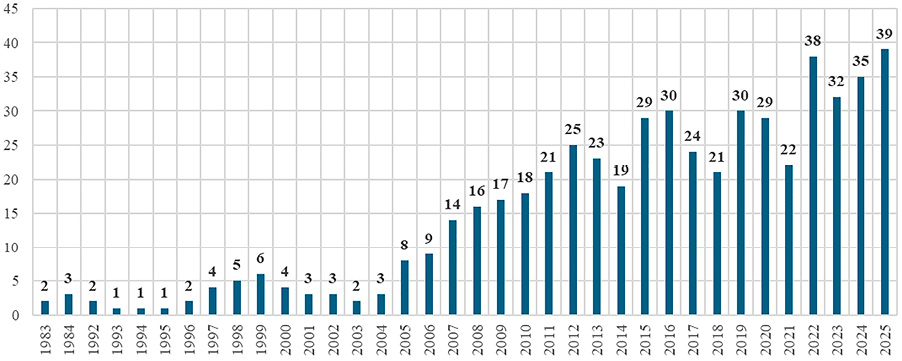
Figure 1. Article Growth Every Year
Source: Processed by Authors from Scopus Database
In the early phase (1983-2000), publications were sparse. Yet the existence of documents in 1983-1984, including Heaven (1983), which asked ‘Ethnic polarization in South Africa: Myth or reality?’, and Hecht, Sharpe, and Wong (1983), on ethnicity in Canada, confirms that discussions about ethnic fragmentation took root long before quantitative indices were developed.
After 2000, the pulse grew stronger. Key publications include Alesina, Baqir, and Easterly (2000) on public policy; Wilkinson (2000) on democratization; Posner (2004) on the PREG index; Montalvo and Reynal-Querol (2005) on polarization and civil war; and Houweling et al. (2005) on child mortality. From 2010 onward, publications increased consistently, with important contributions from Montalvo and Reynal-Querol (2010) on the duration of civil wars, Fearon (2003) on ethnic diversity, and Björkman and Svensson (2010) on community-based health monitoring. The biggest jump occurred in the last five years: 2022 (38 publications), 2023 (32), 2024 (35), and 2025 (39). These numbers (Figure 1) reflect academic responses to rising populism, identity politics, ethnic conflicts, and debates on structural racism. We now shift from when the research was done to who did it.
Authors, Affiliations, and Geographic Distribution of Research
Across the 541 documents we analyzed, 160 authors have contributed to the study of ethnic fractionalization and polarization. However, as is common in many scientific fields, only a handful of names appear consistently over the years, turning ethnicity into a long-term research program rather than an occasional interest. Figure 2 presents the most prolific authors. Easterly occupies the top position with five publications, building a framework that links ethnic fragmentation to low provision of public goods and slow economic growth, particularly in developing countries. Together with Levine (1997), he showed that high ethnic fragmentation in Sub-Saharan Africa explains many of the region’s poor policy characteristics. Later, Easterly (2001) nuanced this finding by showing that ethnic fragmentation negatively affects growth only when institutions are weak; in countries with good institutions, ethnic diversity does not reduce growth. Together with Ritzen and Woolcock (2006), he further demonstrated that social cohesion endogenously determines institutional quality.
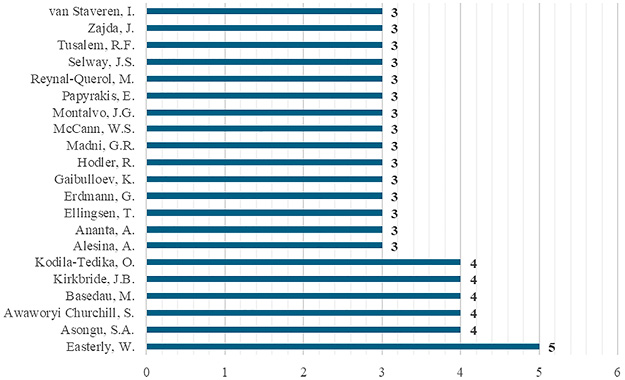
Figure 2. Authors with the Most Article Contributions
Source: Processed by Authors from Scopus Database
Alongside Easterly, names such as Asongu and Kodila-Tedika appear in the top ranks, both based in Africa (Cameroon and the Democratic Republic of Congo, respectively). Their contributions bring perspectives that differ from the American-European mainstream, focusing on governance, corruption, and inequality in African contexts. This signals a gradual decentralization of knowledge production about ethnicity. Authors making significant contributions, such as Montalvo and Reynal-Querol, who formulated the ethnic polarization index, remain productive, confirming that foundational concepts continue to shape the field. If we look at the affiliations of these authors (Figure 3), an interesting institutional map emerges. The World Bank ranks first with 12 publications, reflecting its practical interest in understanding why some ethnically diverse countries fail to achieve inclusive growth while others succeed. World Bank-affiliated studies have shown that ethnic fragmentation is a dominant predictor of property rights protection worldwide (Ayyagari, Demirgüç-Kunt & Maksimovic 2013), which strongly correlates with child mortality (Filmer & Pritchett 1999), and that its impact on labor productivity is moderated by firm size (Khalid & Amin 2023). In second place, the Norwegian University of Science and Technology (NTNU) has nine publications, reflecting Scandinavia’s long tradition of peace and conflict studies. Elite universities such as Harvard, Stanford, Oxford, and the Australian National University each contributed eight publications, confirming that the study of ethnic fragmentation and polarization has become integral to the research agenda of the world’s intellectual centers.
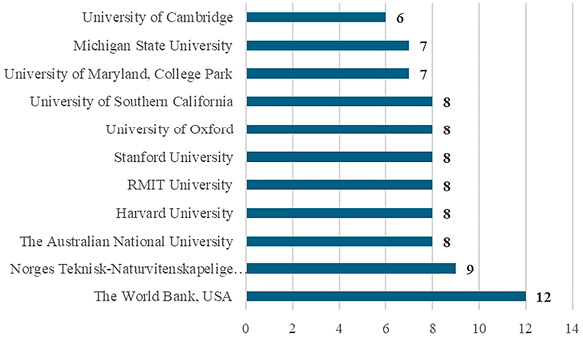
Figure 3. Affiliations with the most articles contributed
Source: Processed by Authors from Scopus Database
The geographic distribution of publications (Figure 4) remains uneven. The United States leads with 182 documents, followed by the United Kingdom (65), Australia (34), Germany (30), the Netherlands (21), and Norway (17). The US publication pattern shows peaks in 2019, 2023, and 2024, which coincide with domestic political events such as the Trump-era immigration debate and the post-George Floyd reckoning on structural racism. The UK’s publications peaked around 2017 and 2019, during the Brexit debate. Germany’s output increased notably after the 2015 refugee crisis. Meanwhile, contributions from developing countries are increasingly visible. Indonesia, for instance, has 14 publications, a number that places it on a par with Canada and above India and Pakistan. Indonesian studies not only calculate fractionalization and polarization indices (Ananta, Utami & Handayani 2016; Ananta et al. 2023) but also explore ethically-sensitive governance in the new capital city (Gunawan et al. 2025), post-conflict social integration through local wisdom (Rahman, Arsal & Shintasiwi 2022), and the historical deconstruction of ethnic polarization in South Sulawesi (Malewa 2024). Such contextual work enriches the global discourse and challenges universalist models derived solely from Western experiences.
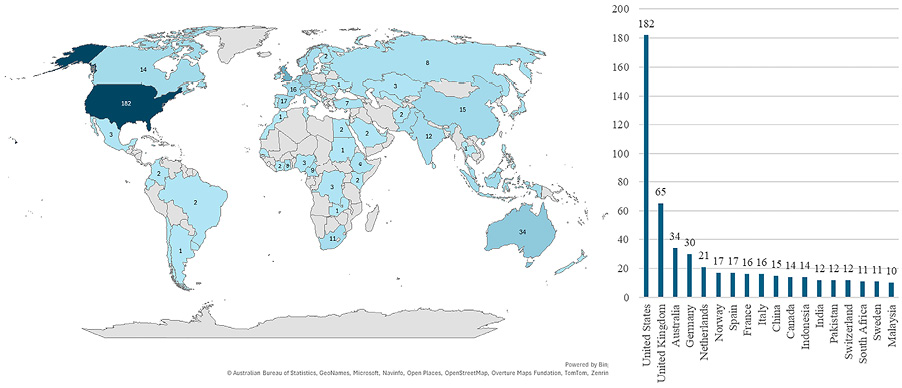
Figure 4. Countries with the highest document contributions
Source: Processed by Authors from Scopus Database
Finally, the subject areas of these publications (Figure 5) reveal a remarkable cross-disciplinary expansion. The Social Sciences still dominate with 385 publications, followed by Economics, Econometrics, and Finance with 196 publications. However, the Arts and Humanities have recorded 75 publications, with a notable surge in 2024 and 2025, suggesting a ‘humanistic turn’ in ethnicity studies. Business, Management and Accounting (57 publications) reflect corporate concerns about diversity. More strikingly, the hard and life sciences have also entered the field: Environmental Science (25), Medicine (17), Psychology (16), Earth and Planetary Sciences (15), and even Engineering (12). Studies in Medicine, for example, have shown that ethnic fragmentation affects child mortality (Houweling et al. 2005). Neighborhood ethnic segregation is associated with the incidence of psychosis (Kirkbride et al. 2007). This broad thematic spread indicates that ethnicity is no longer the exclusive domain of sociologists and political scientists; it has become a truly interdisciplinary concern. The fluctuations in publication growth by subject area confirm that while traditional social-science outputs have remained steady, newer disciplines have begun to contribute significantly over the last five years.
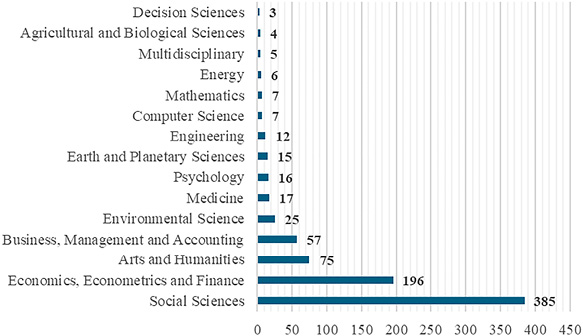
Figure 5. Most Dominant Subject Areas
Source: Processed by Authors from Scopus Database
Dominant Issues in Ethnic Fractionalization and Polarization Research
Cluster analysis using VOSviewer reveals a much richer and more complex intellectual map of the field than is typically captured in narrative reviews. From the 541 documents analyzed, seven major clusters covering 226 keywords emerged. Figure 6 presents a visual network of these seven clusters, while Table 1 details the items in each cluster. Each cluster has distinct thematic characteristics, reflecting how the study of ethnic fractionalization and polarization has expanded into previously unimaginable territories.
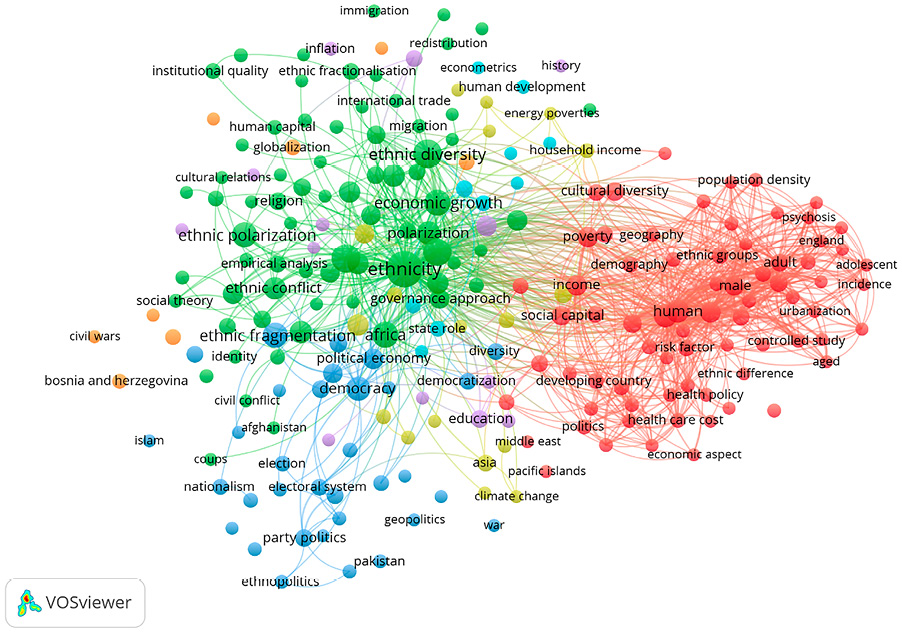
Figure 6. Dominant network of issues discussed in Ethnic Fractionalization and Polarization
Source: Processed by Authors using VOSviewer
Cluster 1, with 73 items, is the largest and most surprising cluster. It focuses on public health and social determinants. This cluster indicates the presence of themes previously absent from mainstream ethnic literature: health, child mortality, health care access, health disparities, health policy, psychosis, schizophrenia, socioeconomic factors, and social determinants of health. This cluster is also associated with keywords such as poverty, income, social capital, and neighborhood, emphasizing that ethnic health cannot be separated from socio-economic conditions. The presence of geography, urban areas, urbanization, and residential characteristics suggests that researchers are beginning to recognize how settlement segregation contributes to health inequalities.
The second cluster (71 items) is the heart of ethnicity studies. Here we find classic keywords: ethnic fractionalization, ethnic polarization, ethnic diversity, ethnic conflict, civil war, inequality, economic development, economic growth, and public goods. The foundation of this cluster rests on the work of Montalvo and Reynal-Querol (2005). The presence of environmental quality, governance approach, and institutional quality indicates that the debate has shifted from ‘is ethnic diversity bad for growth?’ to ‘under what conditions is ethnic diversity a problem, and how can institutions mitigate it?’ Easterly (2001) noted that ethnicity only negatively impacts when institutions are weak. The emergence of specific geographic regions, Afghanistan, Africa, Ethiopia, Ghana, India, Indonesia, and Sub-Saharan Africa, shows that ethnicity research is increasingly contextual.
The third cluster (33 items) covers political themes: democracy, democratization, election, political instability, terrorism, nationalism, ethnopolitics, and voting behavior. Colonial legacy and colonialism shaped ethnic configurations through territorial divisions, ‘divide et impera’ policies, and racial hierarchies. As noted by Wilkinson (2000), policies that aim to share power among ethnic groups can intensify ethnic polarization if not carefully managed. The regions in this cluster, Latin America, Pakistan, Russia, Spain, and Turkey, face a common challenge: building a stable democracy in an ethnically divided society. Evans and Need (2002) showed that cultural differences explain variations in polarization better than economic factors.
The fourth cluster (18 items) reflects contemporary issues: climate change, deforestation, natural disasters, energy poverty, and vulnerability. Their presence marks a new chapter: climate change and natural disasters are never ethnically neutral. Ethnic groups in vulnerable areas, such as coasts, mountain slopes, forests, and drylands, are the worst affected yet contribute the least. Schleussner et al. (2016) found that about 23% of conflicts in highly fractionalized countries coincide with climate disasters. Nyiayaana and Okoh (2023) further illustrate this link in the Nigerian context, showing how climate change exacerbates identity-based conflicts and undermines cosmopolitan ideals. This cluster also includes methodological keywords such as panel data and estimation methods, indicating that the research is empirical and quantitative.
The fifth and sixth clusters, with 13 and 10 items respectively, exhibit distinct thematic focuses. Cluster 5 focuses on fiscal policy, decentralization, and public services, with strong geographic associations with Malaysia and OECD countries. Cluster 6, in contrast, centers on governance, institutional capacity, and development outcomes. This separation reflects the different analytical contexts in which these themes are studied: Cluster 5 focuses on fiscal mechanisms and service delivery, while Cluster 6 emphasizes broader governance and development challenges. Hasnain (2008) on Pakistan showed that fragmented party systems encourage patronage rather than the improvement of public services. The seventh cluster (8 items) holds great potential with trust. Trust determines whether diverse societies can live in peace. Habyarimana et al. (2009) experimentally explored co-ethnic trust. In Bosnia and Kenya, fragile trust after violence shows its importance (Kimenyi & Shughart, 2010). Such case studies provide depth that cross-country analysis cannot.
Reading these seven clusters together, several conclusions emerge. First, research on ethnic fractionalization and polarization has expanded into public health, environment, and public policy. Second, new thematic layers continue to enrich the established classical themes. Third, research is increasingly contextual, with a focus on developing countries. Fourth, interdisciplinary opportunities lie at the intersections of climate, health, and trust. Yet this map answers ‘what’; ‘when’ requires temporal analysis.
Issues Development from Year to Year
The seven clusters we have just mapped give us an idea of what has been studied in research on ethnic fractionalization and polarization. However, an equally interesting question is when these themes became concerns. Has there been a shift in focus over time that reflects changing global circumstances? VOSviewer’s overlay visualization addresses this by coloring keywords according to their average year of appearance, with darker shades indicating older average publication years and brighter shades indicating more recent years (Figure 7). Reading this temporal map is like witnessing an intellectual journey.
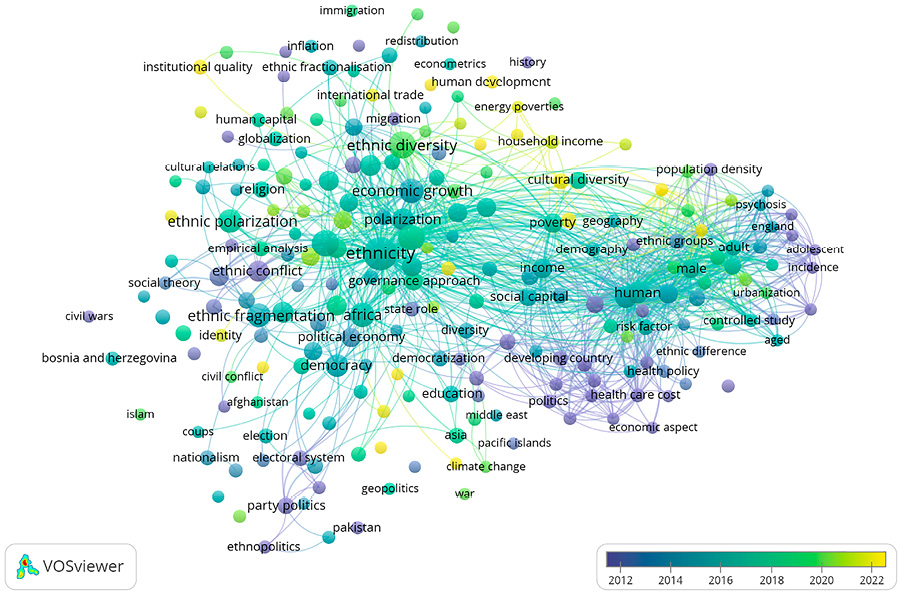
Figure 7. Development Network of Issues Discussed in Ethnic Fractionation and Polarization from Year to Year
Source: Processed by Authors using VOSviewer
In the early 2010s, academic attention was dominated by classical political themes. Keywords such as ethnopolitics, nationalism, geopolitics, war, and election appear predominantly in the earlier part of the timeline, marking the period around 2013-2015. This was the era when the Arab Spring still reverberated, the Syrian conflict triggered the largest refugee crisis since World War II, and identity politics began showing its fangs in many democracies. Researchers asked how ethnicity is mobilized in political contestation and why ethnic nationalism rises in a supposedly cosmopolitan age. Studies such as Somer (2001) on the cascade of ethnic polarization in Yugoslavia became newly relevant.
Entering the mid-decade, around 2016-2018, the focus shifts. Keywords such as civil conflict, ethnic conflict, governance approach, institutional quality, and political economy emerge in the middle range of the timeline. This was the period when researchers moved from merely describing ethnic conflicts to dissecting their structural roots. They asked why some highly diverse countries maintain stability while others collapse. Answers pointed to institutional quality, governance, and policy design. These years coincided with the heated Brexit debate and Trump’s shock election, events that forced social scientists to re-examine the links between identity, institutions, and democracy. Easterly’s (2001) finding that good institutions can mitigate the negative impact of ethnic diversity has become increasingly relevant.
The most dramatic leap occurs in the most recent period (2019-2022). Here we find keywords that were almost invisible in earlier literature: climate change, health policy, health care cost, energy poverty, psychosis, schizophrenia, and socioeconomic factors. The COVID-19 pandemic fundamentally changed the research agenda (Kravchenko & Yusupova 2020; Egorov et al. 2021; Núñez-Sánchez et al. 2022; Waradas 2022). Scholars realized that ethnicity is not just a variable in economic growth or conflict models but also a key determinant of health vulnerability. Why do ethnic minorities have higher COVID-19 death rates? Why is vaccine access so uneven? These questions spawned a wave of research linking ethnicity to epidemiology and health policy. Simultaneously, the climate crisis left its mark. The keywords climate change and energy poverty remind us that the impacts of climate change are never ethnically neutral; groups living in vulnerable coastal, forest, or dryland areas are the first to suffer yet contribute the least to the causes. This temporal evolution teaches us that the study of ethnic fractionalization and polarization is not static. It constantly responds to global shocks, from wars and revolutions to pandemics and climate change, while adding new layers to the old foundations of identity politics, civil conflict, and institutional quality.
New Research Opportunities in Ethnic Fractionalization and Polarization
If the overlay visualization shows when themes emerged, the density visualization serves as a topographic map of research intensity, a purple gradient where the deepest purple indicates heavily explored areas and the fading, opaque purple indicates rarely touched territories (Figure 8). Unsurprisingly, the deepest purple surrounds classic themes: ethnic fractionalization, ethnic polarization, economic growth, democracy, and civil conflict. These are the solid foundations, cultivated by thousands of articles. Yet as we move to the periphery, the purple fades, revealing low-density areas that offer promising opportunities for future research. Most of these opaque areas come from the new clusters that appeared in our dataset.
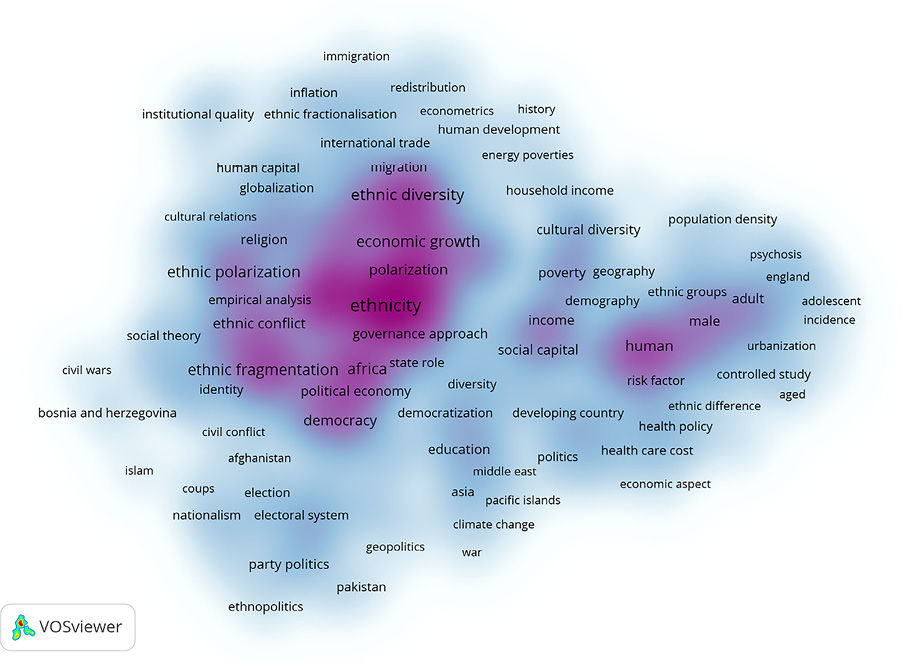
Figure 8. Issue Density in Ethnic Fractionation and Polarization
Source: Processed by Authors using VOSviewer
First, the health area. Keywords such as psychosis (3 occurrences), schizophrenia (3 occurrences), and child mortality (4 occurrences) have low co-occurrence frequencies in our dataset (see Table 1). This indicates that research in this field remains very limited, even though early studies have highlighted its urgency. For example, studies on ethnic disparities in mental health care access and maternal mortality among minority groups have shown significant gaps in both research and policy (Anderson et al., 2014; Gee & Ford, 2011). Yet fundamental questions remain: Do ethnic minority groups have a higher risk of mental disorders? Are the causes biological, social, or both? How can health policies be designed to reach marginalized ethnic communities? In the post-pandemic era, as health disparities widen, research in this area is increasingly urgent.
Second, the environment and disaster area. Keywords such as climate change (3 occurrences) and energy poverty (3 occurrences) appear infrequently in our dataset. Despite evidence that about 23% of conflicts in highly fractionalized countries coincide with climate disasters (Schleussner et al. 2016), few studies systematically link ethnicity to climate vulnerability. Marginalized ethnic groups, indigenous tribes in the Amazon, small-island communities, and poor farmers in Sub-Saharan Africa are the most vulnerable, yet they are rarely the focus of research. How does ethnic fragmentation affect people’s ability to adapt to climate change? Do ethnic conflicts intensify after natural disasters due to resource scarcity? How can climate mitigation policies avoid exacerbating ethnic inequalities? This fertile land awaits cultivation.
Third, the area of trust and social cohesion. The keyword trust (6 occurrences) appears infrequently in our dataset, even though interpersonal and institutional trust are crucial social glue. Experimental work from Uganda (Habyarimana et al. 2009) has begun to explore why people tend to trust co-ethnics more. Yet we still know little about how ethnic fragmentation affects trust levels, how trust mediates the relationship between diversity and political stability, and what factors can maintain cross-ethnic trust. This low research density is both a challenge and an opportunity.
Fourth, the area of fiscal policy and public services. Keywords such as fiscal decentralization (3 occurrences) and public spending (4 occurrences) appear infrequently. While fiscal decentralization is often proposed as a solution for managing ethnic diversity, evidence from Pakistan suggests that fragmented and polarized party systems may instead encourage patronage (Hasnain 2008). In Indonesia, post-1998 decentralization has been in place for over two decades, yet studies of ethnically sensitive governance are only beginning to emerge (Gunawan et al. 2025). Does decentralization reduce or reinforce ethnonationalist sentiment? How does the ethnic composition of a region affect public spending allocation? Empirical answers are still scarce, especially in developing countries.
Fifth, country-specific case studies. Keywords such as Bosnia and Herzegovina (5 occurrences), Afghanistan (3 occurrences), and Pakistan (4 occurrences) appear with low frequencies. In-depth case studies of countries with complex ethnic dynamics can enrich contextual understandings that cross-country analyses miss. For example, Malewa (2024) on the historical roots of ethnic discourse in South Sulawesi, and Arifin et al. (2025) on ethnic fragmentation as a cultural demand in the Uluan community, demonstrate the value of local qualitative work. These research opportunities are not isolated; they can be approached in a multidisciplinary manner, combining environment and health, or trust and fiscal policy, or case studies with health. The seven clusters formed from 541 documents are not the end of the journey but the beginning. The purple gradation, from deepest to most opaque, is a map that invites researchers to delve further into still-vague areas. For those eager to contribute, there is no better time to start filling the opaque areas with a more intense shade of purple.
Discussion
This research begins by mapping the development of research on ethnic fractionalization and ethnic polarization over the past four decades. By broadening the search scope to include variations in British spelling and the equivalent term ‘ethnic fragmentation’, we not only found 541 documents but also uncovered previously hidden thematic layers. These findings not only confirm what is already known but also offer a new perspective on how research on ethnicity has evolved, responded to changing times, and penetrated previously unimaginable territories.
First, the growth of research on ethnicity reflects the collective anxiety of the global community. The significant surge in publications after 2015, with peaks in 2022 (38 documents), 2024 (35), and 2025 (39), suggests that these issues of ethnic fractionalization and ethnic polarization are increasingly urgent to understand. As stated by Qodir, Jubba and Hidayati (2022), ethnic polarization is no longer an exclusive phenomenon of developing countries but also of those considered democratically established. The rise of populism in America and Europe, the strengthening of identity politics in various young democracies, ethnic conflicts in Myanmar and Ethiopia, and the fierce debate about structural racism after George Floyd died in the US all contributed to increased academic attention (Alekseev et al. 2021). Historical data also show that the seeds of these thoughts have long existed, with publications in 1983 and 1984 discussing ethnic polarization in South Africa and Canada (Heaven 1983; Hecht, Sharpe & Wong 1983), confirming that discussions of ethnic fragmentation took root long before quantitative measures were developed.
Second, the geography of knowledge production remains uneven, but it is beginning to shift. The dominance of the United States (182 documents) and the United Kingdom (65 documents) is not surprising. Both countries have strong research infrastructures and a long history of grappling with issues of race, ethnicity, and immigration. As Alesina and La Ferrara (2005) state, ethnic fragmentation in developed countries affects public policy, political stability, and economic performance. However, the emergence of significant contributions from developing countries such as Indonesia (14), India (12), Pakistan (12), and Malaysia (10) signals that Western researchers no longer monopolize the discourse of ethnicity. Academics in these countries bring perspectives born of firsthand experience living in a pluralistic society, enriching our understanding through more diverse contexts. Studies from Indonesia, for example, not only calculate fractionalization and polarization indices (Ananta, Utami & Handayani, 2016; Ananta et al. 2023) but also explore how ethnicity interacts with governance in the new capital city (Gunawan, Taufik & Somlai 2024; Gunawan et al. 2025), how local wisdom builds post-conflict social integration in Aceh (Rahman, Arsal & Shintasiwi 2022), and even how historical narratives shape ethnic polarity in South Sulawesi (Malewa 2024). This diversity of approaches enriches the global discourse and challenges the universalism of models born of Western experience.
Third, the thematic expansion into health and the environment was the most significant finding. The VOSviewer cluster analysis revealed seven clusters, with two of them, public health (Cluster 1) and environment (Cluster 4), marking a new chapter in the study of ethnic fractionalization and polarization. The presence of keywords such as psychosis, schizophrenia, child mortality, health care access, climate change, deforestation, and energy poverty shows that ethnicity is no longer seen only as a variable in economic-political models, but also as a social determinant affecting vulnerability to disease and disaster. As Nyiayaana and Okoh (2023) demonstrate, climate change can intensify identity-based conflicts, reinforcing the need to integrate ethnic perspectives into environmental policy. Similarly, Loyi (2024) shows that while cosmopolitan social movements can challenge ethnonationalism, the underlying ethnic polarization remains a serious concern in plural societies. These findings expand Horowitz’s (2001) argument that ethnic polarization is rooted in political injustice by showing that this injustice also manifests in unequal access to health care and unequal ecological vulnerability. Temporal analysis of the overlay visualization reinforces this reading. Identity-politics themes dominated the 2013-2015 period; 2016-2018 shifted to governance and institutional quality; while 2019-2022 saw a dramatic leap toward health and environmental themes, triggered by the COVID-19 pandemic and the climate crisis. This is a paradigmatic shift that warrants further attention, especially in the design of policies responsive to the needs of vulnerable groups.
Fourth, density visualization opens up vast opportunities for future research. The purple gradation, from deepest to most opaque, shows heavily explored areas (well-established themes) and still-deserted areas (mental health, climate vulnerability, trust, fiscal decentralization, country-specific case studies). These opportunities align with our previous identification. Research on mental health and ethnicity, climate vulnerability and indigenous communities, the role of trust in maintaining social cohesion amid polarization, and the effectiveness of fiscal decentralization in pluralistic countries remains wide open. As emphasized by Qodir, Jubba and Hidayati (2022), strengthening social cohesion in developing countries requires a social justice-based approach and an equitable distribution of resources. New research can empirically test how this approach is implemented in different contexts, for example, by combining environmental and health issues: how does climate change affect the mental health of ethnic groups displaced by disasters? Or integrating trust and fiscal policy: do people who trust the government support ethnically fair decentralization policies?
Finally, this study confirms that ethnic fractionalization and ethnic polarization are multidimensional phenomena requiring a cross-disciplinary approach. The seven mapped clusters, recorded temporal shifts, and opaque areas waiting to be filled with research studies are all invitations for researchers to continue exploring and giving meaning to the world’s increasingly complex diversity. As Putnam (2007) reminds us, ethnic diversity creates social tensions that require careful scientific understanding. However, it also opens up opportunities for social innovation and cultural enrichment. Our job, as an academic community, is to ensure that this understanding is not only meticulous but also aligned with fairness and inclusion.
Conclusion
This study maps the development of research on ethnic fractionalization and polarization by analyzing 541 documents from the Scopus database. Publications increased sharply since 2015, peaking in 2022 and 2025, reflecting academic responses to rising identity politics and global ethnic conflicts. Geographically, the United States and the United Kingdom dominate, but contributions from developing countries such as Indonesia, India, Pakistan, and Malaysia signal a gradual decentralization of knowledge production.
Cluster analysis reveals seven main themes. Three clusters reflect well-established research: diversity conflict development (Cluster 2), politics democracy nationalism (Cluster 3), and fiscal public service policy (Clusters 5 and 6). However, the most significant findings are the emergence of two new clusters, public health and social determinants (Cluster 1) and environment and vulnerability (Cluster 4). Keywords such as psychosis, schizophrenia, child mortality, climate change, and energy poverty mark a paradigmatic shift: ethnicity is no longer understood only as a source of conflict but also as a marker of vulnerability to disease and disaster. Temporal analysis confirms this shift: identity politics dominated 2013-2015, governance and institutional quality from 2016-2018, and health/environmental issues surged in 2019-2022, triggered by the COVID-19 pandemic and the climate crisis.
Density visualization identifies low-research areas offering future opportunities: mental health and ethnicity, climate vulnerability, trust as a driver of social cohesion, fiscal decentralization, and in-depth country case studies (for example, Bosnia, Afghanistan, Pakistan, Indonesia). This study has limitations, including reliance on a single database and a quantitative bibliometric approach. Nonetheless, the intellectual map of these 541 documents shows that research on ethnicity has expanded far beyond its origins. The opaque purple areas in the density map invite researchers to explore intersections among health, the environment, trust, and public policy, enriching our understanding of how diversity is managed, contested, or reconciled.
Disclosure of AI Use
During the preparation of this manuscript, the authors used artificial intelligence (AI) tools solely for language checking, writing style improvement, and sentence restructuring to enhance readability. AI was not used for data analysis, result interpretation, or conclusion drawing. All scientific content, analysis, and interpretation are the original work of the authors. The authors take full responsibility for the accuracy and integrity of this manuscript.
Acknowledgements
We would like to thank our respective institutions, namely Universitas Mulawarman, Universitas Muhammadiyah Yogyakarta, Universiti Malaya, Universitas Muhammadiyah Karanganyar, and Universitas Muhammadiyah Mataram, for providing supportive academic environments and facilities throughout the research and writing process. We also appreciate the close and collaborative spirit among the authors, which greatly enriched the discussions and strengthened the quality of this work. Finally, we extend our sincere gratitude to the journal Cosmopolitan Civil Societies and its entire editorial team for their trust, guidance, and constructive review process. Their efforts have been instrumental in bringing this manuscript to completion. We hope this modest contribution will be useful for the advancement of studies on multicultural societies.
References
Alekseev, A-V, Yazov, Y-K., Sychev, A-M., Bich, M-G. & Skiba, V-Y. 2021, ‘Analysis of the protest movement of African Americans in the United States through denotative and connotative meanings of hashtags’, Journal of Language and Linguistic Studies, vol. 17, special issue no. 2, pp. 1210-1219. https://www.jlls.org/index.php/jlls/article/view/2591
Alesina, A., Basquir, R. & Easterly, W. 2000, ‘Redistributive public employment’, Journal of Urban Economics, vol. 48, no. 2, pp. 219- 241. https://doi.org/10.1006/juec.1999.2164
Alesina, A., Devleeschauwer, A., Easterly, W., Kurlat, S. & Wacziarg, R. 2003, ‘Fractionalization’, Journal of Economic Growth, vol. 8, no. 2, pp. 155-194. https://doi.org/10.1023/A:1024471506938
Alesina, A. & La Ferrara, E. 2005, ‘Ethnic diversity and economic performance’, Journal of Economic Literature, vol. 43, no. 3, pp. 762-800. https://doi.org/10.1257/002205105774431243
Ananta, A., Arifin, E.-N., Purbowati, A. & Carnegie, P-J. 2023, ‘Does diversity matter for development? New evidence of ethnic diversity’s mediation between internal migration and economic growth across Indonesia’s regions’, Journal of Population Research, vol. 40, no. 3. https://doi.org/10.1007/s12546-023-09304-z
Ananta, A., Utami, D. R. W. W. & Handayani, N. B. 2016, ‘Statistics on ethnic diversity in the land of Papua, Indonesia’, Asia and the Pacific Policy Studies, vol. 3, no. 3, pp. 458-474. https://doi.org/10.1002/app5.143
Anderson, K. F. & Fullerton, A. S. 2014, ‘Mental health disparities and ethnic minority groups’, Journal of Health and Social Behavior, vol. 55, no. 2, pp. 189-207. https://doi:10.1177/0022146514531230
Arifin, Z., Afrizal, A., Gani, M. H. & Halim, A. 2025, ‘Ethnic fragmentation: An ethnographic study of the Uluan community of South Sumatra, Indonesia’, Ethnography (online first). https://doi.org/10.1177/14661381251322613
Awaworyi Churchill, S., Nuhu, A. S. & Lopez, K. 2019, ‘Persistence of gender inequality: The role of ethnic divisions’, Applied Economics, vol. 51, no. 8, pp. 781-796. https://doi.org/10.1080/00036846.2018.1513635
Awaworyi Churchill, S. & Smyth, R. 2017, ‘Ethnic diversity and poverty’, World Development, vol. 95, pp. 285-302. https://doi.org/10.1016/j.worlddev.2017.02.032
Ayyagari, M., Demirgüç-Kunt, A. & Maksimovic, V. 2013, ‘What determines protection of property rights? An analysis of direct and indirect effects’, Journal of Financial Econometrics, vol. 11, no. 4, pp. 610-649. https://doi.org/10.1093/jjfinec/nbs010
Banton, M. 2008, ‘The sociology of ethnic relations’, Ethnic and Racial Studies, vol. 31, no. 7, pp. 1267-1285. https://doi.org/10.1080/01419870701710922
Barrows, W-L. 1976, ‘Ethnic diversity and political instability in Black Africa’, Comparative Political Studies, vol. 9, no. 2, pp. 139-170. https://doi.org/10.1177/001041407600900201
Birnir, J. K. & Van Cott, D-L. 2007, ‘Disunity in diversity: Party system fragmentation and the dynamic effect of ethnic heterogeneity on Latin American legislatures’, Latin American Research Review, vol. 42, no. 1, pp. 99-125. https://doi.org/10.1353/lar.2007.0000
Björkman, M. & Svensson, J. 2010, ‘When is community-based monitoring effective? Evidence from a randomized experiment in primary health in Uganda’, Journal of the European Economic Association, vol. 8, no. 2-3, pp. 571-581. https://doi.org/10.1111/j.1542-4774.2010.tb00527.x
Bossert, W., D’Ambrosio, C. & La Ferrara, E. 2011, ‘A generalized index of fractionalization’, Economica, vol. 78, no. 312, pp. 723-750. https://doi.org/10.1111/j.1468-0335.2010.00844.x
Campos, N. F. & Kuzeyev, V. S. 2007, ‘On the dynamics of ethnic fractionalization’, American Journal of Political Science, vol. 51, no. 3, pp. 620-639. https://doi.org/10.1111/j.1540-5907.2007.00271.x
Cerqueti, R., Coppier, R. & Piga, G. 2012, ‘Corruption, growth and ethnic fractionalization: A theoretical model’, Journal of Economics/ Zeitschrift Fur Nationalokonomie, vol. 106, no. 2, pp. 153-181. https://doi.org/10.1007/s00712-011-0253-5
Churchill, S-A., Ivanovski, K. & Bhattacharya, M. 2019, ‘The role of ethnic diversity in sustainable environmental growth: New evidence across different income regions’, Applied Economics, vol. 51, no. 4, pp. 398-408. https://doi.org/10.1080/00036846.2018.1497854
Dadze-Arthur, A. 2017, An analysis of Clifford Geertz’s The Interpretation of Cultures: Selected Essays, Macat Library, London. https://doi.org/10.4324/9781912128310
Deakin, N. & Bourne, J. 1970, ‘Powell, the minorities, and the 1970 election’, The Political Quarterly, vol. 41, no. 4, pp. 399-415. https://doi.org/10.1111/j.1467-923X.1970.tb01181.x
Dincer, O. C. 2011, ‘Ethnic diversity and trust’, Contemporary Economic Policy, vol. 29, no.2, pp. 284-293. https://doi.org/10.1111/j.1465-7287.2010.00215.x
Easterly, W. & Levine, R. 1997. ‘Africa’s Growth Tragedy: Policies and Ethnic Divisions’, The Quarterly Journal of Economics, Vol. 112, No. 4, pp. 1203- 1250. https://www.jstor.org/stable/2951270. https://doi.org/10.1162/003355300555466
Easterly, W. 2001, ‘Can institutions resolve ethnic conflict?’, Economic Development and Cultural Change, vol. 49, no. 4, pp. 687-706. https://doi.org/10.1086/452521
Easterly, W., Ritzen, J. & Woolcock, M. 2006, ‘Social cohesion, institutions, and growth’, Economics and Politics, vol. 18, no. 2, pp. 103-120. https://doi.org/10.1111/j.1468-0343.2006.00165.x
Egorov, G., Enikolopov, R., Makarin, A. & Petrova, M. 2021, ‘Divided we stay home: Social distancing and ethnic diversity’, Journal of Public Economics, vol. 194, article no. 104328. https://doi.org/10.1016/j.jpubeco.2020.104328
Eller, J. D. & Coughlan, R. M. 1993, ‘The poverty of primordialism: The demystification of ethnic attachments’, Ethnic and Racial Studies, vol. 16, no. 2, pp. 183-202. https://doi.org/10.1080/01419870.1993.9993779
Esteban, J. & Ray, D. 2008, ‘Polarization, fractionalization and conflict’, Journal of Peace Research, vol. 45, no. 2, pp. 163-182. https://doi.org/10.1177/0022343307087175
Evans, G. & Need, A. 2002, ‘Explaining ethnic polarization over attitudes towards minority rights in Eastern Europe: A multilevel analysis’, Social Science Research, vol. 31, no. 4, pp. 653-680. https://doi.org/10.1016/S0049-089X(02)00018-2
Fearon, J-D. 2003, ‘Ethnic and cultural diversity by country’, Journal of Economic Growth, vol. 8, pp. 195-222. https://doi.org/10.1023/A:1024419522867
Filmer, D. & Pritchett, L. 1999, ‘The impact of public spending on health: Does money matter?’ Social Science & Medicine, vol. 49, no. 10, pp. 1309-1323. https://doi.org/10.1016/S0277-9536(99)00150-1
Gebrihet, H. G. & Mwale, M. L. 2024, ‘The effects of polarisation on trust in government: Evidence from Ethiopia’, Transforming Government: People, Process and Policy, vol. 18, no. 2, pp. 193-216. https://doi.org/10.1108/TG-09-2023-0130
Gee, G. C. & Ford, C. L. 2011, ‘Structural racism and health inequities’, Du Bois Review, vol. 8, no. 1, pp. 115-132, https://doi.org/10.1017/S1742058X11000130
Geertz, C. (1976). The Religion of Java. University of Chicago Press.Chicago.
Gunawan, I. K., Taufik, M., Imang, N. & Somlai, I. G. 2025, ‘Ethnic-sensitive governance: Redefining good governance in an ethnically polarized region’, International Journal of Human Capital in Urban Management, vol 10, no. 4, pp. 611- 628. https://doi.org/10.22034/IJHCUM.2025.04.02
Gunawan, I. K., Taufik, M. & Somlai, I. G. 2024, ‘Ethnic fractionalization and polarization in new capital city of Nusantara, Indonesia: Analysis of potential conflict’, Journal of Governance and Public Policy, vol. 11, no. 3, pp. 331-351. https://doi.org/10.18196/jgpp.v11i3.21049
Gurr, T-R. 2015, Why Men Rebel, Routledge, New York. https://doi.org/10.4324/9781315631073
Habyarimana, J., Humphreys, M., Posner, D. N. & Weinstein, J. M. 2009, ‘Coethnicity and trust’, In Cook, K. S., Levi, M. & Hardin, R. (eds.), Whom can we trust?: How Groups, Networks, and Institutions make Trust Possible, Russell Sage Foundation, New York, pp. 42-64.
Hasnain, Z. 2008, ‘The politics of service delivery in Pakistan: Political parties and the incentives for patronage, 1988-1999’, Pakistan Development Review, vol. 47, no. 2, pp. 129-151. https://doi.org/10.30541/v47i2pp.129-151
Heaven, P. C. L. 1983, ‘Ethnic polarization in South Africa: Myth or reality?’, Ethnic and Racial Studies, vol. 6, no. 3, pp. 356-362. https://doi.org/10.1080/01419870.1983.9993419
Hecht, A., Sharpe, R. G., & Wong, A. C. Y. 1983, ‘Ethnicity and well-being in central Canada. The case of Ontario and Toronto (Kanada-Projekt II), Marburger Geographische Schriften, vol. 92.
Heckelman, J. C. & Wilson, B. 2018, ‘Fractionalization and economic freedom’, Public Finance Review, vol. 46, no. 2, pp. 158-176. https://doi.org/10.1177/1091142116648012
Horowitz, D. L. 2001, Ethnic Groups in Conflict, updated edition with a new preface, University of California Press, Oakland, CA. https://doi.org/10.1525/9780520926318
Houweling, T. A. J., Kunst, A. E., Looman, C. W. N. & Mackenbach, J. P. 2005, ‘Determinants of under-5 mortality among the poor and the rich: A cross-national analysis of 43 developing countries’, International Journal of Epidemiology, vol. 34, no. 6, pp. 1257-1265. https://doi.org/10.1093/ije/dyi190
Ikenberry, G. J. 2000, ‘Reviewed Work: From voting to violence: Democratization and nationalist conflict ‘, Jack L Snyder, Foreign Affairs, vol. 79, no. 3, p. 162. https://doi.org/10.2307/20049749
Keyes, C-F. 1981, ‘The dialectics of ethnic change’, in Keyes, C-F. (ed.), Ethnic Change, University of Washington Press, Seattle, pp. 3-30.
Khalid, U. & Amin, M. 2023, ‘The impact of ethnic fractionalisation on labor productivity: Does firm size matter?’, Journal of International Development, vol. 35, no.7, pp. 2213-2249. https://doi.org/10.1002/jid.3771
Kimenyi, M. S., & Shughart, W. F. 2010, ‘The political economy of constitutional choice: A study of the 2005 Kenyan constitutional referendum’, Constitutional Public Economy, vol. 21, no. 1, pp. 1- 27. https://doi.org/10.1007/s10602-008-9062-4
Kirkbride, J. B., Morgan, C., Fearon, P., Dazzan, P., Murray, R. M., & Jones, P. B. 2007, ‘Neighbourhood-level effects on psychoses: Re-examining the role of context’, Psychological Medicine, vol. 37, no. 10, pp. 1413-1425. https://doi.org/10.1017/S0033291707000499
Klašnja, M. & Novta, N. 2014, ‘Segregation, Polarization, and Ethnic Conflict’, Journal of Conflict Resolution, vol 60, no. 5, pp. 927-955. https://doi.org/10.1007/s10602-008-9062-4
Kravchenko, N. A., & Yusupova, A. T. 2020, ‘“Soft” factors in pandemic response: Comparative intercountry analysis’, Journal of Siberian Federal University - Humanities and Social Sciences, vol. 13, no. 11, pp. 1770-1780. https://doi.org/10.17516/1997-1370-0682
Lee, A. H. Y. 2022, ‘Social trust in polarized times: How perceptions of political polarization affect Americans’ trust in each other’, Political Behavior, vol. 44, no. 3, pp. 1533-1554. https://doi.org/10.1007/s11109-022-09787-1
Levine, R. 1997, ‘Financial development and economic growth: views and agenda’, Journal of Economic Literature, vol. 35, no. 2, pp. 688-726.
Loyi, T. 2024, ‘Cosmopolitanism over ethnonationalism through social movement: The case of anti-CAA movement in India’, Cosmopolitan Civil Societies, vol. 16, no. 2, pp. 43- 56. https://doi.org/10.5130/ccs.v16.i2.8787
Majumder, S. 2009, ‘Fractionalization and the tragedy of growth’, PhD thesis, University of Houston, Houston, TX.
Malewa, M. A. 2024, ‘Foucault in Sulawesi: Challenging the roots of ethnic discourse in South Sulawesi’, IAFOR Journal of Cultural Studies, vol. 9, no. 2, pp. 7-33. https://doi.org/10.22492/ijcs.9.2.01
Montalvo, J. G. & Reynal-Querol, M. 2010, ‘Ethnic polarization and the duration of civil wars’, Economics of Governance, vol. 11, pp. 123-143. https://doi.org/10.1007/s10101-010-0077-8
Montalvo, J. G. & Reynal-Querol, M. 2005, ‘Ethnic polarization, potential conflict, and civil wars’, American Economic Review, vol. 95, no. 3, pp. 796-816. https://doi.org/10.1257/0002828054201468
Montalvo, J. G. & Reynal-Querol, M. 2002, ‘Why ethnic fractionalization? Polarization, ethnic conflict and growth’ (September 2002). UPF Economics and Business Working Paper No. 660, Available at SSRN: https://doi.org/10.2139/ssrn.394926
Núñez-Sánchez, J. M., Gómez-Chacón, R., Jambrino-Maldonado, C., & García-Fernández, J. 2022, ‘Can a corporate well-being programme maintain the strengths of the healthy employee in times of COVID-19 and extensive remote working? An empirical case study’, European Journal of Government and Economics, vol. 11, no. 1, pp. 51-72. https://doi.org/10.17979/ejge.2022.11.1.8978
Nyiayaana, K. & Okoh, K. 2023, ‘Climate change, identity conflicts and the politics of cosmopolitanism in Nigeria’, Cosmopolitan Civil Societies, vol. 15, no. 3, pp. 142- 156. https://doi.org/10.5130/ccs.v15.i3.8742
Posner, D. N. 2004, ‘Measuring ethnic fractionalization in Africa’, American Journal of Political Science, vol. 48, no. (4), pp. 849-863. https://doi.org/10.1111/j.0092-5853.2004.00105.x
Prothero, R. M. 1956, ‘The population census of northern Nigeria 1952: Problems and results’, Population Studies, vol. 10, no. 2, pp. 166-183. https://doi.org/10.1080/00324728.1956.10404538
Putnam, R-D. 2007, ‘E pluribus unum: Diversity and community in the twenty-first century; 2006 Johan Skytte Prize lecture’, Scandinavian Political Studies, vol. 30, no. 2, pp. 137-174. https://doi.org/10.1111/j.1467-9477.2007.00176.x
Python, A., Brandsch, J. & Tskhay, A. 2017, ‘Provoking local ethnic violence – A global study on ethnic polarization and terrorist targeting’, Political Geography, vol. 58, pp. 77-89. https://doi.org/10.1016/j.polgeo.2017.02.001
Qodir, Z., Jubba, H. & Hidayati, M. 2022, ‘Contesting ethnic and religious identities in the 2019 Indonesian elections: Political polarization in West Kalimantan’, Studia Islamika, vol. 29, no. 1, pp. 111-142. https://doi.org/10.36712/sdi.v29i1.12940
Rahman, A., Wasino, Suyahmo, Arsal, T. & Shintasiwi, F-A. 2022, ‘Local wisdom and strengthening social integration in multiethnic society post-Aceh conflict’, Kasetsart Journal of Social Sciences, vol. 43, no. 3, pp. 575-582. https://so04.tci-thaijo.org/index.php/kjss/article/view/260295. https://doi.org/10.34044/j.kjss.2022.43.3.06
Schleussner, C.-F., Donges, J. F., Donner, R. V. & Schellnhuber, H. J. 2016, ‘Armed-conflict risks enhanced by climate-related disasters in ethnically fractionalized countries’, Proceedings of the National Academy of Sciences of the United States of America, vol. 113, no. 33, pp. 9216-9221. https://doi.org/10.1073/pnas.1601611113
Shils, E. 1957, ‘Primordial, personal, sacred and civil ties: Some particular observations on the relationships of sociological research and theory’, The British Journal of Sociology, vol. 8, no. 2, pp. 130- 145. https://doi.org/10.2307/587365
Shoup, B. D. 2018, ‘Ethnic polarization and the limits of democratic practice’, Democratization, vol. 25, no. 8, pp. 1419-1440. https://doi.org/10.1080/13510347.2018.1475474
Smith, A. D. 1979, ‘Towards a theory of ethnic separatism’, Ethnic and Racial Studies, vol. 2, no. 1, pp. 21-37. https://doi.org/10.1080/01419870.1979.9993249
Smith, A. D. 1989, ‘The origins of nations’, Ethnic and Racial Studies, vol. 12, no. 3, pp. 340-367. https://doi.org/10.1080/01419870.1989.9993639
Snyder, J. L. 2000, From Voting to Violence: Democratization and Nationalist Conflict, Norton, New York. https://doi.org/10.4324/9781315631073
Somer, M. 2001, ‘Cascades of ethnic polarization: Lessons from Yugoslavia’, Annals of the American Academy of Political and Social Science, vol. 573, no. 1, pp. 127-151. https://doi.org/10.1177/000271620157300107
Strobele-Gregor, J. 1994, ‘From Indio to Mestizo.... to Indio: New Indianist movements in Bolivia’, (Trans. Hoffman, B. & Holmes, A.) Latin American Perspectives, vol. 21, no. 2, pp. 106-123. https://doi.org/10.1177/0094582X9402100207
van Eck, N. J., & Waltman, L. 2010, ‘Software survey: VOSviewer, a computer program for bibliometric mapping’, Scientometrics, vol. 84, no. 2, pp. 523-538. https://doi.org/10.1007/s11192-009-0146-3
Waldman, M. R. 1966, ‘A note on the ethnic interpretation of the Fulani Jihād’, Africa, vol. 36, no. 3, pp. 286-291. https://doi.org/10.2307/1157684
Wallerstein, I. 1993, ‘Ethnicity and national integration in West Africa’, In: Maddox, G. (ed.), African Nationalism and Revolution, Routledge, New York, pp. 23-33. https://doi.org/10.4324/9781315048710-2
Waradas, T. 2022, ‘Pandemic life of sexual and gender minorities of Sri Lanka’, In: Banerjera, N., Boyce, P. & Dasgupta, R-K. (eds.), COVID-19 Assemblages: Queer and Feminist Ethnographies from South Asia, Routledge India, London, pp. 145-154. https://doi.org/10.4324/9781003262251
Wegenast T.C. & Basedau, M, 2014, ‘Ethnic fractionalization, natural resources and armed conflict’, Conflict Management and Peace Science, vol. 31, no. 4, pp. 432-457. https://doi.org/10.1177/0738894213508692
Wilkinson, S. I. 2000, ‘Democratic consolidation and failure: Lessons from Bangladesh and Pakistan’, Democratization, vol. 7, no. 3, pp. 203-226. https://doi.org/10.1080/13510340008403678
Zupic, I. & Čater, T. 2015, ‘Bibliometric methods in management and organization’, Organizational Research Methods, vol. 18, no. 3, pp. 429-472. https://doi.org/10.1177/1094428114562629