Cosmopolitan Civil Societies: An Interdisciplinary Journal
Vol. 15, No. 2
2023
ARTICLE (REFEREED)
Kokoda People: Mobilization, Marginalization and Their Economic Lives in Sorong, Southwest Papua
Bustamin Wahid
Universitas Muhammadiyah Sorong, Papua Barat Daya, Indonesia
Corresponding author: Bustamin Wahid, Universitas Muhammadiyah Sorong, Papua Barat Daya, Jl. Pendidikan, No. 27, Remu Utara, Malaingkedi, Kec. Sorong Utara, Kota Sorong, Papua Bar. 98416, Indonesia, bustaminwahid0@gmail.com
DOI: https://doi.org/10.5130/ccs.v15.i2.8211
Article History: Received 06/02/2022; Revised 15/08/2022; Accepted 15/06/2023; Published 30/07/2023
Citation: Wahid, B. 2023. Kokoda People: Mobilization, Marginalization and Their Economic Lives in Sorong, Southwest Papua. Cosmopolitan Civil Societies: An Interdisciplinary Journal, 15:2, 19–32. https://doi.org/10.5130/ccs.v15.i2.8211
Abstract
This qualitative study uses Oberschall’s Theory of Resource Mobilization (RMT) and Allport’s theory of social prejudice, to describe the situation of the Kokoda people in Sorong. The data come from oral sources, interviews, observation and documents. The findings show that the mobilization of the Kokoda people in land of Tarof in Sorong, Southwest Papua was not merely a matter of becoming workers but was rather a political interest ahead of the 1969 PEPERA, Act of Free Choice, as a form of integration of Papua into the Unitary State of the Republic of Indonesia. However, this study also shows that the work carried out by most of the Kokoda people in Sorong, as rock diggers and sellers of mangi-mangi (mangrove) wood and peat, has marginalized them. This ‘entity economy’ has led to racism against the already marginalized Kokoda clan because the community views that they destroy nature by cutting down mangrove forests and digging rocks from now-dead coral reef.
Keywords
Kokoda People; Racism; Marginalization; Papua; Indonesia
Introduction
My argument in this research paper is that the Kokoda have played roles in supporting Indonesian independence, but in the aftermath of independence, the Kokoda’s livelihood has been being marginalized. These roles were distinctive compared to other Papuans who have long fought against Indonesian integration. The discrimination against Papuans has also been applied to the Kokoda people who have historically played a role in supporting Indonesian sovereignty.
Who are the Kokoda people, and what are their dynamics in life? This study aims to describe three crucial things in the life of the Kokoda clan in Sorong City and Regency: 1. Mobilization of the Kokoda people from Imeko Sorong to Sorong; 2. The process of marginalization of the Kokoda people in Sorong, and 3. The livelihoods of the Kokoda clan, known as “the entity economy”. These three things have become a fundamental aspect of the history and survival of the Kokoda people in Sorong. There are many features of the life of the Kokoda clan in Sorong that must be explored. Rocks, mangroves and peat soil do not just decorate the roadside. These three entities are always close by in the environment, and attached to the Kokoda. The Kokoda people have to work hard to support their families and send their children to school, even though education is free. The clan has a long history that has been passed down from generation to generation, including the historical memory of their role in fighting for integration into the Republic of Indonesia. The Kokoda played an important role in meeting the independence agenda, but now they have become the objects of racial discrimination and stereotypes.
The Kokoda live on the banks of the river and adjacent to the sea. They are island people whose survival depends on marine life. So far, the State has not taken the fate of the Kokoda people seriously, even though they played an essential part in the success of the 1969 Act of Free Choice. The State has ignored them. The Kokoda people have been the bridge and energy in the process of national integration, but their lives and existence are again questioned and perceived in a negative light. A social stereotype constrains the perception that others have of them, not just in terms of the household economic affairs they carry out, but also in their struggles for economic and social improvement and their continued survival (Arsyad, Wahid, & Saeni 2021).
The results of research by Widodo and Wekke (2020, p. 4) explain that the Kokoda people are looking for the right way to improve the circumstances of their children, although so far, they have only had modest success. In addition, research conducted by Arsyad, Wahid, and Saeni (2021) on ‘the meaning of family religion in the oral stories of the Kokoda people’ concludes that the Kokoda people place a very high value on inter-religious tolerance, and even that the implications of these tolerance values have become part of the value system that exists in the Kokoda community. One form of tolerance is by helping each other celebrate religious holidays. If it is a Muslim holiday, Christians actively participate in the committee, and vice versa. In the historical record of the religion of the Papuan people, especially the Kokoda people, there is no trace of a history of religious conflict.
Eichhorn (2022) found that mining projects in West Papua have marginalized indigenous Papuans. The effects of mining and plantation investments undermine the standing of indigenous peoples. The effects of resource extraction on a culture of sustainability and its replacement by industrial colonialism are presented as a form of racism. The concepts of ‘industrial racism’ and ‘industrial colonization’ are introduced in this context.
Judging from the history of this mobilization of the Kokoda people, it seemed as if it had disappeared from historical memory. It was retaliated against in the form of systematic discrimination, and this happened gradually. The mobilization of the Kokoda people from the land of Tarof to Sorong is part of a movement spearheaded by the kings and Jojau (regional leaders in a sultanate) in Kokoda for the benefit of the integration of Papua into the Unitary State of the Republic of Indonesia. However, after integration, they are the tribe that most often gets stereotyped by other tribes. Accusations are levelled against them as “thieves” of valuables, food and agricultural products. This phenomenon has become stereotyped and generalized to the Kokoda people. Nevertheless, in reality, they struggle to defend their people through education. Besides that, the common perception of the Kokoda people is that they are lazy people who cannot work; they only steal the work of the surrounding community.
In this study, the author has used Oberschall’s (2017) theory of resource mobilization (RMT), and also refers to the theory of social prejudice by Gordon Allport (1958; Soelaeman 2005, p.296). This theoretical base is used to guide the analysis of social phenomena in the Kokoda Sorong clans. The roots of social mobilization, marginalization and economic lives are part of the story of the Kokoda people. Social-economic practices referred to as entity economies such as exploitation of coral reefs, mangroves and peat soil are the Kokoda people’s livelihood source. This kind of job has become the speciality of the Kokoda people. This living and working space has become such a social marker for the people in Sorong that it is seen as the work of the Kokoda people. The Kokoda people who do the work are from suburban communities. This work is full of law violations because mangrove forests (mangi-mangi) and coral reefs must be protected, but they are exploited by the Kokoda people. The allegations of taking mangrove wood and coral reefs endanger natural conditions, primarily by causing a lack of green open space, reducing marine biota and causing beach erosion because the mangrove trees on the shoreline are decreasing. So the workspace to defend the lives of the Kokoda people often becomes material for racism in society.
Research Method
The approach to this study is qualitative, using a type of analysis-description to read the mobilization, marginalization, and economic phenomena of the Kokoda ethnic group in Sorong. The research subjects were the majority of the second generation from the Kokoda clan in Sorong. The data collection process in this study relied on primary data such as the results of interviews, observations, and secondary data from literature reviews. Furthermore, the process of data analysis was carried out with an iterative reduction process because the interviews generated large amounts of data.
Results and Discussion
Mobilization: Work and Freedom
The silent path continued to question the surface. The Kokoda clan, who now live in several settlements in Sorong, were directly involved in the long pre-independence mobilization process and fought at the lowest level for the integration of Papua into the Unitary State of the Republic of Indonesia, which was marked by the 1969 Act. In the historical narrative, relayed by oral tradition, the Kokoda people were present in Sorong because they were involved as workers in the NNGPM (Nederlandsche Nieuw Guinea Petroleum Maatschappij; Netherlands New Guinea Petroleum Company). Research conducted by Malak and Likewati (2012) is quite helpful for us to picture the indigenous Papuan clans involved in oil exploration in Sorong land. If traced to the meta-oral narrative of the Kokoda people, they cannot be separated from the long story of labor mobilization and the struggle for the integration of Papua into the Unitary State of the Republic of Indonesia. So, in history, there were two important things in the mobilization process of the Kokoda clan, namely the politics of integration and the process of finding jobs in Sorong.
In addition, a letter from Batavia (Jakarta), addressed to Raja, Kapitan Lau, and to Jojau and Sangaji in Papua, including the land of Tarof (Kokoda in South Sorong), contains details of the preparations for independence and preparing to expel the Dutch from the land of Papua, all of which are told in cold tones by a descendant of Kapitan Lau (Wahid 2018). The significant meaning is that the presence of the Kokoda people in the extensive mobilization, which was then concentrated on the island of Dom, was part of the interest in declaring independence, as Daud Wugaje (61 years old) explained:
At that time, the Kokoda people received directives from King Ibrahim Bau and King Macmud Singirei Rumagesan from Fakfak to participate and fight for integration with Indonesia. In addition to the calls for independence in letters distributed by the Indonesian military, Muslims in Papua are of the view that the Dutch were not behaving reasonably towards Muslims in Papua, so that the Islamic kingdoms in Papua, whether in Kaimana, Fakfak and Tanah Tarof, were actively involved in resistance and integration with Indonesia.
Bung Karno’s call for revolution was firm and constantly repeated for the struggle for West Irian (Papua) in Bung Karno’s 1962 letter entitled ‘Brothers of the Indonesian people in the West Irian/Papua region’. The letter calling for resistance against the Dutch was distributed in the land of Cendrawasih (the name of Papua). The Kokoda people received letters calling for resistance to Dutch colonialism from the kings in Fakfak. The Kokoda people also received calls from the King of Rumbati and Jojau in the land of Tarof. They emphasized that all kings, Jojau, Sangaji, Kapitan Lau and all the people of Irian/Papua must stand up and fight against the Dutch colonialists. The consolidation of Muslim forces and groups in the struggle to integrate Papua into the Republic of Indonesia is evident. The present state used the king’s power to consolidate its independence and succeeded. Besides the kings in Kokoda, other kings included King Ibrahim Bauw and King Machmud Rengen Rumagesan in Jazira Onim (Fakfak). (Musa’ad, 2005)
In 1968, Indonesia carried out massive mobilizations for the Kokoda, Mee (Misol) and Maya (Batanta) clans; in addition to that, the Gebe, Yoi, Gak, Patani and Maba people were mobilized for Indonesia’s political interests ahead of the PEPERA (Penentuan Pendapat Rakyat), the Act of Free Choice, a plebiscite to determine control over West Papua. Consolidation towards this PEPERA was carried out in many ways, using a historical and cultural approach from the Tidore sultanate. This approach was an effective step in mobilizing the strength and support of the local community to fully support West Irian to return and join the Republic of Indonesia. The Kokoda people were not only mobilized at the time of the PEPERA, but the Kokoda people were the essential part and participated in the supply of logistics (especially sago supplies) for the Indonesian army/war troops during the struggle for West Irian (Wahid 2018). It was reported by Djumati, a senior journalist for the Cendrawasih Post, that several clans in Papua, such as Maya, Mee, Gebe and Kokoda, helped the troops to provide sago for war logistics supplies for the Indonesian army. At the same time, some of these clans also helped carry out sea-boat propaganda sent from Bulukumba (South Sulawesi) to carry out Soekarno’s strategy in the glory of the Maritime Wars (Farok 2015).
The involvement of the Kokoda clan in Sorong occurred several times, but the most heroic was in the name of independence. Arobi Biyete (41 years old) stated that:
We Kokoda people met the Moi people in the Klamono area; then we were invited to the Coastal area around the Remu river (now the Remu market area); from here, we settled for the first time in Sorong, our second settlement in the Rufei area of the District West Sorong. We, the Kokoda people, are a coastal community; our settlements are mainly close to beaches, rivers/rivers, which provide us with a source of life. In the history of oral speech, we were present in Sorong with three phases, namely as Dutch oil workers, before the 1969 PEPERA and after the integration of Papua into the Republic of Indonesia.
The Kokoda people live in the Malamoi land (Sorong) due to mobilization ahead of the PEPERA. They were workers/hunters brought in by the Dutch during the demolition of the Sorong port area at that time. Nevertheless, the most prominent historical memory for the Kokoda people is that they were mobilized for the sake of the Act, which was far more critical and was part of the struggle and defending the nation and religion. Oberschall’s (2017) Resource Mobilization Theory, in the context of this phenomenon, that the resources were established at that time; because there were two essential elements, namely the historical relations of Islamic power and cultural enthusiasm. The relationship between the history of Islamic rule and Melanesian cultural awareness became an essential part of the mobilization process of the Kokoda clan in Sorong. The Rajas of Kokoda, Jojau and Sangaji became pioneers and essential actors in mobilizing the struggle for the return of Papua to the Republic of Indonesia, which was marked by PEPERA, the Act of Free Choice of 1969.
Jalil (51 years old), one of the third generation of the Kokoda clan who came to Sorong in, argues that:
The third generation of Kokoda clan came to land of Tarof, Sorong in 1970. They got free land from the Moi people at Pondok Sageri (Remu market complex), a settlement close to the river. The second mobilization of Kokoda people was mainly prioritized for the benefit of log workers. Then most settled down to live in Sorong and moved slowly to build Human Resources.
In the current context, the process of mobilization and distributing the population in Sorong Regency is undergoing rapid changes. The indigenous Papuan residents in Aimas have mixed with migrants. However, precisely the Kokoda clan occupy new residential areas by living in groups of fellow Kokoda clans (Romdiati et al. 2020). Findings from the oral history of the Kokoda people explain that the mobilization process of the Kokoda people in the Malamoi land is part of the cyclical story of social shifts because they came gradually and had different interests from the original mobilization process. It can be seen as the mobilization of ideology and imagination of independence; and mobilization for workspaces in Sorong that are adequate and easy to revive economic needs.
Population distribution is a way of understanding the mobilization process towards the PEPERA in 1969. Many residents returned to their places in the hills at that time due to political problems. Then in the 1970s, the Indonesian government, through the Ministry of Social Affairs, provided housing facilities to residents who had spread to hilly areas. A critical view by Solossa (2006) is that this mobilization was also being hampered because indigenous Papuans limit migration routes which are part of the pursuit of rights, especially under Papua’s Special Autonomy. It is an effort to avoid social conflict due to social jealousy.
From all these explanations, there were three periods of waves of mobilization of the Kokoda clan from the land of Tarof (South Sorong) to the city of Sorong, namely:
1. 1930s period: In this period, many Kokoda people were mobilized for employment in the Netherlands New Guinea Petroleum Airlines (NNGPM).
2. Period 1968-1969: The process of mobilizing the resources of the Kokoda people for the benefit of the struggle for the integration of Papua into the Unitary State of the Republic of Indonesia, which was ended with PEPERA 1969. This massive mobilization initiative in the history of the Kokoda people was also prompted by the role of the Islamic kings in the Fakfak, Kokas, Misol, Salawati and Tidore areas.
3. The 1970s period: The mobilization of this period was post-independence and integration, where the majority had economic motives or were looking for work.
Generations of the Kokoda clan now live on riverbanks and adjacent to coastal areas, all of which characterize them as a social typology originating from the land of Tarof Kokoda. The world of work is always close and attached to the natural surroundings to struggle and maintain life. Rocks from dead coral reefs and mangi-mangi wood (mangrove) give them their way of making a living. They are also seen as sellers of peat for landscaping and agriculture needs in some places—they do what they need to be able to live. The spread of settlements of the Kokoda people in Sorong characterizes the typology of the Kokoda tribe who tend to live close to their economic activities, in the wilderness of the river. For example, the Kokoda people who live in Kladufu Village (Viktori Street, km 8) are close to the Viktori river, Rufei Village is close to the Rufei river, Maybo Village is close to the coast, Sagu Village and Usili Village are close to the Usili river and Warmon is close to the Warmon river.
The villages of Usili and Maybo are very close to the oil pipelines that carry oil from the Seget and Sele areas. They could only watch as their natural resources were being controlled and seized by the Dutch oil company. However, the company paid little attention to their lives, and as a result Kokoda’s children were exposed to malnutrition and to stunting. The lives of the Kokoda children have faced many obstacles, not to mention that school-age children in Kampung Sago have not received proper education. The process of marginalization and racism seems to be aimed at them, especially in the ways that the Kokoda people are referred to as being too lazy to work and thieves of the transmigration communities. Even though the Kokoda are in poor socio-economic conditions, they have integrity and have never put up a fight or called for separation from Indonesia, they respect the historical values of their ancestors who fought for the integration of Papua into the Unitary State of the Republic of Indonesia.
Marginalization in the Paradox of the Struggle for Papuan Integration into Indonesia
If we ask the question about when the marginalization process occurred to the Kokoda people, there is no definite and clear answer. Nevertheless, the findings of this study can show that the process of marginalization is evident to the Kokoda people. It can be seen from the justifications the surrounding community give for their perceptions about the Kokoda people. The story of the Kokoda people is closely related to the triggers of social conflict in Sorong. Although intellectual actors continue to hide in this social conflict, the community’s stereotype has been embedded that the Kokoda people have a history of social conflict that is not good. Even people from other clans avoid dealing with the Kokoda people because they do not want to be in the vortex of trouble.
Our observation of the activities of the Kokoda people in Sorong is filled with various problems, stigma, and justifications about the troublemakers in Sorong, even though we realize that there are many good Kokoda people. Jalil Biyete (51 years old) stated that:
We, the Kokoda clan, have often been used as a shield for problems, not just a social shield, but in history, we have become a shield for the State. We are willing for it all, but please look out for us and do not take this as an insult. We love this country because our ancestors fought for this country, “we do not want to eat pork anymore”. It means that we do not want Papua to become independent because the Dutch support it. After all, the Dutch forced our ancestors to convert to Christianity. The difference between us Kokoda people and other ethnic groups is that we have never cried out for independence, even when our skin is peeled off.
There seems to be idealism and commitment in the Kokoda people. Even though they are the object of discrimination and racism, their commitment as a nation is firm to remain together with the Unitary State of the Republic of Indonesia. Even though racist behavior comes in different models, empirical experience is that the Kokoda people are often accused of being lazy, thieves, dirty, living in slums, and often creating inter-ethnic conflict, but they love Indonesia wholeheartedly. None of the Kokoda people takes advantage of their exhaustion and hardship to scream and fight against the country and ask for independence.
Kusumaryati (2021) provides an overview of black consciousness in the world and Papua and explores a 2019 racism incident. Racism indeed occurs against indigenous Papuans and Papuans encourage the issue of independence and call for a referendum. In the results of a survey by a local research institute in Sorong regarding ‘social perceptions of post-racism in Papua in 2019’, the findings showed that 89.2% of indigenous Papuan respondents are aware that they have always been objects of discrimination and marginalization by non-indigenous people (Indekspol report, 2019).
The racism case on August 16, 2019, in Surabaya, has even triggered anger for the Papuan people, who are determined to exercise their rights and separate from the Republic of Indonesia. The survey results showed that 92% of indigenous Papuans were willing to be independent and separate from the Unitary State of the Republic of Indonesia. (Indekspol report, 2019). The perception of indigenous Papuans at the time of the survey was very high regarding Papuans feeling discriminated against and wanting independence or a referendum. Responding to this momentum, the Kokoda people held a meeting on December 10, 2019, at Aba Ugaje’s residence, resulting in two important things: 1. The issue of racism that occurred was not a religious problem but a purely political problem; 2. The attitude of the Kokoda people is that they reject the issue of a referendum based on racism. Therefore, it can be concluded that the Kokoda people are the most sincere and willing clan arguing for the nation and the State. Even though they are discriminated against in the form of extraordinary accusations, respect for the message of the ancestors and the historical root of religious civilization is important, and the traditional positions are upheld. The sovereignty of Indonesia is a historical path given wisdom by their ancestors; generations are the successors of that struggle even though we know that the Kokoda people are discriminated against in almost all aspects of life.
The Kokoda clan is one of the Papuan peoples that has significantly contributed to the struggle for West Irian because the Kokoda people’s relationship with the Tidore sultanate is inseparable. This cultural relationship has become the node and force for the mobilization of support for the Kokoda clan to integrate West Irian into Indonesia. The Papuan people on the west coast of the island of Papua received an order from the Tidore sultanate to assist and play a role in the implementation of the PEPERA in August 1969 and pushed for the acceleration of the preparation of the province of West Irian, whose temporary capital was Soasio Tidore with Sultan Zainal Abdin Syah as the First Governor appointed by President Sukarno. Historically and culturally, legitimacy for this position came from Raja, Jojau, Kapitalau, and Sangaji, asserting the benefit of Papua’s return to the Republic of Indonesia; further, the figure of Amir Machmud as the minister of home affairs at that time prepared many things related to the Act, so that the mobilization of local powers was clearly to promote the interests of the State in the land of Papua.
Jojau, in the land of Tarof Kokoda, was one of the actors in West Irian Jaya’s struggle to enter the Republic of Indonesia. These actors share roles; PEPERA is one of them in the Fakfak and Sorong areas. Raja Arguni’s recorded words explained that the Kokoda people arrived by sea, using Kokas as a gathering point, then walked along the Arguni Bay and arrived in Fakfak City, which was the center of consolidated support for PEPERA. After that, the Jojau in the land of Tarof mobilized the strength of the northern people with the help of ships, arriving at Sorong Raya in Dom at that time (Wahid 2018). We can see this epistemic history in the long story of the role of kings in the Onim peninsula, also known as Fakfak; King Rumbati XVI H. Ibrahim Bauw played a vital role in the unification of Papua into the Republic of Indonesia (Musa’ad 2005). Raja Sekar in Fakfak also had a big hand in the joint struggle of Papua to join the Unitary State of the Republic of Indonesia. The young king, Machmud Singgire Rumagesan, was classified as progressive in building a resistance movement against Dutch colonialism; one of the movements he pioneered was the 1953 West Irian Revolutionary Movement. (Adryamarthanino 2021).
Lekitoo (2003) explains to the public the identification of the minority Papuan work ethic, which is so good. However, some are discouraged (desperate) over the oppression that is so strong. Lekitoo gives a portrait of the conflicting ethos and enthusiasm for the life of the Papuan people, even though they are so often accused of being lazy. The findings show that the Javanese who live on Cendrawasih Street in Malasom district think that the Kokoda people who live on Pariwisata Street like to steal. This opinion has grown because the Javanese farmers around there often find their agricultural products stolen by the Kokoda people.
Imanuel Kao (47 years old) in Wusili referred to this view that the Javanese have of the Kokoda people:
Indeed, we Kokoda people are often judged as such (troublemakers), but we still work and struggle for our family (go chopping wood, digging stones). We are different from the Javanese who came to Papua and were given land and houses by the government; they live with the land they own, but we have never sold the land for a luxurious life as they did. While we were not given land and houses, the government only occasionally came to provide rice assistance, which differed from the government’s responsibility. The government should not assume that building a house is assistance. It is just compensation.
Indeed, all sectors of the community are oppressed, so Papuans like the Kokoda clan do not get a decent living space. Oppression, sharp discrimination against the Kokoda people, and severe prejudice often occur among indigenous Papuans themselves and non-original Papuans. The social conditions of the grassroots community have many problems and stereotypes just below the surface, that sometimes break out in the community, exacerbating the situation. Pals’ (Sulaeman, 2005) prejudice to one ethnic group or another depends on the socio-cultural and historical characteristics of the two groups. Although not all Kokoda people are like that, social stereotypes generally influence the social justification process for Kokoda people (Soelaeman 2005). Indeed, Geertz (1973), quoted by Pamungkas and Triindriasari (2018), states that the elements that form a plural society are primordial sentiments. Woodman, writing about the imperialism of Indonesia against indigenous Papuans, concludes that ‘Indonesia’s expansion to be driven by the greed and self-interest of Jakarta’s ruling class, which had also resulted in the deaths of the Indonesian people and was supported by global transnational companies that sought to loot Melanesia’s mineral resources (Woodman 2022, pp. 20-21). From one perspective, the findings of this study could be seen to confirm the research outcomes revealed by Woodman, but if we look at the mindset of the Kokoda people, the picture is very different. They are always willing to be material for marginalization and objects of racism; they respect the messages and struggles of their ancestors who have fought to unite Papua into Indonesia, and thus they could be seen as the shield of the state and a vestige of Indonesian civilization.
Based on the recorded speech of the predecessors reported above, one common thread can be drawn: the Islamic kings also had a significant role and contributed to the joining of Papua to the Unitary State of the Republic of Indonesia. Therefore, the role of the Muslim community in Papua before independence became strategic, in contrast to the case after Papua had joined the Republic of Indonesia. We draw attention to the phenomenon of the shifting role of the Muslim community in West Papua, especially the clans that have played a prominent role in the joining of Papua to the Republic of Indonesia. Attention to development in areas such as Misol, Kokoda and South Sorong has not been maximized, and the welfare and health indices are also still concerning. Moreover, the space in the power structure seems minimal, and the state still needs to give full opportunities to indigenous Papuans.
This is relevant to the story of Arobi Beyete (42 years old), a civil servant from the Sorong City Religious Office, who considers that:
We Papuans, especially Kokoda, so far have not been given serious trust by the central government, every summons is often directed that the leadership wants to give trust to Indigenous Papuans to lead the Ministry of Religion in Papua, but are we ready and able? That statement only diverts a discourse and creates an anomaly. In principle, the central government (Jakarta) does not give total trust to Papuan Muslims to lead. Even though Special Autonomy legitimizes Papuans to lead and manage regional potential, but in several agencies, the center (Jakarta) is still carrying out a power struggle by appointing Javanese as our superiors.
The process of domination and entity relations is firmly embedded in the position and determination of leadership in Papua. The domination of power for reasons of ‘lack of capacity’ against the Papuan people is a trajectory of discrimination and marginalization carried out by the center (Jakarta). It is not just a process of social class marginalization but a marginalization of Papuan knowledge. The author realized that the process of marginalization is not only at the biological level (skin color and hair curl) but has justified the intelligence and morality of the Papuan people. Pamungkas and Triindriasari (2018) view identity problems as undermining relationships with fellow native Papuans and immigrants. They explain that identity problems are exacerbated due to direct military operations and economic marginalization. However, after the 1998 reform, especially after the implementation of the Special Autonomy for Papua, Papuan identity has been eroded so it seems clear that the process of marginalization of fellow Papuan peoples continues to occur at every turn, and it is dominated by migrants who were brought in to fill labor shortages.
The process of marginalizing the Papuan people is ingrained; their living space is dominated by a hegemony, except for people with power and solid economic capital and only a few have such an economic position. (Eichhorn 2022) It was recently reported, by the International Coalition for Papua, that 41,851 West Papuans had become internally displaced between 2019 and April 2020, of whom 214 died due to illness, malnutrition, exhaustion, and hypothermia. These displacements have changed identities, cultures, and the ability to maintain and form relationships with the lands and resources they depend on and have historically relied on.
In line with Eichhorn’s review, this study also found that around 42 Kokoda children in Jalan Viktori and Maibo Village at Sorong were stunted or malnourished. Even though these areas are urban, they should receive special attention from the government. All these factors occur because there are dominant economic factors. The Kokoda people do not get the same workspace as other Papuans and immigrants. The stereotypes ingrained in the Kokoda people make it difficult for them to get a living space and pressure them from all sides. Currently, we know that differences in positions and issues are not only between indigenous Papuans and big companies, but indigenous Papuans like the Kokoda clan are also dealing with migrants from elsewhere in Indonesia, and the losers are certainly the Kokoda people because they do not have the momentum and economic resources to develop power and a strong economic position, two factors that are common among those who seek to dominate other groups. Therefore, the cultural relationship with the land is distorted and there is a push for resource extraction (Eichhorn 2022). The culture and livelihoods of the indigenous people of West Papua are framed in violence and oppression, adding to a sense of racial division and, thus, racism. We see that the state weakens the historical memory of the struggle of the Kokoda people, and then the state comes to dominate the indigenous Papuans by encouraging global investment, including in resource extraction. Woodman (2022) stated that Indonesia’s expansion is driven by the greed and personal interests of the ruling class in the capital city (Jakarta), which also results in the death of the Indonesian people—furthermore, supported by global, transnational corporations seeking to plunder their mineral resources.
Indeed, the effects of marginalization, especially in the Kokoda people, come from pressure from the state, the private sector, and the domination of other social groups. The Kokoda people in Maibo village live in poverty in stilt houses; their children are deficient because of stunting and malnutrition. However, sadly, beneath the stilt houses they live in, the oil produced from the earth flows. The Papuans can only see and hear how the wealth of their land is being exploited. They are powerless to fight against all acts of exploitation resulting from the infidelity of the state and the private sector. This phenomenon is like ‘living with giants’ (Murray Li & Semedi 2021).
Observing the processes and phenomena of marginalization of the Kokoda people, the study found that Kokoda people lacked three essential assets after the integration of Papua into Indonesia. First, they lack privilege: one of the primary sources of marginalization of the Kokoda people is that they do not have adequate economic capital. It is evidenced by their employment situation, which is only as rock diggers, selling mangrove wood and peat. Second, they lack power. This power is closely related to aspects of wealth/economic capital and social capital; even though the social capital aspect of the Kokoda people is vital, they are not part of the ruling elite in Sorong. Third, they are affected by the prestige paradox. One’s prestige is about success in the eyes of others; the advantages and capabilities of human resources can be of particular concern to others. In the context of the Kokoda people, the struggle of their predecessors in fighting for the integration of Papua into Indonesia seemed to have been swallowed up by the arrogance of the State, that pays little attention to them, even under policies that should benefit them. The history they are proud of is a paradox, existing only in the internal memory of the Kokoda people and it continues to be their romantic view of their part in achieving independence.
Economic Lives: The Livelihoods of Marginalized Groups
This paper now turns away from reports and analysis of the situation of the Kokoda people to focus briefly on the economic realities of their lives and to consider their mobilization of resources and the perceptions that arise in contemporary times. Here, the paper reviews the three economic pillars of the Kokoda people and uses this economic approach to describe the work of most of the Kokoda community in Sorong. An exploration of the economic activities of the Kokoda people in Sorong gives us a portrait of the economy of marginalized communities. Kokoda people have been marginalized and often stereotyped as environmental destroyers because they work as diggers for the rock of the dead coral reef, sellers of mangi-mangi (mangrove) wood and peat diggers. All three jobs are in protected areas.
1. Rock from Coral Reef
The focus in this section is on Kokoda’s livelihood which relies on the environment around them, such as dead corals and rocks. Rocks are dug up and then sold for daily needs. This activity may be contrary to ecological ethics, but it must be done for survival. Rocks are intended not just for money for food but also for developing intelligence in the world of education. Children who go to school must be able to meet their needs, especially the cost of transportation every day to school.
The process is not easy; these rocks are dug up and then loaded by boat to be shipped to a place accessible for buyers to reach. There is also a price negotiation. Local knowledge of super and non-super stones and the quality of the stones also show the price difference. The process of digging stones is said to be haphazard. It is certainly not done to enrich oneself by mobilizing heavy equipment. Everything is done using the muscle power and sweat of humans; they almost have no other way; they only rely on the natural surroundings to survive.
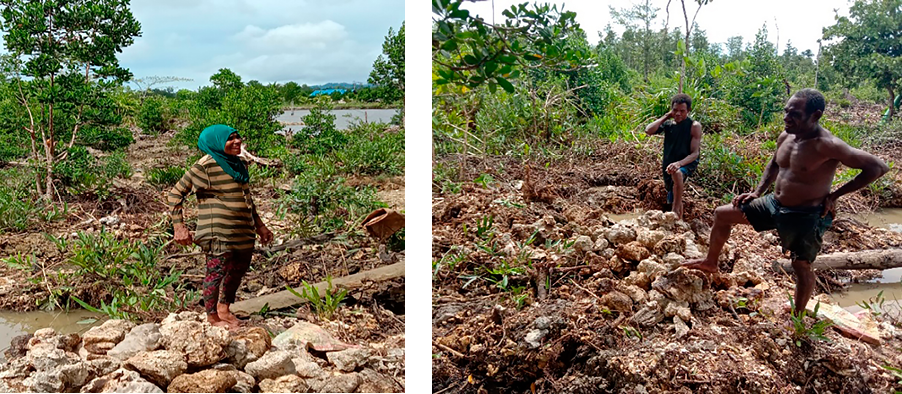
Figure 1. A Papuan Kokoda Woman and Men Lifting a Rock from a Well
2. Mangi-Mangi Wood (Mangrove)
The Kokoda people use their natural surroundings to sustain life. Mangi-mangi (mangrove) wood is one way to revive the economy. Sometimes they work based on orders and reading the market. The use of mangi-mangi wood has economic links with national holidays (Indonesian Independence Day in August) and other activities that require the establishment of flagpoles (every house erects a flag at the Republic of Indonesia’s Independence Day). The streets are crowded on August 17th; every year, they line up these mangroves on the side of the road for sale. Everyone knows that the wood sellers are Kokoda people. Their work already characterizes who they are and where they come from. This is labelled an economic aspect of their identity because their workspace and how they maintain their life are the characteristics of their identity. Everyone knows that the person doing the job must be a Kokoda person.
Mangi-mangi wood (mangrove) has become part of a national and political routine because mangi-mangi wood is needed at times of state momentum and organizational agendas. This relationship is prioritized to revive the local community’s economy, although some people see it as an unfinished process of environmental destruction. Mangi-mangi (mangrove) wood is an essential tool in the life of the Kokoda people; they use this wood to secure their daily needs.
3. Peat Soil
Along the Pariwisata Street, Malawili Sorong Regency, the roadside is lined with peat sellers; this peat was taken from the area around the hamlet or sago plantations. The Kokoda people live their lives relying on cultivated land even though it is not their own, in small huts built to house their family. This work of selling peat is carried out by people living around the tourism road only and the Kokoda people from Sorong City and South Sorong. The peat is sold for landscaping, nurseries, and flower planting. The local farmers have never bought peat for their agricultural needs; most buyers of peat are people who develop flower and fruit seed businesses and housewives who like to plant flowers in their yards.
These three forms of economic activity are not lucrative, as Table 1 shows.
Source: Author primary data (26/12/2021)
These livelihoods characterize the economic lives of a marginalized community. This is an economy that depends on the natural surroundings and has a position that can be threatened at any time if there is the presence of power (the State) because it is considered destructive and impacts the ecology. The findings of research conducted by Romdiati et al. (2020), a research team from the Indonesia Institute of Sciences (LIPI) show that the Kokoda people still have low levels of education in several communities, the household economy is unstable, and children’s health and nutrition have not improved.
Low education also impacts work trust for the Kokoda people in the public sector, it shows that they are marginalized, so the best way to earn a living is to take advantage of the natural surroundings to survive and provide for the household economy (Scott 2008). In the economic turmoil in the lower class society of farmers, using stealth as a mode of resistance with the means and knowledge or abilities they have is a symbol of resistance to power. Now the economic context of the enterprise built by the Kokoda community is a form of resistance to economic domination or hegemony and power structures in the public sphere that work to exclude them economically. From this perspective, the culture and livelihoods of the indigenous people of West Papua are framed in violence and oppression, adding to a sense of racial difference and, thus, to racism (Eichhorn 2022). These three economic activities are used as an approach to reading the realities of life for most of the Kokoda people in Sorong, who are far from achieving their expectations. Arobi Beyete said in his interview that the Kokoda people are struggling to build their lives; ‘we are accused of destroying the environment, but the [the problems we face in our] livelihood have not in the least diminished our sense of nationalism in the State and we remain loyal to the Unitary State of the Republic of Indonesia.
Conclusion
The findings of this study show that the Kokoda people had a significant role in the mobilization leading up to PEPERA in Sorong 1969 and that the historical relations of this mobilization must be connected to the need for labor during the Dutch era. As the social and economic mix of the society in Sorong is so diverse, the Kokoda people themselves are gradually being marginalized in the public space, be it in the economy, politics, or education. The Kokoda people massively feel this marginalization, and the stereotypes that occur in waves have become symbolic of them.
The life of the Kokoda people is dominated by social structure and order, which makes it inevitable that the Kokoda people must maintain their lives by taking advantage of the natural surroundings. Mangi-mangi wood (mangrove), coral reefs and peat are the most critical parts of the economic history of the Kokoda people, with the concept of an economic entity that has become a ‘symbol’ of the clan. Even the economic pattern of the group is inseparable from the process of social stereotyping, the social assumption that the work is only carried out by people who do not have resources, that is, that it is only done by marginalized communities.
Implications flow from the political effect in the 1969 PEPERA victory that the mobilization of the Kokoda people’s resources had. Legally and politically, Papua joined the Republic of Indonesia. The relationship between the history of Islamic rule and Melanesian cultural awareness is the most crucial part of the mobilization process of the Kokoda clan in Sorong. The Rajas of Kokoda, Jojau and Sangaji can be seen as pioneers and essential actors in this mobilization process, reflecting Oberschall’s resource mobilization theory (2017). Oberschall’s work (2017) on Social Movements also gives a way to understand the motivations, successes, and failures of thousands of people who crave high ideals of justice but sometimes help perpetuate actions and political systems that are not fair and just; we can see this in the phenomenon of the Kokoda people who were used by the state and then ignored. Similarly, the acts of marginalization and economic practices of groups are part of social prejudice among other ethnic groups against the Kokoda people in Sorong and occur in all aspects of life. This social prejudice that results from the social stereotyping processes that other ethnic groups engage in against the Kokoda people in Sorong arises from a complex, multi-factor background (Allport 1958), including historical, socio-cultural and situational factors.
References
Adryamarthanino, V. 2021, ‘Machmud singgirei rumagesan, pahlawan nasional pertama Papua barat’, Kompas.com, 27 July. https://www.kompas.com/stori/read/2021/07/22/133325679/machmud-singgirei-rumagesan-pahlawan-nasional-pertama-papua-barat?page=all
Allport, G. 1958, The Nature of Prejudice, abridged edition, Doubleday, New York, NY.
Arsyad, Y., Wahid, B., & Saeni, A. 2021, ‘Pendampingan sosial masyarakat kokoda tentang makna “torang basodara” antar etnis di kota Sorong dalam perspektif pendidikan multikulturalisme’, ABDIMAS: Papua Journal of Community Service, vol. 3, no. 1, pp. 15-19. https://doi.org/10.33506/pjcs.v1i1.1290
Eichhorn, S. J. 2022, ‘Resource extraction as a tool of racism in West Papua’, International Journal of Human Rights, pp. 1–23. https://doi.org/10.1080/13642987.2022.2036722
Farok 2015. Jejak Sejarah Islam di Tidore. Unpublished Paper.
Kusumaryati, V. 2021, #Papuanlivesmatter: black consciousness and political movements in West Papua, Critical Asian Studies, vol. 53, no. 4, pp. 453-475. https://doi.org/10.1080/14672715.2021.1963794
Indekspol 2019, Laporan survei Persepsi Masyarakat Pasca konflik rasisime 2019 di Papua. Unpublished Report.
International Coalition for Papua 2020, Right to Land under the UN Declaration on the Rights of Indigenous Peoples: A Human Rights Focus; A stakeholder submission by the International Coalition for Papua (ICP) on the land rights situation of indigenous peoples in West Papua, Indonesia, 15 January 2020. https://www.ohchr.org/sites/default/files/Documents/Issues/IPeoples/EMRIP/RightToLand/ICP.docx
Lekitoo, H. Y. 2003, Kitorang Tra Maju-Maju: Marginalisasi Orang Papua di Kampung Sendiri, Doctoral dissertation, Universitas Gadjah Mada.
Malak, S. & Likewati, W. O. 2012, Emas Hitam dari Sorong: Menuju Peradaban Baru, PT Sarana Komunikasi Utama, Bogor.
Murray Li, T. & Semedi, P. 2021, Plantation Life: Corporate Occupation in Indonesia’s Palm Oil Zone, Duke University Press, Durham, NC.
Musa’ad, Y. Ibnu. 2005, Sejarah Islam di Papua, Makalah Ilmiah yang Tidak di Publikasih.
Oberschall, A. 2017, Social movements: Ideologies, Interests, and Identities, Routledge, Abingdon. https://doi.org/10.4324/9781315129631
Pamungkas, C. & Triindriasari, D. 2018, ‘Pemilihan Gubernur Papua 2018: Politik Identitas, Tata Kelola Pemerintahan dan Daya Hidup Orang Papua’, Jurnal Masyarakat dan Budaya, vol. 20, no. 3, pp. 391-406. https://doi.org/10.14203/jmb.v20i3.721
Putra, J. I., Alfiandi, B., & Afrizal, A. 2021, ‘Strategi Pemanfaatan Sumber Daya dalam Gerakan Sosial Perlawanan Komunitas Salingka Gunung Talang terhadap Penetapan Wilayah Kerja Geotermal Gunung Talang-Bukit Kili, Kabupaten Solok, Sumatra Barat’, Jurnal Pendidikan Tambusai, vol. 5, no. 1, pp. 2109-2117.
Romdiati, H., Surtiari, G. A. K., Katherina, L. K., Kusumaningrum, D., & Prasojo, A. P. S. 2020, Orang Asli Papua: Kondisi Sosial Demografi dan Perubahannya, Yayasan Pustaka Obor Indonesia, Jakarta.
Scott, J. C. 2008, Weapons of the Weak: Everyday Forms of Peasant Resistance, Yale University Press, New Haven, CT.
Soelaeman, M. M. 2005, Ilmu Sosial Dasar: Teori dan Konsep Ilmu Sosial, 5th edn, Refika Aditama, Bandung.
Solossa, J. P. 2006, Otonomi Khusus Papua: Mengangkat Martabat Rakyat Papua di Dalam NKRI, Pustaka Nisar Harapan, Jakarta.
Wahid, B. 2018, Raja Ampat: Petuanan, Risalah dan Kuasa Pulau-Pulau, Tanah Air Beta, Yogyakarta.
Widodo, S. & Wekke, I. S. 2020, Yayasan Emeyodere dalam Pelayanan Pendidikan Masyarakat Kokoda di Kota Sorong, Deepublish, Yogyakarta.
Woodman, C. 2022, ‘The West Papuan liberation movement, Indonesian settler colonialism and Western imperialism from an international solidarity perspective’, International Journal of Human Rights, pp. 1–33. https://doi.org/10.1080/13642987.2022.2132235