ARTICLE
Enduring community value from mining: Measuring the employment impacts of mine closure for remote communities and considering issues for transformation


Boyd Dirk Blackwell1*, Jim McFarlane2, Andy Fischer3
1,2 CRC for Remote Economic Participation, University of New England, Australia
3 Institute of Marine and Antarctic Studies, University of Tasmania, Australia
International Journal of Rural Law and Policy, No. 2 2017
© 2017 The Author(s). This is an Open Access article distributed under the terms of the Creative Commons Attribution 4.0 Unported (CC BY 4.0) License (https://creativecommons.org/licenses/by/4.0/), allowing third parties to copy and redistribute the material in any medium or format and to remix, transform, and build upon the material for any purpose, even commercially, provided the original work is properly cited and states its license.
Citation: Boyd Dirk Blackwell, Jim McFarlane and Andy Fischer, ‘Enduring Community Value from Mining: Measuring the Employment Impacts of Mine Closure for Remote Communities and Considering Issues for Transformation’ (2017) 2 International Journal of Rural Law and Policy, Article ID 4943. http://dx.doi.org/10.5130/ijrlp.i2.2017.4943
ISSN 1839-745x | Published by UTS ePRESS | http://ijrlp.epress.lib.uts.edu.au
*Corresponding author: Boyd Dirk Blackwell, CRC for Remote Economic Participation, University of New England, Australia, bblackw2@une.edu.au
DOI: http://dx.doi.org/10.5130/ijrlp.i2.2017.4943
ABSTRACT
Tracking and mapping the employment impacts from mine closure forms an important element in planning for the economic transformation of remote communities and delivering enduring value from mining. This paper presents the results from two case studies of the employment impacts from mine closure: 1) the Ranger uranium mine in the Northern Territory and 2) the Leigh Creek coal mine in South Australia. The impacts for both locations are significant and link to a number of supporting industries, particularly construction, but also more broadly across other sectors of the economy. The spatial impacts are principally felt locally, but are also distributed more broadly at regional, state and national scales because of modern-day work commuting practices. Loss of jobs and associated income to Aboriginal and Torres Strait Islander people are also significant. Developing policy options to prepare for managing imminent mine closures in remote locations requires careful analysis of the structure of the local economy, within the context of a globalised world, in order to help identify sustainable transformation opportunities for these remote communities.
Keywords
mine closure, remote communities, employment impact
Introduction
Since the height of the mining boom in 2011, mining companies across the globe have been cutting costs and raising the efficiency of their operations in response to falling global commodity prices.1 Falling global commodity prices also mean that many mining operations are no longer viable, resulting in a succession of mine closures and associated significant job losses; some reports suggest a halving of the global labour force of the mining industry.2
As a case in point, Australia has experienced a succession of recent mine closure announcements. Rio Tinto recently announced that it would no longer financially support the continued operation through expansion of the Ranger uranium mine owned by Energy Resources Australia (ERA).3 The mine is close to the town of Jabiru (see Figure 1) in the Northern Territory (NT) and has an authority to mine that expires in 2021.4 Similarly, Alinta Energy in South Australia (SA) has closed the Leigh Creek coal mine (see Figure 1), with the concomitant May 2016 closure of the Port Augusta power stations that rely on the mine for their coal supply.5
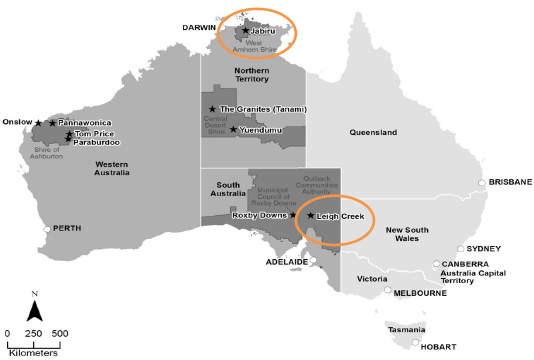
Figure 1: Location of Jabiru and Leigh Creek relative to other case study locations of the CRC REP Enduring Community Value from Mining (ECVM) project.
(Source and notes: Prepared by Kate Rampellini, 2014, dark grey areas are ECVM case study Local Government Areas)
These mines and their associated communities exist in remote and sparsely populated areas where towns and hinterlands are particularly vulnerable to the loss of business activity, and the associated services and benefits this provides,6 such as loss of jobs, both directly – for those related to and in support of mining – and indirectly for related jobs which deliver key services for remote peoples and for which there are no feasible substitutes.7 Knowing the spatial extent of the job losses and their associated income in advance of closure is critical to better understanding the extent of economic impact and how and where policy can be directed to ensure the most efficient transition to alternative economic futures for these communities.
Using Ranger and Leigh Creek as cases, we model and analyse the employment impacts from mine closure to help inform the transformation of these economies to viable futures beyond mining. Doing so can help to deliver policy prescriptions that ensure mining provides enduring value to these remote communities rather than leaving them vulnerable and short of economic opportunity.
The remainder of the manuscript is set out as follows: the second section outlines the methods used to model and analyse the employment impacts in both locations; the third section provides the results of the modelling, quantifying the employment impacts spatially and in monetary terms; the fourth section discusses these results in the context of the cases at hand and identifies some limitations and areas for future research; the paper ends with concluding remarks.
Methods
The key to estimating the employment impacts of mine closure is to know how many people are currently employed in the mine and more broadly across the local economy in its various industry subsectors. Establishing the employment structure of a local economy ex ante (before the impact) also helps to identify the connections between mining, mining support industries and other sectors of the economy.8 Having a map of the economic structure of the local economy then allows a ‘what-if’ analysis to proceed by withdrawing mine-related employment from the economic base to help predict the loss of jobs and associated income.
Estimating current levels and spatial distribution of impacts
We identified, through the Australian Bureau of Statistics’(ABS)9 census data using the Tablebuilder Pro interface, employees’ place of work in 2011 by Local Government Area (LGA). We collapsed the industry subsectors from the four-digit level (ie, 720 subsectors) to an equivalent of the two-digit level (ie, 111 subsectors) of the economy, then matched these with employee place of usual residence.
For Jabiru, workers’ place of work was fixed on West Arnhem, while the place of usual residence was allowed to expand from West Arnhem to all other territory LGAs and the rest of Australia. In this way, only people working in West Arnhem were analysed, rather than people who may commute out of the LGA to work elsewhere.10 In the case of Ranger Creek, we were also able to establish the ‘spatial impact’ of whether employees identified as Aboriginal and Torres Strait Islander.
Given that Jabiru fits within the West Arnhem LGA, the first step in analysing the impacts of mine closure for Jabiru was relatively straightforward. For Leigh Creek, however, the analysis was not so simple because it falls within the vast area of unincorporated SA and does not have its own LGA. This means that people who work in Leigh Creek in any industry cannot be representatively identified from the ABS data. However, by working backwards and identifying people’s place of residence as Leigh Creek and their place of work as Outback SA, we could reasonably identify those people employed ‘locally’; we tagged these as Local2. This measure of local employment is, therefore, different to that of Jabiru because Jabiru local employment is truly local – place of work matches place of usual residence. This process means that only one scale of spatial impact is presented for Leigh Creek: Local2, while three are known for Jabiru: local, rest of the NT, rest of Australia.
Predicting future employment levels
Once the employment structure of a local economy was estimated, the likely loss of jobs as a result of mine closure could be estimated by considering the likely loss of jobs in the subsector concerned (mining), supporting and related subsectors (eg, construction) and then indirectly related industry subsectors (eg, all other sectors). This deduction results in an ex post (after impact) number of employees by industry subsectors in the medium-to-long run once subsequent rounds of indirect effects take their course through the economy. Subtracting the ex post number of people employed in each industry subsector from the ex ante employment levels provides the change, marginal or loss of jobs resulting from the mine’s closure for each subsector.
Given our analysis was undertaken at a micro economic level of 111 subsectors, we are able to identify those people directly employed with the mine in question through the identification of the mineral resource being extracted. This precision of industry subsector analysis also allows for mine supporting industries to be identified and for less related subsectors to be identified, helping to identify strong, mild or weak connections between industry subsector employment and income.
Sensitivity analysis
We also undertook a sensitivity analysis of the loss of jobs, taking account of the variation in the connection between mining and mining support industry subsectors, and other subsectors of the local economy at three levels:
- Base case or best estimate
- Upper bound
- Lower boundIn this way, our best estimate of the loss of jobs is provided within a range of possible job losses to help guide policy makers. No doubt the actual loss of jobs will be different from our best estimate but, in effect, it will never really be known because economies can only be modelled rather than exactly known.
Tables 1 and 2 outline the connection factors used to determine the job loss results from the Ranger and Leigh Creek mine closures, respectively, for the above three levels. We established the best estimate connection factors through expert experience and studying the structure of the economy subsectors and their connections. Each local economy is different11 and hence there are different employment connections between industry subsectors, resulting in different connection factors: best estimate and bounded estimate connection factors.
| Level | Spatial scale Local2b |
|---|---|
| Base case (best estimates) | 48% |
| Upper bound | 58% |
| Lower bound | 38% |
| Notes: a. The previous methods section describes ABS census limitation on spatial analysis for Leigh Creek versus Jabiru. | |
| b. Local2 = employees who live in Leigh Creek and work in Outback SA2. | |
Predicting changes in employment concentration
A further extension of our analysis was to estimate the location quotients from the ex ante 111 division of subsector employment of the local economies. Location quotients provide a measure of employment concentration relative to territory or state levels.12 Through our approach, the concentration of employment losses can be estimated ex post, as can the vulnerability of the local economy, in turn helping to better inform policy responses.
Results
Jabiru
The total employment impacts from the Ranger uranium mine closure are significant: 298 (219-393) jobs lost, worth approximately $28 million ($23m-$33m) in employment income, representing a 49% (36-64%) reduction on current employment levels and a 61% (51-73%) reduction in employment income. The mining and building industries lose a majority of the jobs, with 148 and 28 jobs respectively, accounting for $18 million (mining) and almost $3 million (building) in employment income. The next most effected is the trade and accommodation industry, which mimics the mining cycle with the advent of the FIFO phenomenon; this industry incurs 58 jobs lost and a reduction in employment income of $2 million. The public and personal services industry is the next most adversely impacted with 44 total jobs lost, accounting for over $3 million in employment income.
Figures 1, 2 and 3 present base case (best estimate), upper bound and lower bound spatial and industry impacts of the mine’s closure. In the bottom left corners of the figures, the pie charts show that the majority, or around 60%, of jobs and income are lost locally, with 25-30% of the job loss falling to the rest of the NT and 10% to the rest of Australia. Losses of income and employment to Aboriginal and Torres Strait Islander people are also significant and equate to around 10% of total employment loss and income.
Of the local losses, 86 jobs and $10 million in income are lost from the mining industry, and 22 jobs and over $2 million in income from the building industry. A further critical insight from the spatial analysis represented in Figures 1 to 3 is that it is not just mining jobs and mining support services that are impacted; second round or indirect job losses are also significant, particularly in the public and personal services industry, but also noticeably in the business services, and trade and accommodation industry.
Interestingly, as shown in the bottom right of Figures 1 to 3, the indirect impact on Aboriginal and Torres Strait Islander jobs and income is particularly felt through the public and personal services industry, in addition to the initial direct losses through the mining and building industries. Also appearing to be impacted are Aboriginal and Torres Strait Islanders employed in the business services sector.
The results for Aboriginal and Torres Strait Islanders are in stark contrast to the indirect impacts felt by the rest of Australia by the mine’s closure (top right hand graphs of Figures 1 to 3). For the rest of Australia, the impacts are predominantly in the trade and accommodation industry, followed by the business services then public and personal services industries.
The trade and accommodation industry plays a critical role in connecting the flow of loss of jobs and employment income across the local, regional and national economies, as is shown by the relatively large light blue bars as one scans from left to right in the bar graphs in Figures 1 to 3.
The bottom set of bar graphs on the left of Figure 1 summarises the change in concentration of employment (location quotients – LQs) as a result of closure of the mine. Naturally, the economy contracts with very high levels of greater concentration in the public and personal services, business services, and trade and accommodation industries.
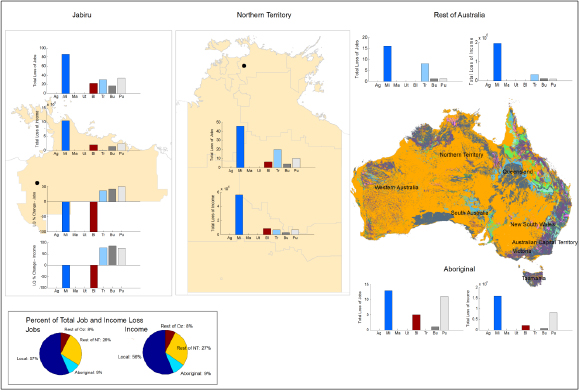
Figure 1: Employment impacts of Ranger uranium mine closure: Base Case
Notes: Ag=agriculture, Mi = Mining, Ma = Manufacturing, Ut = Utilities, Bl = Building, Tr = Trade and accommodation, Bu=Business services, Pu = Public and personal services; x106 = 1,000,000; oz = Australia; Income is in AUD$
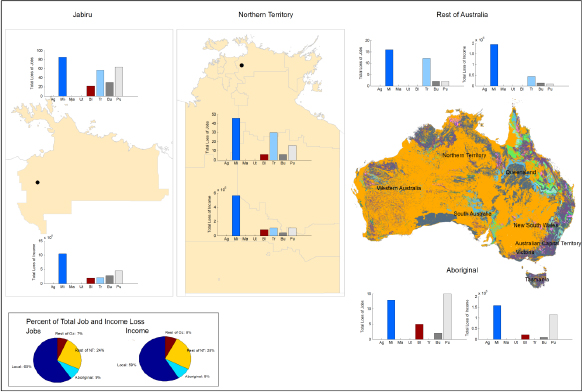
Figure 2: Employment impacts of Ranger uranium mine closure: Upper bound
Notes: Ag=agriculture, Mi = Mining, Ma = Manufacturing, Ut = Utilities, Bl = Building, Tr = Trade and accommodation, Bu=Business services, Pu = Public and personal services; x106 = 1,000,000; oz = Australia; Income is in AUD$
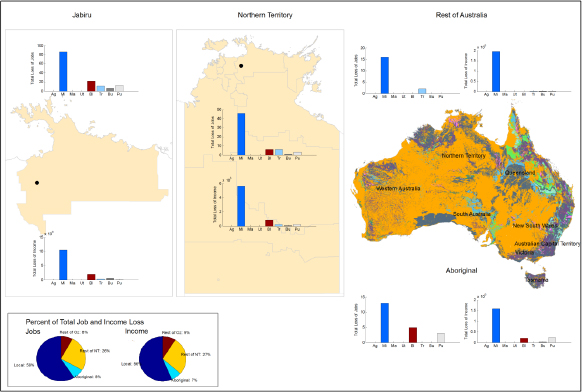
Figure 3: Employment impacts of Ranger uranium mine closure: Lower bound
Notes: Ag=agriculture, Mi = Mining, Ma = Manufacturing, Ut = Utilities, Bl = Building, Tr = Trade and accommodation, Bu=Business services, Pu = Public and personal services; x106 = 1,000,000; oz = Australia; Income is in AUD$
Leigh Creek
The local impacts from Leigh Creek coal mine closure are also significant, more so than Jabiru in relative terms: 196 (183-209) jobs lost13 accounting for 73% of current employment levels, with $24 million ($23m-$25m) million or 87% of current employment income. Mining again accounts for the majority of jobs lost, with 132 jobs accounting for $21 million in employment income. In contrast with Jabiru, there are no building employees on record from the ABS Census for Leigh Creek place of usual residence. The next industry most heavily impacted is public and personal services, followed by trade and accommodation, and business services, as depicted in Figure 4. In contrast to the impact on the building industry, jobs in the utilities industry and employment income are halved as a result of the mine closure.
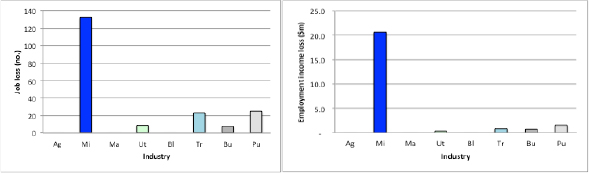
Figure 4: Local2 employment impacts of Leigh Creek coal mine: Base Case
Notes: Ag=agriculture, Mi = Mining, Ma = Manufacturing, Ut = Utilities, Bl = Building, Tr = Trade and accommodation, Bu=Business services, Pu = Public and personal service
Figure 4 shows the relative Local2 impacts by industry. Similar to Jabiru, there are a number of other industry jobs that the mining industry supports locally, notably public and personal services, trade and accommodation, business services and utilities industries that are adversely impacted by the mine closure. In total income terms, the public and personal services industry provides the next greatest loss to local employment income after mining industry, similar to Jabiru.
Figure 5 shows the results of the changes in employment concentration. Because of the loss of jobs in the mining industry, all other industries experience increased concentrations in terms of jobs (left) and employment income (right). These are extraordinarily higher than that experienced in Jabiru.
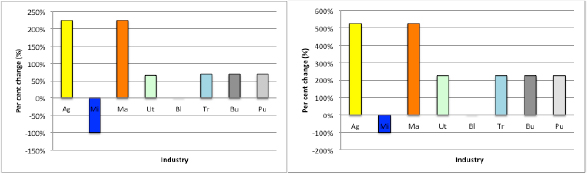
Figure 5: Changes in employment concentrations (LQS) from Leigh Creek mine closure: Left – jobs; Right – Income.
(Notes: Ag=agriculture, Mi = Mining, Ma = Manufacturing, Ut = Utilities, Bl = Building, Bl = Building, Tr = Trade and accommodation, Bu =Business services, Pu = Public and personal services)
Discussion
Jabiru
A number of prescient insights can be drawn from the results presented for Jabiru. Firstly, the employment impacts from the Ranger mine closure are predominantly felt locally and will cause significant financial and economic hardship to the people of Jabiru and East Arnhem. Secondly, while the local impacts are extenuating, the trade and accommodation industry provides critical connective tissue for more adverse impacts from the local level to flow to regional and national levels. This is particularly true given that mining work practices are now dominated by FIFO operations. This is also apparent in other sectors, such as in the business services, and public and personal services industries.
Thirdly, Figures 1 to 3 show that Aboriginal and Torres Strait Islander employment impacts, particularly those that are indirectly felt, fall more greatly across the public and personal services sector. Given this result and the second insight, it is clear that mining plays a far more important role in remote economies than simply providing direct income and jobs. The direct jobs and income, in turn, support a range of second-round jobs and employment income across the building, trade and accommodation, public and personal services, and business services industries, with the public and personal services industry being equally impacted in second round effects for Aboriginal and Torres Strait Islander people.
Indeed, mining, while in existence, contributes to a much greater diversity of jobs across the economy, potentially leading to enduring value, but once the mine is gone, the impacts are significant and, unless alternative plans are laid for diversity creation after the closure, and policies are put in place to help people, particularly those that are local and regional, to transition to alternative futures, then much of mining’s value is lost and is not enduring.
Fourthly and related to the third point, some anecdotal evidence suggests that Aboriginal and Torres Strait Islander communities may be considerably better off as a result of mine closure in both locations. This could be argued for a number of reasons, including the need for local people to be no longer economically tied to an outside interest that may have goals which are incongruent to their own, particularly in relation to respect of the land, country, descendants and culture. Leigh Creek was a closed town, meaning only mine or mine support workers could live in the town; there has never been a plan for enduring value for the regional community from the mine, and no royalties have been paid to the traditional owners. These measures are argued to have bred distrust, contempt and racial separation. This is not ideal for building lasting benefits for local communities and the mining industry; rather it is likely to create lasting disbenefits. In this case, the closure of the mine presents an opportunity for an improved future for greater cross-cultural and community respect.
Fifthly, the increased concentration of employment presented in Figure 1 provides some insights as to strategies and plans for Jabiru and West Arnhem’s future without the mine. Historically, Jabiru was established as a package deal between the Commonwealth and Territory governments and the mine proponent.14 The mine contributed to much of the town’s infrastructure, including airport, power supply, streets and homes, sports fields etc.15 Part of this package was the development of Kakadu National Park as a Commonwealth asset16 that was promoted as World Heritage to the domestic and international tourism markets. Since these initial investments, renewed investment would be useful in revitalising the tired assets and reinvigorating these opportunities, particularly given the lower value of the Australian dollar. This provides a potentially better mix for the employment of local Aboriginal and Torres Strait Islander people whose interests may lie better with conserving and protecting their lands and culture rather than being employed to mine uranium. While the tourism dollar development presents an opportunity, it is not the only opportunity to reinvigorate the economy once the mine closes and, in fact, other small business and employment opportunities need to be considered, as has been outlined by others.17
Leigh Creek
Again, a number of timely insights can be drawn from the Leigh Creek impact results. Firstly, the census data for Leigh Creek indicate no building industry employees; an event that is in stark contrast to the experience of Jabiru. Leigh Creek may have very little building activity that helps explain this inconsistency relative to Jabiru and may hint to underlying poor business confidence given the looming closure.
Secondly, similarly to Jabiru, mining employment in Leigh Creek helps support a number of other local industries indirectly, most notably the public and personal services, and the trade and accommodation industries. However, in contrast to Jabiru, Leigh Creek mining supports local jobs in the utilities industry. The business services industry earns considerable income for local employees, so much so it surpasses in lost income terms other non-mining industries.
Thirdly, the data indicates that half the jobs and employment income of the utilities industry in Leigh Creek will be lost because of the mine closure. This is to be expected, given that the coal mine supplies coal to Alinta Energy and closure of the mine resulted from the planned closure of the power stations at Port Augusta owned by Alinta Energy, the major utility in the region.
Fourthly, the data also shows that the changes in employment concentrations for Leigh Creek were extraordinarily higher than those of Jabiru, showing that Leigh Creek is particularly vulnerable due to its highly concentrated employment in mining. This is further compounded by there being no public plan prepared early in the mine’s lifecycle to deliver enduring value beyond mining, no royalties paid to traditional land owners, and a closed-town policy for mine development.18
Limitations and areas for future research
There are a number of limitations in our analysis that provide opportunities for future research. Firstly, our analysis assumes that anyone who loses their job in a mine will not immediately find work elsewhere. In realty and with time, some people will, doubtless, find jobs elsewhere. However, there is no question that the local economy will be particularly adversely impacted. People who live and work locally in a remote town are likely not to have as many opportunities for employment compared to workers from the rest of the NT or Australia, particularly where this latter group live in large populated cities and economies. Moreover, people who are mobile with their employment and reside in large capital cities with major airports may be more flexible and able to take up a job in another location compared to people who have established their residence in a remote town.
Secondly, our analysis is relatively narrow, particularly when one considers that sustainability should typically occur socially and culturally, economically and politically, as well as environmentally and ecologically. As one example, we have not included the ecological or human health related impacts which will be lasting beyond the life of the mine. For an ecological-economics conference, to which this paper was presented, not considering these impacts would demonstrate first-class incompetency for the authors. We are, however, conscious of the limitation and decided to constrain our analysis to employment economic impacts only. Further research would, naturally, incorporate these broader environmental impacts.
Thirdly, as noted in the methods section, our analysis of Leigh Creek employment impacts was constrained by the unincorporated nature of Leigh Creek being part of a considerably larger area of Outback South Australia. This points to two possible policy prescriptions. The first is that democracy must be delivered to the remote people of this region, given they currently have little or no democratically and locally elected and accountable representation. Such democracy can be delivered through the traditional mechanism of establishing a local government for the Northern Flinders Ranges or through less traditional means.19 The second is reform of the ABS collection of data that would follow the democratic reform, providing more precise information about the people of this region.
Finally, our analysis only captures the employment and employment income impacts of mine closure. While employment impacts are an important and natural first step, further research could include additional analyses such as an input-output analysis to gauge the full impact on the economy. Our measures of lost economic activity are, therefore, inherently conservative.
Conclusion
Mining, and particularly mining in the remote locations that are considered in this manuscript, provides an important employment and income base for regional economies. Once mines close a local economy can be short of employment opportunities, with a renewed concentration and inherent vulnerability falling on a few other industries. Part of planning for mine closure requires some assessment of the employment impacts: how these are felt across industry subsectors directly and indirectly, with subsequent contraction of employment income and further jobs losses in second round effects. The impacts for the remote locations considered in this manuscript are extenuating to say the least, and even more so for the people of Leigh Creek in South Australia. Without early and ongoing mine life cycle planning, and town and regional development strategies, these towns and their regions will no doubt suffer severe financial and economic hardship. In the case of Leigh Creek, this is particularly so with no pre-mining plan, no royalties paid to traditional owners to leverage alternative futures, and no open-town policy to encourage the early development of alternative futures.20
Indeed, significant investment from Commonwealth, state or territory, and local governments is warranted in these prima facie cases for the urgent need for transitional funding and development. The role of community and mining companies is also clear. Enduring value from mining may only be delivered where there is ongoing trust and mutual respect, and a fair agreement and plan drawn on how mining will deliver lasting benefits to communities at various stages of the mine lifecycle.
Moreover, the work in this manuscript provides a sound starting point for better understanding the current employment structures of these remote economies and how these will be impacted as a result of mine closure. Impact work of this nature represents a first and necessary step in planning for the transition to alternative futures, by estimating the loss of benefits to employees and how these losses fall spatially across Australian society and industrial subsectors.
DECLARATION OF CONFLICTING INTEREST AND ACKNOWLEDGEMENT: The work reported in this publication was supported by funding from the Australian Government Cooperative Research Centres Program through the Cooperative Research Centre for Remote Economic Participation (CRC-REP). The views expressed herein do not necessarily represent the views of the CRC-REP or Ninti One Ltd or its participants (eg, University of New England). We are also grateful to Kate Rampellini of Curtin University for providing the map at Figure 1. Errors or omissions remain with the authors.
References
ABS, TableBuilder: Place of Usual Residence by Place of Work by Local Government Area for the Northern Territory and SSC SA2 for South Australia 2011 (2015) <http://www.abs.gov.au/websitedbs/censushome.nsf/home/tablebuilder>.
Blackwell, Boyd D, ‘Local and Regional Government in Remote and Unincorporated Australia: Sui Generis?’ (2012) 7 Public Policy, 23-46 (2012), doi: https://doi.org/10.1080/13562576.2015.1014227
Blackwell, Boyd D, Brian Dollery and Bligh James Grant, ‘Institutional Vehicles for Place-Shaping in Remote Australia’ (2015) 19 Space and Polity 150, doi: https://doi.org/10.1111/1759-3441.12182
Blackwell, Boyd D, Andy Fischer, Jim McFarlane and Brian Dollery, ‘Diversifying Cores but Stagnant Peripheries: Mining and Other Industry Employment Contributions to Development in Local Government Areas of the Northern Territory’, (in press) Economic Papers, doi: https://doi.org/10.1111/1759-3441.12182
Blackwell, Boyd D, Andy Fischer, Jim McFarlane and Brian Dollery, ‘Mining and Other Industry Contributions to Employment Leakage in Australia’s Northern Territory’, (2005) 49(6) Journal of Developing Areas 26, DOI: 10.1343/jda.2015.0105.
Blackwell, Boyd D, Andy Fischer, Jim McFarlane and Brian Dollery, ‘Diversifying Cores but Stagnant Peripheries: Mining and Other Industry Employment Contributions to Development in Local Government Areas of the Northern Territory’, (in press) Economic Papers, DOI: 10.1111/1759-3441.12182.
Blackwell, B D, and B Dollery, ‘The Impact of Mining Expenditure on Remote Communities in Australia: The Ranger Uranium Mine and the Tanami Gold Mine in the Northern Territory’ (2014) 20 Australasian Journal of Regional Studies, 61 <http://www.anzrsai.org/system/files/f8/f4/f82/f85/o546//Blackwell%20and%20Dollery.pdf>.
Carson, D A, and D B Carson, ‘Mobilities and Path Eependence: Challenges for Tourism and “Attractive” Industry Development in a Remote Company Town’, (2014) 14 Scandinavian Journal of Hospitality and Tourism 460, doi: https://doi.org/10.1080/15022250.2014.967997.
Director of National Parks, Kakadu National Park Management Plan 2007–2014 (Canberra, 2007).
ERA ASX, ‘Interim Report’, 30 June 2015 <http://www.energyres.com.au/documents/1457306.pdf>.
UN Industrial Development Organisation, Mining and Utilities Statistics (UN, 2015), <http://www.unido.org/en/resources/statistics/statistical-databases.html
Knight, D R, Jabiru Town Development Ammendment Bill 2008 (Northern Territory Second Reading Speeches. 2008), <www.austlii.edu.au/au/legis/nt/bill_srs/jtdab2008354/srs.html>.
Lannin, S, Around 30,000 Mining Jobs Threatened as Industry Looks into ‘Painful’ Future: Survey, ABC News, 29 June 2015 <http://www.abc.net.au/news/2015-07-29/thousands-of-mining-jobs-threatened-ahead-painful-future-survey/6657882>.
Nicholson, Leigh, ‘Alinta Extends Port Augusta Power Station Closure Deadline’, In Daily, 22 January 2016 <http://indaily.com.au/business/2016/01/22/alinta-extends-port-augusta-power-station-closure-deadline/>
Office of the Chief Economist, ‘Resources and Energy Quarterly’ (Department of Industry, Innovation and Science, June 2015), <http://www.industry.gov.au/Office-of-the-Chief-Economist/Publications/Pages/Resources-and-energy-quarterly.aspx>.
Robertson, Stuart, and Boyd Blackwell, ‘Remote Mining Towns on the Tangelands: Determining Dependency Within the Hinterland’, (2015) 37 The Rangeland Journal, 583, DOI: 10.1071/RJ15046.
Smith, M Stafford, ‘The ‘Desert Syndrome’: Causally-Linked Factors that Characterise Outback Australia’, (2008) 30 The Rangeland Journal 3, doi: https://doi.org/10.1071/RJ07063.
South Australian Government, Request for Information on Commercial Opportunities for Leigh Creek (2015) <http://www.oca.sa.gov.au/?q=LeighCreekRFI>.
Stevens, M, ‘Rio Tinto Signs Ranger Uranium Mine Death Warrant’, Australian Financial Review, 12 June 2015 <http://www.afr.com/business/mining/rio-tinto-signs-ranger-uranium-mine-death-warrant-20150612-ghmp9j>.
Whiting, Natalie, ‘Leigh Creek for Sale after Alinta Energy Closes SA Coal Mine’, ABC News, 22 January 2016 <http://www.abc.net.au/news/2016-01-22/sa-outback-town-leigh-creek-for-sale/7107922>.
FOOTNOTES
1 Office of the Chief Economist, ‘Resources and Energy Quarterly’ (Department of Industry, Innovation and Science, June 2015), <http://www.industry.gov.au/Office-of-the-Chief-Economist/Publications/Pages/Resources-and-energy-quarterly.aspx>.
2 UN Industrial Development Organisation, Mining and Utilities Statistics (UN, 2015), <http://www.unido.org/en/resources/statistics/statistical-databases.html; S Lannin, Around 30,000 Mining Jobs Threatened as Industry Looks into ‘Painful’ Future: Survey, ABC News, 29 June 2015 <http://www.abc.net.au/news/2015-07-29/thousands-of-mining-jobs-threatened-ahead-painful-future-survey/6657882>.
3 M Stevens, ‘Rio Tinto Signs Ranger Uranium Mine Death Warrant’, Australian Financial Review, 12 June 2015 <http://www.afr.com/business/mining/rio-tinto-signs-ranger-uranium-mine-death-warrant-20150612-ghmp9j>.
4 ERA ASX, ‘Interim Report’, 30 June 2015 <http://www.energyres.com.au/documents/1457306.pdf>.
5 Leigh Nicholson, ‘Alinta Extends Port Augusta Power Station Closure Deadline’, In Daily, 22 January 2016 <http://indaily.com.au/business/2016/01/22/alinta-extends-port-augusta-power-station-closure-deadline/>; Natalie Whiting, ‘Leigh Creek for Sale after Alinta Energy Closes SA Coal Mine’, ABC News, 22 January 2016 <http://www.abc.net.au/news/2016-01-22/sa-outback-town-leigh-creek-for-sale/7107922>.
6 Boyd D Blackwell, Brian Dollery and Bligh James Grant, ‘Institutional Vehicles for Place-Shaping in Remote Australia’ (2015) 19 Space and Polity 150, DOI: 10.1080/13562576.2015.1014227; M Stafford Smith, ‘The ‘Desert Syndrome’: Causally-Linked Factors that Characterise Outback Australia’, (2008) 30 The Rangeland Journal 3, DOI: 10.1071/RJ07063.
7 Stuart Robertson and Boyd Blackwell, ‘Remote Mining Towns on the Rangelands: Determining Dependency Within the Hinterland’, (2015) 37 The Rangeland Journal 583, DOI: 10.1071/RJ15046.
8 Boyd D Blackwell, Andy Fischer, Jim McFarlane and Brian Dollery, ‘Diversifying Cores but Stagnant Peripheries: Mining and Other Industry Employment Contributions to Development in Local Government Areas of the Northern Territory’, (in press) Economic Papers, DOI: 10.1111/1759-3441.12182.
9 ABS, TableBuilder: Place of Usual Residence by Place of Work by Local Government Area for the Northern Territory and SSC SA2 for South Australia 2011 (2015) <http://www.abs.gov.au/websitedbs/censushome.nsf/home/tablebuilder>.
10 For an analysis of people commuting to work between LGAs in the NT see Boyd D Blackwell, Andy Fischer, Jim McFarlane and Brian Dollery, ‘Mining and Other Industry Contributions to Employment Leakage in Australia’s Northern Territory’, (2005) 49(6) Journal of Developing Areas 26, DOI: 10.1343/jda.2015.0105.
11 Boyd D Blackwell, ‘Local and Regional Government in Remote and Unincorporated Australia: Sui Generis?’ (2012) 7 Public Policy, 23-46 (2012), DOI: 10.1071/RJ15046.
12 Boyd D Blackwell, Andy Fischer, Jim McFarlane and Brian Dollery, ‘Diversifying Cores but Stagnant Peripheries: Mining and Other Industry Employment Contributions to Development in Local Government Areas of the Northern Territory’, (in press) Economic Papers, DOI: 10.1111/1759-3441.12182.
13 Job losses of about 240 have been reported by the media (Nicholson, above n 5), noting that our estimates represent a degree of local employment only and not total employment sourced from across Australian residential locations. Given this context, our estimates appear to be in the ball park.
14 D R Knight, Jabiru Town Development Ammendment Bill 2008 (Northern Territory Second Reading Speeches. 2008), <www.austlii.edu.au/au/legis/nt/bill_srs/jtdab2008354/srs.html>.
15 B D Blackwell and B Dollery, ‘The Impact of Mining Expenditure on Remote Communities in Australia: The Ranger Uranium Mine and the Tanami Gold Mine in the Northern Territory’ (2014) 20 Australasian Journal of Regional Studies, 61 <http://www.anzrsai.org/system/files/f8/f4/f82/f85/o546//Blackwell%20and%20Dollery.pdf>.
16 Director of National Parks, Kakadu National Park Management Plan 2007–2014 (Canberra, 2007).
17 Robertson and Blackwell, above n 2; D A Carson and D B Carson, ‘Mobilities and Path Dependence: Challenges for Tourism and “Attractive” Industry Development in a Remote Company Town’, (2014) 14 Scandinavian Journal of Hospitality and Tourism 460, DOI: 10.1080/15022250.2014.967997.
18 Robertson and Blackwell, above n 17.
19 As outlined by Boyd D Blackwell, Brian Dollery and Bligh James Grant, ‘Institutional vehicles for place-shaping in remote Australia’ (2015) 19 Space and Polity 150, DOI: 10.1080/13562576.2015.1014227; Smith, above n 6.
20 Since undertaking this impact analysis, the SA Government has released a request for information for commercial opportunities to rejuvenate the Leigh Creek economy given the closure announcement: South Australian Government, Request for Information on Commercial Opportunities for Leigh Creek (2015) <http://www.oca.sa.gov.au/?q=LeighCreekRFI>. This also includes the unusual offer to sell the town. At the time of writing, received submissions were under review.