Gateways: International Journal of Community Research and Engagement
Vol. 16, No. 2
December 2023
PRACTICE-BASED
Formation of a Transdisciplinary Community of Practice in Rural Areas, with an Interactive Database of Co-created Knowledge: A Case Study in Noto, Japan
Kenji Kitamura1, Yasuko Kinoshita2, Koji Ito3, Sakiko Kawabe4, Hideki Kobayashi2, Haruka Naya5, Hiroaki Sugimori6, Yoshihiro Takata2, Manabu Teraguchi7, Chiharu Baba8
1 Otemon Gakuin University, Osaka, Japan
2 Kanazawa University, Ishikawa, Japan
3 Gifu University, Gifu, Japan
4 National Museum of Japanese History, Chiba, Japan
5 Haru Design, Ishikawa, Japan
6 Suzu City Office, Ishikawa, Japan
7 Noto Town Office, Ishikawa, Japan
8 Former Local Vitalization Cooperator, Suzu City, Ishikawa, Japan
Corresponding author: Kenji Kitamura, k-kitamura@otemon.ac.jp
DOI: https://doi.org/10.5130/ijcre.v16i2.8696
Article History: Received 29/06/2023; Revised 06/11/2023; Accepted 09/11/2023; Published 12/2023
Abstract
Many rural areas suffer from severe depopulation, and the absence of a university is one reason for outmigration. Where research and education are valued, however, such rural areas can attract scholars and students visiting from universities and other external institutions. Scholarly outputs of research, such as research articles and project reports, particularly those from community-based research (CBR), can themselves become an asset for use by local communities. We consider that CBR can contribute to asset-based community development (ABCD) when a transdisciplinary community of practice (TDCOP) emerges and drives the processes of collaborative creation and use of the knowledge. A particularly critical mechanism, which is currently lacking, is to allow the local community to collect knowledge outputs and make them easily available to interested actors within and outside of the community. We assume that a core tool in this mechanism is an interactive database. It can be equipped with a user interface, allowing enjoyable and active searches, and possibly a mechanism by which users themselves can contribute to gradual development of the database. We formed a study group of researchers and practitioners to conduct a case study in the Noto region of Japan. We identified the existing assets in Noto, including the knowledge created through CBR, and then collected and shared our own experiences and practices, as well as lessons learned from other regions in Japan, to explore the principles of designing a database. A CBR database should not only be a static inventory of past research, but also capable of facilitating new cycles of knowledge co-creation. With a comprehensive and easily accessible inventory of knowledge in place, we conclude that there is high potential in enabling CBR itself to be an asset, which can help achieve ABCD in rural communities.
Keywords
Asset-Based Community Development; Community-Based Research; Transdisciplinary Community of Practice; Database; Noto
Introduction
Many rural communities around the world face shrinking populations and contracting economies. These communities typically have no university or institution of higher education (referred to generically as ‘university’ in this article), prompting local youth to move to cities for better educational and professional opportunities. A decreasing youth population makes it even less feasible for a university to be established there, which results in a difficult-to-break vicious cycle effect. The absence of a university also means that the local community is disadvantaged in terms of opportunities for community development. This is because a university has the potential to play the role of an anchor institution, which promotes socio-economic development in its host community through research, education and, more specifically, collaborative knowledge creation with local residents (Drucker & Goldstein 2007; O’Farrell, Hassan & Hoole 2022).
There are potential means, however, to revitalise such local communities, if existing local assets are identified and used purposefully. The concept of asset-based community development (ABCD) can be applied to this endeavour, where the community actors map and mobilise their assets for community development (Kretzmann & McKnight 1993; Nel 2018). This article explores how the scholarly outputs of research, particularly those from community-based research (CBR), can themselves become an asset for use by local communities, and thereby help to address pressing issues, such as the wellbeing of the people.
CBR is defined as a methodological approach to research that is equitable, collaborative and action-oriented, involving both community members and researchers (Israel et al. 1998; Minkler 2005; Strand et al. 2003; Takeda 2015). Its research outputs include peer-reviewed journal articles, reports, blogs, newsletters and visual presentations. In this article, we argue that CBR can shed light on local assets, and CBR itself can become an asset if actively managed by the local community in partnership with others, such as researchers. As such, it is a realistic possibility, not just a conceptual idea, that CBR can become an asset for community development.
The question then arises as to how that possibility can be realised. Research towards identifying the actual processes for achieving ABCD through CBR has only just begun. This study hopes to add to the emerging interest in how ABCD and CBR can better support each other. Specifically, it is an attempt to contribute to, or address, what these processes might constitute. In order for the outputs of CBR to become a usable and positive asset for the local community, we argue that two facilitating factors are needed: a transdisciplinary community of practice (TDCOP) and a mechanism for the collaborative, accessible and action-oriented harnessing and sharing of research.
First, we assume that the question of whether or not a TDCOP emerges and functions in the course of ABCD is significant. Community of practice describes a group of people who ‘share a concern, a set of problems, or a passion about a topic, and who deepen their knowledge and expertise in this area by interacting on an ongoing basis’ (Wenger, McDermott & Snyder 2002, p. 4). Where researchers, possessing various kinds of expertise beyond their academic disciplines, alongside citizens, policy makers and others, pursue shared learning, this constitutes a TDCOP, which co-creates purposeful knowledge (Cundill, Roux & Parker 2015). Where a TDCOP is well moderated to connect diverse stakeholders, different bodies of knowledge can be translated and integrated to address complex problems in society (Chapman & Schott 2020; Kitamura, Nakagawa & Sato 2018; Sato, Chabay & Helgeson 2018). Therefore, we regard knowledge co-creation as the process of local and external actors sharing diverse bodies of understandings, spanning traditional wisdom through to scientific discoveries, in forms that are useful for community development.
Second, for a TDCOP to function, there need to be enabling mechanisms for collecting the knowledge outputs of CBR and facilitating their use. Such mechanisms are not easy to build because knowledge management requires both expertise and manual labour, and incentives for this work are often insufficient (Matsumoto 2019).
Our study explores the design of an online database, as the main mechanism by which access to and promotion of CBR can lead to ABCD via the formation of a TDCOP. We undertook a case study in the Noto region, located in a rural part of Japan, to identify design principles for a database, as well as mechanisms for promoting its use. This article reports on the key findings of our study and discusses the significance and future prospects for our study.
Noto Region – the Case Study Site
The Noto region lies on the Noto Peninsula in central-north Japan (Figure 1). It is a rural part of the country with a rapidly ageing and decreasing population. This trend is particularly severe in Okunoto at the northern end of the peninsula. For example, the population of Suzu City, the northernmost municipality in Noto, was 13,700 in 2020, accounting for less than half of the population a half century earlier. Approximately 50 percent of the current residents in the city are 65 years of age or older (Suzu City 2021). One of the factors accounting for the ageing and decreasing population is the outmigration of the youth, who seek professional and higher educational opportunities in large cities elsewhere. Noto does not have its own university, although it has a few branch-type facilities of universities headquartered elsewhere. On the one hand, therefore, the contraction on social-ecological-economic fronts in the Noto region is undeniable.
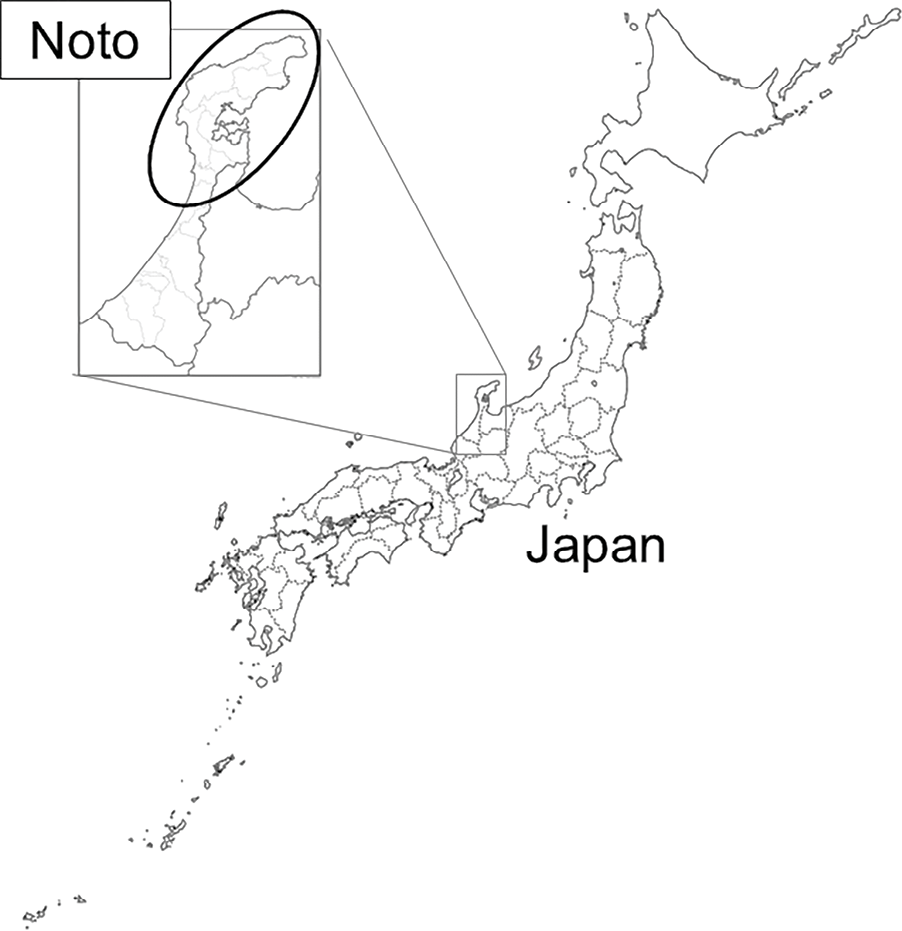
Figure 1. Location of Noto in Japan
On the other hand, however, the Noto region has a wealth of assets. During this study, we identified three types of assets that had particular relevance to CBR. The first were the traditional social-ecological systems of ‘satoyama and satoumi’, which are described as landscapes and seascapes with ‘a mosaic of different ecosystem types, including secondary forests, agricultural lands, irrigation ponds and grasslands, along with human settlements’ (Duraiappah & Nakamura 2012, p. 3). This feature led to the designation in 2011 of Noto’s Satoyama and Satoumi as a site of Globally Important Agricultural Heritage Systems (GIAHS) by the Food and Agriculture Organization of the United Nations. University students and researchers find academic and educational value in Noto, largely due to this asset, and visits to Noto for field studies are a consistent feature (Takahashi 2018). The assets of Noto’s Satoyama and Satoumi relate to food and other primary products, such as rice, vegetables, mushrooms, fish, shellfish and seaweed. The traditional production systems associated with these products contain and embody a wealth of local knowledge on what we now refer to as sustainability. This knowledge also ties in with cultural assets, including traditional festivals in each local community, the purpose of which is to express reverence and gratitude to the deities of nature (Yiu 2014; Yiu & Nagata 2018).
Preceding the GIAHS designation, in 2006 Kanazawa University opened a branch, called the Noto School, in Suzu City, at the very tip of the peninsula. Four to five researchers with doctorates have since been based at the School. They are residential researchers, who live in the local community and mediate processes of knowledge co-creation (Nakamura & Kitamura 2018; Sato, Chabay & Helgeson 2018).
Kanazawa University, in collaboration with the local authorities, has offered a capacity development program at the Noto School since 2007, targeting the local population, mainly in the age range from their 20s to 40s. The recurrent program, currently called the Noto Satoyama Satoumi SDGs Meister Program, has provided hundreds of participants with opportunities to gain basic and practical knowledge that would be helpful for their livelihoods as well as for local development in Noto. As of March 2023, a total of 232 people have successfully completed the program, which combines lectures, workshops, fieldwork and individual research projects. Each participant selects their topic of research, generally related to their livelihoods, and must pass an oral exam at the end of the program. Some of the areas covered in past research projects that can be cited include topics on food and agriculture, charcoal production, tourism development based on natural and/or cultural values, mechanisms for reusing old vacant houses, and development of products, including handicrafts using local resources. The program targets not only the original residents of Noto, but also people who have recently moved or returned to the Noto area. For the latter group, the program supports their livelihood plans and network building. Human and social capital accumulated through this kind of collaboration between local communities and a university can be regarded as a second type of asset in Noto, built on the first assets, i.e. satoyama and satoumi (Kitamura, Utsunomiya & Ito 2020).
We consider the knowledge co-created with local residents, students and researchers as a third asset in Noto. Tangible outputs of such knowledge include academic papers and project reports. The knowledge created in the Meister Program should also be included in these assets.
These three types of assets are already contributing to community development in Noto to some extent. There are alumni of the Meister Program, for example, who have become entrepreneurs in agriculture, tourism, textiles and other handicrafts, as well as various kinds of specialist enterprises, after applying the knowledge gained from Noto’s satoyama and satoumi.
A particularly critical mechanism, which is currently lacking, is to allow the local community to collect knowledge outputs and make them easily available to interested actors within and outside the community. With a comprehensive and easily accessible inventory of knowledge in place, there would be high potential for furthering community development in Noto. We believe that a core tool would be an interactive database, which could be equipped with a user interface, allowing enjoyable and active searches, and possibly a mechanism by which users themselves could contribute to gradual development of the database.
Study Group as a Small TDCOP
As our major means of collecting and analysing data on designing a database in Noto, we formed a team, called the Noto Community-University Collaboration (CUC) Study Group. Its members included researchers based in or deeply engaged with Noto and those knowledgeable about information science, as well as local government officials and practitioners with experience in CBR in Noto.
There are numerous concepts describing the same process used in a synonymous or near-synonymous context as CUC, including ‘university-community (or community-university) engagement’ (Bell et al. 2021; Chupp, Fletcher & Graulty 2021; Sousa 2021), ‘university-community (or community-university) partnership(s)’ (Fisher, Fabricant & Simmons 2004; Hidayat & Stoecker 2021; Johnson Butterfield & Soska 2004; Kearney, Wood & Zuber-Skerritt 2013), and ‘higher education institutions (HEIs)-community partnership’ (Plummer et al. 2022). We chose to place the community first, emphasising its initiating role. The reason for our using the word ‘collaboration’ is that it has a literal meaning of joint labour, which we consider is stronger and more action-oriented in terms of the nature of the relationships than other synonyms. With the above intentions, the Noto CUC Study Group regarded itself as a facilitator for participatory learning and action (Chambers 2007; Kearney, Wood & Zuber-Skerritt 2013). It aimed to resemble a TDCOP in trialing a mechanism aimed at driving cycles of CBR, which would ultimately contribute to ABCD.
The Study Group had six online meetings from 2021 to 2022 (Table 1), complemented by communication via email and other means of information gathering, to share our own relevant ongoing activities or projects relevant to the three types of assets in Noto or database development. There was no ethical examination or approval required in this study because it was not targeting any specific human subject. Regarding intellectural property rights, we made it clear that they should be protected with respect in all of the processes of our research. This was particularly important because our study aimed to promote co-creation and use of knowledge, in which intellectual property rights of knowledge creators needed to be securely protected.
In addition to mutual learning by the members of the Study Group, we learned from good practices presented by external guests. The second meeting had a guest lecturer from the municipal government of Tsushima City. Tsushima, like Noto, is a rural region in Japan, where a comprehensive package of CUC had been implemented in the past decade. The fifth meeting of the Study Group had another invited guest lecturer from the Research Institute for Humanity and Nature, who explained the purpose and design principles of the Visual Keyword Map for Global Environmental Studies. This is a highly interactive database, in which end-users can browse and choose from keywords of interest. By navigating through the options, users can use the system to find concise definitions, as well as sources of more detailed information about a particular keyword. The guest lecturers provided us with clues, tips and insights, as well as networking opportunities, to familiarise ourselves with other practitioners and their practices elsewhere, for possible future collaboration.
The sixth author of this article had a facility for organising and producing graphic representations of information. She applied this skill to producing 18 sheets of graphic records to visually summarise the main points of discussion at meetings. One of these (Figure 2), for example, summarises part of the guest lecture on Tsushima, mentioning the local community itself as a valuable site for field study, through which university students from elsewhere could gain practical learning experience, while at the same time helping the host community to revitalise itself. The graphic records also view the Tsushima Studies Forum as a regular event where local residents can learn about CBR projects ongoing in Tsushima. We regard the graphic recording as possibly an effective tool for communication with a broad range of people. We also find much potential in graphic recording in the context of a TDCOP, which will be discussed later.
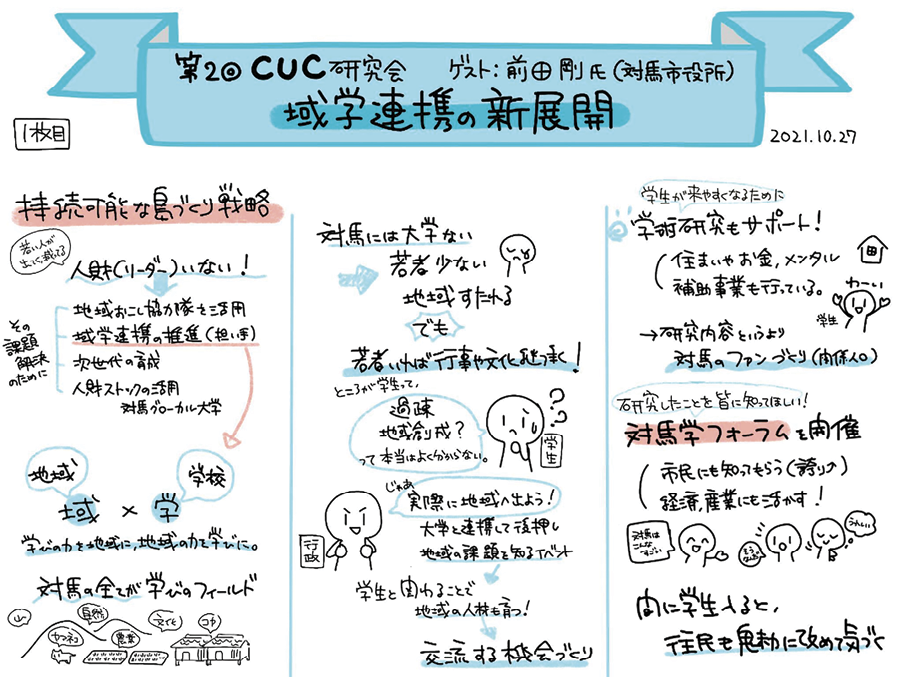
Figure 2. One of the series of 18 sheets of the study group’s graphic records , titled ‘The second meeting of the CUC Study Group on the new movements of CUC’
The Study Group also compiled a report in Japanese in March 2022, showing its activities and practical findings (Noto CUC Study Group 2022). A number of the active members of the Study Group decided to present the report in an academic format as a record of the knowledge gained: this article is the result of that process. The aim was to position our practical findings in the broader context of CUC, and to promote new cycles of collaboration. We found the themed volume of Gateways journal highly compatible with our topic and goal. Communication with the editors, as well as discussions at the writers’ online workshop organised by the editorial team, helped us in achieving clearer context for our article and higher relevance to the journal’s theme.
Key Findings
As its preliminary outcome, the Study Group found the following design principles for the proposed interactive database of CBR in Noto.
Who will use the database?
We identified three broad and approximate user categories: end users, content providers, and facilitators for use. With respect to the first category, the Study Group engaged in active debate as the fundamental design principles would depend largely on the definition of end users. It makes a substantial difference for design of a database, for example, if the choice is made to target either professional researchers or children in local schools as the main user category. At the end of the discussion, we concluded that the database should nevertheless target anyone interested in any studies related to Noto, including students in local schools, participants and alumni of the Noto Satoyama Satoumi SDGs Meister Program, and scholars and students visiting from universities outside of Noto. This is a very broad and vague definition, which makes specification of the design principles somewhat complicated. That said, however, if the database aims to promote TDCOP formation, such inclusiveness is an inevitable requirement. We regard this user diversity as one distinguishing feature of the community-based interactive database.
A second user group we discussed is content providers: those who produce outputs of studies related to Noto. Researchers and students typically fall into this user category. Such researchers and students can access several kinds of benefits from use of the interactive CBR database. A first benefit is that, as end users, they can search for existing knowledge from past studies, which is particularly important at the early stages of research. Another benefit is that, as content providers, they can achieve exposure for their own outputs, such as project reports, published research articles and books, from their studies related to Noto, among those interested in their theme. Outputs included in the database will have an increased chance of being referred to by other people undertaking research on Noto. Particularly in the later stages of research, this will have important benefits in terms of facilitating improved impacts and use of their knowledge outputs. These two kinds of benefits indicate that there is an overlap between the first and second categories of the database users.
The Study Group identified as a third user group those who design and facilitate situations involving use of the database. Such facilitators include teachers and librarians affiliated with existing institutions, such as local high schools, local libraries and universities, which send students to Noto for fieldwork sessions. When all the above categories of users are working together, multiple and potentially endless cycles of CBR can occur, from which everyone can benefit.
What to include in the database?
The Study Group then discussed how to define the types of information to include in the database. The working definition we reached is ‘materials related to Noto and edited for a certain purpose’. While excluding arbitrary types of information, such as private posts on social media, our definition is still rather broad and vague. This reflects our position to be as inclusive as possible. The actual types of information contained in the database will be two-fold. One is meta-data simply accumulated in a database, like the items of information listed in a library catalogue, and the other is information published and made available through an interface with user-oriented design.
With respect to the first type of information, the already existing outputs typically include books, journals and journal articles, and project reports. Statistical data and conventional scientific academic articles will appear in the database, while outputs of CBR will also occupy an important part; for example, reports of the projects conducted by the Noto Satoyama Satoumi SDGs Meister Program alumni, as well as those by university students on their field research, will constitute valuable contents in the database. Other forms of outputs, such as video and census data, may also be included, provided that they are purposefully edited. Where available, digital object identifiers (DOI) and other types of access information will be included so that the end users can easily find the actual materials they are seeking.
As a first step, the Study Group began in 2021 to make a list of meta data of past research outputs, which will be the basis of the proposed database. The tenth author of this article, who, as a university student, visited Noto on fieldwork, later worked for the same university, dispatching students through the Noto fieldwork programs. She subsequently took up residence in Noto, where, as a local community member, she hosted university student visits and undertook the aforementioned listing work for research outputs.
The results of the listing work proved to be a reminder of the vast outputs already in place pertaining to studies on Noto. The work also exemplified the difficulties involved in deciding whether to include particular outputs that are in a grey zone of the criteria, such as articles in magazines. Another challenge was to decide at what stage of development it would be appropriate to allow public access to, and use of, the database.
The Study Group also considered it important to explore mutual linkages with existing databases, whereby the proposed database in Noto would also function as a meta-level database. The Knowledgebase of Historical Resources in Institutes (khirin), provided by the National Museum of Japanese History, is an example of such a meta-level database providing added value to its users (Goto 2019). Interlinkages with local library catalogues might also be beneficial to users of all the databases in the new digital network. Another point which came up in the Study Group’s discussion was that raw data collected in CBR should be considered for inclusion, with proper accreditation, in the database, without waiting for publication of research articles or even data analysis, to accelerate open science and knowledge co-creation (Horii et al. 2019).
The second type of information in the database that we found important is that made available through the user interface, by which end users access and interact with the data stored therein. In particular, because the database targets broad user groups, including high-school students and other non-academics, we concluded that it should incorporate a fun-to-navigate and explore user-friendly design in the graphic interface, which will serve as the doorway to the database. The Visual Keyword Map for Global Environmental Studies, mentioned earlier, is an excellent example of a user interface design (Kumazawa 2023) which achieves this.
Our use of the graphic records proved a useful trial run for incorporating visual materials of this type into the interface as a means to create a user-friendly entrance to the database. To illustrate this, non-academic users of the database may be less inclined to read highly technical academic papers. However, if a group of academics or specialists were interested in a particular topic, they could be encouraged to read and discuss such a paper and produce a graphic record illustrating its main points and interpretations of its relevance. This, in turn, would create an accessible entry point for a broader range of users. Ideally, this graphic data would be linked to other sources in the database to facilitate synergies among various outputs of the CBR.
How to maintain database sustainability?
Another important question was ‘How can the database be maintained so that it is sustainable?’ If the time, money and labour required to maintain the database were a burden to a particular person or organisation, less and less care would be invested in its maintenance and it would ultimately risk becoming a mere repository of dead data. It is therefore critically important to design mechanisms so that no single actor will shoulder an excessive burden.
Two elements render database maintenance sustainable in the long term. The first is technical: creating a database over-reliant on technical complexities for its administration and updating is inadvisable. Nor should it rely on the work or presence of one particular person with a defined skillset. If the technical aspects are relatively simple to comprehend and negotiate for many actors, and if any modifications can be easily completed, this will contribute to the likelihood of the database being maintained properly over the long term.
The issue of who should maintain the database leads to the second question of database sustainability. A well thought-out design for a mechanism whereby multiple user groups can participate in the database development and maintenance will be important. The third user group, mentioned earlier (facilitators), will play a particularly important role. This group includes librarians at local schools and public libraries, who support student and citizen learning. Another important group includes researchers and practitioners who have built close relationships with local communities, such as some of the members of the Study Group, and can play the role of knowledge curators and translators in the database development.
Here it is relevant to invoke the concept of ‘loose preservation’, which is currently proposed in the field of museum collection management when dealing with everyday objects of historical and cultural value. Because strict museum-based preservation has limitations in terms of the temporal and spatial extents possible, maintaining these objects by keeping them in use involving various actors outside museum settings in the society can be an effective alternative way of preservation (Kawabe 2022). Researchers and practitioners working together as a TDCOP and maintaining the database through consistent use of its content will facilitate it becoming a sustainable and equitable mechanism for knowledge co-creation.
How to actively ensure use of the database?
Constructing a database and ensuring that it is used are two distinct issues. In its capacity as a tool to help form and sustain a TDCOP, in particular, the database should be in continuous use. In other words, if it exists merely as a static storage site, not much can be expected in terms of its impact on community development. The means employed to design and implement the mechanisms of database use are thus important factors. We considered the potential in Noto of several means to ensure the active use of the database (Table 2), while also referring to similar examples found elsewhere, including those from Tsushima.
| Means | Potential in Noto |
|---|---|
| Recurrent learning programs | High (precedent – Noto Satoyama Satoumi SDGs Meister Program) |
| Lectures and workshops at local schools | High |
| Hosting of facilitated fieldwork | High |
| Research funding | Medium (possibly through the Noto Future Society SDG Research Program) |
| Non-academic activities | High (precedent – festivals of modern art) |
| Conferences for a broad range of participants | High (precedent – Society for Noto Satoyama Satoumi Studies) |
First, recurrent learning programs for capacity development are highly promising. There is a high level of potential for participants in the Noto Satoyama Satoumi SDGs Meister Program to become the primary group of end users of the database. We are also aware of a wide age range of opportunities to learn about sustainability in local contexts, provided by the Tsushima Glocal University to both local and external participants, for example. Lecture materials and videos are constantly being added to, and made available through the CBR database in Tsushima. These recurrent programs can become important sources of new content for the database as the participants produce reports of their research projects.
Second, those providing lectures and workshops at local schools will certainly find the database useful. Collaboration in school learning is already underway in Noto, as it is in Tsushima. In the case of the Visual Keyword Map for Global Environmental Studies, the researchers of the Research Institute for Humanity and Nature designed and implemented a workshop with local high school students, using the Keyword Map as the primary database (Kumazawa & Soda 2020). A greater degree of participation by teachers and librarians in what we regard as a TDCOP has the potential to enrich student learning experiences using information accessed via searches of the database.
Third, the database can be used when hosting fieldwork by researchers and students of external universities. These visitors will benefit from the database as they will be able to access existing CBR outputs, as well as add their own subsequent outputs, to achieve greater impact for their research. Visitors who are undertaking fieldwork are already a feature in Noto, and they will undoubtedly become important potential users of the database.
Fourth, research funding is another way to promote use of the database. Tsushima has a program of research funding, which invites research proposal applications to help local and external actors plan and implement collaborative studies in Tsushima. As demonstrated by the example of Tsushima, the amount of funding available for each project does not need to be substantial for this to have a positive impact. The funding program also functions to visualise local issues of sustainability, prompting both external and local actors to contribute solutions. Kanazawa University’s Noto Future Society SDGs Research Program, operating in parallel with the Meister Program, has the potential to establish such a funding program. This would involve the researchers based at the Noto School working together with fund recipients.
Fifth, the database can be used in activities that are not generally considered academic. An example in Noto is the Okunoto Triennale. This is a large-scale modern arts festival held once every three years in Suzu City. Most of the participating artists come from outside to learn about the local assets of satoyama and satoumi in Noto, and express what these inspire through the creation of artworks. The database could be an excellent means by which the artists could acquire an initial knowledge of Noto’s natural and cultural environment. This would in turn be an example of using the CBR database for broader purposes and contexts, going beyond academic research to facilitate uses in various cultural and artistic activities in the local community, in collaboration with external actors, while integrating the cerebral and playful aspects of modern art.
Last, but not least, events involving diverse user groups have the potential to be an important means of facilitating increased access to the database. In the case of Tsushima, the municipal government took the initiative and organised an annual conference, called ‘Tsushima Studies Forum’, to bring together the local population, including the students of local schools, researchers and university students to share and further develop their studies on Tsushima. We consider this process an example of TDCOP formation, which also makes use of a database to collect outputs, as an asset for community development. The Noto region has several citable activities with some similarities. Among these, perhaps the highest potential lies in the Society for Noto Satoyama Satoumi Studies. While its name may suggest an academic association, it is in fact an annual event, only partly resembling an academic conference. It is open to anyone who is interested, including local residents, practitioners and researchers, to gather together and listen to keynote lectures by invited guests, parallel sessions with oral and poster presentations, as well as small hands-on workshops to highlight the skills of the alumni of the Meister Program. If an increased budget and human and other resources become available, it will potentially become a core space of TDCOP in Noto, while the database could be used as an effective tool for knowledge co-creation.
In summary, we consider the principles for promoting active use of the database to be unique and important in designing the CBR database. There is a Japanese proverb, ‘Making a Buddha statue without putting a soul into it’, which has a similar meaning in English to ‘ploughing the field and forgetting the seeds’. Even from the early stage of planning, it was important to picture situations in which the database would be used to promote TDCOP formation and enhancement. The TDCOP in turn can promote shared and active use of the database by designing an appropriate interface and providing opportunities for collaboration among diverse users, together with funding programs to create an asset for community development. By these combined mechanisms, the TDCOP will be functionable, with participation open to diverse actors, and will also preclude overreliance on a person or persons with a particular skill set.
Conclusion
This article reported the key findings of our Study Group pertaining to the local assets already in existence, and the principles for designing an interactive CBR database. Taking into account the purpose and nature of the database, it should be inclusive in terms of the target users as well as the contents. We emphasised the importance of mechanisms to promote its active use, while making sure that it can be maintained in the long run. If all the conditions are met, the database and the accompanying mechanisms, should likely enable a TDCOP to emerge and grow over time.
To our knowledge, there are few, if any, extant studies specifically focused on the database as a driving tool for TDCOP formation. This article addresses this gap in terms of the practical matters involved. We conclude that CBR has high potential to be an important part of ABCD, through the formation of a TDCOP, with well-designed facilitation mechanisms in place.
Acknowledgements
We are grateful to Tsuyoshi Maeda and Terukazu Kumazawa for sharing their insights and experiences; all the collaborators in our study group for their support; and Philip Brunton for his support in editing the manuscript. We also thank the Editorial Committee of Gateways journal and guest editors for their helpful guidance, as well as the reviewer for their insightful comments. The process towards publication, including the Writers’ Workshop offered by Gateways journal, was like a transdisciplinary community of practice, from which we learned a great deal.
References
Bell, S, Lee, R, Fitzpatrick, D & Mahtani S 2021, ‘Co-producing a community university knowledge strategy’, Frontiers in Sustainability, vol. 2, p. 661572. https://doi.org/10.3389/frsus.2021.661572
Chambers, R 2007, From PRA to PLA and pluralism: Practice and theory, IDS Working Paper 286, Institute of Development Studies, Brighton, UK.
Chapman, J & Schott, S 2020, ‘Knowledge coevolution: Generating new understanding through bridging and strengthening distinct knowledge systems and empowering local knowledge holders’, Sustainability Science, vol. 15, pp. 931–43. https://doi.org/10.1007/s11625-020-00781-2
Chupp, M, Fletcher, A & Graulty, J 2021, ‘Toward authentic university-community engagement’, Journal of Community Practice, vol. 29, no. 4, pp. 435–49. https://doi.org/10.1080/10705422.2021.1992556
Cundill, G, Roux, D & Parker, J 2015, ‘Nurturing communities of practice for transdisciplinary research’, Ecology and Society, vol. 20, no. 2, p. 22. https://doi.org/10.5751/ES-07580-200222
Drucker, J & Goldstein, H 2007, ‘Assessing the regional economic development impacts of universities: A review of current approaches’, International Regional Science Review, vol. 30, no. 1, pp. 20-46. https://doi.org/10.1177/0160017606296731
Duraiappah, A & Nakamura, K 2012, ‘The Japan satoyama satoumi assessment: Objectives, focus and approach’, in A Duraiappah, K Nakamura, K Takeuchi, M Watanabe & M Nishi (eds), Satoyama-satoumi ecosystems and human well-being: Socio-ecological production landscapes of Japan, UNU Press, Tokyo, pp. 1–16. https://doi.org/10.18356/d8c916b5-en
Fisher, R, Fabricant, M & Simmons, L 2004, ‘Understanding contemporary university-community connections’, Journal of Community Practice, vol. 12, nos. 3–4, pp. 13–34. https://doi.org/10.1300/J125v12n03_02
Goto, M 2019, ‘Attempt to open data for the sustainable historical resources’, Journal of Japan Society of Information and Knowledge, vol. 29, no. 4, pp. 309–14 [in Japanese]. https://doi.org/10.2964/jsik_2019_043
Hidayat, D & Stoecker, R 2021, ‘Collective knowledge mobilization through a community-university partnership’, Journal of Higher Education Outreach and Engagement, vol. 25, no. 2, pp. 95–110. https://openjournals.libs.uga.edu/jheoe/article/view/1729
Horii, H, Horii, M, Ako, T & Takata, Y 2019, ‘A consideration on investigation, organization, and disclosure of academic resources based on the concept of “successive disclosure”’, Journal of the Japan Society for Digital Archive, vol. 3, no. 2, pp. 257–60 [in Japanese].
Israel, B, Schulz, A, Parker, E & Becker 1998, ‘Review of community-based research: Assessing partnership approaches to improve public health’, Annual Review of Public Health, vol. 19, no. 1, pp. 173–202. https://doi.org/10.1146/annurev.publhealth.19.1.173
Johnson Butterfield, A & Soska, T 2004, ‘University-community partnerships’, Journal of Community Practice, vol. 12, nos. 3–4, pp. 1–11. https://doi.org/10.1300/J125v12n03_01
Kawabe, S 2022, ‘Loose preservation of mingu: From a perspective of lifecycle of things’, Journal of Rural Planning, vol. 41, no. 1, pp. 6–9 [in Japanese]. https://doi.org/10.2750/arp.41.6
Kearney, J, Wood, L & Zuber-Skerritt, O 2013, ‘Community-university partnerships: Using participatory action learning and action research (PALAR)’, Gateways: International Journal of Community Research and Engagement, vol. 6, pp. 113–30. https://doi.org/10.5130/ijcre.v6i1.3105
Kitamura, K, Nakagawa, C & Sato, T 2018, ‘Formation of a community of practice in the watershed scale, with integrated local environmental knowledge’, Sustainability, vol. 10, no. 2, p. 404. https://doi.org/10.3390/su10020404
Kitamura, K, Utsunomiya, D & Ito, K 2020, ‘Participatory evaluation of community-university collaboration programs: A case study of Noto, Japan’, Journal of Community Practice, vol. 28, no. 4, pp. 403-15. https://doi.org/10.1080/10705422.2020.1841054
Kretzmann, J & McKnight, J 1993, Building communities from the inside out: A path toward finding and mobilizing a community’s assets, The Asset-Based Community Development Institute.
Kumazawa, T 2023, ‘Chikyu kankyo SDGs nekusasu chishiki no joho dezain’ [Information design of the global environmental SDGs nexus], in M Taniguchi (ed.), SDGs tassei ni muketa nekusasu apurochi (Nexus Approach for Sustainable Development Goals: Toward Solutions of Global Environmental Problems), Kyoritsu Shuppan, Tokyo, pp. 206–31 [in Japanese].
Kumazawa, T & Soda, K 2020, ‘“Pikutoguramu de tabisuru chikyukankyogaku” no kokoromi’ [Trial of ‘global environmental studies with journeys by pictograms’], in K Soda (ed.), Chikyukankyogaku no tobira wo hiraku [Opening the door of global environmental studies], Research Institute for Humanity and Nature, Kyoto, pp. 16–23 [in Japanese].
Matsumoto, Y 2019, Jissenkyodotai no gakushu [Learning of communities of practice], Hakuto Shobo, Tokyo [in Japanese].
Minkler, M 2005, ‘Community-based research partnerships: Challenges and opportunities’, Journal of Urban Health, vol. 82, no. 2, Supplement 2, pp. ii3–ii12. https://doi.org/10.1093/jurban/jti034
Nakamura, K & Kitamura, K 2018, ‘Creating platforms for capacity building in rural communities of Noto Peninsula in Japan and Ifugao in the Philippines’, in T Sato, I Chabay & J Helgeson (eds), Transformations of social-ecological systems: Studies in co-creating integrated knowledge toward sustainable futures, Springer Nature, Singapore, pp. 189–207. https://doi.org/10.1007/978-981-13-2327-0_11
Nel, H 2018, ‘Community leadership: A comparison between asset-based community-led development (ABCD) and the traditional needs-based approach’, Development Southern Africa, vol. 35, iss. 6, pp. 839–51. https://doi.org/10.1080/0376835X.2018.1502075
Noto CUC Study Group 2022, Chiiki to daigaku no kyodogatakenkyu no seikataikeika ni muketa yobikenkyu hokokusho [Report of preliminary study on systematization of outputs from community-university collaborative research], Noto SDGs Laboratory, Suzu [in Japanese]. https://noto-sdgs.jp/2022/708/
O’Farrell, L, Hassan, S & Hoole, C 2022, ‘The university as a just anchor: Universities, anchor networks and participatory research’, Studies in Higher Education, vol. 47, no. 12, pp. 2405–2416. https://doi.org/10.1080/03075079.2022.2072480
Plummer, R, Witkowski, S, Smits, A & Dale, G 2022, ‘Appraising HEI-community partnerships: Assessing performance, monitoring progress, and evaluating impacts’, Gateways: International Journal of Community Research and Engagement, vol. 15, no. 1, pp. 1–17. https://doi.org/10.5130/ijcre.v15i1.8014
Sato, T, Chabay, I & Helgeson, J 2018, ‘Introduction’, in T Sato, I Chabay & J Helgeson (eds), Transformations of social-ecological systems: Studies in co-creating integrated knowledge toward ustainable futures, Springer Nature, Singapore, pp. 1–7. https://doi.org/10.1007/978-981-13-2327-0_1
Strand, K, Marullo, S, Cutforth, N, Stoecker, R, Donohue, P 2003, ‘Principles of best practice for community-based research’, Michigan Journal of Community Service Learning, vol. 9, iss. 3, pp. 5–15. http://hdl.handle.net/2027/spo.3239521.0009.301
Sousa, J 2021, ‘Community members as facilitators: Reclaiming community-based research as inherently of the people’, Gateways: International Journal of Community Research and Engagement, vol. 14, no. 2, pp. 1–14. https://doi.org/10.5130/ijcre.v14i2.7767
Suzu City 2021, Tokei Suzu [Statistics of Suzu], viewed 8 May 2023. https://www.city.suzu.lg.jp/uploaded/attachment/2460.pdf
Takahashi, K 2018, ‘Chiiki shigen no saihyoka to nettowaaku ni yoru chiikikasseika ni kansuru kosatsu’ [Discussion on re-evaluation of local resources and network-driven community vitalisation], Chiikikasseika Kenkyushoho, vol. 15, pp. 57–61 [in Japanese].
Takeda, J 2015, ‘Past, present, and future of community-based participatory research: A research approach to collaborate with a community’, Japanese Journal of Human Welfare Studies, vol. 8, no. 1, pp. 9–25 [in Japanese, with English abstract]. https://kwansei.repo.nii.ac.jp/?action=repository_uri&item_id=22145&file_id=22&file_no=1
Wenger, E, McDermott, R & Snyder, W 2002, Cultivating communities of practice: A guide to managing knowledge, Harvard Business School Press, Boston.
Yiu, E 2014, ‘Noto Peninsula after GIAHS designation: Conservation and revitalization efforts of Noto’s Satoyama and Satoumi’, Journal of Resources and Ecology, vol. 5, no. 4, pp. 364–69. https://doi.org/10.5814/j.issn.1674-764x.2014.04.012
Yiu, E & Nagata, A 2018, The road to Globally Important Agricultural Heritage Systems (GIAHS): United Nations University’s journey with local communities, United Nations University, Institute for the Advanced Study of Sustainability Operating Unit Ishikawa Kanazawa. https://ouik.unu.edu/wp-content/uploads/Road_to_GIAHS.pdf