Gateways: International Journal of Community Research and Engagement
Vol. 19, No. 1
September 2026
RESEARCH ARTICLE (PEER REVIEWED)
Shared Ground: Identifying Common Values to Support Cross-Cultural Education Collaborations
Carolina Michel1,3,4,*, Alfonzo Mendoza2, Bloom Sánchez1, Mirna Juarez1, Elisabet Miramontes1, Ramona Gutierrez1, María Aparicio1, Julie Libarkin3
1 Grupo Yolloincuauhtli
2 Arizona State University
3 CREATE for STEM, Michigan State University
4 Earth Science, Planning and Design, University of Rhode Island
Corresponding author: Carolina Michel, Carolina.michel@uri.edu
DOI: https://doi.org/10.5130/mgdfgh10
Article History: Received 17/06/2026; Revised 07/07/2026; Accepted 05/09/2026; Published 09/2026
Abstract
Values in normative academic collaborations are often assumed, disregarded or sidelined. In contrast, Indigenous-led collaborations with/in academia consider values as foundational for partnerships. This article presents an example of centring and enacting values in a partnership between an Aztec dance group and western researchers. The values of prayer/spirituality, transformation, family/community, reciprocity/abundance, tradition, respect, welcoming and caring were identified by the partners. The project aimed to co-produce an informal, holistic, education model weaving Indigenous and western Earth and environmental knowledges, called Land Engagements. In this article, Land Engagements are the context in which we embodied and visibilised all of our values. Community engagement sought to share decision power between Indigenous and western partners through governance and epistemological pluralism, enacting the values of respect, welcoming and transformation. We present our analyses through a collaborative and relational form of writing that is also a reflection of the values being discussed. In this article we (1) discuss community engagement models and their crossroads with Indigenous research methods in academia (2) define and analyze the values orienting our partnership and (3) enact the values through our collaboration and writing process. Rather than strictly writing, community researchers expressed their knowledge in multimedia, following Indigenous science approaches and enacting the values of prayer/spirituality, abundance and caring.
Keywords
Values-Centered Research; Indigenous–Western Collaboration; Community-Engaged Research/Writing; Danza Azteca
Introduction
Community-based participatory research (CBPR) offers a powerful opportunity of innovation by relocating knowledge-making within communities themselves, enabling participants to contribute as partners, co-researchers and leaders in the research process (Maguire 1987; Brown & Strega 2005; Israel et al. 2017). In work with Indigenous communities, CBPR could help level power relations, strengthen trust between researchers and community members and nurture a sense of collective ownership that propels social transformation (Tobias, Richmond & Luginaah 2013). However, participation and collaboration alone may not be enough to realise these aspirations or to honour Indigenous perspectives. In this article, we position values not as peripheral considerations, but as the organising framework that shapes research relationships, processes, products and outcomes. We explore how does it look like to centre and enact Indigenous values in community-engaged research and writing?
Academia and research have a long history of extraction, linked to European imperialism and colonialism (Smith 2012). The modern university has its roots in medieval Europe where it educated elite men in Christian theology, law and medicine (Cobban 1975). These institutions and their idiosyncrasies spread during the conquest and colonisation of the Americas. Universities helped consolidate the power of the crowns and legitimise domination and colonisation (Mignolo 2000; Quijano 2000). Colonial exploration and research were often tools to facilitate the claiming, classification and governance of lands and people (Smith 2012). Colonial or western knowledge constructed racial hierarchies that portrayed Indigenous and African peoples as inferior, thereby justifying domination and exploitation (Quijano 2000). Although modern universities have ethical standards and review boards for human research, extraction continues in many ways, including in the form of studies that only benefit academia or academics with no return to communities (Liboiron 2021; Emanuel & Bird 2022). Unsurprisingly, Indigenous peoples are suspicious of academia, research and education; some of them considering ‘research’ a dirty word (Quiroz, pers comm). Building trust among universities and communities is an ethical mandate that must be grounded in institutional accountability to communities and in Indigenous research values such as relevance, reciprocity, respect and responsibility (Tsosie et al. 2022).
In the past few decades, Indigenous scholars have called out harm from mainstream research and education and developed Indigenous and decolonial approaches. To name a few, these include research as ceremony and relational accountability (Wilson 2004), Red Pedagogy (Grande 2010), culturally sustaining and revitalising pedagogy (McCarty & Lee 2014), decolonial research methods (Smith 2012), Indigenous research methodologies (Kovach 2021), and values-centered research (Kirkness & Barnhardt 1991; Montgomery & Blanchard 2022; David-Chavez et al. 2024). In values-centred research, values are acknowledged and actively used to shape research design, process and evaluation, and to inform how results are to be assessed and disseminated. Values provide frameworks to prevent further harm, maximise benefits to communities and support Indigenous sovereignty and self-determination.
Danza Azteca/Mexica
Danza Azteca/Mexica (or “Danza” for short) is a traditional dance and political movement originating in ancient Mexico. In the USA, Danza informs the political, spiritual and identity base of the Chicano and other Latinx immigrants reclaiming their Indigenous roots (Luna 2013). We capitalise Danza in this article to refer to Aztec dance, differentiating it from other types.
As practiced in modern times, Danza groups exist on a spectrum between Catholicism and Indigeneity. Many of the dances and associated rituals are of pre-Hispanic origin (Lamadrid 2018), although most incorporate influences from Spanish colonial Catholicism. Modern Danza circles (groups), use a military structure introduced by the Spanish. Dancers (danzantes) are considered soldiers or warriors and can earn various ranks from sergeant to captain (Miño-Bucheli 2022). Modern Danza values are expressed in the motto: Unity, Conformity and Conquest (Aguilar 2009). Unity occurs through the creation and maintenance of family relationships, either from blood-ties, godparent-godchild relationships, friendships or marriage between members of different groups. Conformity means respecting traditional hierarchies and protocols to work collectively. Conquest includes recruiting new members and providing education to non-dancers about cultural matters. It can also relate to conquering oneself, as in living a disciplined life.
Dance for Land (D4L) is the name of a collaboration between members of Grupo Yolloincuauhtli Danza (YD), based in Arizona and western researchers from Michigan State University and beyond in the United States. D4L co-produced Land Engagements, a Land-based education model that supports collective learning of Earth systems within cultural, social and historical contexts. Land Engagements are the topic of a forthcoming publication; here they are presented as the instruments through which Indigenous values were enacted, allowing coexistence of diverse ways of knowing. The name of our collaboration, Dance for Land, reflects that the majority are Aztec dancers and it is in this collective knowledge and tradition that we ground ourselves to co-produce our work, including this manuscript.
Dance for Land provided a unique entrance point for rethinking the role of Indigenous values in community-engaged research. We present research done with/by and as a community, including the co-production and dissemination of knowledge through writing. Specifically, we examine how values are collaboratively identified, negotiated and enacted within an Indigenous–western research partnership, and how these values shape the research structure, process and its outcomes. Through this work, we explore: (1) how Indigenous community frameworks can serve as templates for community-engaged research with/by/as a community of Aztec dancers in collaboration with western-trained scientists; (2) what values guide and embody our work, including re-imagining the standard research article.
The Collaboration–Dance for Land
Positionalities
Carolina Michel is a danzante, Earth scientist and educator. She is from Colombia and identifies as a mestiza (mixed ancestry). She is an assistant professor at the Department of Earth Sciences, Planning and Design, University of Rhode Island, USA. She specializes in community-engaged geoscience education research.
Mirna Juarez is a Chicana matriarch, danzante and therapeutic horticulturalist. She facilitates wellness through intimate connections with and as nature. She is of Raramuri and Basque descent, residing in Akimel O’odham territory.
Ramona Gutierrez is committed to teaching advocacy to parents and families, assisting with birth and breaths of life: peace and dignity for all.
Bloom Sanchez is a 25-year-old queer disabled Pueblo-Mēxihcah community organiser and food sovereignty educator currently residing on the historic homelands of O’odham and Piipaash peoples and their ancestors in Tempe, Arizona, where they earned degrees in Ecosystems Sustainability (B.S.), Sociocultural Anthropology (B.A.), and Biomimicry (Undergraduate Certificate) in 2022. Bloom’s lifelong work is with plants.
Elisabet Miramontes is a danzante, mom and educator committed to student and family wellness, advocacy and college readiness. She actively challenges institutionalised racism, promoting equitable access, and fostering cultural awareness and inclusivity within all spaces. She holds a Bachelor in Criminal and Social Justice/Politics and Law with a minor in Spanish and a Masters in Higher Education from the University of St. Francis, Illinois, USA.
María Aparicio holds Bachelor and Master degrees in Native American Studies from the University of California, Davis; and a Doctor of Jurisprudence from the University of Colorado, Boulder, USA. She is a member of Grupo Tlaloc and a visitor of Grupo Yolloincuauhtli.
Alfonzo Mendoza (Fonzi), Ph.D., is a Mexican American critical race theorist and queer studies scholar from Brownsville, Texas, USA. His work focuses on the intersections of colonialism, race, sexuality, empire and surveillance.
Julie Libarkin is a western trained geoscientist, mother and justice-focused scholar. Her work seeks to build pathways for the open exchange of knowledge by communities for communities. She is of Eastern European descent.
Origins
Between 2020 and 2022, during the global pandemic, most Aztec dance groups, both in the United States and Mexico, suspended their activities. The late Alida Earthy Montiel was a captain of the Aztec dance tradition, based in the Salt River area, Arizona. During the pandemic, Earthy suspended the in-person activities of Yolloincuauhtli Danza (Eagle’s heart) group. To keep her dance community united and engaged, Earthy held weekly virtual meetings in lieu of practice. Earthy lit her sahumador (incense burner) and prayed. Then, one dancer would present on a topic to be discussed by the group. Topics followed the interests of the group; they ranged from hummingbirds, to the history of the Yaqui people, the sacred volcanoes towering over Mexico City, and the ancient painted books of Mesoamerica (i.e., codexes). During one of those meetings, Earthy decided to have a field trip to Picacho Peak, in Arizona, USA. Carolina Michel, being a geoscientist, offered to share about the geology of this iconic peak and current issues with water. Earthy shared the Indigenous O’odham name and story behind it. In another field trip, the group visited Casa Grande National Monument in Coolidge, Arizona. This is an archaeological site where the ancient Hohokam civilisation thrived in the Sonoran desert. Another field trip was planned, but Earthy joined the ancestors, passing away suddenly in December of 2022. She left us the seed for Dance for Land.
Dance for Land officially emerged in 2023 when Carolina Michel thought of Earthy’s field trips as powerful informal educational models that braided western and Indigenous knowledges. Distinct from conventional geology fieldwork or informal educational talks, Yolloincuauhtli’s field trips were holistic and contextualised in the social and political realities of the group. These field trips presented a research opportunity in community-engaged research in STEM education. With mentorship from Julie Libarkin, Carolina Michel presented her idea to the YD group. With YD chiefs’ approval, community enthusiasm and early concepts for Land Engagements, they secured funding from the National Science Foundation’s Advancing Informal STEM (Science, Technology, Engineering and Mathematics) Education division. From the beginning, the emphasis on establishing and living their values has been foundational for the rest of the work.
Research, in an Indigenous paradigm, emerges from relationships among people, communities and land, and researchers must be accountable to such relations (Wilson 2004). Land Engagements, an outcome of our partnership, recognise the holistic nature of Land. We follow Styres & Zinga 2013 to distinguish between ’land’ and ‘Land’. ‘land’ (lowercase) refers to the physical landscape—rocks, soils, water and skies. In contrast, ‘Land’ (capitalised) signifies a relationship beyond the physical; it includes ancestors, and the knowledges and pedagogies that emerged from relation to place (McCoy, Tuck & McKenzie 2016). Land Engagements conceive Land not as a background or an ‘object of study’, but as participant, teacher and co-creator of the educational experience. Through the process of Native science (Cajete, 2000), we move beyond observation and analysis of the landscape. Land becomes context, content and co-creator—indivisible from what happens ‘on’ it and from those involved. Land Engagements are not about simply learning about land or the environment, but about remembering that we are the Land, indivisible from her.
Research Process and Structure
The project officially started with a two-day retreat in Tucson, Arizona. The retreat was attended by 35 people including members of Yolloincuauhtli, their families, MSU researchers and the external evaluator. The activity was planned by co-authors Carolina Michel, Ramona Gutierrez and Julie Libarkin and facilitated by Dr Enjolie Lafaurie, a psychologist and Aztec dancer from a different Arizona group. Among other outcomes, the group agreed on shared goals, protocols and research governance. Governance here refers to the team structure, processes and culture. Team structure considers the roles and responsibilities of participants in project activities. Process refers to systems, methods and approaches. Culture refers to values and behaviours. The group defined foundational values to guide the Indigenous-western collaboration.
Soon after the 2-day retreat, a steering committee was established with five people representing elders, the middle-aged and youth. The steering committee played a significant role in the planning and development of activities. A community research committee was formed by inviting all active Yolloincuauhtli Danza members, approximately 15 people, including the steering committee, to participate via a sign-up sheet. Eight people, five from the steering committee, formed the community research team and collaborated to co-produce and evaluate the Land Engagements. Dancers and families who attended the events and consented to respond to a survey at the end of the event constitute the participants of the Land Engagements. We welcomed YD members, as well as dancers from other groups, family and friends who may or may not be dancers. Membership in the participant group was fluid, with no expectation or requirements for participation.
The D4L project structure (steering committee, community research committee and participants) directly relates to Yolloincuauhtli’s group structure (Table 1). Yolloincuauhtli’s organisation follows the hierarchical/military Danza model. At the top of the chain of command, the jefas/capitanas (chiefs) of YD are the spiritual and ceremonial heads, guardians of the Danza tradition. Although they were not directly involved with the research, Yolloincuauhtli chiefs remained Dance for Land’s chiefs. The group, and Carolina in particular, remained accountable to them, reporting on activities and requesting permission when needed. Next in line is the sargento (sergeant), charged with maintaining discipline in the group and ensuring the dance runs smoothly. The sergeant role in D4L was fulfilled by the steering committee. Other important roles in Danza include the sahumadora (fire and incense bearer), drummers and the atecocoleros (those who summon dancers and energies with the seashell). These officers are equivalent to the community research committee in D4L. These officers guarantee that Danza happens in a proper and safe way.
The interactions between all individuals engaged in D4L are represented in Figure 1. The YD community, to the right, interfaces with the academic team through the boundary spanner. The academic team included researchers and two advisors. This ‘infinite’ loop shows the active and continuous communication, feedback and mutual learning in the collaboration. This community-engaged process and structure is founded on all of the values of D4L.
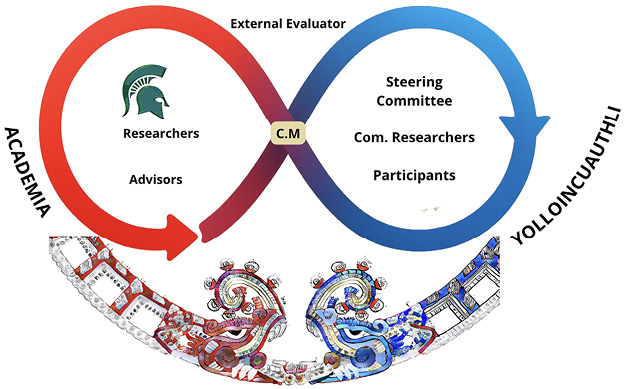
Figure 1 . Model of continuous communication and collaboration in D4L. The academia/western side of the loop is represented in red. The green Spartan Helmet mark is Michigan State University’s symbol, the institution where researchers Carolina Michel and Julie Libarkin worked. The right side of the loop, in blue, depicts the community space, with a research structure that mirrors that of YD. The arrows show the flow of energy (e.g., ideas and input) and resources (e.g., financial and human). The external evaluator, Alfonzo Mendoza, and the boundary spanner, Carolina Michel, sit in between and in both loops. Among the many meanings of the serpent is that of Earth knowledge. The two serpents stand for the balance and synergy of the western (red) and Indigenous knowledges (blue).
Community-led and Value-centred Research
Here, the community refers to the Yolloincuauhtli Danza group. YD was involved prior to the proposal and had meaningful input throughout the research process (Figure 2), gradually taking ownership of the project and its outcomes. Further, during the pre-proposal and early stages of the project, YD was asked for approval and to confirm their support for the project moving forward. If the group had not approved the project at the retreat, it would not have proceeded. This is an embodiment of respect.
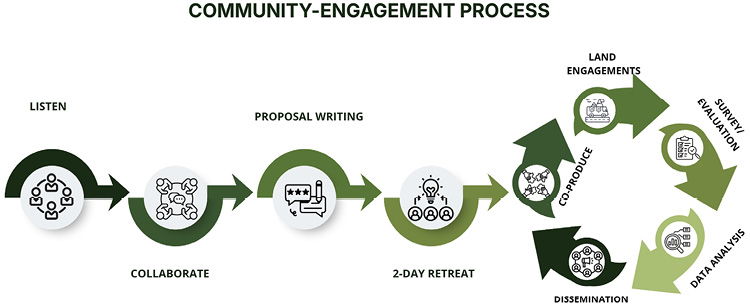
Figure 2. Community engagement process in Dance for Land.
Setting the Stage–Values Research
Our research foregrounded relationship and trust-building for our collaboration (Gardner-Vandy and Scalice. 2022. This was achieved through attitudes such as deep listening from researchers, sharing decision power, and valuing communities’ perspectives and contributions. The value of reciprocity/abundance was expressed in this case by compensating community researchers for the time they spent in the project, in meetings, writing or creating products.
Values were identified, analyzed and mobilised through the following activities:
1. Two-Day Retreat: To define foundational values, researchers Carolina Michel and Julie Libarkin, and progressively community researchers, used qualitative methods (Bernard 2018). Prior to the retreat, YD members (n =12) responded to a survey that asked them to create a list of values relevant to themselves, to YD, and to the larger Danza community. The items in this list were grouped in themes (Clarke & Braun 2017) by Lafaurie (facilitator). During the retreat, 25 participants worked in groups of four to five people to discuss a value assigned by the facilitator and responded to the prompt ‘what do you mean by this value’. Groups shared their thoughts. Notes were collected by the facilitator and given to Carolina Michel and Julie Libarkin who were present at the retreat. CM participated in the group discussion in her role as a dancer. She participated as a researcher in other instances, such as when providing more context for the funding. JL participated as an invited researcher, mostly listening and answering questions.
2. Community Researchers’ Meetings: Community researchers (n = 6, including CM, MA, EM, BS and MJ) discussed the values identified in the retreat in the context of Danza and Indigenous values. The group added more values during these meetings. Discussion around shared values was a common item on the agenda. Individually, we each reflected on how these values showed up in our life, in our work, how they might orient D4L and assist us when or if conflict occurs. In this sense, reflexivity emerged as a methodology for critically examining our value systems both individually and in the context of the project.
3. Graphical/artistic representation: Community researchers discussed how to represent the values. This process was highly individual. Some drew inspiration from the ancient codices; others tapped into their own creativity and understandings, and others used traditional Danza forms such as song. Community researchers were inspired to create their own representations of the values as they appeared in the Land Engagements.
Results
Identifying our Values
The pre-retreat survey produced 56 items that were grouped into six themes: (1) prayer/spirituality, (2) tradition/culture, (3) community/family, (4) welcoming and accepting, (5) decolonisation (later renamed transformation) and (6) respect. At the retreat, participants provided initial definitions. After the retreat, the community research group added two more values: (7) abundance/reciprocity and (8) care.
We analysed our values through multiple rounds of discussion, noticing the intricate connections created a value-tapestry rather than independent concepts with neat boundaries. We agreed on basic working definitions while acknowledging differences in our individual interpretations. Far from being a drawback, this brought richness to our results. We present these interpretations as dances below. Land Engagements are mentioned to contextualise the values. Although we do not unpack them in this article, the reader will get a glimpse of them through each dance. To help the reader with this section, we introduce the process of Danza. This serves two purposes: (1) explain how we navigated commonalities and differences when defining our values and (2) engage the reader as an active participant in Danza.
Danza Azteca
In Danza, one person is chosen to come to the centre to lead a dance; the rest follows. The dance comes from a shared repertoire; it is not free-style dancing. However, each dancer can personalise the steps to give it their own style. This is what we did with the values; each dancer will present their perspective on each of the eight values identified. To adapt the normative manuscript, we turned the results section into a ‘Danza’. Each D4L member offers their interpretations, artistic expressions, prayers and/or songs, to make a particular value tangible. You, esteemed reader, are in the outer circle. We invite you to follow along.
Upon entering the sacred space of the Danza, the sweet, fragrant scent of copal (a tree resin incense) hits the olfactory nerves. The copal smoke billows and rises, carrying our prayers to the heavens, inviting ancestors and preparing us to pray. Drummers stand in the centre of the circle and create rhythm on upright drums, which are approximately waist high. We can feel the vibration of the drums in our bodies and are filled with excitement, joy and a little nervousness. The nervousness stems from a desire for all to go well, and to temporarily let go of whatever is troubling us in our day-to-day lives. Before we begin to dance, we stand and turn to face each direction, starting with the East. To dance, we hop in place, sway, spin, squat, and jump, following the lead dancer. Each movement has its own meaning. Each dance has its own grammar. We close by turning to face each direction again, and by sharing words of prayer and encouragement of one another.
Audio 1. Song Montañas Lindas (Beautiful mountains; Aparicio 2026) https://works.hcommons.org/records/gxhk2-e3w27, written by Carlos Bermúdez Calvero
First dance: María: Value Prayer/Spirituality
The first step of the Danza is with the left foot. We are led by our hearts, which lie slightly to the left of the centre of our chests.
In the cosmology of the Indigenous Nahua people, one thinks with one’s heart. And with that first step, we begin a physical prayer, a prayer to ask for permission to begin our dance.
Similarly, when we begin a Land Engagement, we pray and we ask for permission. We acknowledge that we are but mere threads in the fabric that is the universe. We acknowledge that as humans, we are no greater and no lesser than those that crawl on the ground, those that fly and those that walk with four legs.
Each person prays in their own way. However, there are some common threads in our prayers. We pray that the ancient ones who once inhabited the land allow us to continue with our Land Engagement in a good way and that they accept our offerings. We may offer a song, some tobacco, some cornmeal or some flowers to those ancient ones and to the Land itself. We pray that those Indigenous peoples currently connected to the land we are visiting have their basic, human and civil rights met. We pray for the wellbeing of all non-human creatures and plants that may inhabit the land. We offer our hope that we learn more about the science and history of the Land. We pray that our children enjoy, play and learn as we engage. We pray for the health and happiness of those folks back home who were not able to attend. We also pray that the Land may be protected in perpetuity from destruction.
As we dance, let us take a step back, circling back to pre-Hispanic times for just a moment. The Mexica conceptualised time in 20-day increments, each marked by a ritual celebration honouring aspects of nature such as rivers, wind, rain and seeds (Meza Gutiérrez 2024). These celebrations, often centralising song and dance, were considered essential for a successful agricultural cycle rich with corn, beans, squash, chia, and agave to provide nourishment for the people. Thus, the people physically and spiritually gave of themselves, and in turn the Land provided for them.
This connection to the land continues today. For example, contemporary Danza ceremonies still honour key agricultural moments, such as the springtime. Inspired by a vision of Xipe Totec, the Mexica embodiment and mythological figure associated with the springtime, Danza captain Earthy Montiel led annual springtime ceremonies for several decades. Earth had envisioned Xipe Totec as having a life force circulating through him, and of plant life emerging from his body.
As participants in the Dance for Land project, we dance and we honour the Land. Upon visiting the ancient agave fields cultivated by the Hohokam people located in Marana, Arizona, we danced a particular dance by the name of Mayahuel. Mayahuel is the Mexica embodiment and mythological figure associated with agaves. We also read about the geology, archaeology, and horticulture of the agave fields. In addition, two archaeologists accompanied us and provided insights. Through this, we felt a deep spiritual connection to the agaves and the ancient cultivators, embodying Luna’s sentiment, “It is the people who belong to the earth, not vice versa.” (Luna 2011, p. 67).
Second Dance: Ramona: Value Transformation [Decolonisation/Resistance]
In the Dance for Land project, we have worked as a group to identify terms, phrases or words that express our shared values as a community. One word the group has used is decolonisation. I felt that word was developed in the American colonies to be free of the king. In medicine, decolonisation describes the killing of antibiotic-resistant cells.
Decolonisation is not the word I would use for the work we have been doing. I felt that the work in Dance for Land was not about being at war or killing parts of me but about being aware of the transformation and change I need, to be in the right relationship with the Earth: to understand the Earth’s ancientness and transformation through the retrieval of my own ancestral memory.
You have steps that you must complete to transform, like a butterfly. The agreed-upon value of prayer, family and recognition of the circular motion of nature, was the guide for our process of transformation to become community scientists, observers of cyclic changes. Awakening our ancestral knowledge passed through oral traditions in our family, and the shared knowledge of Danza. With western knowledge, understanding the geological landscapes explained migrations of our people and climate change from billions of years ago and how the land where we now reside changed.
Within our Dance for Land community, we pause to offer our ancestral respect for the elders’ elements of earth, wind, fire, water and the cosmos that we recognise as elders. We ask permission to be on the land and recognise the ancient and current caretakers of the land. We give thanks. We make offerings to nature and begin each engagement with gratitude for her cycles.
A Land Engagement in ancient agave fields once again reinforced the wisdom of our antepassados. They used rock mulching and careful placement of the agave field on fans so it could receive runoff from the mountains and thrive. Our ancestors brought this non-native plant to the Sonoran Desert and used their science to help it thrive and grow in a place not its home. Within the Dance for Land community, the majority are not from the Sonoran Desert. Transplanted like the agave, finding ways to connect cyclically to land, offering our flowers, our tobacco, our corn, our water, songs, our danza.
The land engagements allowed us to be embodied, to be in the present and observe it with ritual practice and with knowledge of the past and so we transform.
Prayer
Ōmeteōtl most giving and resourceful
I implore you
Make it your will
That this people enjoy
The goods and riches you naturally give
That are pleasing and savory
That delight and comfort,
Though lasting but briefly, passing away as in a dream
Third Dance. Mirna. Value Community/Family
Neuhua Notoca Agave, My name is Agave.
Today the ones who walk on two legs gathered many of us. One of them carefully separated me from my family. She kept my roots intact and wrapped them in wet fibres from my elders. They were offered back to the mother with sacred fire that concentrated their sweetness into syrup. Their sacrifice served to bring nourishment for the journey ahead. Fuelled by their nectar, my human carried me in her bundle north. She finds the place where the rain waters created the alluvial fans that guide the water down the mountain. She makes room in the flesh of our mother for my roots. She arranges stones at my base that gather and hold the rain for me to drink and brings me life giving water she gathered from a spring along the route. I have a new home now, where I have sun, wind, soil and wait for rain to grow.
As our ancestors migrated thousands of years ago, they were intimately in relationship with and familiar with every living thing around them. Their cosmovision guided their discovery and cultivation of select plant species to sustain them, such as the Agave . As we honour Mayahuel , sacred energy of the maguey (agave plant) and mark the Danza , Mother Earth receives the code in the rhythm and the steps. This dance mimics the motions of harvesting, roasting and processing the Agave. During our Land Engagements, we travelled, gathered, danced and related to each other and the land as nature. We learned from Professor Fish, that it took a collaborative effort of several families in the community to transplant, grow and roast agave. They showed us the evidence, the rock mounds and roasting pits. The children explored the roasting pit and found pottery shards. Families and communities have always migrated, collaborated and thrived on this continent. Through our connection to the land and conducting ancestral rituals, we reconnect with ourselves and our ancestors.
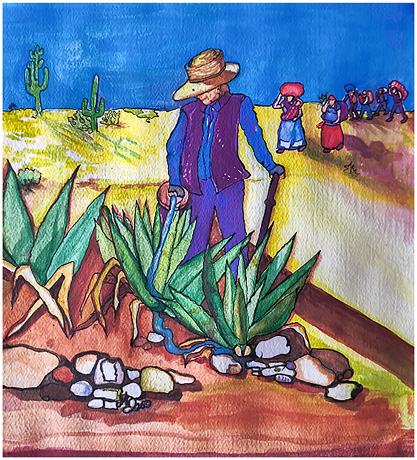
Figure 3 . This gouache on paper depicts the migration north of the plant species Agave murpheyi (Hohokam Agave). In loving memory of researcher Professor Suzanne Fish, depicted here watering the agaves she planted in Marana, AZ. Concept and artwork by Mirna Juarez.
Fourth Dance. Bloom. Value Reciprocity/Abundance
As we write this article in the year Ce Tochtli (One Rabbit), the world enters a fresh 52-year cycle and puts another to rest. May our prayers for balanced awareness and transformative love reach you and all our relatives across time, space and spirit.
This beaded medallion (Figure 4) depicts our research, during which we engaged with caves (Kartchner Caverns and Tonto Lower Cliff Dwelling), maguey plants (Marana Fields), water (present at all Land Engagements, with particularly large bodies of water at Roosevelt Lake and Bullfrog Lake), and rabbits (all), as well as celestial bodies including stars (Kartchner Caverns), the moon (Marana Fields), and our own human selves (all).
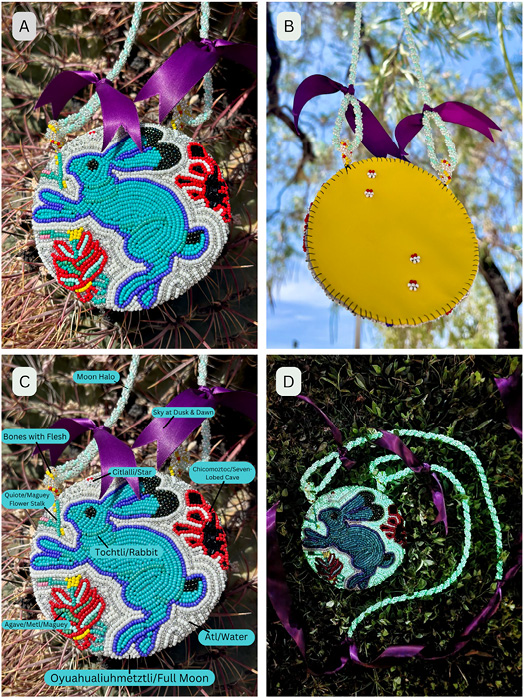
Figure 4 . A. Beaded medallion (front) depicting our research, during which we critically engaged with water, caves, maguey plants, rabbits and celestial bodies including stars, the moon and our own human selves. B. Beaded medallion (back) depicting stars as eyes of relatives, ancestors and descendants. C. Beaded medallion (front, with labelled elements). D. Beaded medallion (front, showing glow-in-the-dark features). Concept and beadwork by Bloom Sánchez; Black-Tailed Jackrabbit Sketch by Manny Fares; Photography support from Mirna Juarez and Manny Fares.
When our abundant planet’s moon is full and bright, you can see a tochtli (rabbit) on her face, a symbol of prolific fertility and imagination, as opposed to the tecpatl (flint knife) our Mēxihcah ancestors depict on a dark ‘new’ moon, symbolising the sacrificial offering of a dying, enigmatic moon that will soon be reborn again as the cycle continues. We also find this calm and refreshing element of yohualli (darkness) in periods of quiet renewal, in caves like Chicomoztoc (the emergence place of Nahua people), and beneath the soil in which we grow the restorative nutrients that fuel our futures. Obscurity, shadow and stillness provide a counterbalance to light and abundance, and yohualli thus supports critical elements of a healthy sacred womb, sheltering and caretaking the cosy home place that nourishes the creative and tender roots of change.
In Mēxihcah tradition we see Oyuahualiuhmetztli, the full moon, as a cup made of bone and filled with water, often depicted with bits of red and yellow decaying flesh. Just as the maternal quiote (reproductive stalk) of the maguey (genus Agave) plant falls from the sky to the earth when she gives her final blessings to her next generation, we view bones as seeds that support new life. So too our moon experiences these generative rhythms of life and death as water fills and empties throughout her phases, tilting gently to pour the lifeblood of rain down from the heavens. Citlaltin (stars) represent the brilliant, watchful eyes of ancestors and descendants as we attentively recover creative ways to provide for one another and live in harmony throughout life’s successions and cambios (changes, versions and phases). Tending to our relationships with these transmutative cycles, and dancing alongside these rhythms, help us cultivate resourcefulness within and between our communities.
As a Danza for Land team, our value of Abundance and Reciprocity revolves around nurturing these balanced and equitable exchanges of energy, resources and respect. To grow towards this vision, we work to cultivate intentional relationships through practice. We maintain and cherish a bountiful gratitude for life, for the generosity of the elements, and for our humble place in the flow-energy fabric of creation (Teotl). We assume best intentions from those with whom we share the miracle of community, we make space for meaningful accountability for our actions, and we balance what we give with what we receive. We know that our spiritual liberation and the wellbeing of our descendants seven generations from now depend on a true togetherness and resilience that transcends constructed borders, builds mutual reciprocal economies of labor and practice and emerges into complex adaptive systems between all beings.
Fifth Dance. Eli. Value Tradition/Culture
When I think about tradition and culture, I think about certain values, beliefs, norms, music and language. These are elements that each Danza group passes down to the next generation. In our practice of Danza, elements of our tradition and culture were passed down in a specific way to save their essence, and now this has transformed into different ‘languages’ of dance. What I have observed is that there are constants in our tradition: honouring the past, honouring the sacred and honouring our ancestors who did everything and anything possible to save our practices.
The central practice of recognising, acknowledging and engaging with the ancestors of any place has transcended millennia. During land engagements, this means taking time to recognise the ancestors connected to that land and asking how we should respectfully enter, gather, learn and act there. This tradition can take the form of a prayer, making an offering, saying an ancestor’s name and/or bringing them into your life and into what you are about to do. In that moment of acknowledgement, your present unites with your past and becomes an eternal expression of gratitude to nature and to the limitless cosmos. There are many elements within this tradition, but one in particular brings us together, regardless of the language we decide to connect to our creator: alabanza. There is one alabanza that really ties this in for me by Luis Antonio Ramirez Ornelas:
Aquellos Tiempos
Aquellos Tiempos cuando los viejos en una cuenta con Dios hablaban (×2)
Allí veían lo que pasaba y con ella daban a Dios las gracias (×2)
… Suben al cosmos entrelazados van con el humo que sube al cielo
Son energía flores divinas que embriagan mi alma de alegría
Por eso todo mi ser le ofrezco aquel que vida a todo ha dado
Prendiendo luces con gran respeto almas santas a ustedes rezo
… Luces divinas luces eternas, almas vengan a acompañarnos
Pues no olvidamos que por ustedes y con ustedes siempre danzamos
No olvidemos lo que enseñaron a encender velas al dios eterno
Pues en nosotros siguen viviendo y su legado siempre perdura
_________________________________________________________________
Those Times
Those times when the elders spoke with God in their obligation (2×)
There they saw what was happening, and with it they gave thanks to God (2×)
… They rise to the cosmos entwined, carried by the smoke that ascends to heaven,
They are divine energy, sacred flowers that intoxicate my soul with joy,
For that reason, I offer my whole being to the one who has given life to everything,
Lighting candles with great respect, I pray to you, holy souls.
… Divine lights, eternal lights, souls, come and accompany us,
For we do not forget that because of you and with you we always dance,
Let us not forget what was taught: to light candles to the eternal God,
For in us you continue living, and your legacy always endures.
Audio 2: https://youtu.be/TR8Mj0lnH1o?si=ctkBAfwTX8gh-zau
Lyrics: Córdova 2023
Sixth Dance. Carolina. Value Respect [Collaborations with Integrity]
We stand in a circle. Nobody in front, nobody behind. A circle orients our research, the D4L compass in Figure 5. In each of the four directions we find a precious jade stone, chalchihuitl, representing a foundational value. Two serpents create and hold the space for respectful collaborations between Indigenous and western peoples and knowledges. The blue serpent represents the Indigenous paradigm, and the red serpent represents the western one. They meet in a sacred circle in their right place, and as a result collaborations flourish, we come to know and benefit. At the centre lies a heart, a drum beating, and a triad of that which is above, that which is below, and that which is inside. The D4L compass reminds us of the connectedness of all values. If conflict arises, if we need to reorient ourselves, or check what we are doing, we can look at the compass and decide which value-direction will help us out. This symbol also talks about the coexistence, balance and dialogue between Indigenous and western knowledges inside an individual, which directly speaks to my experience as a danzante in academia.
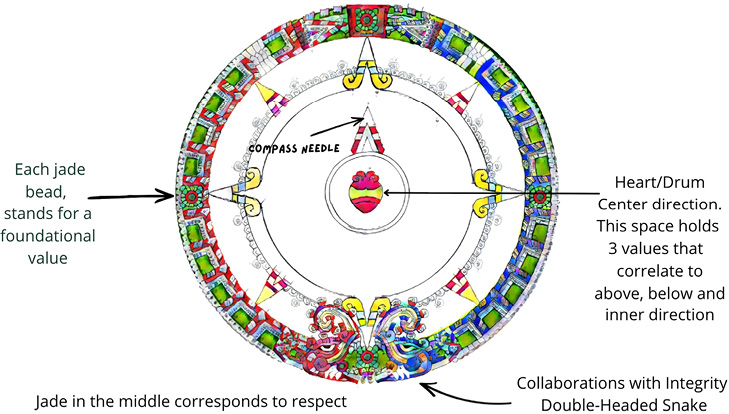
Figure 5. D4L value compass, adapted by Carolina Michel from Calendario Azteca o Piedra del Sol by Vega, CC, BY-SA 4.0.
The symbol in Figure 5 is a modification of the ‘Sun stone’, a carved basalt monolith that synthesises Aztec cosmology and time. The meaning and purpose of the stone are still debated and have been discussed elsewhere (Solís 2000). The two serpents represent two deities, the night and the day and the passage of time (Matos 2000).
The cosmic serpent, represented by a two-headed snake, is a framework that guides ethical collaborations between Indigenous and western peoples (Maryboy et al. 2012). As a transcultural symbol, the cosmic serpent is a global archetype highlighting the interconnected nature of Earth, space, life and environmental sciences. The serpent archetype has specific, varied and layered cultural meanings. Yet, as a global archetype, it conveys a message of the interconnectedness of all knowledges, and their entanglement with Earth, Cosmos and cycles. By adapting the cosmic serpent framework D4L, we articulate our work to that of Maryboy et al. (2012) and the communities they worked with. We seek to embody the value of respect and integrity to create a good space for all values.
Seventh Dance: Fonzi. Placing Care Forward [Care]
In the Dance for Land project, I observed community values in action. The community-agreed upon values included (1) prayer/spirituality, (2) tradition/culture, (3) community/family, (4) welcoming/accepting, (5) transformation/decolonisation, (6) respect, (7) abundance/reciprocity and (8) care. These values guided the ways the group interacted with each other. People were not just learning about Land and formal science as an object of study, but instead through active participation in the community that informed prayers, community relationships and engagements, reciprocal gatherings and transformative models. The learning and engagement with land, tradition and culture came through these values and were shared across participants, facilitators and community members.
In one visit, the group visited the Marana Agave Fields in traditionally Hohokam territory (occupied Arizona). As a part of this visit, we walked the historic Land and learned from western archaeologists who discussed the scientific and anthropological importance of the agave fields. The combination of history, ecological, geological and cultural knowledge allowed participants to build/renew a sustained connection to memory, land and community. As an evaluator, I found the most meaningful connections were not always easily captured through traditional metrics. Much of the project’s impact was visible in the quality of relationships built, the care with which knowledge was shared and the ways every member of the group were open to collaborating with one another, including the Land.
In my own experience with traditional and cultural knowledge, I believe the most important aspects of community-based participatory research are the care, respect and relationships that are maintained during and afterwards. Although initially I felt apart from the group as an outside observer, I was quickly welcomed into the group as a participant when appropriate, as well as a relative and community member. In the interviews I conducted with the danzantes, many explained that this project contributed to their process of self-discovery or rediscovery. The community values influenced their lives outside of the Land Engagements, and they practised and carried these values in their everyday lives. I see this project as an example of how community-based participatory research should function: as a collaborative, reciprocal and place-based approach to knowledge sharing, exchange and care.
Eighth Dance: Julie. Welcoming/acceptance
I have been transformed through being welcomed into the outer circle of Danza Azteca. I am neither Latina nor Indigenous but am rather the daughter of a first son born to immigrants from Eastern Europe and the daughter of a first daughter born to first-generation parents. I grew up without significant culture or community – although my parents spoke a language other than English, I never learned more than a few words. We had few rituals and very little that tied our family to others. As an adult, I have built my own found family and familiar traditions, but do not have a ‘community’. This is who I was when I was welcomed into Danza.
Overall, I have learned. We all know the harms and wounds and destructions wrought by colonisation in and beyond the Americas. And sitting with that knowledge is important. Yet, listening and learning during the retreat – especially the careful facilitation, free conversation and values exploration – opened opportunities for Yolloincuauhtli to imagine and explore a future of regrowth. Being welcomed to witness was a gift – seeing and hearing how history and culture and science and song and dance can interweave to bring greater meaning and connection to Land was overwhelming. The invisible threads that connect how we experience and make meaning of the world are more visible – western science is not something we need to bring people to. Rather, making meaning of the world is in everyone – and thus, as many participants realised, everyone can be and already is a scientist. In seeing this, I personally came to see how belonging can happen even when one is outside of a group (in the outer circle), and I am brought back to community. Dance For Land offered everyone – Yolloincuauhtli and western scientists alike – connection to each other and to Land.
Discussion: Reflections after Danza
Collaborations function on common ground. We ground ourselves in our Aztec Dance tradition, on the Land that supports us and on the values we agree to share. Danzantes of the Yolloincuauhtli group come from many tribes, life experiences, generations, personalities, knowledge bases, viewpoints and understandings. Working together is a sacred and sometimes heavy task that asks that we find ways to uplift, and not merely tolerate, the differences among us, both through big-picture open-sky dreaming of what is possible and a strategic collective knowing of what is important. From these varied perspectives we come together by upholding protocols that are an expression of values. For example, we ask for permission from the directions and bring offers to the Land; acknowledge the ancestors and the Indigenous Nations past and present and respect everyone’s voice in talking circles. These protocols maintain the elegant natural unity between Danza and science in an intentionally cultivated environment, preserving cultural traditions that serve innumerable multidimensional social, spiritual, economic, ecosystemic purposes. These living protocols confront the misunderstanding that Indigenous peoples are a stagnant figment of a long-departed conquered and colonised era and also support and encourage conversations regarding their own evolution directly.
Defining our values provided a strong foundation for our research and for building trusting relationships within and beyond the group. This was particularly important because when one of the members was both a dancer and a researcher, the relational fabric expanded from being personal to professional and to weaving in members from the research community into the Danza space. Aware of the strain this would create, and of the harms inflicted on our communities by western research/education, drawing on our values and mutual accountability effectively rooted the project in our tradition while creating space for western researchers and paradigms. Our values research consolidated us as an Indigenous/danzantes research group, oriented us, and served as an artefact for inspiration. Through our research process, structure, outcomes and reporting, we enacted the values of prayer. Locating our values in the larger context of Indigenous research in general, and that of Danza specifically, allowed us to honour Indigenous ways while attending to the specificity of our own community.
Consistent with our value of transformation and the cyclicity of our project design, the group made adjustments to better align work dynamics and activities. The two-day retreat illuminated the discomfort of some YD members with academia in general, and with academic settings, including the physical space of the conference room at the hotel where it was hosted. Choosing a community space, such as a community gathering place or even a casino/hotel – which are in tribal lands in the US, might have helped alleviate feelings of inadequacy or alienation. We also learnt that organising the room in a circle with no tables, and giving participants the option to sit on the floor, would have created a more welcoming space by aligning with the group’s style. These shortcomings were noted by members of the steering committee, and future activities followed their lead.
Indigenous community-led research thus moves beyond models conducted on, to or for communities towards work carried out with, by, and as communities (Koster, Baccar & Lemelin 2012; Michel et al. 2025). Using the group’s existing structures (i.e., military ranks), to map out the research team (steering committee, community researchers and participants) effectively allowed for many Danza rules and protocols to transfer tacitly into the research project. Relating to Land as a being, a teacher and a participant situates knowledge within living relationships, responsibilities and political contexts. In this way, research enacted with, by and as communities places power within communities (Wehipeihana 2019), helping to address and reduce harms associated with medieval legacies of colonial and imperial research practices.
Writing the Article
The writing process required negotiating the preferences, expectations and responsibilities of academic and community co-researchers. At the outset, Carolina Michel served as lead author and assumed primary responsibility for drafting, coordinating and adapting the standard research article (i.e., the ‘hourglass’ article, Malone 2023). This role distribution was a form of equitable exchange, acknowledging that academic publications offer incentives and rewards to western researchers that are irrelevant to non-academics (Harris et al. 2021). Although community co-researchers contribute essential knowledge, experiences and reflections, they do not generally benefit from academic publishing. They were generously compensated for their time. Community researchers were invited to contribute by exploring a value and its relationship to Land Engagements in writing or in ways that were meaningful and enriching to them. This included reflections, stories and artistic expressions, without the expectation of adhering to academic writing conventions. Some of these contributions are published on our community website https://dance4land.wordpress.com/.
Writing this piece occurred asynchronously and was complemented by meetings in which we discussed, listened to one another, and/or shared stories and artistic expressions. The group also held a writing retreat that included sharing a meal and time to socialise. Art and storytelling constitute both a way to pass on knowledge and the knowledge itself in Native science. In the words of Cajete (2000), ‘the application of the metaphoric mind brings forth the descriptive and creative “storying” of the world by humans.’ Freeing our writing from the standard structure of the academic article allowed each author to share their gifts to create a piece that articulates multimedia and the plurality of our knowledges. Co-researchers submitted their contributions to Carolina Michel who added them to the article; read and suggested changes to the rest of the text, and revised their contributions.
People working in community-engaged research, plural epistemologies, and science education fields may find the methodology for enacting values in writing provocative as they find ways to share their findings in a more communal way while respecting availability, capacities, interests and unique voices of community researchers. We encourage those embarking on inquiry alongside communities to define their shared values and enact them in writing. Researching values can be achieved by sharing stories, creating pictures or diagrams, and writing together as a way of knowing. Values influence behaviour and are part of the partnership culture. We encourage scholars and communities to adapt this method to meet their own needs. Specifically, we recommend (1) modifying the academic article to welcome contributions from community co-researchers unfamiliar with academic conventions, (2) removing the neutral or monotone to allow for co-presence and multivocality, (3) encouraging the use of art/multimedia in addition to written text and (4) finding ways to reciprocate the time and effort that the co-author put into the piece. In sum, we propose that the publication process in CBPR must evolve to include more voices as opposed to making all voices fit one convention. We hope that communities and community-engaged researchers greatly benefit from analysing and embodying their values and not only co-author academic articles but also innovate research, analysis, and outcomes.
Acknowledgments
This material is based upon work supported by the National Science Foundation under awards No. AISL-2415369 and DGE-2222234. The authors acknowledge the support of Yolloincuauhtli leadership: the Montiel sisters. Enjolie Lafaurie skilfully facilitated the 2-day retreat and helped to gather and analyse data on values. We also acknowledge the support of the sacred territory of the O’odham and Piipash, and the Pascua Yaqui where we live and dance.
References
Aguilar, M 2009, The rituals of kindness: The influence of the Danza Azteca tradition of Central Mexico on Chicano-Mexcoehuani identity and sacred space, pp. 553–554, The Claremont Graduate University.
Aparicio, M 2026, ‘Montañas lindas’ interpreted by María Aparicio, Mesa, Arizona: Carolina Michel. https://doi.org/10.17613/gxhk2-e3w27
Bernard, HR 2018, Research methods in anthropology: Qualitative and quantitative approaches, 6th edn, Rowman & Littlefield.
Bierhorst, J (ed.) 1991, In the trail of the wind: American Indian poems and ritual orations, Farrar, Straus and Giroux, New York.
Brown, LA & Strega, S 2005, Research as resistance: Critical, Indigenous and anti-oppressive approaches, Canadian Scholars’ Press.
Cajete, G 2000, Native science: Natural laws of interdependence, Clear Light Publishers.
Clarke, V & Braun, V 2017, ‘Thematic analysis’, The Journal of Positive Psychology, vol. 12, no. 3, pp. 297–298. https://doi.org/10.1080/17439760.2016.1262613
Cobban, AB 1975, The medieval universities: Their development and organization, Methuen.
Córdova, C 2023, Alabanzas y cantos: Septiembre 2023. Available at: https://www.scribd.com/document/717104180/Alabanzas-y-Cantos-Septiembre-2023-Recopilacion-Cristina-Cordova (Accessed: 21 September 2026).
David-Chavez, D, Gavin, M, Ortiz, N, Valdez, S & Carroll, S 2024, ‘A values-centered relational science model: Supporting Indigenous rights and reconciliation in research’, Ecology and Society, vol. 29, no. 2. https://doi.org/10.5751/ES-14768-290211
Emanuel, RE & Bird, KD 2022, ‘Stories we tell: Unpacking extractive research and its legacy of harm to Lumbee people’, Southern Cultures, vol. 28, no. 3, pp. 48–69. https://doi.org/10.1353/scu.2022.0025
Gardner-Vandy, K & Scalice, D 2022, ‘Relationships first and always: A guide to collaborations with Indigenous communities’, in The Astrobiology Science Conference (AbSciCon), pp. 321-05.
Grande, S 2010, ‘Chapter 21: Red pedagogy’, Counterpoints, vol. 356, pp. 199–207.
Harris, LA, Garza, C, Hatch, M, Parrish, J, Posselt, J, Alvarez Rosario, JP, Davidson, E, Eckert, G, Wilson Grimes, K, Garcia, JE & Haacker, R 2021, ‘Equitable exchange: A framework for diversity and inclusion in the geosciences’, AGU Advances, vol. 2, no. 2, p. e2020AV000359. https://doi.org/10.1029/2020AV000359
Israel, BA, Schulz, AJ, Parker, EA, Becker, AB, Allen, AJ, Guzman, JR & Lichtenstein, R 2017, ‘Critical issues in developing and following CBPR principles’, in Community-based participatory research for health: Advancing social and health equity, 3rd edn, pp. 32–35, John Wiley & Sons.
Kirkness, VJ & Barnhardt, R 1991, ‘First Nations and higher education: The four R’s – respect, relevance, reciprocity, responsibility’, in R Hayoe & J Pan (eds), Knowledge across cultures: A contribution to dialogue among civilizations, Comparative Education Research Centre, The University of Hong Kong, Hong Kong.
Koster, R, Baccar, K & Lemelin, RH 2012, ‘Moving from research ON, to research WITH and FOR Indigenous communities: A critical reflection on community-based participatory research’, The Canadian Geographer/Le Géographe canadien, vol. 56, no. 2, pp. 195–210. https://doi.org/10.1111/j.1541-0064.2012.00428.x
Kovach, M 2021, Indigenous methodologies: Characteristics, conversations, and contexts, University of Toronto Press.
Lamadrid, ER 2018, ‘Choreographies in ritual danzas and popular’, in Routledge handbook of Chicana/o studies.
Liboiron, M 2021, Pollution is colonialism, Duke University Press. https://doi.org/10.1215/9781478021445
Luna, J 2011, ‘Danza Mexica: Indigenous identity, spirituality, activism and performance’, PhD thesis, University of California, Davis, SJSU Scholarly Works, https://scholarworks.sjsu.edu/mas_pub/1/
Luna, J 2013, ‘La tradición conchera: Historical process of Danza and Catholicism’, Diálogo, vol. 16, no. 1, pp. 47–64. https://doi.org/10.1353/dlg.2013.0000
Maguire, P 1987, Doing participatory research: A feminist approach [online].
Malone, M 2023, ‘Re-imagining the research article: Social-semiotic signposts and the potential for radical co-presence in the scholarly literature’, Gateways: International Journal of Community Research and Engagement, vol. 16, no. 1, pp. 1–16. https://doi.org/10.5130/ijcre.v16i1.8606
Maryboy, N, Begay, D, Peticolas, L, Stein, J & Valdez, S 2012, The cosmic serpent: Bridging Native ways of knowing and Western science in museum settings, Indigenous Education Institute, Friday Harbor, 110 pp.
Matos, EM 2000, La piedra del sol, Fondo de Cultura Económica.
McCarty, TL & Lee, TS 2014, ‘Critical culturally sustaining/revitalizing pedagogy and Indigenous education sovereignty’, Harvard Educational Review, vol. 84, no. 1, pp. 101–124. https://doi.org/10.17763/haer.84.1.q83746nl5pj34216
McCoy, K, Tuck, E & McKenzie, M (eds) 2017, Land education: Rethinking pedagogies of place from Indigenous, postcolonial, and decolonizing perspectives, Routledge.
Meza Gutiérrez, A 2024, Cauhpohualli: Collar de turquesas engarzado con oro de Sol, Altepetl Editores.
Michel, CL, Libarkin, J, Huitzilopochtli, S, Kleiner, C, Huss, S, Velasco, K et al. 2025, ‘Researcher and community roles in geoscience education research’, Earth Science, Systems and Society, vol. 5, no. 1, esss2025-003. https://doi.org/10.1144/esss2025-003
Mignolo, WD 2000, Local histories/global designs: Coloniality, subaltern knowledges, and border thinking, Princeton University Press, Princeton, NJ.
Miño-Bucheli, S 2022, ‘We dance united: Aztec dance troupes preserve a proud heritage for Bay Area’s Latinx community’, The California Report Magazine, 3 November, KQED.org, viewed 29 May 2026, http://kqed.org.
Montgomery, M & Blanchard, P 2022, Testing justice: New ways to address environmental inequalities, Resilience.org, 17 February. Available at: https://www.resilience.org/stories/2022-02-17/testing-justice-new-ways-to-address-environmental-inequalities/ (Accessed: 21 September 2026).
Quijano, A 2000, ‘Coloniality of power, Eurocentrism, and Latin America’, Nepantla: Views from South, vol. 1, no. 3, pp. 533–580.
Quiroz, A 2025, Personal communication.
Solís, F 2000, ‘La piedra del sol’, Arqueología Mexicana, no. 41, pp. 33–39.
Styres, S & Zinga, D 2013, ‘The community-first land-centred theoretical framework: Bringing a ‘good mind’ to Indigenous education research’, Canadian Journal of Education, vol. 36, no. 2, pp. 284–313.
Tobias, JK, Richmond, CA & Luginaah, I 2013, ‘Community-based participatory research (CBPR) with Indigenous communities: Producing respectful and reciprocal research’, Journal of Empirical Research on Human Research Ethics, vol. 8, no. 2, pp. 129–140. https://doi.org/10.1525/jer.2013.8.2.129
Tsosie, RL, Grant, AD, Harrington, J, Wu, K, Thomas, A, Chase, S, Barnett, D, Hill, SB, Belcourt, A, Brown, B & Plenty Sweetgrass-She Kills, R 2022, ‘The six Rs of Indigenous research’, Tribal College Journal of American Indian Higher Education, vol. 33, no. 4. https://tribalcollegejournal.org/the-six-rs-of-indigenous-research/
Smith, LT 2012, Decolonizing methodologies: Research and Indigenous Peoples, 2nd edn, Zed Books, London.
Wehipeihana, N 2019, ‘Increasing cultural competence in support of Indigenous-led evaluation: A necessary step toward Indigenous-led evaluation’, Canadian Journal of Program Evaluation, vol. 34, no. 2, pp. 368–384. https://doi.org/10.3138/cjpe.68444
Wilson, SS 2004, Research as ceremony: Articulating an Indigenous research paradigm, PhD thesis, Monash University.