Gateways: International Journal of Community Research and Engagement
Vol. 19, No. 1
September 2026
RESEARCH ARTICLE (PEER REVIEWED)
Towards Equitable Employment: Academic Researchers’ Perspectives on Establishing a Participatory Research Social Enterprise in Canada
Batool AlMousawi1,*, Katelyn Greer2, Furqan Waleed3, Anmol Shahid2, Karyn Jackson4, Turin Tanvir Chowdhury2, Zack Marshall2
1 University of Toronto
2 University of Calgary
3 Community Alliance for Accessible Treatment
4 SafeLink Alberta
Corresponding author: Batool AlMousawi, batool.almousawi@mail.utoronto.ca
DOI: https://doi.org/10.5130/vdsyez26
Article History: Received 11/11/2025; Revised 17/06/2026; Accepted 24/08/2026; Published 09/2026
Abstract
Despite the social justice underpinnings of participatory research (PR), the community researchers driving this work are often employed precariously. This amplifies existing inequities, undermining ethical commitments and partnership sustainability. To address these inequities within Canadian institutional contexts, this study examines academic researchers’ perspectives on the potential of a participatory research social enterprise (PRSE) to act as an employer, training institution and bridge between community and academia. A mixed team of academics, students and community researchers co-conducted 19 virtual, semi-structured interviews with a diverse sample of academic researchers who compensated community researchers in federally funded PR projects. Analysed using a reflexive thematic analysis, participants envisioned the PRSE as a values-driven hub that serves as an intermediary between universities and individual academics by delivering ethical guidance, administrative and employment equity, professional development and community organising support. However, enthusiasm for the PRSE was tempered by feasibility concerns surrounding infrastructure limitations, financial viability and community relevance. The PRSE emerges as a promising innovation to address systemic inequities in PR; however, its success is contingent upon a co-designed blueprint that embeds features of relevance and resolves the structural, financial and relational challenges inherent to PR employment.
Keywords
Social Enterprise; Participatory Research; Labour and Employment Practices; Precarious Employment; Community-Based Research
Introduction: The Precarious Employment of Community Researchers Warrants Attention
Participatory research (PR) is an umbrella term for approaches that engage non-academic actors such as peer researchers, community scholars and organisations (henceforth collectively referred to as community researchers) as collaborators in the research process (Cargo & Mercer 2008; Vaughn & Jacquez 2020). Community researchers involved in PR may take on different types of roles, ranging from advisory consultation to data collection, analysis and knowledge mobilisation (Marshall et al. 2025; Mosavel et al. 2022; Shahid et al. 2022; Vaughn et al. 2018). Within PR, compensating community members for work within research teams is becoming an increasingly common practice, and multiple resources have been developed to inform PR compensation practices (CIHR 2022; Greer & Buxton 2016). These employment arrangements are diverse and include employing community members in part-time or full-time roles, engaging community researchers as self-employed contractors and compensating community members through honoraria or stipends (MacKinnon et al. 2021; Soklaridis et al. 2020). We refer to these work arrangements as ‘PR employment’ (Marshall et al. 2025).
Despite these emerging efforts, community researchers engaged in PR are often employed precariously (MacKinnon et al. 2021; Mertens 2023; Papoulias & Callard 2022; Ross et al. 2023; Soklaridis et al. 2020). Precarious employment is a social determinant of health that encompasses informal or temporary employment arrangements that erode health through employment insecurity, income inadequacy and a lack of worker rights and protections (Kreshpaj et al. 2020; World Health Organization 2008). Compensation in the context of PR employment is complicated by difficulties related to the valuation of community labour, mode of compensation, financial exclusion, human resource constraints, power imbalances, community researchers fearing retribution when self-advocating and structural barriers that amplify existing experiences of marginalisation that collectively underscore the urgent need for change (Greer et al. 2018, 2020; Guta, Flicker & Roche 2013; MacKinnon et al. 2021; Marshall et al. 2025; Papoulias & Callard 2022; Soklaridis et al. 2020). Reducing the precarious employment practices associated with PR is not solely a pragmatic goal, but a necessity to ensure that PR honours its social mission. Within high-income countries, the rise of precarious employment within the last century is attributed to increasing technological developments, privatisation and deregulation, and is independently associated with poorer health outcomes (Frank et al. 2023; Jaramillo, Trillos & Julià 2022; Jaydarifard et al. 2023). The values underpinning PR and material PR employment practices are therefore in tension with each other.
This study is part of Shift: Working for Change in Participatory Research (henceforth called Shift), a national, multi-phase research initiative dedicated to understanding and enhancing employment practices in PR. The Shift group is transdisciplinary, and includes community researchers, students and academic collaborators dedicated to improving the material realities faced by community researchers. Community and academic members of the Shift team are a highly experienced group of community-based researchers who each bring 15 – 25 years of experience in the field. Each Shift team member has worked on multiple community-based research projects and directly experienced the challenges with current employment models.
Alongside these experiences runs a parallel and intertwined history with community-based HIV research, where community researchers have consistently highlighted employment challenges and advocated for changes in the ways peer work is conceptualised and structured. Conversations as part of research teams, within the community and at provincial and national gatherings have highlighted the critical need for new ways of working. Collective models such as social enterprises or worker co-operatives have been discussed informally between community-based HIV research leaders in Canada for at least a decade. One specific conversation that informed the development of the current project was held at Not Without Us Halifax!, a learning institute was held in 2019 designed for and with advanced peer researchers. During the 3-day in-person gathering, Zack Marshall facilitated a session entitled, ‘Sustaining a national co-op model to support peer researchers in Canada: What will it take?’, exploring this topic with community and academic researchers in attendance. Data for this study are connected to Shift phase one, which occurred from 2019 to 2021, when the team surveyed principal investigators who held federal research funding from the Canadian Institutes for Health Research (CIHR), Natural Sciences and Engineering Research Council (NSERC) or the Social Sciences and Humanities Research Council (SSHRC) about their PR practices (Marshall et al. 2025). These data sources situate our analyses within the Canadian academic research context. While the general challenges of precarious employment are well documented, the empirical work presented draws on Canadian funding structures, institutional landscapes and research governance frameworks to structure the proposed approach. Specific strategies must be tailored to regional and jurisdictional contexts. Survey respondents were asked if they would be willing to participate in a follow-up qualitative interview. The current study formed part of phase two and employed semi-structured interviews with consenting survey participants. This article presents findings from the interviews and explored the potential benefits and challenges of establishing a participatory research social enterprise (PRSE), offered as an innovative response to the issue of precarious employment conditions within PR. Phase three of the study, envisioned at a later stage, will involve collaboratively developing a blueprint for the PRSE with a roundtable of diverse interest holders.
Social Enterprise Informed by the Social and Solidarity Economy
The social and solidarity economy (SSE) is a theoretical paradigm encompassing a diverse set of organisations, including worker cooperatives, community-development ventures and social enterprises, that explicitly value social objectives over profit imperatives (OECD 2011; 2023). Common approaches used by SSE organisations in the service of achieving a specific social mission include the democratisation of profit generation, organisational governance (i.e., collective ownership) and decision-making authority (Defourny & Nyssens 2017; Laville, Young & Eynaud 2015). These strategies support the mobilisation of market/non-market resources, while further empowering workers to exercise more control over their employment. Increased control improves psychological coping, emotional wellbeing and promotes good health (Borzaga, Salvatori & Bodini 2019; OECD 2023; Spector 1986; Thompson & Spacapan 1991). SSE organisations function as a distinct mode of economic organisation that has the potential to improve social equity and ecological sustainability (Utting 2015).
Social enterprises represent one expression of the SSE. They are designed to redirect profits towards social goals, including employment generation, harm reduction, poverty alleviation or health promotion (Roy, Lysaght & Krupa 2017; UNDP 2015). Evidence suggests that social enterprise employment is linked to improved health and social outcomes, particularly among economically disenfranchised groups experiencing labour market exclusion (Caló et al. 2019; Macaulay et al. 2018). For example, social enterprises may provide meaningful employment opportunities that create income security and offer flexible programming better attuned to the needs of individuals, facilitating feelings of connectedness, ownership and control for enterprise employees (Caló et al. 2019; Macaulay et al. 2018). Further, engagement with a social enterprise can lead to the development of individual and community-level assets, including healthy lifestyle, improved social functionality and investment into the local economy (Roy & Hackett 2016). Through the development of individual and community-level assets, individuals engaged with a social enterprise experience improved social capital, connectedness and coherence that collectively enhance health (Roy & Hackett 2016). This is further corroborated by evidence that highlights how social enterprise engagement can positively impact mental health, promote self-reliance and reduce stigmatisation (Roy et al. 2014).
Roy and colleagues (2017) present several examples of how engagement in Canadian social enterprises can begin to address the social determinants of health. In their work, they spotlight Inside Art, a British Columbia-based cooperative run by and for incarcerated individuals, as an example of how opportunities to engage disenfranchised people in business directly promotes positive wellbeing through increased confidence and skill development. Similar effects are seen across other Canadian social enterprises, including Manitoba Green Retrofit and Parkdale Green Thumb Enterprise in Toronto, where participants are meaningfully trained and employed in positions that cultivate feelings of belonging. Roy and colleagues (2017) advance that while lay and anecdotal evidence in support of social enterprise efficacy exists, particularly as presented through case examples such as these, there is a need to collect more empirical data on the effects of social enterprise engagement on health (Roy et al. 2014, 2017).
These cases highlight the unique value proposition presented by social enterprises. These approaches stabilise employment and cultivate local assets in contexts where market volatility and systemic inequities undermine more secure work (Roy & Hackett 2016). Further, social enterprises directly counter the instability of precarious employment via various operational mechanisms, including wage parity, formalised employment contracts that stipulate minimum hours, equity-driven hiring and social benefit structures (Borzaga, Salvatori & Bodini 2019; Utting 2015). This makes social enterprises particularly relevant to PR contexts, where precarious employment arrangements sustain and amplify inequities for community researchers. A social enterprise model applied to a PR context may be uniquely oriented to offer more equitable employment, while further embodying the values of reciprocity and relationships at the core of PR.
Proposing a Participatory Research Social Enterprise
In part, this conceptualisation of the PRSE is informed by existing participatory research initiatives that seek to support the equitable engagement of community researchers. In Canada, for example, Community-Based Research Canada (CBRCanada) is a leading organisation that supports community-based research via training, networking and institutional advocacy (CBRCanada n.d.). University-affiliated research centres and community-university partnerships also exist across Canada, including research shops at the University of Guelph and McMaster University, and the Community-Engaged Research Institute at Simon Fraser University (Community Engaged Scholarship Institute n.d.; McMaster University n.d., Simon Fraser University n.d.). These organisations help build capacity for PR in Canada by facilitating relationships between communities and academics, and providing best practice guidelines for engagement. However, these organisations are not positioned to navigate institution and funding body-specific barriers to precarious employment in Canada. To our knowledge, there are no social enterprises in Canada that serve as a bridge between community researchers and academia, engaging in agreements with academic institutions and community organisations to employ community researchers. The PRSE can be distinguished from other PR bodies in Canada in three ways: (1) the PRSE functions as the employer of record for community researchers (drawing on the formalised contracts, equity-driven hiring, wage parity and benefit structures modelled by organisations embedded with the SSE); (2) it formalises competitive wages, benefits and professional development opportunities within PR projects; and (3) it explicitly frames the precarious employment of community researchers as requiring an intentional course correction. In these respects, the PRSE builds on existing PR models and infrastructures by attending specifically to employment precarity as an unaddressed gap in equitable PR.
In the PRSE model, academic researchers seeking to collaborate with community researchers would enter a contract with the PRSE, which would serve as the employer of record. The PRSE would share job postings and administer human resources, support payroll distribution and provide legal support where necessary. For academic researchers, the PRSE would simplify the administrative burden while operating under a robust ethical framework. As part of this framework, the PRSE would support the development of more standardised employment contracts, promote transparent compensation practices and help create guidance on equitable labour practices. The PRSE would also be equipped to support academic researchers in navigating institutional and funding-related barriers to equitable employment.
Rather than hiring community researchers individually for each project, academic researchers would purchase specific research services from the PRSE. The PRSE would employ community researchers in paid PR roles, offering stable work options. The PRSE would provide fair wages, benefits and facilitate professional development to its community research workforce. By aggregating demand across multiple projects and partner institutions, the PRSE could offer longer-term or flexible employment options that could reduce the effects of precarious employment. For community researchers, engagement with the PRSE could mitigate the insecurity of grant-dependent work while further offering a pathway to meaningful employment.
In this way, the PRSE facilitates partnerships by addressing labour and employment challenges. As a values-driven social enterprise, establishing equitable employment practices is an intentional decision aimed at addressing community researcher employment precarity that undermines good health (Chatterjee, Cornelissen & Wincent 2021). A proposed model for the PRSE, including ideation related to core services, values and relevant interest holders is provided (Figure 1). The current study presents one phase of a broader, multi-phased research initiative, and attempts to assess the feasibility of developing the PRSE. Future research intends to empirically examine the specific health effects and employment outcomes associated with engaging directly with the PRSE.
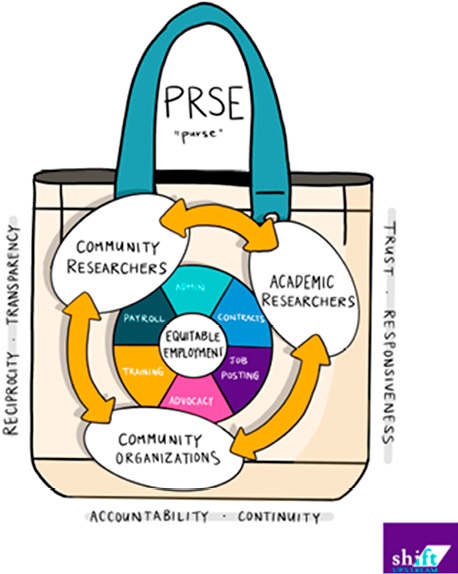
Note: The figure represents the model for the participatory research social enterprise (PRSE, pronounced ‘purse’). Illustration credit: Maya Morton Ninomiya
Research Questions
As part of this study, the authors sought to identify the key features and values that could incentivise engagement with a PRSE from an academic perspective. We also sought to explore factors that would limit engagement with the PRSE or otherwise undermine its sustainability. Specifically, the following questions guided our study:
1. What are academic researchers’ perspectives on establishing a PRSE?
2. What are the key features and values that academic researchers would like to see embedded into a PRSE?
3. What are the factors that may limit the sustainability of a PRSE?
Methods
Data Source, Study Population, and Sample
Of the 1793 people who responded to the original Shift survey, 288 indicated they would be willing to participate in an interview. From this group, 136 academic researchers reported compensating community researchers as employees or as self-employed contractors within their research project and were eligible to be interviewed. We recruited from this subgroup as our interview questions focused on the problem of precarious employment in PR.
To ensure sociodemographic variation in our sample, a purposeful stratified random sampling procedure was employed (Crenshaw 1991; Fox Tree & Vaid 2022; Palinkas et al. 2013; Parsons 2017). This ensures that voices historically excluded from academic discourses, particularly the voices of women, racialised and Indigenous faculty, were included in our study. Recruitment emails were distributed between 7 November 2023 and 21 November 2023, and sent in batches of 25. A total of 50 recruitment emails were distributed, and 19 participants were recruited.
To determine sample size, we drew on the notion of information power, which posits that the more information a sample holds relative to the study objectives, the smaller the sample can be (Malterud, Siersma & Guassora 2016). Based on the specificity of our sample and study objectives, we aimed to conduct between 15 and 20 interviews.
Ethics Approval
This study was approved by the Conjoint Health Research Ethics Board at the University of Calgary (REB #23-1218) and the Research Ethics Boards at Wilfrid Laurier University (REB #6640) and the University of Victoria (REB #23-0500).
Data Collection
All interviews were semi-structured and conducted virtually using the video conference software Zoom® (version 5.16.0). This design enabled the research team to raise questions beyond the interview guide and create a space for participants to ask questions at their discretion (Magaldi & Berler 2020; Velardo & Elliott 2021). Team members co-conducted the interviews to ensure a diversity of perspectives from community researchers, students and academic researchers were reflected. Due to scheduling conflicts, four interviews were conducted without a co-interviewer.
All interviews were recorded, transcribed using Otter.ai, and manually verified and anonymised prior to analysis. Transcripts were then reviewed using Braun and Clarke’s (2022) reflexive thematic analysis in the qualitative data analysis software NVivo (version 14) (Terry et al. 2017).
Data Analysis
To embody the reflexive process and support analytic rigour, data analysis involved a combination of reflexive memoing, visual mapping to support theme generation, and co-design of research outputs. Reflexive memoing encompassed informal notes and reflections taken after each interview during co-interviewer debrief sessions, enabling surfaced ideas to shape our understanding of the data and inform early codes. To create the codebook used during data analysis, two members of the research team (BA and KG) inductively coded two interviews. The results of this coding process were integrated into a single codebook that BA used to code the remainder of the interviews. After completing coding, BA clustered codes that shared meanings together using NVivo’s native parent/child node hierarchies. To support theme generation, BA organised the preliminary results of the coding using visual maps and diagrams and presented these findings with a subset of the larger team (ZM, KG). After this co-design session, the findings were expanded to encompass a greater array of concepts, and a comprehensive ‘theme guidebook’ was developed. During this process, themes were renamed and redefined to reflect emerging understandings of the data.
Results
Participant Demographics
Of the 19 participants interviewed for this study, 73.68% (N = 14/19) identified as women (Table 1). The average age of participants was 55.2 years (range = 40 to 70 years). More than half (57.89%) of the participants (N = 11/19) were identified as racialised and/or Indigenous. Stratified data on race/ethnicity and Indigenous identity were collected; however, detailed distributions were not reported to maintain participant confidentiality. Less than half (42.11%) of the participants were full professors (N = 8/19).
Note: The table features the demographic characteristics of the study sample.
*Other: denotes researcher participants in research director or other administrative academic roles.
Thematic Analysis Overview
The reflexive thematic analysis produced two overarching themes: (1) desired features and values of a PRSE and (2) considerations for feasibility and sustainability. Collectively, these themes highlight opportunities for the development of a PRSE, centring its unique value proposition while also emphasising the practical and logistical concerns that must be addressed for it to succeed.
Theme 1: Features of Relevance in the Establishment of a PRSE
Participants identified several features of interest when developing the PRSE that would increase their likelihood of engagement. These features reflect opportunities to potentially reduce or ameliorate the challenges participants reported experiencing in their research, and encompass both technical features and values relevant to conducting ethical PR.
Skills Exchange with Community Researchers
Many participants envisioned the PRSE as a training hub that could equip community researchers with various research tools, skills and competencies. While perspectives on the specifics varied across participants, the need for training was described as something that transcends single one-off education sessions. Rather, participants suggested an ongoing commitment to facilitating skills exchange, including research methods, mentorship and resource access. Some participants envisioned a more transformative approach, arguing that training should extend beyond formal research skills and move towards supporting community autonomy to drive and conduct research on their own terms. One participant specifically noted how ‘[Participatory research driven by community interests] sort of gives [community] space to be able to confront things on their own behalf, and then sometimes the tools, skills, and knowledge to do that more effectively’ (Participant 03).
By offering formal instruction in research methods, ethics navigation and research project management, community members would have opportunities to enhance transferable skills that strengthen the quality of community-led research and reduce dependence on university-based expertise. The participant further drew on the ideas of Oldenburg and Brissett (1982), highlighting how a physical ‘third place’ (an accessible location outside of the home and workplace to facilitate meeting and strategising) could allow communities to ‘… get more training... to brainstorm and come up with some of their own research questions or research objectives... have the connections to people... [and] have the space to be able to confront things on their own behalf’ (Participant 03). This comment illustrates a broader aspiration for the PRSE, in which knowledge exchange is a route to community self-determination. Another participant highlighted the value of having a space to support physical organising, emphasising how communities at the intersections of systems of oppression may benefit from enhanced visibility and connection through a model that resists extractive research practices. They observed:
I think it could be cool to have some kind of place for… communities that could really benefit from [enhanced research support]. Like, ‘Yes, we’re interested in this research, we see the possibilities, but we want to make sure that this, this, and this isn’t going to happen (Participant 17).
The presence of a physical space that supports community organising, coupled with general opportunities for skills exchange, positions PRSE as a hub for community-driven research and academic partnerships.
The PRSE as an Intermediary Between Universities and Communities
Several participants stressed misalignment between university systems and PR practices. Specifically, institutional rules, funding-body requirements and administrative procedures often limited participants’ ability to ensure equity in their PR. These tensions complicated academic and community partnerships. For instance, several participants cited challenges related to universities limiting access to research tools and technological infrastructure. This effectively excluded community researchers from participating in certain elements of research. One participant shared that:
Sometimes the hardest thing is mediating the relationship between the university and the community members. For instance, if we decide that we want to do a review of the literature, our community members don’t have access to our library. Managing that, negotiating that access, is incredibly frustrating… I could imagine a mediator that helps to facilitate those relationships, so it is not so frustrating (Participant 11).
In this account, administrative barriers undermined PR approaches. This not only limited the scope of community engagement but also reinforced the notion that community researchers are not recognised as legitimate producers of knowledge. Participants envisioned the PRSE as an intermediary capable of bridging discrepancies in understanding of PR between institutions, academics and communities. Rather than putting the onus on individual academics to negotiate agreements with their universities, the PRSE would serve as a bridging function between diverse interest holders. The PRSE could act as an advocacy body and logistical hub, handling paperwork, negotiating technical infrastructure and creating more equitable mechanisms for compensating community researchers. The above participant later showed enthusiasm for this model and shared that:
I would really like to see it building or developing partnerships with academic institutions and funders where there are gaps. If some funds don’t support food, make sure they do… this could be really interesting, a bridge between institutions and communities (Participant 11).
The PRSE would be uniquely positioned to advocate for flexible funding processes, including budgeting for food, transportation and accessibility support for community researchers that better align institutional practices with the material needs of community researchers. This approach could transform individual negotiations between academic researchers and institutions into a coordinated effort to imbue equity in the ways that institutions approach PR.
Values-Driven Programming
Across interviews, participants emphasised the importance of values in their PR practices, including reciprocity, transparency, accountability, trust, responsiveness and continuity. As such, their conceptualisations of the PRSE involved embedding these values in its governance, employment practices and day-to-day operations. Embedding a values-driven approach was identified as necessary for building trust and credibility with both community and academic researchers.
Many participants centred relationships at the heart of PR. Participants repeatedly described PR as a commitment to long-term relational practice over a transactional engagement. As one participant explained:
...Well, you know, people aren’t going to share with a stranger, but in the context of the work that we do… using those values of relationality and valuing people’s voices and [really] taking the time to illustrate that value (Participant 15).
These reflections underscore the importance of sustained presence and trust in relational work. For many participants, the PRSE must embody similar values and centre relational practice. Participants extended this relational piece to the structural level, envisioning the PRSE as an advocacy body capable of reshaping broader research practice. Rather than replicating university norms, respondents felt that the PRSE should challenge inequities and advocate for reforms in PR employment that better reflect commitments to social justice. In these views, advocacy involved pushing for more equitable pay scales, benefits and recognising community researchers as skilled research professionals. One participant specifically highlighted how the PRSE needed to advocate for the recognition of participatory labour as a whole:
So, it’s about legitimising the labour, it’s not just about, ‘Oh, you’re doing good for your community, so you get a pat on the head and here’s a little, $10’, or some kind of nominal fee. It’s about recognising that this is work (Participant 03).
The call to legitimise PR employment and labour reflects the positioning of the PRSE as an advocacy body concerned with social justice. Participants saw an opportunity for the PRSE to advocate directly with institutions and funding agencies to catalyse material change. In this way, the PRSE would help challenge structural inequities that devalue PR by attending to misalignments between actors. In aligning its own operations with PR principles, the PRSE could both reflect and model the social transformation it advocates for.
PRSE as a Reference Resource
Participants demonstrated interest in the PRSE operating as a knowledge hub where academic researchers could find practical guidance to support equitable PR. Given the complexities of PR employment, even experienced researchers found it difficult to bridge the evidence-practice divide. This is further complicated by university policies that differ across departments and jurisdictions, and the absence of formal templates, models or ethical standards tailored to PR. As such, the need to translate evidence into clear, actionable strategies to ensure fairness in PR has become increasingly relevant. As one participant summarised:
Where [the PRSE] would help is like… Once you have the funding, what do you do with it? How do you use it ethically? What are the standards? And so, [the PRSE would serve] as a hub of information for researchers… in terms of establishing standards and training to kind of fill the gaps that we have at the university… [by providing] sample memorandums of understandings, consent materials, pay scales, things like where we can get models to work off (Participant 05).
By offering resources to academic researchers seeking to do PR, including wage scales, consent forms and best practice recommendations, time spent otherwise negotiating institutional red tape could be avoided. However, regulations governing employment, taxation and research ethics vary widely by province and institution. One participant highlighted the need to ensure that recommendations remained flexible and regionally sensitive:
I think it would be great to do [PRSE], and keep an audit trail of challenges and things that work and use it as a model. I don’t think that it can be universal, I think they have to be locally based… Within each province, each institution will have its own rules and legality. So, I think it might be tricky, but I can see it working (Participant 13).
One recommendation to address this complexity involves maintaining a dynamic database of case studies or ‘audit trails’ that document successful engagement strategies and common pitfalls across different regions and institutional settings. This would enable researchers to reference operational strategies that are regionally and institutionally relevant, anticipate challenges and advocate for policy changes within their own institutions. Consolidating this information has the potential to elevate overall capacity for equitable PR, while respecting the diversity that exists within local contexts.
Theme 2: Considerations for Feasibility and Sustainability
While participants expressed interest in the conceptual promise of a PRSE, they also voiced concerns about its technical feasibility and long-term viability. These concerns centred on two interconnected issues: the need for reliable infrastructure and the limitations in funding availability. Without meaningfully attending to these complex issues, questions of sustainability could easily become unmanageable.
Backing Infrastructure, Resources, and Finances
Participants highlighted the structural realities of academic research, including the fact that grants are awarded on a project-by-project basis and are almost always time-limited, as a key determinant of the precarity of PR employment. The idea of research being contingent on ‘soft money’ (i.e., externally awarded, time limited research funding contingent on securing competitive funding awards) left participants feeling that there was little room to build infrastructure to support the development of permanent community research positions and offer health benefits. Some participants were curious about the mechanism by which the PRSE would sustain itself financially. One participant described the following:
Well, as an academic, it would make my life a lot easier, but... you’re downloading all these... really huge social problems... onto an organisation that is going to have even fewer resources to manage those challenges than the university does (Participant 26).
Others elaborated on the systemic nature of this constraint, explaining that these funding problems transcend PR and encompass the entire academic research enterprise:
Everybody’s on a contract, and I spent [my entire academic research career] writing grants so I could get money to keep my people… There’s no core funding for research positions, because universities don’t get money for that… research is always soft money… project by project, grant by grant, it’s time limited (Participant 07).
This recognition sparked larger conversations about how the PRSE, which intends to provide stable, equitable employment for community researchers, could avoid reproducing the precarity it aims to address. Participants questioned whether the PRSE would face the same challenges that university-funded research ventures often did and ultimately replicate bureaucratic and hierarchical processes. Beyond finances, participants emphasised the need for a robust backbone to support payroll, human resources, and governance. They raised the idea that the PRSE may serve as an additional bureaucratic layer for community researchers to navigate; this added complexity may ultimately undermine its feasibility. As exemplified by the participant quote below, structural and relational dimensions must be embedded into conversations about feasibility to ensure long-term sustainability:
You always need a backbone kind of infrastructure for it, and who leads the backbone? So then does it end up becoming an academic institution again, right? Around who holds power… the idea, concept, fantastic, but then, of course, you get into the nuance (Participant 04).
While there are no easy answers to these challenges, some participants offered insights into potential strategies. One participant suggested starting small and leveraging local institutional recognition to gradually expand the scale of PRSE programming. By first providing a local ‘proof of concept’, buy-in could then grow over time. They ultimately used this buy-in to envision a model in which both universities and funding agencies recognise PRSE as an eligible research partner. They explain:
I think it’s a great idea if you can get buy-in… It would require universities and funding agencies to also recognise it so that you could put into your grants… I think it would require quite a bit of buy-in to get into a position where faculty members and universities and research service centres would go there first (Participant 05).
Taken collectively, while many participants showed enthusiasm for PRSE’s mission, these expectations were tempered by the financial and infrastructural realities of academic research. Participants emphasised that without diversified revenue streams, commitments to leveraging institutional partnerships and a carefully designed governance model, PRSE might struggle to realise its central goal of reducing employment precarity in PR. This underscores the need for early planning around potential funding mechanisms, power-sharing structures and attention to long-term sustainability.
Utility of PRSE in Communities of Varying Needs
Although participants supported the idea of a PRSE as a resource to empower equitable PR practice, many cautioned against framing PRSE as a general recruitment support. Multiple respondents described engaging in partnerships that confront issues that are highly localised and are both population and context specific. These researchers viewed community knowledge as inseparable from place, community and governance. Respondents explained that these features could not be easily replicated or adequately ‘matched’ to a pre-existing body of skilled research professionals. For example, some academic researchers voiced the importance of land-based engagement in their work. One participant contrasted the value of connecting communities of practice with their own work with Indigenous communities:
I could see it working well for communities of practice that are dispersed across the country, where people don’t necessarily belong to a particular community that is really local and land-based… I can see it working with different types of populations, but with Indigenous communities, it might still be a good resource, but I’m not sure that it would take on quite the role as it might with other populations where there isn’t already some infrastructure (Participant 05).
Another participant raised similar concerns about projects focused on highly specific populations, arguing that recruitment often mobilises relationships with local networks, care providers or advocacy groups. They argued that to facilitate adequate recruitment, PRSE would need to maintain extensive, specialised connections with diverse networks and agencies and have capacity to connect academic researchers with these networks upon request. This raises practical issues related to scope of practice.
In response to these logistical challenges, respondents argued that a ‘one-size fits all’ model for the PRSE would risk reducing their ability to conduct PR in diverse contexts. Participants instead highlighted the appeal of multiple solution models offering flexible approaches tailored to working with different types of communities with a range of partnership styles. Ensuring that the PRSE adds value to contemporary PR practice without overinflating its applicability across the entire PR arena remains essential.
Discussion
To address the problem of the precarious employment of community researchers engaged in PR, this study explores the possibility of establishing a PRSE. This work contributes to ongoing debates about how to operationalise equity in PR by proposing a structural intervention that helps to address the material inequities experienced by community researchers. Participants approached the concept of a PRSE with cautious optimism and discussed features of relevance that would incentivise their engagement in this type of social enterprise. Specifically, they highlighted the PRSE’s potential to provide ethical employment infrastructure, support capacity building, bolster community organising and platform best practices in PR as reference resources. At the heart of PR, participants identified the significance of values, including relationality, transparency, reciprocity, accountability, trust, responsiveness and continuity. Respondents underlined the importance of embedding these values in the ethos, operations and governance of a PRSE, mirroring calls for values work in social entrepreneurship (Chatterjee, Cornelissen & Wincent 2021). Participants also raised critical questions about the PRSE’s funding, infrastructure and ability to generalise across diverse PR contexts, emphasising the value in supporting multiple models of practice. These questions reinforce the structural and relational challenges inherent to sustaining a values-driven social enterprise within an academic research ecosystem.
Participants discussed opportunities for the PRSE to support a suite of resources that guide best practices in PR. This could include platform templates, wage scales and equity-enhancing practices that ease the administrative burden placed on academic researchers seeking support for equitable engagement (Greer & Buxton 2016; Vaughn & Jacquez 2020). The PRSE could also serve as a knowledge intermediary; knowledge intermediary bodies have proven valuable across SSE contexts, where model sharing and public audit trails support learning and adaptation (Roy & Hackett 2016). Collectively, there is interest in the PRSE building and supporting a regionally attuned repository of PR resources that, when coupled with community-focused skills exchange and serving as an incubator for community organising, supports more equitable practice.
A central tension concerned the PRSE’s institutional positioning. Some participants described how aligning with a major university was a route to ensure financial stability and administrative support, while others cautioned that doing so may replicate deficiencies in university structures and policies, perpetuating practices that undermine the equity focus of PR (Nyden 2003; Vander Kloet & Wagner 2024). This is particularly relevant, given that universities are often constrained by bureaucratic and hierarchical processes that limit the equitable engagement of community researchers (MacKinnon et al. 2021; Papoulias & Callard 2022). Locating the PRSE outside a university may better align with SSE principles; however, independence raises sustainability concerns around funding, budgets and resource availability; the absence of which may undermine the positive effects of engaging with a social enterprise (Caló et al. 2019; Defourny & Nyssens 2017; OECD 2023). These tensions reinforce the need to collaboratively blueprint the PRSE moving forward in partnership with community and academic leaders. This blueprinting is envisioned for the third phase of this initiative, and embodies a co-design philosophy, in which community and academic leaders co-create governance structures, identify funding mechanisms and map opportunities for sustainability.
Strengths and Limitations
This project has two core strengths. First, it explores a novel application of a social enterprise model to a PR context. Second, by prioritising the participation of women, racialised and Indigenous researchers in our recruitment strategy, we were better able to seek insights from underrepresented groups in academia who disproportionately engage in emotional and relational labour central to PR practice (Marshall et al. 2025). This enabled us to better attend to dimensions of structural injustice institutionalised within academia (Elfil & Negida 2017).
This project has three main limitations. First, our recruitment strategy was limited by phase one of the Shift project, which, in 2021, surveyed federally funded academics in Canada who conducted PR between 2013 and 2018. In lieu of a national repository of PR projects, this pool of researchers was a convenient source from which to recruit participants, but its use limited participation to those who responded to the survey. Moreover, this naturally excluded researchers who receive no funding or external funding awards to support their PR work, or may otherwise contribute unpaid labour to community research projects. These voices are important in better understanding the full breadth of PR practice. In their absence, our sample may have over-represented federally funded tenure-stream perspectives.
Second, some participants recognised and had interacted with members of the research team independent of this research project. These existing relationships and interactions may have led the participants to view the idea of a PRSE more favourably. To account for this, members of the research team did not co-conduct interviews with participants they recognised.
Third, our analysis was not powered to reveal minute differences in codes generated across demographic groups. The absence of strong demographic differences may suggest that the larger structural barriers that underpin PR employment extend across diverse social positions within academia. However, our limited sample size precluded formal comparative analyses between different demographic groups. We encourage that future work attend to group-level differences in analyses via stronger analytic power and larger samples.
Future Initiatives and Research
The next steps for our project team will involve working with a group of community researchers and academics to collaboratively develop a conceptual framework and operationalisation plan for PRSE. Future research in this area might also seek to explore the viability of alternative solution models. Researchers interested in the social enterprise model may choose to conduct additional interviews with community researchers, university administrators and funding-body representatives.
Conclusion
In this study, we explored perspectives related to establishing a PRSE to support community-academic partnerships in PR, specifically by attending to employment equity. Participants generally appreciated the theoretical appeal of a model that facilitates equitable employment. However, budgetary and infrastructure-related processes were identified as barriers. Several features were identified that may facilitate academic researcher engagement, including ethical guidance, the creation of a focused space for community-driven action and support for knowledge exchange. Our findings inform the potential development of a PRSE and represent a promising means of addressing inequities in PR employment while simultaneously facilitating partnerships in PR. It is critical to continue dialoguing with academic and community researchers to ensure the PRSE is developed ethically and sustainably.
References
Borzaga, C, Salvatori, G & Bodini, R 2019, ‘Social and solidarity economy and the future of work’, Journal of Entrepreneurship and Innovation in Emerging Economies, vol. 5, no. 1, pp. 37–57. https://doi.org/10.1177/2393957518815300
Braun, V & Clarke, V 2022, Thematic analysis: A practical guide, SAGE Publications, London. https://doi.org/10.53841/bpsqmip.2022.1.33.46
Caló, F, Roy, MJ, Donaldson, C, Teasdale, S & Baglioni, S 2019, ‘Exploring the contribution of social enterprise to health and social care: A realist evaluation’, Social Science & Medicine, vol. 222, pp. 154–161. https://doi.org/10.1016/j.socscimed.2019.01.007
Canadian Institutes of Health Research [CIHR] 2022, Considerations when paying partners in research, viewed 18 June 2025, https://cihr-irsc.gc.ca/e/51466.html
Cargo, M & Mercer, SL 2008, ‘The value and challenges of participatory research: Strengthening its practice’, Annual Review of Public Health, vol. 29, pp. 325–350. https://doi.org/10.1146/annurev.publhealth.29.091307.083824
Chatterjee, I, Cornelissen, J & Wincent, J 2021, ‘Social entrepreneurship and values work: The role of practices in shaping values and negotiating change’, Journal of Business Venturing, vol. 36, no. 1, 106064. https://doi.org/10.1016/j.jbusvent.2020.106064
Community Based Research Canada [CBRCanada] n.d., Community-Based Research Canada, viewed 14 June 2025, https://www.communityresearchcanada.ca
Community Engaged Scholarship Institute n.d., About the Research Shop, viewed 16 June 2026, https://www.cesinstitute.ca/about-research-shop
Crenshaw, K 1991, ‘Mapping the margins: Intersectionality, identity politics, and violence against women of color’, Stanford Law Review, vol. 43, no. 6, pp. 1241–1299. https://doi.org/10.2307/1229039
Defourny, J & Nyssens, M 2017, ‘Fundamentals for an international typology of social enterprise models’, Voluntas: International Journal of Voluntary and Nonprofit Organizations, vol. 28, no. 6, pp. 2469–2497. https://doi.org/10.1007/s11266-017-9884-7
Elfil, M & Negida, A 2017, ‘Sampling methods in clinical research: An educational review’, Emergency, vol. 5, no. 1, e52.
Fox Tree, JE & Vaid, J 2022, ‘Why so few, still? Challenges to attracting, advancing, and keeping women faculty of color in academia’, Frontiers in Sociology, vol. 6. https://doi.org/10.3389/fsoc.2021.792198
Frank, J, Mustard, C, Smith, P, Siddiqi, A, Cheng, Y, Burdorf, A & Rugulies, R 2023, ‘Work as a social determinant of health in high-income countries: Past, present, and future’, The Lancet, vol. 402, no. 10410, pp. 1357–1367. https://doi.org/10.1016/S0140-6736(23)00871-1
Greer, AM, Bungay, V, Pauly, B & Buxton, J 2020, ‘“Peer” work as precarious: A qualitative study of work conditions and experiences of people who use drugs engaged in harm reduction work’, International Journal of Drug Policy, vol. 85, 102922. https://doi.org/10.1016/j.drugpo.2020.102922
Greer, AM & Buxton, JA 2016, A guide for paying peer research assistants, City of Vancouver, viewed 28 March 2021, https://paninbc.ca/wp-content/uploads/2016/05/A-guide-for-paying-peer-research-assistants-challenges-and-opportunities.pdf
Greer, AM, Pauly, B, Scott, A, Martin, R, Burmeister, C & Buxton, J 2018, ‘Paying people who use illicit substances or ‘peers’ participating in community-based work: A narrative review of the literature’, Drugs: Education, Prevention and Policy, vol. 26, no. 6, pp. 447–459. https://doi.org/10.1080/09687637.2018.1494134
Guta, A, Flicker, S & Roche, B 2013, ‘Governing through community allegiance: A qualitative examination of peer research in community-based participatory research’, Critical Public Health, vol. 23, no. 4, pp. 432–451. https://doi.org/10.1080/09581596.2012.761675
Jaramillo, NR, Trillos, CE & Julià, M 2022, ‘The measure of precarious employment and its impact on the mental health of workers: A systematic review 2007–2020’, Work, vol. 73, no. 2, pp. 639–650. https://doi.org/10.3233/WOR-210064
Jaydarifard, S, Smith, SS, Mann, D, Rossa, KR, Nikooharf Salehi, E, Gnani Srinivasan, A & Shekari Soleimanloo, S 2023, ‘Precarious employment and associated health and social consequences: A systematic review’, Australian and New Zealand Journal of Public Health, vol. 47, no. 4, 100074. https://doi.org/10.1016/j.anzjph.2023.100074
Kreshpaj, B, Orellana, C, Burström, B, Davis, L, Hemmingsson, T, Johansson, G, Kjellberg, K, Jonsson, J, Wegman, DH & Bodin, T 2020, ‘What is precarious employment? A systematic review of definitions and operationalizations from quantitative and qualitative studies’, Scandinavian Journal of Work, Environment & Health, vol. 46, no. 3, pp. 235–247. https://doi.org/10.5271/sjweh.3875
Laville, JL, Young, D & Eynaud, P 2015, Civil society, social enterprise, the third sector: Governance and democracy, Routledge, London.
Macaulay, B, Mazzei, M, Roy, MJ, Teasdale, S & Donaldson, C 2018, ‘Differentiating the effect of social enterprise activities on health’, Social Science & Medicine, vol. 200, pp. 211–217. https://doi.org/10.1016/j.socscimed.2018.01.042
MacKinnon, KR, Guta, A, Voronka, J, Pilling, M, Williams, CC, Strike, C & Ross, LE 2021, ‘The political economy of peer research: Mapping the possibilities and precarities of paying people for lived experience’, The British Journal of Social Work, vol. 51, no. 3, pp. 888–906. https://doi.org/10.1093/bjsw/bcaa241
Magaldi, D & Berler, M 2020, ‘Semi-structured interviews’, in V Zeigler-Hill & TK Shackelford (eds), Encyclopedia of personality and individual differences, Springer, Cham, pp. 4825–4830. https://doi.org/10.1007/978-3-319-24612-3_857
Malterud, K, Siersma, VD & Guassora, AD 2016, ‘Sample size in qualitative interview studies’, Qualitative Health Research, vol. 26, no. 13, pp. 1753–1760. https://doi.org/10.1177/1049732315617444
Marshall, Z, Wang, M, Benz, V, AlMousawi, B, Worthington, C, Morton Ninomiya, ME, Lauscher, D, Pooyak, S, Switzer, S, Watson, J, Wilson, CL, Demchuk, J, Coen, SE & Turin, TC 2025, ‘Participatory research in Canada (2013–2018): A cross-sectional survey of academic researchers’, Science and Public Policy, scaf061. https://doi.org/10.1093/scipol/scaf061
McMaster University n.d., Research Shop, viewed 15 June 2026, https://community.mcmaster.ca/our-programs-and-initiatives/research-shop/
Mertens, DM 2023, Research and evaluation in education and psychology: Integrating diversity with quantitative, qualitative, and mixed methods, 6th edn, SAGE Publications, London.
Mosavel, M, Henderson, A, Beck-Berman, R, Ferrell, D & LaRose, JG 2022, ‘The WE project partnership: The role and scope of community researchers’, Collaborations: A Journal of Community-Based Research and Practice, vol. 5, no. 1. https://doi.org/10.33596/coll.87
Nyden, P 2003, ‘Academic incentives for faculty participation in community-based participatory research’, Journal of General Internal Medicine, vol. 18, no. 7, pp. 576–585. https://doi.org/10.1046/j.1525-1497.2003.20350.x
Oldenburg, R & Brissett, D 1982, ‘The third place’, Qualitative Sociology, vol. 5, no. 4, pp. 265–284. https://doi.org/10.1007/BF00986754
Organization for Economic Cooperation and Development [OECD] 2011, Social entrepreneurship & social enterprises, viewed 28 February 2024, https://www.oecd.org/cfe/leed/social-economy/social-entrepreneurship.htm
Organization for Economic Cooperation and Development [OECD] 2023, What is the social and solidarity economy? A review of concepts, viewed 28 February 2024, https://www.oecd.org/en/publications/what-is-the-social-and-solidarity-economy-a-review-of-concepts_dbc7878d-en.html
Palinkas, LA, Horwitz, SM, Green, CA, Wisdom, JP, Duan, N & Hoagwood, K 2013, ‘Purposeful sampling for qualitative data collection and analysis in mixed method implementation research’, Administration and Policy in Mental Health and Mental Health Services Research, vol. 42, no. 5, pp. 533–544. https://doi.org/10.1007/s10488-013-0528-y
Papoulias, SC & Callard, F 2022, ‘Material and epistemic precarity: It’s time to talk about labour exploitation in mental health research’, Social Science & Medicine, vol. 306, 115102. https://doi.org/10.1016/j.socscimed.2022.115102
Parsons, VL 2017, ‘Stratified sampling’, Wiley StatsRef: Statistics Reference Online, pp. 1–11. https://doi.org/10.1002/9781118445112.stat05999.pub2
Ross, LE, Pilling, M, Voronka, J, Pitt, KA, McLean, E, King, C, Shakya, Y, MacKinnon, KR, Williams, CC, Strike, C & Guta, A 2023, ‘“I will play this tokenistic game, I just want something useful for my community”: Experiences of and resistance to harms of peer research’, Critical Public Health, vol. 33, no. 5, pp. 735–746. https://doi.org/10.1080/09581596.2023.2268822
Roy, MJ, Donaldson, C, Baker, R & Kerr, S 2014, ‘The potential of social enterprise to enhance health and well-being: A model and systematic review’, Social Science & Medicine, vol. 123, pp. 182–193. https://doi.org/10.1016/j.socscimed.2014.07.031
Roy, MJ & Hackett, MT 2016, ‘Polanyi’s “substantive approach” to the economy in action? Conceptualising social enterprise as a public health “intervention”’, Review of Social Economy, vol. 75, no. 2, pp. 89–111. https://doi.org/10.1080/00346764.2016.1171383
Roy, MJ, Lysaght, R & Krupa, TM 2017, ‘Action on the social determinants of health through social enterprise’, CMAJ, vol. 189, no. 11, E440–E441. https://doi.org/10.1503/cmaj.160864
Shahid, A, Lalani, IN, Rosgen, BK, Sept, BG, Longmore, S, Parsons Leigh, J, Stelfox, HT & Fiest, KM 2022, ‘A scoping review of methods to measure and evaluate citizen engagement in health research’, Research Involvement and Engagement, vol. 8, no. 1. https://doi.org/10.1186/s40900-022-00405-2
Simon Fraser University n.d., Community-Engaged Research Initiative, viewed 15 June 2025, https://www.sfu.ca/ceri.html
Soklaridis, S, de Bie, A, Cooper, RB, McCullough, K, McGovern, B, Beder, M, Bellissimo, G, Gordon, T, Berkhout, S, Fefergrad, M & Johnson, A 2020, ‘Co-producing psychiatric education with service user educators: A collective autobiographical case study of the meaning, ethics, and importance of payment’, Academic Psychiatry, vol. 44, pp. 159–167. https://doi.org/10.1007/s40596-019-01160-5
Spector, PE 1986, ‘Perceived control by employees: A meta-analysis of studies concerning autonomy and participation at work’, Human Relations, vol. 39, no. 11, pp. 1005–1016. https://doi.org/10.1177/001872678603901104
Terry, G, Hayfield, N, Clarke, V & Braun, V 2017, ‘Thematic analysis’, in C Willig & W Stainton Rogers (eds), The SAGE handbook of qualitative research in psychology, 2nd edn, SAGE Publications, London, pp. 17–37. https://doi.org/10.4135/9781526405555.n2
Thompson, SC & Spacapan, S 1991, ‘Perceptions of control in vulnerable populations’, Journal of Social Issues, vol. 47, no. 4, pp. 1–21. https://doi.org/10.1111/j.1540-4560.1991.tb01831.x
United Nations Development Programme [UNDP] 2015, Social enterprise: A new model for poverty reduction and employment generation, viewed 29 March 2025, https://www.undp.org/publications/social-enterprise-new-model-poverty-reduction-and-employment-generation
Utting, P 2015, Social and solidarity economy: Beyond the fringe, Zed Books, United Kingdom. https://doi.org/10.5040/9781350222618
Vander Kloet, MA & Wagner, AE 2024, ‘Accountability, ethics and knowledge production: Racialised academic staff navigating competing expectations in the social production of research with marginalised communities’, Higher Education Research & Development, vol. 43, no. 4, pp. 996–1010. https://doi.org/10.1080/07294360.2023.2291058
Vaughn, LM & Jacquez, F 2020, ‘Participatory research methods–choice points in the research process’, Journal of Participatory Research Methods, vol. 1, no. 1. https://doi.org/10.35844/001c.13244
Vaughn, LM, Whetstone, C, Boards, A, Busch, MD, Magnusson, M & Määttä, S 2018, ‘Partnering with insiders: A review of peer models across community-engaged research, education and social care’, Health & Social Care in the Community, vol. 26, no. 6, pp. 769–786. https://doi.org/10.1111/hsc.12562
Velardo, S & Elliott, S 2021, ‘Co-interviewing in qualitative social research: Prospects, merits and considerations’, International Journal of Qualitative Methods, vol. 20. https://doi.org/10.1177/16094069211054920
World Health Organization [WHO] 2008, Closing the gap in a generation: Health equity through action on the social determinants of health – final report of the Commission on Social Determinants of Health, viewed 28 February 2024, https://www.who.int/publications/i/item/WHO-IER-CSDH-08.1