Cultural Studies Review, Vol. 24, No. 2, 2018
ISSN 1837-8692 | Published by UTS ePRESS | http://epress.lib.uts.edu.au/journals/index.php/csrj/index
RESEARCH ARTICLE
Sight Unseen: Neoliberal Visions of (In)Security.
Dr. Bruce Buchan
Associate Professor in the School of Humanities, Languages and Social Sciences Griffith University.
Corresponding author: Bruce Buchan,School of Humanities, Languages and Social Science, Nathan campus, Griffith University, 170 Kessels Road QLD 4111, Australia, B.Buchan@griffith.edu.au
DOI: https://doi.org/10.5130/csr.v24i2.6051
Article History: Received 03/05/2018; Revised 30/08/2018; Accepted 30/08/2018; Published 28/11/2018
Citation: Buchan, B. 2018. Sight Unseen: Neoliberal Visions of (In)Security. Cultural Studies Review, 24:2, pp. 130-149. https://doi.org/10.5130/csr.v24i2.6051
© 2018 by the author(s). This is an Open Access article distributed under the terms of the Creative Commons Attribution 4.0 International (CC BY 4.0) License (https://creativecommons.org/licenses/by/4.0/), allowing third parties to copy and redistribute the material in any medium or format and to remix, transform, and build upon the material for any purpose, even commercially, provided the original work is properly cited and states its license.
Abstract
Is security seen? Is security seen in images of peace and safety, or is it perceived in the troubled images of the horrors of violence and suffering? Vision has played a crucial role in shaping the modern Western preoccupation with, and prioritisation of security. Historically, security has been visually represented in a variety of ways, typically involving the depiction of its absence. In Medieval and Early Modern Europe especially, security and insecurity were presented as coterminous insofar as each represented separate conditions–their shared boundary envisioned in representations of the temporal threshold separating human mortality from divine salvation. This ocular demonstration of thresholds has been heightened by the ‘war on terror’ conducted by neo-liberal states since 2001. Neoliberalism operates as a discourse of constant global circulations (of money, goods and people) premised on a perpetual anticipation and pre-emption of insecurity. In the neoliberal scheme, security and insecurity are no longer coterminous, but mutually sustaining in perpetuity. In that sense, neoliberal security is ‘sight unseen’ - an uncanny presence that is not there. In the reiterated troubled images of horror amplified by the seemingly endless ‘war on terror’, neoliberal security operates as a terrifying visual reflex: we cannot see it but in new horrors.
How do we see security? Is it seen in images of peace and safety, or is it perceived in the depiction of the horrors of violence and suffering? Security is not typically thought to be a quality of vision, or of the other senses. Rather, security is typically thought to pertain to the experience of physical, bodily integrity. Yet security is an uncanny concept in contemporary neoliberalism––a ghostly presence measured by its present absence. Neoliberalism is a doctrine that asserts the ruthlessly economistic basis of social order. Order is the spontaneous product of the individual pursuit of self-interest through market mechanisms that validate relations of monetary value maximization. This market utopianism, coupled with distaste for ‘planned’ economies, led some early neoliberals to view security with a degree of scepticism. As defined by the ideological ‘godfather’ of contemporary neoliberalism, F. A. von Hayek (1899-1992), the security consistent with the maximisation of liberty was simply the provision of physical safety and of basic needs.1 Forms of economic or social security, security of income or status, on the other hand, were redolent of planned economies that sacrificed individual liberty to absolute security.2 As a range of more recent critics have pointed out, however, the neoliberal prevarication on security and liberty masks the routine pairing of them by neoliberal governments who employ invasive techniques aimed at pre-empting perceived threats, or managing anticipated risks in the name of ‘liberty’ or ‘efficiency’.3 By these means the reach of neoliberal governments has been telescoped in both spatial and temporal dimensions––seeming at once to compress space by prioritizing the global circulation of goods, money and people, while accelerating time to accommodate the algorithmic speed of financial transactions.4 In the neoliberal-democracies of the Anglosphere, these techniques have imbibed a pervasive militarization in which the mobilization of perpetual war (whether it be on drugs, or on crime, or, perhaps most tellingly now, on terror) provides new opportunities for the expansion of market imperatives.
The ambiguity of security in contemporary neoliberalism is the product of a very long history of conceptual uncertainty––not simply about who is to be secured from whom, or the structure of mechanisms for providing security, but over the meaning and value of security itself.5 Thomas Hobbes (1588-1679) attempted to sweep away such uncertainties in the seventeenth century by construing security as the purpose for political order and the establishment of sovereignty. By these means, the aggressively acquisitive individuals he presumed humans to be, could secure themselves and their properties through mechanisms of government capable of inspiring mutual fear.6 Hobbes has proved an enormously powerful asset to the tradition of Western political liberalism for three main reasons. First, he provided a rigorously reductive account of human motivation premised on salient self-interest and acquisitiveness.7 Second, on that basis he provided a compelling foundation for prioritizing security of person and property by imaging the threat to both (the ‘war of all against all’) in the absence of an awesome sovereign––that ‘Mortal God’––that was alone capable of ending it.8 Third, his argument that such a sovereign could be both coercively awesome and based on narrow self-interest was resolved by means of a contract between subjects to establish sovereignty. Though liberals have always been deeply sceptical about the scope and extent of the Hobbesian sovereign’s power, in their avowal of the psychological salience of self-interest, the abhorrence of insecurity of person and property, and in their assumption that sovereignty emanates from a popular (even if not always contractual) consent, liberalism remains very much in Hobbes’ shadow.9
For that reason, liberalism has been haunted by the twin spectres of security and insecurity.10 The fear of the one snaps like a line of tension weighted by the dread of the other. This conceptual tension is an indelible sign not so much of liberalism’s incoherence, but of the supremacy of the Hobbesian security paradigm. In that paradigm, security is a fitful dream of individuals trapped between their fear of what fellow subjects would do to them in the absence of sovereignty (the ‘poor, nasty, brutish, and short’ life in the ‘state of nature’), and the fear (Hobbes calls it ‘terror’) of the sovereign. The insecurity of the state of nature is thus not simply abolished by the contractual establishment of sovereignty. It is subsumed within it, and the individual remains viz-a-viz the sovereign, in a veritable state of nature, as indeed each sovereign remains viz-a-viz other sovereigns.11 It is this paradigm, that makes security inseparable from insecurity that continues to reverberate within neoliberal discourse, especially in relation to the continuing ‘war on terror’.
By driving a relentless commodification and marketization of all social domains (labour, polity, family, community), neoliberalism creates anomic subjectivities conditioned to sustained precarity.12 Whereas liberalism had enabled governmental and civil society mechanisms for ameliorating the effects of marketization, neoliberalism accentuates perpetual human vulnerability which it commodifies as risk.13 Neoliberalism thus sustains human insecurity which in turn frames the creative projection of state sovereignty and, paradoxically, its diffusion among a host of corporate and private instrumentalities (prisons, militaries, tech companies, and other financial interests).14 Hence the personal liberty so prized by neoliberals is premised on institutional delimitations between zones for liberty (typically envisioned as markets), and zones for the invasive control of those deemed incapable of such liberty.15 The Hobbesian security paradigm perpetuates the neat assumption that while it should be understood merely as part of a contractual arrangement for mutual safety, it mobilizes discursive strategies under the radar enabling populations to be ‘striated’ into zones of security and insecurity, liberty and domination, and those ‘perpetually traversed by relations of war’.16 In the neoliberal ‘war on terror’ this paradigm of insecurity in security are accentuated. In this paper, I will place the Hobbesian ‘insecurity in security’ paradigm in a historical context in which visualization has played an important, if regularly under-examined role. Here, what is seen is security in its absence. I am not seeking here to study, as others have, the mediation of politics through images, nor how the law ‘looms’ over us in emblems and symbols.17 Rather, I have a different aim in exploring how security are seen in troubled images that encapsulate the apprehension of its absence. By doing so, I will argue that neoliberal security imbibes not only an absence at its heart, but a projection into that absence of terror and horror.
The troubled images of neoliberal security
Security resonates in contemporary politics like few other concepts. The provision of physical safety and protection has become the new categorical imperative in modern political rhetoric in liberal democracies worldwide.18 Yet this ethical imperative is profoundly compromised. In the name of security, those very same liberal democracies have pushed ever more invasive police and other surveillance powers, while they have also used security as a justification for policies that keep others (refugees, ‘irregular migrants’, over-policed racial minorities, or foreign subjects exposed to military interventions) in conditions of sustained and irremediable insecurity. This double feature of security as a mechanism for sustaining insecurity is captured by its visualization in the constant stream of troubled images of violence, cruelty, suffering and death in which we are all immersed.19 An ethics of troubled images demands of us a critical and reflexive study of how the very ubiquity of these troubled images conditions the ways we mediate our place in the world through virtual reality, social media, and digital technologies. Paying heed to these troubled images invites us to reconsider the ethical implications of security conveyed in our field of vision. Troubled images are those that normalise or legitimate violence, suffering and victimisation by their very ubiquity. Amid the welling tides of such images we are at once disoriented and disconnected by their constant supersession. Troubled images of security are those that convey the terrible uncertainty of its absence––in the sheer horror of violence and cruelty.
As long ago as 1826 the now little known pioneer of Gothic fiction, Ann Radcliffe (1764-1823), suggested that obscurity was the essence of terror. Terror was distinguished from horror in the experience of proximate anguish, so clear, so undeniable in its visceral impact it holds the imagination fast, rooted to the site of pain and revulsion. By contrast, the ‘obscurity, or indistinctness’ of terror, she wrote, ‘leaves the imagination to act upon the few hints that truth reveals to it’, and thus:
…it may, by mingling and confounding one image with another, absolutely counteract the imagination, instead of exciting it. Obscurity leaves something for the imagination to exaggerate; confusion, by blurring one image into another, leaves only a chaos in which the mind can find nothing to be magnificent, nothing to nourish its fears or doubts, or to act upon in any way…20
Here Radcliffe hints at something distinctly of our neoliberal moment––the succession of images, the chaos that comes from a blurring between troubled and troubling images creates an obscurity that is itself terrifying.21 Terror is a disabling, disorienting fear. ‘Now’ she asks, ‘if obscurity has so much effect on fiction, what must it have in real life?’
In real life today, a wellspring of images of deliberate human suffering flows from the fountainhead of visualized horror tapped by the neoliberal ‘war on terror’. Judith Butler has argued that we must respond to the multiplication of such images by focusing on the ‘framing’ of images of human precariousness, vulnerability and insecurity. We must acknowledge ‘what is left out, maintained outside the frame within which representations appear.’22 Butler’s analysis invites us to use images of horror against the process that created and framed them by tilting the images on their frames, highlighting the process by which the victims were anonymised, thereby locating their humanity in these frozen moments of scarifying fragility and precarity.23 Butler’s technique of paying attention to the framing of fragile humanity hits a raw liberal nerve in activating critique of the horrors perpetrated on largely anonymous or anonymized individuals in the name of their freedom and rights in the ‘war on terror’. How well can we apply her technique to the troubled images of horror so carefully framed by Islamic State executioners of terrifying, televised, and tweeted beheadings? These are images of victims whose suffering has been very clearly identified and deliberately, publicly, pitilessly and viciously eliminated, sometimes in urban settings, at other times in open, empty landscapes. In both cases, a terrain is being claimed and colonised, a state is being made in and by these acts of horror, and blood is shed in consecration of claimed sovereignty in vicious mimesis of the bloody tropes of Western imperialism. Each execution is a ceremony of possession, a reanimation of colonial presumption. These images succeed because they terrify. This is the object of campaigns of terrorism––to mobilize a generalisable condition of disorienting fear––a fear so profound it disrupts the framework of norms and expectations among the target population. Although the particular victims of these acts of terror are meant to be clearly identifiable, it is their vulnerability to attack, their random replaceability by any other individual or group that makes the strategy of terrorism so effective. Terrorism, whether employed by states or non-state actors, harnesses the fear borne of our random insecurity. This political affect is fuelled by the invocation of sheer horror, understood as a profound revulsion elicited by extreme violence and cruelty.24 Horror is induced most powerfully by proximity, unleashing the capacity of violence to overwhelm the senses, and for this reason it brings in its wake a paralysing fear.
Neoliberal warfare operates by making omnipresent the perception of horror, and the fear it generates, thereby making terror permanent––framing a field of vision in which security becomes inseparable from insecurity.25 This inseparability has not always formed part of the visual field of security. In order to explain why, I want to explore the visualization of neoliberal security in two images of death. The two images juxtapose our own global moment of frightful terror in a world whose supposed order is unravelling in unquenchable streams of blood, with a time almost 500 years ago when many also perceived a great unwinding of the order of the world, and indeed the cosmos, in an unleashed fury of blood shedding and cruelty. The first image is a photograph of a dead man on an operating table in an MSF hospital in Kunduz, Afghanistan, that was attacked, apparently by mistake, in late 2015 by an American gunship as part of the continuing (now 17 year-long) ‘war on terror’.26 The photograph (here) was taken about a week after the attack, that killed 42 medical staff and patients, by the photojournalist Andrew Quilty, on October 3rd. In 2016, the photograph garnered journalistic praise by winning the Nikon-Walkley Photo of the Year Award. According to the ABC, ‘The man in the image was identified as Baynazar Mohammad Nazar, 43, a husband and father of four.’27 The photo was published with the consent of Mr Nazar’s wife and son who believed that the image needed to be seen. Once seen, it is impossible to forget. The image encapsulates human frailty––the transience of life cruelly taken precisely at the moment when Mr Nazar had hope of medical treatment. A double cruelty. In the image of a hospital destroyed, a place we associate with the restoration of health and a site supposed to be privileged from the violence of war, the image conveys a double horror. The hospital itself has become a slaughterhouse. War and violence have turned the world upside down.
The second image (Figure 1) (here) dates from the tumultuous early years of the Protestant Reformation in Europe; 1521-22 to be precise. It is ‘The Body of the Dead Christ in the Tomb’ by Hans Holbein. Holbein’s is a calculatedly confronting image of the deathly rigor and putrefaction of the human Jesus. Holbein’s is a late product of a long tradition of iconography stretching back to the Byzantine tradition of depicting the dead Christ in Epitaphios Threnos images of lamentation over the dead Jesus, or as Basileus tes Doxes or the ‘King of Glory’ either dead upon the cross, or enthroned once resurrected.28 The point of these icons was precisely to underscore the divinity of Christ at the moment that his most vulnerable and frail humanity terminates. Western European artists adopted and adapted this tradition from about the middle of the thirteenth century where it developed its own stylistic tropes as Imago Pietatis, especially in the image of Christ as the ‘Man of Sorrows’.29 In early depictions, the ‘Man of Sorrows’ was often shown dead or dying upon the cross, but always copiously bleeding from his five wounds. In later images, Christ was typically shown in deathly contemplation of his wounds, especially the ostentatio vulnerum (the showing of his side wound), often surrounded by the arma Christi––the instruments of his final humiliation. In some devotional images, the ‘Man of Sorrows’ was kaleidoscopically rendered in a myriad depiction merely of the Arma, or his body fragmented and reduced to the lurid depictions of miraculously bleeding wounds.30
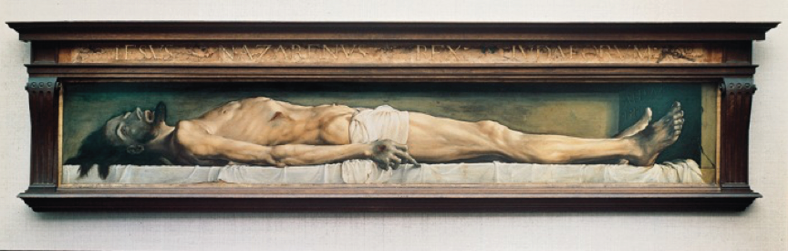
Figure 1 Hans Holbein ‘The Younger’, The Body of the Dead Christ in the Tomb, 1521-1522. (Der Tote Christus im Grab. Öl auf Lindenholz. Kunstmuseum Basel, Amerbach-Kabinett 1662. Inv. 318).
Holbein gives us the frail humanity of the dead Jesus, the agonized face, the rictus of his bony fingers, the bruised and tumid wounds. His image confronts us in presenting death, and that an anguished and agonizing death, as the avenue for contemplation of and access to the divine.31 There is no mediation of the agony by sorrow, as in Andrea Mantegna’s ‘Lamentation Over the Dead Christ’ (1480). Nor did Holbein choose to place us visually at Christ’s feet, thus foreshortening the bodily site of his agonies. Holbein instead has us literally in the tomb with Christ in frightful intimacy with his corpse. According to Julia Kristeva, the corpse or cadaver signifies a falling away from being:
…corpses show me what I permanently thrust aside in order to live… There, I am at the border of my condition as a living being. My body extricates itself, as being alive, from that border. Such wastes drop so that I might live, until, from loss to loss, nothing remains in me and my entire body falls beyond the limit––cadere, cadaver. …the corpse, the most sickening of wastes, is a border that has encroached upon everything.32
The existential opposition Kristeva identifies between abject corpse and living subject was not so firmly drawn in Medieval and Early Modern European culture. Holbein’s image of the ‘Dead Christ’ is a deliberate ‘encroachment’ in Kristeva’s terms, that is meant to take us ‘beyond the limit’ of our physical existence, but was to do so in a kind of rhapsody of death that was at once a guarantee, not a denial of personal security. Holbein’s image is thus an enlivening of the dead in intimate companionship, almost in exemplification of Leon Battista Alberti’s philosophy that ‘Painting contains a divine force which not only makes absent men present, as friendship is said to do, but moreover makes the dead seem almost alive.’33 Holbein presents Christ’s rotting mortality as a smorgasbord of putrefaction to overwhelm and enrapture us, synaesthetically bearing us toward the divine. In doing so, Holbein’s image was a visual affirmation of the Lutheran doctrine of justification by which the reception of holy grace depended on faith in the vitality of the resurrected Christ.34 Holbein chose to ground that vitality by juxtaposing it to the gruesome pallor of Jesus’ dead body. In doing so however, Holbein was not innovating, but molding an established tradition of depicting the suffering Christ.
In late Medieval Europe, the five wounds Christ was said to suffer at the crucifixion were thought by the devout to represent the possibility of salvation. The wounds became privileged objects of devotion, revered as thresholds of the divine, or as portals through which salvation may be achieved by opening a way to Christ’s ‘sacred heart’.35 The wounds on Christ’s body were to be read not simply as abstract metaphors, or empty symbols, but as real, physical spaces in which the divine was made present, tactile, and could even be tasted. Indeed, the security afforded by devotion to the wounds and blood of Christ’s own physical insecurity was thought of as a kind of ‘medicine’ for the soul.36 For this reason, greater significance was attributed to Christ’s copiously flowing blood––in the late Middle Ages depicted gushing out of gaping wounds in ever greater quantities, trickling down his tortured limbs, sometimes caught in a golden chalice.37 Here, the duality of Christ as mortal man and god, mirrored the duality of blood, as both life force and sign of death. Christ’s blood shed was a message for the devout. His blood was the substance of his human sacrifice, and a medium for our salvation, and hence of our ultimate security.
At the heart of this association between salvation and security lay the fundamental conviction that human life after ‘The Fall’ was marked by the perennial signs of our physical vulnerability (pain, death, sin, and violence). ‘Living in this wretched life, in these dying bodies’, St Augustine wrote, meant that we were ‘weighed down by the burden of their corruptible flesh…’ that only god’s gift of grace could avert.38 Insecurity, as St Augustine defined it, was literally inscribed in our bodies in the multiple avenues of our physical vulnerability; our uncurbed desires, our yearning for pleasure, our temptation to sin. Security consisted in that ‘peace [which] is most full and most certain’ only when guaranteed by divine order structuring all creation and human associations. Our security hinged on our quest for salvation: ‘an ordered obedience, in faith, under an eternal law’ achievable only in ‘the peace of the Heavenly City [which] is a perfectly ordered and perfectly harmonious fellowship in the enjoyment of God, and of one another in God.’39
It was this spiritual affirmation that enabled the ever more graphic visualization of vulnerable and traumatized Christly suffering to be understood as images of coterminous security/insecurity. In other words, these images operated as a bridge between the insecurity of profane life and the infinite security of salvation. In that sense, the condition of security/insecurity was coterminous insofar as the insecurity depicted in the ‘Man of Sorrows’ or in Holbein’s ‘Dead Christ’ was finite, as indeed was the illusory promise of security offered by the laws and governments in our physical lives. Insecurity and security were linked at a single moment where one condition gave way to another, where physical insecurity gave way to salvation, where life was sundered by death, and death conquered by eternal life.40
Leaving aside the difference in media between the two images, Quilty’s photograph of the abject corpse of Mr Nazar on the operating table in Kunduz, and Holbein’s painting of the ‘Dead Christ’, offer us two striking images of corpses that present to us Kristeva’s threshold. Whereas Holbein’s artwork can be understood as a threshold that encroaches upon the viewers by inviting them to prepare for their own crossing, Quilty’s photograph of Mr Nazar suggests a complete foreclosure of this coterminous boundary. In Holbein, the sarcophagus is a portal, a scoped projection from the most sacred of portals, the wound that Longinus inflicted in Christ’s side. Through the borders of the sepulchral entrance, the pious viewer attains hope of sacred deliverance from the trials and terrors of physical existence. In Quilty’s photograph, human vulnerability has been distilled into an image of perpetual insecurity typified by the placement of the corpse on the operating table––a site of remediation permanently ruptured. Here, there is no way through, but a perpetual withholding. Quilty’s is a perfect depiction of the unmediated and irredeemably abject insecurity generated by the neoliberal war on terror. Unlike Holbein’s image of Christ who is known by and revered in his death, Mr Nazar’s body has been stripped of identity and dignity. Defiled by the indifferent fall of rubble and begrimed by a carpet of dust from exploded masonry, Quilty’s image encapsulates the random and unexpected slaughter to be expected from both terrorism and war.
The banality of dust belies a key distinction between these two images of death. Dust, as Walter Benjamin reflected, is the patina of the mundane.41 Dust is the physical layering of desacralized time. Dust coats the surface things; it is a layer of ubiquitous grime laid down in time.42 Its presence is a visible reminder of the passage of time measured by inexorable decay. Holbein’s ‘Dead Christ’ is transcendent in death, his is the palour of timelessness. Undefiled by mere dust, Christ embodies the sacredness of the deathly undead. He is literally out of time. He is eternal. The body of Mr Nazar by contrast has become a surface begrimed by dust signifying the passage of time. Mr Nazar’s abject corpse is a symbol of the perpetual insecurity of neoliberalism. Holbein’s image uses the evident physical insecurity depicted in the ‘Dead Christ’ to suggest the security that is won by eternity. The coterminous boundary between life and death, or security and insecurity was not a physical demarcation, but a moment in time, or to be more precise, it was the moment at which time gave way to eternity. Quilty’s image however, depicts a perpetual frailty, a sustained vulnerability that passes no threshold. Time unfolds and reveals only the inexorable forces working on human insecurity. There is no threshold. Only the terror awakened by mutual exposure to perpetual insecurity. Quilty’s image reminds us that human vulnerability and insecurity as well as human safety and security constantly impend in the passage of time that begrimes bodies and buildings in dust.
Horror, terror, security
The visual fiat of contemporary neoliberalism resides precisely in making security a political imperative ‘sight unseen’. Neoliberal security is seen in images of insecurity. In order to interpret the novelty of this visible mandate, in this section, I will compare it to some earlier visualisations of the concept of security. One of the few of such images is Ambrogio Lorenzetti’s fresco of 1338-9 in the Sala dei Nove of the Palazzo Pubblico in Siena. In Lorenzetti’s vision, the barely clad and beautiful form of a young female, angelic ‘Securitas’ (here) flies out over a peaceful, orderly and productive contado of tilled fields, sturdy homesteads, and safe highways conveying prosperous merchants demonstrating the salutary effects of a well governed city for the inhabitants and travellers passing in and out of its gates. Most recently, Hamilton has read this image as typical of a pervasive Medieval concept of security understood as the ‘removal’ of threats.43 This negative quality of security pays scant regard to the dependence of security on the simultaneous visualisation of insecurity. The force of Lorenzetti’s fresco derived from its presentation of Good Government (and its effects) painted on one wall and Bad Government (and its effects) on the opposite wall of the Sala dei Nove––the hall in which Siena’s governing council (‘The Nine’) convened. Hence as the council processed to in judgment, the frescoed alternatives towered over them on their right (dexter-auspicious) and left (sinister-pernicious) hand sides. These frescoes and their deliberate placement were not simply a demonstration of visual truism, they were a vivid presentation of viable alternatives confronting governors and subjects each and every time they cast a political judgment.44 As Graziolo de Bambiglioli (1291-1342), Chancellor of Bologna from 1321-24, emphasised in his own verses on the virtues, the point was that only by emulating social virtues (prudence, magnanimity and fortitude), and eliminating vices (avarice, envy and fear) will the city avoid the miseries of war, and enjoy a ‘safe peace’ (sicura pace) and the blessings of ‘a secure and pleasant state’ (Sicuro e dolce stato).45

Hence, Lorenzetti’s images of the virtues of good government corresponded graphically, morally and politically to his images of the vices of bad government.46 ‘Securitas’ was paired with the corresponding image of ‘Timor’ (fear) flying out over the walls of the city foundering under ‘Bad Government’ (here). ‘Timor’ flies over a blasted landscape of burned farmhouses, tumbled bridges, ruined crops, and highways haunted by gangs of armed thugs. ‘Timor’ herself, pictured as a witch-like crone clad in rags with dishevelled hair and a cadaverous look, clutches in her emaciated hand a sword symbolizing arbitrary violence and terror. In contrast, the controlled, legal violence of ‘Securitas’ is symbolized by the abject figure of a hanging malefactor at the gallows that she holds in her outstretched hand in affirmation of the proposition familiar in late Medieval humanist scholarship, that by the terror of its punishment and the certainty of its laws the well governed city provides ample security to its subjects.47 Lorenzetti’s imagery is powerfully suggestive of an ideology of strict punitive justice, including capital punishment (which was certainly part of Siena’s legal codes). The rigor of punishment had been strongly recommended by Brunetto Latini in his widely read encyclopedia of humanist scholarship, the Livres dou Tresor:
Rigor is a virtue which restrains wrongdoing by a suitable punishment. … Cicero says: the third precept of rigor consists in removing evil men from the community of men; for just as one would amputate a limb if it began to be bloodless and lifeless, so that it would not cause harm to the others, one should separate the felony and the cruelty of evil men from the company of people…48
Later on in Book III Latini amplified the advice:
Above all things, the magistrate must see to it that the city which he governs is in good state, without turmoil and without crime, and this cannot be the case if he does not see to it that the country is emptied and free from thieves and murderers and all evildoers, for the law very clearly commands that the lord purge the country of evil people, and for this reason he has power over outsiders as well as insiders who commit crimes within his jurisdiction.49
Timor and Securitas operated together, representing for those in whose hands the fate of the city rested, two divergent but viable forks in the road. Timor and Securitas operated as coterminous conditions that the governing ‘Nine’ were asked to reflect on in the adjacent depictions of the effects of good and bad government. The security afforded by good government was manifest in the scenes of prosperity, armed force, certain justice and concord of citizens. The insecurity borne of bad government was characterized in the scenes of violent thuggery, the absence of law and justice, poverty and crumbling civic amenities. Good and bad government, security and insecurity, were viable options, each eternally potent but bound to finite moments in time, the one ending as the other began.
This visualization of coterminous security/insecurity ends with Hobbes. To see why, we need only look at the much remarked frontispiece to his 1651 masterwork, Leviathan, or the Matter, Forme, & Power of a Common-Wealth Ecclesiasticall and Civill (here).50 Much ink has been expended on the interpretation of Hobbes’ frontispiece image––its biblical framing, its portraiture likeness to King Charles II, its scenic structure conforming to a stage set that conceals as much as it reveals, and most recently its symbolic representation of monstrosity.51 The frontispiece was supervised by Hobbes himself, and it conveys in remarkably vivid terms the central elements of his, then, revolutionary argument. An earlier preparatory sketch (here) of the frontispiece was produced by either of two of the leading artists working in England at the time, Abraham Bosse, or possibly by Wenceslaus Hollar, for presentation to King Charles II. There are some significant differences between the two images, but together they encapsulate Hobbes’ argument that at the basis of all civil association, at the heart of any legitimate commonwealth lies the provision of security. In Hobbes’ scheme security is the supreme good that we all crave from the mutually violent and mutually acquisitive self-interest of our fellow men and women. Given his relentlessly bleak appraisal of human motivation, Hobbes’ answer to the security conundrum was to argue that we should understand our obedience to sovereign power as if it were established by social contract among the members of civil society to surrender their own power of self-protection to an awesome sovereign, either king or assembly or parliament, it really didn’t matter so long as the sovereign’s power vis-à-vis the subjects was awesome. This sovereign was named Leviathan in echo of the Biblical sea beast in the Book of the Job, whose terrifyingly scaly form could be over mastered only by God. Hobbes’ sovereign Leviathan was a literally terrifying creature, a beast of security Hobbes famously described as ‘that Mortall God, to which we owe under the Immortal God, our peace and defence.’52 The sovereign, Hobbes wrote, ‘…hath the use of so much Power and Strength… that by terror thereof’ this beastly monster is able to over-ride our own violent and competitive nature to ensure ‘Peace at home’ and defence against ‘Enemies abroad.’53 The function of the sovereign Leviathan was to terrify us into security.
The conceit of the 1651 frontispiece image is that the body of the Hobbesian sovereign is made from the bodies of those who have contracted to form it. The Leviathan thus appears in this image as a composite body, the individual subjects making up its form resembling the scales of the Biblical beast. Significantly, the sovereign Leviathan is framed in panoramic vision––in spectacular demonstration of its awesome status.54 Hobbes’ sovereign’s eye sees all, his mighty arms overreach the puny works of his tiny subjects. The subjects themselves are shown with backs turned to the viewer, as if they all in pilgrimage or homage to the sovereign, look up and inward into the body of the beast.55 Leviathan does not merely shelter bodies, but is literally made from them. Hobbesian security is a quality pertaining to bodies perpetually under threat, forever exposed to the possibility of irremediable insecurity. The Hobbesian subject is secured to the degree and only to the degree that he or she is suspended in a perpetual state of anticipation that is implied by the securing sovereign’s gaze outward, toward the far horizons in expectation of threat. Here the gaze is directed to the threat posed by other sovereigns who confront one another with ‘frontiers armed, and cannons planted against their neighbours round about.’
There is a greater scopic conceit of the Frontispiece, however, that reveals itself in our, the viewer’s, exclusion from the interior lines of sight within the body the sovereign Leviathan. The sovereign’s gaze alone is directed outward over a panoramically rendered landscape and cityscape––a terrain of security surveyed, seen, known, controlled. The sovereign towers mountainously over the denuded fields and streets, dominating the scale of both nature and civil society. Here, security is panoramic in its ambition and sweep. The Leviathan of Hobbes’ frontispiece stands over and dominates territory. The security offered by Leviathan is not agoraphobic (like that offered by the frightful intimacy of Holbein’s ‘Dead Christ’). Rather, the security offered by Hobbes’ Leviathan is claustrophobic. Leviathan surveys an entire landscape and cityscape of security. The tiny subjects who make up the sovereign’s body look inwardly. On looking at the Frontispiece, we see only their backs, but we are held in sight by the sovereign alone. The effect is deliberate. We have not joined the contract for security, we are invited to imagine ourselves remaining in the state of nature. As such we must imagine ourselves to be outside the social compact for security, and thus apprehended by the securitizing sovereign’s gaze. The sightlines built into the Frontispiece are thus an affirmation of the disruptive nature of Hobbesian ‘security’. It is a condition guaranteed only by the creation of a literally awesome, God-like sovereignty. It impends on us through anticipation, but it remains essentially elusive.
Carl Schmitt famously interpreted Hobbes’ sovereign divinity as an admission of the theological basis of modern sovereignty, and thus symbolic of the mythic structure of modern political thought.56 More importantly, by speaking of the attributes of sovereignty as god-like, Hobbes effectively liberated the sovereign from the contingency of the present enabling the resolution of our perennial anticipation of insecurity.57 It might have been possible in Hobbes’ ‘state of nature’ to conquer for oneself a sufficient security for a limited time, but no individual human conqueror could be omniscient and omnipotent. Even the strongest might be overthrown by an alliance among the weakest. It was in this sense that Hobbes likened the temporal dimension of war, and the insecurities it entailed, to the weather. As Hobbes’ expressed it, ‘...as the nature of Foule weather, lyeth not in a showre or two of rain; but in an inclination thereto of many dayes together’, so in a state of war the fear attendant on persisting, foreseen but not necessarily expected attacks rendered the subject inherently insecure.58 Hobbes’ ‘state of nature’ thus consisted in war: ‘and such a warre, as is of every man, against every man’, that persists over ‘a tract of time, wherein the Will to contend by Battell is sufficiently known…’. The unsustainable nature of this war of all against all animated the individual desire for a protection ‘to last all the time of their life’.59 Hobbes’ now classic description of the catastrophic condition of insecurity was framed temporally - in terms of this need to secure the future, making possible all the conveniences and commodities of civilised life.60
What enabled Hobbes to construe security in these terms was a shift in the understanding of time itself in Europe’s Early Modern period. As Ernst Kantorowicz noted long ago, the idea that Medieval Roman Catholic eschatology mandated an end of time at the Last Judgement, is false.61 Artistic representations of the Last Judgement throughout the period dwelt on the horrifying depiction of a sudden termination of time inexorably followed by judgement and damnation of the sinful. They also depicted scenes of new life––of the resurrection of the faithful and their inheritance of a new dispensation: eternity. Time did not end, but was transformed at the Last Judgement. A new orientation toward the future arose following upon the diversification of eschatological schemes in the Reformation and the prioritization of progress in Europe’s Enlightenment.62 This led toward the measurement of the rapidity of time’s singular and perpetual unfolding, not toward eternity but to an open future. This demanded an orientation toward change as constant and unbound.63 The effect of this intellectual development was to open the future as a field of indeterminate expectation; ‘from that time on’ Koselleck writes, ‘the horizon of expectation was endowed with a coefficient of change that advanced in step with time.’64 In response, the field of government expanded not only under the imperative of necessity (self-preservation), but of pre-emption, securing society and state on the basis of knowledge about the spaces and bodies within it and the strengths and vulnerabilities they represented.65 This change enabled the conceptual step Hobbes undertook to endow security with a temporal dimension, to cast it forward into an indeterminable future characterised by near constant anticipation of endemic insecurity. Security thereby came to refer, as Foucault memorably described it: ‘…to a series of possible events; it refers to the temporal and the uncertain…’.66 Zwierlein and Graf have described the same conceptual shift in another context, as the activation of a ‘mode of anticipation’.67 In this sense, the vision of security and insecurity ceased to be coterminous, and began to bleed into one another. Security could no longer be separated from insecurity by means of crossing thresholds in time. Rather, insecurity became constitutive of security, such that a release from the former or a lapse from the latter was no longer understood as a transition from one state to another, but a consequence of one’s place in the constant mutability and flux of exacerbated temporal uncertainty.
Conclusion
In this paper, I have used the concept of a troubled image to open up the investigation of how we see security by its absence, in pervasive insecurity. By focusing on vision––on how security is seen––I have sought to re-emphasise that security imbibes both spatial and temporal dimensions. Security exists not just in space and place, but in time. Security is forever forestalled by infinitude. Security of person, property, or polity is a dynamic relation of present means to future uncertainty. Security is thus clouded by obscurity, forever cast forward into an apprehended future that recedes beyond our comprehension. It is this feature of security, its obscurity, that seems heightened by the surging tide of digitally produced, enhanced and communicated troubled images of profound cruelty shot, shopped and shared on social media, momentarily renewed and replaced at dizzying speed. It is in this field of vision that security is seen by its absence.
The modern obsession with security seen as insecurity derives in part from the ultimate valuation of the term by Thomas Hobbes in his Leviathan. Inherent in the Hobbesian and neoliberal concept of security is a radical temporal indeterminacy that drives a constant desire for protection68 impelled by the apprehension of its future uncertainty. In the absence of a mechanism for the provision of security (which for Hobbes was an awesome sovereign Leviathan), it remained perpetually immanent. As Hobbes himself put it, there is:
…no way for any man to secure himself, so reasonable, as Anticipation; that is, by force, or wiles, to master the persons of all men he can, so long, till he see no other power great enough to endanger him…69
This avid search motivated by anticipated insecurity drove an incessant conquest resulting in a furious pre-emption ‘so as to avoid having to face prospective adversaries later.’70 Hobbes’ infamously bleak but resonant image of a brutish existence in the absence of the cooperation and amenity won through security was founded on the inability of the insecure to secure their future properties and livelihoods in both temporal and spatial dimensions.71 The condition of insecurity in the state of nature would persist, Hobbes argued, not merely because it was the price we paid to serve our own selfish interests, but because of our sovereign-less incapacity to pursue those very same interests by forming plans, making investments, or seeking knowledge––in short, by building the architecture of civilisation. To live in Hobbesian security then, was not simply to live in a safe or protected space, but to perceive its present absence in the uncertainty of time. Hobbesian subjects and sovereigns alike were immersed in the inexorable elapse of time in which security could only be apprehended by the anticipation of its loss––a state of Hobbesian fear.
In the reiterated images of horrific fragmentation amplified by the seemingly endless ‘war on terror’ today, security is the presently absent presence in neoliberal discourse. Security operates within neoliberalism much as horror operates in literature, as a freezing of reason in abject fear, an ontological vacuum that roots the self in place and strips it of identity and agency.72 Security is a ‘sight unseen’. What we see in its place is horror and insecurity. Horror has become an endemic presence in neoliberal security discourse which is now geared to perpetual war. Neoliberal security activates omnipresent horror that is ready to erupt at any moment, at any place. This is the problem of security at the heart of the neoliberal project: security cannot be seen but in new horrors.
Bibliography
ABC News Australia, ‘Airstrike on Afghan MSF Hospital last year not a war crime, says US military’, April 2016 <http://www.abc.net.au/news/2016-04-30/msf-hospital-strike-not-a-war-crime,-says-us-military/7372718>.
ABC News Australia, ‘Nikon-Walkley Awards: Graphic image from Afghan hospital bombing wins photograph of the year’, 7 October 2016 <http://www.abc.net.au/news/2016-10-14/nikon-walkley-photography-prize/7933176>.
Ainsworth, M.W., ‘”À la façon grèce”: The Encounter of Northern Renaissance Artists with Byzantine Icons’ in Helen C Evans (ed) Byzantium: Faith and Power, Yale University Press, New Haven, 2004.
Alberti, L. B., On Painting, Book II, trans. John R. Spencer, Yale University Press, New Haven, 1966.
Aradau, C., ‘The Signature of Security: Big Data, Anticipation, Surveillance’, Radical Philosophy, 2015, 191.
Atkins, E.M. and Dodaro, R.J. (eds.), Augustine: Political Writings, Cambridge: Cambridge University Press, 2007.
Augustine, City of God Against the Pagans, R. W. Dyson (ed.), Cambridge University Press, Cambridge, 1998.
Bambiglioli, G., ‘Trattato delle Volgari Sentenze sopra le Virtù Morale’ in L. Frati, Rimatori Bolognesi del Trecento, Romagnoli-Dall’Acqua, Bologna, 1915.
Barthes, R. Mythologies, trans. A. Lavers, Granada, London, 1973/1980.
Bätschmann, O. and Griener, P. Hans Holbein, Reaktion Books, London, 2014.
Belting, H. Likeness and Presence: A History of the Image Before the Era of Art, trans. E. Jephcott, University of Chicago Press, Chicago.
Belting, H., Likeness and Presence. A History of the Image Before the Era of Art, trans. by E. Jephcott, University of Chicago Press, Chicago, 1994.
Benjamin, W., The Arcades Project, trans H. Eiland and K. MacLoughlin, Cambridge, Mass: Belknap Press of Harvard University Press, 1999.
Bottici, C., Imaginal Politics: Images Beyond Imagination and the Imaginary, Columbia University Press, New York, 2014.
Brady, A. and Butterworth, E., (eds), The Uses of the Future in Early Modern Europe, New York, Routledge 2010.
Brown, W., ‘American Nightmare: Neoliberalism, Neconservatism and Democratizing’, Political Theory, vol. 34, no. 6, 2006, 690-714. https://doi.org/10.1177/0090591706293016
Buchan, B., ‘Liberalism and Fear of Violence’, Critical Review of International Social and Political Philosophy, vol. 4 no. 3, 2001, 27-48. https://doi.org/10.1080/13698230108403355
Burke, B. Fear of Security: Australia’s Invasion Anxiety, Cambridge: Cambridge University Press, 2008
Butler, J., Frames of War: When is Life Grievable?, Verso, London, 2009.
Coleman, J., ‘Negotiating the Medieval in the Modern: European Citizenship and Statecraft’, Transactions of the Royal Historical Society, vol 22, 2012, 75-93. https://doi.org/10.1017/s0080440112000072
Conze, E., ‘Security as a Culture: Reflections on a ‘Modern Political History’ of the Federal Republic of Germany’, German Historical Institute London Bulletin, vol 28, no. 1, 2006, 5-34.
Conze, W., ‘Sicherheit, Schutz’, in Otto Brunner, Werner Conze, and Reinhart Koselleck (eds.), Geschichtliche Grundbegriffe: historiches Lexikon zur Politisch-Sozialen Sprache in Deutschland, vol. 5, Stuttgart, 1974, 831-862.
Debrix, F., Global Powers of Horror: Security, Politics, and the Body in Pieces, Abingdon: Routledge, 2017. https://doi.org/10.4324/9781315725383
Debrix, F. and Barder, A., Beyond Biopolitics: Theory, Violence and Horror in World Politics, Abingdon: Routledge, 2012. https://doi.org/10.4324/9780203804810
Duffield, M., Development, Security and Unending War: Governing the World of Peoples, Cambridge University Press, Cambridge, 2007.
Evrigenis, I., Images of Anarchy: The Rhetoric and Science in Hobbes’s State of Nature, Cambridge University Press, Cambridge, 2014. https://doi.org/10.1017/cbo9781139023290
Fasolt, C., ‘Herman Conring and the European History of Law’ in Politics and Reformations: Essays in Honour of Thomas A. Brady, Jr., eds. C. Ocker, M. Printy, P. Starenko and P. Wallace, Brill: Leiden, 2007, 115-134. https://doi.org/10.1163/ej.9789004161726.i-476.31
Fishel, S., The Microbial State: Global Thriving and the Body Politic, Minneapolis: University of Minnesota Press, 2017. https://doi.org/10.5749/j.ctt1pwt5z8
Foucault, M. ‘Governmentality’, in G. Burchell, C. Godron and P. Miller (eds.), The Foucault Effect: Studies in Governmentality, Harvester Wheatsheaf, London, 1991.
Foucault, M., “Society Must be Defended.” Lectures at the Collège de France, 1975-76, M. Bertani and A. Fontana (eds.), D. Macey (trans.), Picador, New York, 2003.
Foucault, M., Security, Territory, Population. Lectures at the Collège de France, 1977-78, ed. M. Snellart, trans. G. Burchell, Palgrave, Houndmills, 2007. https://doi.org/10.22439/fs.v0i5.1412
Goodrich, P., Legal Emblems and the Art of the Law: Obiter Depicta as the Vision of Governance, Cambridge University Press, Cambridge, 2014.
Gray, D., ‘The Five Wounds of Our Lord’, Notes and Queries, vol. 208 February-May, 1963, 50-51, 82-89, 127-34, 163-68. https://doi.org/10.1093/nq/10-3-82d; https://doi.org/10.1093/nq/10-2-50; https://doi.org/10.1093/nq/10-4-127
Groebner, V., Defaced. The Visual Culture of Violence in the Late Middle Ages, Zone Books, New York, 2004.
Hamilton, J. T., Security. Politics, Humanity and the Philology of Care, Princeton University Press, Princeton, 2013.
Hayek, F. A., The Road to Serfdom, London, Routledge, 1944/2001.
Hindess, B., ‘Neo-liberal Citizenship’, Citizenship Studies, vol. 6, 2002, 127-143. https://doi.org/10.1080/13621020220142932
Hobbes, T., De Cive [On the Citizen], eds. R. Tuck and M. Silverthorne, Cambridge University Press, Cambridge, 1642/1998.
Hobbes, T., Leviathan, or the Matter, Forme, & Power of a Common-Wealth Ecclesiasticall and Civill[, ed. R. Tuck, Cambridge University Press, Cambridge, 1651/1996.
Hobbes, T., The Elements of Law, Natural and Politic, Human Nature, De Corpore Politico, ed. J.C.A. Gaskin, Oxford University Press, Oxford, 1640/1994.
Hunt, L., Measuring Time, Making History, Budapest: Central European University Press, 2008.
Jessop, B., The State: Past, Present, Future, Polity, Cambridge, 2016.
Kantorowicz, E. H., The King’s Two Bodies. A Study in Mediaeval Political Theology, Princeton University Press, Princeton, 1957/1997.
Kaufmann, F-X., Sicherheit als Soziologisches und Sozialpolitisches Problem, Stuttgart, 1973.
Kaufmann, F-X., European Foundations of the Welfare State, trans. John Veit-Wilson, Berghahn Books, New York, 2012.
Koepplin, D., ‘On Holbein’s Painting of the Pauline Creed of Law and Grace’ in Christian Müller (exhibition curator), Hans Holbein the Younger. The Basel Years 1515-1532, Prestel, Munich, 2006, 79-96.
Konings, M., ‘Governing the System: Risk, Finance, and Neoliberal Reason’, European Journal of International Relations, vol. 22 no. 2, 2016: 268-288. https://doi.org/10.1177/1354066115593393
Kristeva, J., Powers of Horror. An Essay on Abjection, trans. Leon S. Roudiez, Columbia University Press, New York, 1982.
Kristiansson, M. and Tralau, J., ‘Hobbes’s Hidden Monster: A New Interpretation of the Frontispiece of Leviathan’, European Journal of Political Theory, vol. 13 no. 3, 2014, 299-320. https://doi.org/10.1177/1474885113491954
Larkins, J., From Hierarchy to Anarchy: Territory and Politics Before Westphalia, Palgrave Macmillan, New York, 2010.
Latini, B., The Book of the Treasure (Li Livres dou Tresor), trans. Paul Barrette and Spurgeon Baldwin, Garland Publishing, New York, c.1267/1993.
Martel, J., ‘The Spectacle of Leviathan: Thomas Hobbes, Guy Debord and Walter Benjamin on Representation its Misuses’, Law, Culture and the Humanities, vol. 2, 2006, 67-90. https://doi.org/10.1191/1743872106lw004oa
Martinich, A.P., The Two Gods of Leviathan: Thomas Hobbes on Religion and Politics, Cambridge University Press, Cambridge, 1992.
Mavelli, L., ‘Governing the Resilience of Neoliberalism Through Biopolitics’, European Journal of International Relations, 2016: 1-24. https://doi.org/10.1177/1354066116676321
Norman, D., ‘Pisa, Siena, and the Maremma: A Neglected Aspect of Ambrogio Lorenzetti’s Paintings in the Sala dei Nove’, Renaissance Studies, vol. 11 no. 4, 1997, 310-342. https://doi.org/10.1111/1477-4658.00242
North, J., The Ambassador’s Secret: Holbein and the World of the Renaissance, Hambledon, London, 2004.
Olalquiaga, C., ‘Dust’ in Ruins, ed. B. Dillon, Whitechapel Gallery and MIT Press, London, 2011, 32-35.
Radcliffe, A., ‘On the Supernatural in Poetry’, The New Monthly Magazine and Literary Journal, Part 1, 1826, 145-152.
Rose, N., ‘Government, Authority and Expertise in Advanced Liberalism’, Economy and Society, vol. 22, no. 3, 1993, 283-299. https://doi.org/10.1080/03085149300000019
Rosenwein, B.H., Negotiating Space: Power, Restraint, and the Privileges of Immunity in Early Medieval Europe, Cornell University Press, Ithaca, 1999.
Rubenstein, N., ‘Political Ideas in Sienese Art: The Frescoes by Ambrogio Lorenzetti and Taddeo di Bartolo in the Palazzo Pubblico’, Journal of the Warburg and Courtauld Institutes, vol. 21 nos. 3-4, 1958, 179-207. https://doi.org/10.2307/750823
Rubin, M., Corpus Christi. The Eucharist in Late Medieval Culture, Cambridge University Press, Cambridge, 1991.
Schiller, G., Iconography of Christian Art. Volume 2. The Passion of Jesus Christ, trans. J. Seligman, Lund Humphries, London, 1968/1972.
Schmitt, C., Political Theology: Four Chapters on the Concept of Sovereignty, trans. G. Schwab, University of Chicago Press, Chicago, 2005.
Shoaf, M. G., ‘Painted for the Ear: Amborgio Lorenzetti’s “Fraud” and Political Oratory”, Word & Image, 159-174. https://doi.org/10.1080/02666286.2011.552240
Skinner, Q., ‘Ambrogio Lorenzetti and the Portrayal of Virtuous Government’, Visions of Politics, Volume II, Cambridge University Press, Cambridge, 2002, 41-67. https://doi.org/10.1017/cbo9780511613777.006
Skinner, Q., Hobbes and Republican Liberty, Cambridge University Press, Cambridge, 2008.
Sliwka, J., “Armet ed duritia’: Domenico Beccafumi and the Politics of Punishment’, in Art as Politics in Late Medieval and Renaissance Siena, eds. T.B. Smith and J. B. Steinhoff, Ashgate, Farnham, 2012, 163-194. https://doi.org/10.4324/9781315096933-9
Springborg, P., ‘Hobbes’s Biblical Beasts: Leviathan and Behemoth’, Political Theory, vol. 23 no. 2, 1995, 353-75. https://doi.org/10.1177/0090591795023002008
Williams, M.J., ‘(In)Security Studies, Reflexive Modernization and the Risk Society’, Cooperation and Conflict, vol, 43, no. 1, 2008, 57-79. https://doi.org/10.1177/0010836707086737
Yeatman, A. and Zolkos, M., (eds.), State, Security, and Subject Formation, Continuum, New York, 2010
Zwierlein C. and Graf, R., ‘The Production of Human Security in Premodern and Contemporary History’, Historical Social Research––special issue on The Production of Human Security in Premodern and Contemporary History, vol. 35 no. 4, 2010, 7-21.
Notes
1. F.A. Hayek, The Road to Serfdom, London, Routledge, 1944/2001, p. 124.
2. Hayek, Road to Serfdom, p. 132.
3. See for example, Michel Foucault, ‘Governmentality’, in G. Burchell, C. Godron and P. Miller (eds.), The Foucault Effect: Studies in Governmentality, Harvester Wheatsheaf, London, 1991, pp. 87-104; N. Rose, ‘Government, Authority and Expertise in Advanced Liberalism’, Economy and Society, vol. 22, no. 3, 1993, pp. 283-299; Barry Hindess, ‘Neo-liberal Citizenship’, Citizenship Studies, vol. 6, 2002, pp. 127-143; Wendy Brown, ‘American Nightmare: Neoliberalism, Neconservatism and Democratizing’, Political Theory, vol. 34, no. 6, 2006, pp. 690-714; E. Conze, ‘Security as a Culture: Reflections on a ‘Modern Political History’ of the Federal Republic of Germany’, German Historical Institute London Bulletin, vol. 28, no. 1, 2006, p. 12 5-34; Franz-Xaver Kaufmann, European Foundations of the Welfare State, trans. John Veit-Wilson, Berghahn Books, New York, 2012, pp. 137-138. This discussion is based on his earlier analysis of the sociological and socio-political problem of security: Franz-Xaver Kaufmann, Sicherheit als Soziologisches und Sozialpolitisches Problem, Stuttgart, 1973.
4. Bob Jessop, The State: Past, Present, Future, Polity, Cambridge, 2016, pp. 208-209.
5. John T. Hamilton, Security. Politics, Humanity and the Philology of Care, Princeton University Press, Princeton, 2013; W. Conze, ‘Sicherheit, Schutz’, in Otto Brunner, Werner Conze, and Reinhart Koselleck (eds.), Geschichtliche Grundbegriffe: historiches Lexikon zur Politisch-Sozialen Sprache in Deutschland, Volume 5, Stuttgart, 1974, pp. 831-862.
6. Janet Coleman, ‘Negotiating the Medieval in the Modern: European Citizenship and Statecraft’, Transactions of the Royal Historical Society, vol. 22, 2012, p. 93.
7. Hobbes was a key figure in the transformation of the ancient metaphor of the organic body politic into a mechanical construction. The contemporary implications of the metaphor are discussed in Stefanie Fishel, The Microbial State: Global Thriving and the Body Politic, Minneapolis: University of Minnesota Press, 2017.
8. Thomas Hobbes, Leviathan, edited by Richard Tuck, Cambridge: Cambridge University Press, 1651/1996, Book II, ch. xvii, p. 120.
9. Bruce Buchan, ‘Liberalism and Fear of Violence’, Critical Review of International Social and Political Philosophy, vol. 4 no. 3, 2001, pp. 27-48.
10. Anthony Burke, Fear of Security: Australia’s Invasion Anxiety, Cambridge: Cambridge University Press, 2008, pp. 10-12.
11. Hobbes, Leviathan, Book I, ch. Xiii, p. 90; II, xvii, p. 120.
12. Claudia Aradau, ‘The Signature of Security: Big Data, Anticipation, Surveillance’, Radical Philosophy 191, 2015, pp. 1–10.
13. Martijn Konings, ‘Governing the System: Risk, Finance, and Neoliberal Reason’, European Journal of International Relations, vol. 22, no.2, 2016: 268-288.
14. Susan George, Shadow Sovereigns: How Global Corporations Are Seizing Power, Cambridge: Polity, 2015, pp. 16-18.
15. Luca Mavelli, ‘Governing the Resilience of Neoliberalism Through Biopolitics’, European Journal of International Relations, 2016: pp. 1-24. On the growth of the liberal and neoliberal authoritarian state, Jessop, The State, pp. 231-233.
16. Michel Foucault, “Society Must be Defended.” Lectures at the Collège de France, 1975-76, M. Bertani and A. Fontana (eds.), D. Macey (trans.), Picador, New York, 2003, p. 49. Mark Duffield, Development, Security and Unending War: Governing the World of Peoples, Cambridge University Press, Cambridge, 2007, p. 227. See also the essays in: Anna Yeatman and Magdalena Zolkos (eds.), State, Security, and Subject Formation, Continuum, New York, 2010.
17. Chiara Bottici, Imaginal Politics: Images Beyond Imagination and the Imaginary, Columbia University Press, New York, 2014, pp. 93-95; Peter Goodrich, Legal Emblems and the Art of the Law: Obiter Depicta as the Vision of Governance, Cambridge University Press, Cambridge, 2014, p. 25.
18. M.J. Williams, ‘(In)Security Studies, Reflexive Modernization and the Risk Society’, Cooperation and Conflict, vol. 43, no. 1, 2008, pp. 57-79.
19. Bottici, Imaginal Politics, p. 162.
20. Ann Radcliffe, ‘On the Supernatural in Poetry’, The New Monthly Magazine and Literary Journal, Part 1, 1826, p. 150.
21. Bottici, Imaginal Politics, pp. 13-14.
22. Butler, Frames of War: When is Life Grievable?, Verso, London, 2009, p. 73.
23. Butler, Frames of War, p. 94.
24. Francois Debrix, Global Powers of Horror: Security, Politics, and the Body in Pieces, Abingdon: Routledge, 2017, p. 5.
25. Francois Debrix and Alexander Barder, Beyond Biopolitics: Theory, Violence and Horror in World Politics, Abingdon: Routledge, 2012, pp. 27-28.
26. The incident was investigated by the US military in April 2016 but the verdict, according to General Joseph Votel, commander of US Central Command, was that: “The investigation concluded that certain personnel failed to comply with the rules of engagement and the law of armed conflict, however, the investigation did not conclude that these failures amounted to a war crime”. ‘Airstrike on Afghan MSF Hospital last year not a war crime, says US military’, ABC News Australia, 30 April 2016, http://www.abc.net.au/news/2016-04-30/msf-hospital-strike-not-a-war-crime,-says-us-military/7372718 (accessed 12 June 2017).
27. ‘Nikon-Walkley Awards: Graphic image from Afghan hospital bombing wins photograph of the year’, 1ABC News Australia, 7 October 2016, http://www.abc.net.au/news/2016-10-14/nikon-walkley-photography-prize/7933176 (accessed 12 June 2017).
28. Maryan W. Ainsworth, “À la façon grèce’: The Encounter of Northern Renaissance Artists with Byzantine Icons’ in Byzantium: Faith and Power, ed. H.C. Evans, Metropolitan Museum of Art, New York, Yale University Press, New Haven, 2004, p. 556 [545-57]. Hans Belting, Likeness and Presence: A History of the Image Before the Era of Art, trans. E. Jephcott, University of Chicago Press, Chicago, p. 270-1.
29. Gertrud Schiller, Iconography of Christian Art. Volume 2. The Passion of Jesus Christ, trans. J. Seligman, Lund Humphries, London, 1968/1972, pp. 179-200; Hans Belting, Likeness and Presence. A History of the Image Before the Era of Art, trans. by E. Jephcott, University of Chicago Press, Chicago, 1994, pp. 158-159. As Schiller has explained, the imago pietatis was said to have miraculously appeared during the Mass of St Gregory in the sixth century, when the host is supposed to have turned into a bleeding finger. The Western tradition of depicting the ‘Man of Sorrows’ intensified after a Byzantine icon was displayed in the church of Santa Croce in Gerusalemme in 1350, a jubilee year, in which the Pope decreed a 14,000-year remission for prayers said in the presence of the icon.
30. Miri Rubin, Corpus Christi. The Eucharist in Late Medieval Culture, Cambridge University Press, Cambridge, 1991, pp. 168-9.
31. Oskar Bätschmann and Pascal Griener, Hans Holbein, Reaktion Books, London, 2014, p. 138.
32. Kristeva reminds us that the word cadaver derives from the Latin ‘cadere’ meaning ‘to fall’. Julia Kristeva, Powers of Horror. An Essay on Abjection, trans. Leon S. Roudiez, Columbia University Press, New York, 1982, p. 3.
33. Leon Battista Alberti, On Painting, Book II, trans. John R. Spencer, Yale University Press, New Haven, 1435-36/1966, p. 63.
34. Dieter Koepplin, ‘On Holbein’s Painting of the Pauline Creed of Law and Grace’ in Christian Müller (exhibition curator), Hans Holbein the Younger. The Basel Years 1515-1532, Prestel, Munich, 2006, P. 84. John North argues that at this time, Holbein was most likely influenced by the conciliatory attitude toward emergent Protestant teachings evinced by Erasmus and fostered by the humanist circles in which he moved. John North, The Ambassador’s Secret: Holbein and the World of the Renaissance, Hambledon, London, 2004, pp. 16-17.
35. Rubin, Corpus Christi, pp. 302-3; Douglas Gray, ‘The Five Wounds of Our Lord’, Notes and Queries, vol. 208 February-May, 1963, pp. 50-51, 82-89, 127-34, 163-68.
36. The late fifteenth century ‘Coventry Ring’ (AF.897) in the British Museum bears engravings of Christ in his sarcophagus bearing his wounds and surrounded by the arma. In part, the text inscribed on the ring reads: ‘The five wounds of God are my medicine, the holy cross and passion of Christ are my medicine…’. It is clear from this and other inscriptions, that the ring was a devotional object, which also had a ‘protective’ function in warding off ill health and the threat of violence. http://www.britishmuseum.org/research/collection_online/collection_object_details.aspx?objectId=45589&partId=1&people=89836&peoA=89836-1-8&sortBy=producerSort&page=1 (Accessed 7/2/17).
37. Valentin Groebner, Defaced. The Visual Culture of Violence in the Late Middle Ages, Zone Books, New York, 2004, p. 93.
38. Augustine, ‘Letter 155, Augustine to Macedonius’, in E.M. Atkins and R.J. Dodaro (eds.), Augustine: Political Writings, Cambridge: Cambridge University Press, 2007, p. 90.
39. Augustine, City of God Against the Pagans, R. W. Dyson (ed.), Cambridge: Cambridge University Press, 1998, Book 19.13, p. 938.
40. Long ago, Ernst Kantorowicz memorably spoke of the ‘bone-rattling vitality’ of the late Middle Ages intensified by the intellectual currents of the Renaissance, whereby a ‘fictitious immortality’ (in his case of regal dignitas) was made present ‘through a real mortal man as its temporary incarnation’. Ernst H. Kantorowicz, The King’s Two Bodies. A Study in Mediaeval Political Theology, Princeton University Press, Princeton, 1957/1997, pp. 436-437.
41. Walter Benjamin, The Arcades Project, trans H. Eiland and K. MacLoughlin, Cambridge, Mass: Belknap Press of Harvard University Press, 1999, pp. 102-118.
42. Celeste Olalquiaga, ‘Dust’ in Ruins, ed. B. Dillon, Whitechapel Gallery and MIT Press, London, 2011, pp. 32-35.
43. Hamilton, Security, pp. 140-144.
44. Nicolai Rubenstein, ‘Political Ideas in Sienese Art: The Frescoes by Ambrogio Lorenzetti and Taddeo di Bartolo in the Palazzo Pubblico’, Journal of the Warburg and Courtauld Institutes, vol. 21 nos. 3-4, 1958, pp. 182-4; Diana Norman, ‘Pisa, Siena, and the Maremma: A Neglected Aspect of Ambrogio Lorenzetti’s Paintings in the Sala dei Nove’, Renaissance Studies, vol. 11 no. 4, 1997, pp. 313-314
45. Graziolo Bambiglioli, ‘Trattato delle Volgari Sentenze sopra le Virtù Morale’ in L. Frati, Rimatori Bolognesi del Trecento, Bologna: Romagnoli-Dall’Acqua, 1915, XI, p. 14, and also, LXIIII, 33, LXXXVIIII, 42.
46. Matthew G. Shoaf, ‘Painted for the Ear: Amborgio Lorenzetti’s “Fraud” and Political Oratory”, Word & Image, vol. 27 no. 2, 2011.
47. Quentin Skinner, ‘Ambrogio Lorenzetti and the Portrayal of Virtuous Government’, Visions of Politics, Volume II, Cambridge University Press, Cambridge, 2002, pp. 41-67; Jennifer Sliwka, “Armet ed duritia’: Domenico Beccafumi and the Politics of Punishment’, in Art as Politics in Late Medieval and Renaissance Siena, eds. T.B. Smith and J. B. Steinhoff, Ashgate, Farnham, 2012, p. 169.
48. Brunetto Latini, The Book of the Treasure (Li Livres dou Tresor), trans. Paul Barrette and Spurgeon Baldwin, Garland Publishing, New York, c.1267/1993, II, 92, 1-2, p. 241.
49. Latini, Tresor, III, 91, 1, p. 370.
50. Thomas Hobbes, Leviathan, or the Matter, Forme, & Power of a Common-Wealth Ecclesiasticall and Civill[, ed. R. Tuck, Cambridge University Press, Cambridge, 1651/1996.
51. M. Kristiansson and J. Tralau, ‘Hobbes’s Hidden Monster: A New Interpretation of the Frontispiece of Leviathan’, European Journal of Political Theory, vol. 13 no. 3, 2014, pp. 299-320. See also: A. P. Martinich, The Two Gods of Leviathan: Thomas Hobbes on Religion and Politics, Cambridge University Press, Cambridge, 1992, pp. 362-8; Patricia Springborg, ‘Hobbes’s Biblical Beasts: Leviathan and Behemoth’, Political Theory, vol. 23 no. 2, 1995, pp. 353-75; Quentin Skinner, Hobbes and Republican Liberty, Cambridge University Press, Cambridge, 2008, pp. 187-98.
52. In his early work, Hobbes in fact used the term ‘body politic’ when speaking of the sovereign. Thomas Hobbes, The Elements of Law, Natural and Politic, Human Nature, De Corpore Politico, ed. J.C.A. Gaskin, Oxford University Press, Oxford, 1640/1994, Part I, XIX, p. 107. In his later work, the imagery of artificiality jostled with the earlier organicist connotations. Hobbes, Leviathan, Part I, XVI, 111-114, Pt II, ch. xxix, p. 230, ch. xvii, p. 120.
53. Hobbes, Leviathan, Pt II, ch. xviii, pp. 120-121.
54. James Martel, ‘The Spectacle of Leviathan: Thomas Hobbes, Guy Debord and Walter Benjamin on Representation its Misuses’, Law, Culture and the Humanities, vol. 2, 2006 p. 87.
55. In this sense, there is a certain parallel between my analysis of the uncanny embodiment and sovereign eye of Leviathan, and Goodrich’s analysis of the dismembered and spectral vision implied in legal symbolism. Goodrich, Legal Emblems and the Art of the Law, pp. 100-101.
56. Carl Schmitt, Political Theology: Four Chapters on the Concept of Sovereignty, trans. G. Schwab, University of Chicago Press, Chicago, 2005, pp. 36-48.
57. In a similar sense, Fasolt has spoken of Jean Bodin’s sovereignty as standing ‘outside of time’ – the incontingent fount of law. Constantin Fasolt, ‘Herman Conring and the European History of Law’ in Politics and Reformations: Essays in Honour of Thomas A. Brady, Jr., eds. C. Ocker, M. Printy, P. Starenko and P. Wallace, Brill: Leiden, 2007, p. 127.
58. Hobbes, Leviathan, Pt. I, ch. xiii, pp. 88-89
59. Hobbes, Leviathan, Pt II, ch. Xvii, p. 119.
60. Hobbes, Leviathan, Pt. I, ch. xiii, p. 89.
61. Kantorowicz, The King’s Two Bodies, pp. 275-291.
62. See for example, A. Brady and E. Butterworth (eds), The Uses of the Future in Early Modern Europe, New York: Routledge 2010.
63. Lynn Hunt, Measuring Time, Making History, Budapest: Central European University Press, 2008, p. 32.
64. Koselleck, Futures Past, p. 266.
65. J. Larkins, From Hierarchy to Anarchy: Territory and Politics Before Westphalia, Palgrave Macmillan, New York, 2010, pp. 87-89, 162-167; Barbara H. Rosenwein, Negotiating Space: Power, Restraint, and the Privileges of Immunity in Early Medieval Europe, Cornell University Press, Ithaca, 1999, pp. 202-207.
66. Michel Foucault, Security, Territory, Population. Lectures at the Collège de France, 1977-78, ed. M. Snellart, trans. G. Burchell, Palgrave, Houndmills, 2007, ‘Lecture 1: 11 January 1978’, p. 20.
67. Cornel Zwierlein and Rüdiger Graf, ‘The Production of Human Security in Premodern and Contemporary History’, Historical Social Research – special issue on The Production of Human Security in Premodern and Contemporary History, vol. 35 no. 4, 2010, p. 16.
68. Thomas Hobbes, De Cive [On the Citizen], eds. R. Tuck and M. Silverthorne, Cambridge University Press, Cambridge, 1642/1998, Ch. IV, art. 3, p. 77.
69. Hobbes, Leviathan, Pt I, ch. xiii, pp. 87-88. (My italics).
70. Ioannis D. Evrigenis, Images of Anarchy: The Rhetoric and Science in Hobbes’s State of Nature, Cambridge University Press, Cambridge, 2014, p. 75. As Evrigenis points out, the strategy of preemption in the state of nature was a feature of Hobbes’ thought from its earliest formulation in The Elements of Law, I, 14.13. Here Hobbes even countenances the elimination of the weak and infants who are mastered by the strong.
71. Hobbes here asked his skeptical readers to reflect on the precautions she or he might take ‘when taking a journey’, thus demonstrating the premise of his argument. Evrigenis, Images of Anarchy, pp. 104-105.
72. In Kristeva’s terms, the abject is an existential negation that ‘has only one quality of the object – that of being opposed to I.’ Kristeva, Powers of Horror, p. 1.