Cultural Studies Review, Vol. 24, No. 2, 2018
ISSN 1837-8692 | Published by UTS ePRESS | http://epress.lib.uts.edu.au/journals/index.php/csrj/index
RESEARCH ARTICLE
'Do You Really Want to Live Forever?': Animism, Death, and the Trouble of Digital Images
Grant Bollmer1 and Katherine Guinness2
1 North Carolina State University
2 University of Colorado Colorado Springs
Corresponding author: Grant Bollmer, North Carolina State University, Department of Communication, Campus Box 8104, Raleigh, North Carolina 27695-8104 USA, gdbollme@ncsu.edu
DOI: https://doi.org/10.5130/csr.v24i2.5995
Article History: Received 02/04/2018; Revised 02/06/2018; Accepted 02/06/2018; Published 28/11/2018
Citation: Bollmer, G. and Guinness, K. 2018. 'Do You Really Want to Live Forever?': Animism, Death, and the Trouble of Digital Images. Cultural Studies Review, 24:2, 79-96. https://doi.org/10.5130/csr.v24i2.5995
© 2018 by the author(s). This is an Open Access article distributed under the terms of the Creative Commons Attribution 4.0 International (CC BY 4.0) License (https://creativecommons.org/licenses/by/4.0/), allowing third parties to copy and redistribute the material in any medium or format and to remix, transform, and build upon the material for any purpose, even commercially, provided the original work is properly cited and states its license.
Abstract
This essay examines two works of video art to think through the apparent 'immortality' of recorded data and digital images, along with the use of 'animism' as a framework to describe the 'liveliness' of objects in recent cultural theory. In discussing Cécile B. Evans' Hyperlinks or it Didn't Happen (2014) and Korakrit Arunanondchai's Painting with history in a room filled with people with funny names 3 (2016), we highlight how framings of death and digital images are not uniform, and are often articulated to other cultural beliefs. Yet these beliefs cannot be temporally or spatially opposed in any rigid fashion (as 'modern' or 'premodern', 'Western' or 'Eastern'), in spite of attempts to suggest a 'return' to animism to theorise the agency of objects is an embrace of premodern, non-Western epistemologies and ontologies. The 'troubled images' we discuss here should be thought through a sense of 'trouble' derived from Donna Haraway: as stirring up, or making cloudy. We aim to further complicate and 'trouble' the ethical imperatives of animism (in the work of those like Haraway) given the role of digital media in sustaining or putting into practice the animisms of our present. In doing this, we also advance an ontological argument about data and its relationality, suggesting that data be theorised through tropes of metonymy and synecdoche.
Keywords
Video art, death, data, digital culture, animism, new materialism, object-oriented ontology
By way of multiple, often circuitous routes, digital media evoke the animistic with their oft-troubling effects of seemingly autonomous images and data. The agency of these objects resonates with the varied theoretical positions of object-oriented ontology, speculative realism, or new materialism, where 'premodern' doctrines of vitalism and superstition provide means to do away with subject/object binaries, a separation of nature and culture, and other 'modern' principles,1 accounting for impersonal forces and actions beyond the anthropocentrism of Western culture. Timothy Morton suggests that his version of object-oriented ontology aims to rethink 'what counts as people', and that 'Ancient animisms treat beings as people… Perhaps I'm aiming for an upgraded version of animism'.2 Donna Haraway suggests, citing a conversation with anthropologist Eduardo Viveiros de Castro, 'Animism is the only sensible version of materialism', the only ontology that permits for the sense-ability of agencies and actors beyond the human.3 At its broadest, animism refers to little more than a belief in spirits, including most Western theology. But recent interest in animism is derived from Pagan, indigenous, or Eastern belief systems beyond Western modernity, stemming from their similarity to theoretical claims of vital entanglement, through which animism becomes an onto-ethical imperative. Animism is obliquely positioned as a moral stance that can address environmental crisis and biological collapse.4 Yet, if these animisms are still about 'spirits' in some form or another, then perhaps we should think about them through the ghosts which have long haunted Western modernity, ghosts that recur throughout this special section: the persistence of images of the deceased captured by media—and particularly the 'agentic' spirits that haunt the digital.
Contemporary animisms are derived neither solely from the speculations of theorists, nor entirely from attention to 'traditions' beyond Western modernity. We may note their appearance via transformations in filmmaking, where performance capture, motion capture, digital composting, and animated models enable the deceased to 'act' in film, television, and advertising.5 Or, the everyday use of social media has revealed how users who have passed away can 'act' through the data they leave behind, guided by automated, algorithmic techniques employed by specific platforms, appearing as 'animated' beings even after the death of the user represented by any specific assemblage of data.6 Though media have long provided means for haunting the present, the digital gives life to these images, creating new spirits that move independently of those captured or modelled in the image itself. As is implicit in the work of those like Haraway and Morton, this context demands an 'ethics' that rethinks questions of agency, and even personhood—though, we want to suggest, embracing an animistic posthumanism is not a simplistic, or intrinsically ethical response to these changes in agency.
In this essay, we explore problems provoked by digital images, death, and animism. We do this through a discussion of two works of video art, Cécile B. Evans's Hyperlinks or it Didn't Happen (2014), which we'll refer to as Hyperlinks, and Korakrit Arunanondchai's Painting with history in a room filled with people with funny names 3 (2016), which we'll refer to as Painting. These works incite questions about the intertwining of human intentionality, technological agency, contemporary spirituality, and the political economy of digital media. Yet, in juxtaposing these works, one by a Belgian-American artist who lives and works in London and Berlin, the other by a Thai-born artist who lives and works in New York and Bangkok, we highlight how the implications of digital media are not uniform, and are often articulated to other cultural beliefs. These beliefs cannot be temporally or spatially opposed in any rigid fashion (as 'modern' or 'premodern', 'Western' or 'Eastern'), in spite of attempts to suggest a 'return' to animism is an embrace of premodern, non-Western epistemologies and ontologies. Interpretations of animism—long rejected in Western 'enlightenment', long central to the particularities of Thai Buddhism—initially appear to mark different framings of death and digital media in these two works as 'cultural' or about 'tradition'. We aim to complicate this simplistic distinction, positioning animism as broader, entirely contemporary theme employed to make sense of the animating potentials of the digital, one that cannot be framed as a theoretical innovation because it exists, already formed, in how digital media are comprehended as autonomous agents.
While the impact of digital media may appear to be global, grasped through an engagement with a 'materiality' that elides local specificity, the ways we come to understand the present are uneven and particular. And yet these distinctions are nevertheless always already 'global'. Perhaps what we're suggesting in this essay is that theories of digital culture (and culture more broadly) must continue to acknowledge the politics of difference, but return to how difference has been framed by way of postcolonial theory—as a range of intertwined hybridities and oppositions that, in spite of references to temporality and spatiality, only exist in the present. These arguments are framed to orient centre and margin, 'modern' and 'premodern', perpetuating and negotiating imperialist systems of power in the process of shaping and locating difference.7 If anything, the 'troubled images' we discuss here should be thought through a sense of 'trouble' derived from Haraway: as stirring up, making cloudy, of 'learning to be truly present, not as a vanishing point between awful or edenic pasts and apocalyptic or salvific futures, but as [beings] entwined in myriad unfinished configurations of places, times, matters, meanings'.8 But we do this to highlight the work of power in framing difference and distinction, not the ontology of difference as such. Even though Haraway invokes animism as a means to do this, we aim to further complicate and 'trouble' her own ethical imperatives, especially given the role of digital media in sustaining or putting into practice the 'animisms' of our present.
This task is particularly pressing as the social effects of 'Western' technologies are often linked with a turn to 'Eastern' aesthetics and spirituality for their redemption. This tendency, which R. John Williams terms 'Asia-as-technê', suggests 'that at the core of Western culture since at least the Enlightenment there lies an originary and all-encompassing philosophical error, manifested most immediately in the perils of modern technology', and so-called 'Eastern' thought provides 'both the antidote to and the perfection of machine culture'.9 This orientalistic interpretation of technology is implicit in the turn towards animism in digital culture, and should cause hesitation in references to animism in cultural theory. The animistic is positioned as closer to nature, as removed from the ethical problems of Western individualism, and is discussed almost entirely through reference to indigeneity or Eastern spirituality. In short, we ask, does embracing the agency of objects and images rely on an ontotheological assumption that requires animistic spirituality? And, if so, is it possible to do this without perpetuating an implicitly orientalist relationship towards Eastern or indigenous spiritualistic 'tradition'? Is it even possible to clearly differentiate animisms in this way? We place 'tradition' in scare quotes because, as we'll elaborate, any actually existing animisms, such as those in Thai Buddhism, may make reference to 'tradition' but should be thought of as wholly contemporary.
What is an ethical relation, in this context? And what does it mean to embrace difference in thinking these ethical relations, especially with the multiple forms of difference articulated here? The infinite interiority and alterity of the other, following philosophers such as Emmanuel Levinas, is a precondition for the possibility of an ethical relation.10 But, traditionally, this kind of ethics—especially in its use of 'faciality' as a central organizing concept—is assumed explicitly anthropocentric. In moving towards agencies beyond the human, must we assume an interior 'spirit' to engender the possibility of an encounter that would be 'ethical'? Likewise, what is the role of the technological in bringing forth the possibilities for these ethical relations? Is it the case that, as Russell Bennetts and Jeremy Fernando suggest, 'we forget that there exists a ghost in the machine, one that remains beyond us. And in thinking that we know, all that we are doing is to make meaning where there is none'.11 In assuming that the animistic agencies of objects indicate the presence of another, what are the particularities of this other? Are we projecting 'meaning' onto the agencies of an object, and thus negating its alterity? Or is it possible to acknowledge this other without a metaphysical transformation that animates it, spiritually, from within?
We should not disregard questions of meaning and sense, and the politics of differentiation that link materiality with meaning.12 Thus, there is a procedural question required for our analysis. We must still attempt to define what, precisely, is the ontological status of data—as the materiality of data and the interpretive framings of this materiality both serve to produce the 'reality' of digital culture. So, before comparing these two works, we advance the argument that data should be understood not as copies or exfoliations of a human body, but through the tropes of synecdoche—a part standing for a whole—and metonymy—an attribute of something that stands in for something else with which it is associated. Framing the ontology of data as trope permits us to emphasise the importance of reference in the operation of digital computers, but likewise admits the partiality, autonomy, and relationality of data.13
To advance these claims and develop these questions, we'll outline the larger concerns we have about digital media and death, then turn to a reading of these two works. These readings, we'll admit, are partial. But they can provide a beginning for questioning the implications of animism and the digital, especially when some of the implications of our analysis have dropped out of many ways of thinking about objects and their agencies, leading to an embrace of animism as if it were a simple theoretical move, and not one troubled by questions of cultural difference.
Data and Death
Every photograph shows us death in the future anterior—so claims Roland Barthes in Camera Lucida, a founding document of thinking through the link between media and death.14 The photograph resurrects its object in perpetuity, a material marker of light reflecting off of the body, etched through the mechanism of the camera and the chemical reaction of film developer. The photograph is a sign of human death with a temporality that is inhuman. The indexicality of the trace, the intertwining of an imprint with the deictic function of pointing back to the physical body or object which has been inscribed, means that an act of inscription, an act often thought essential for any form of 'analogue' media, produces a remainder in the present, which persists as the past bleeds into the future.15
But the creation of an index, of a document that speaks to my life and afterlife, does not require my touch, or my enduring presence to be written as a marker of my body. Collections of objects—even banal, mass produced objects of media culture—can be imbued with a spiritual association of those no longer with us. Some objects are synecdochial traces that speak to the presence of an absence through signatures, through stains, through dirt.16 But some are metonyms, in which the physicality of one object stands in for another, without any direct material relation. Both synecdoche and metonymy are tropes that serve the indexical function of the object through deixis, pointing back to what is only present as a spectre.
The mediated inscriptions of the human body have long haunted us, from spirit photography to the 'resonant tombs' of early audio recording.17 The indexicality of the physical thing speaks as that which stands in for another. Digital media, however, change our relationship to these traces. For many, digital media cancel out the indexicality of an inscription, replacing touch with computation, reimagining the trace as ideal schema, not material form.18 At the same time, digital media are 'lively' in ways that previous forms of media never were. With digital media, one can animate the traces left by the deceased to effectively create 'new' performances never intended by an individual while living—a phenomenon that unsettles ideas of control, privacy, and intentionality.19
Seen when a hologram of Tupac Shakur performs on stage as a 'live' recording, or when Marlon Brando appears in Superman Returns after his death, speaking lines never uttered while living, one implication of digital culture is not just the persistent trace of the deceased, but the ability to make traces speak and perform in new ways. These immortal digital figures are complicated by the political economy of digital media. The hologram of Tupac, after all, is literally owned by Dr Dre.20 The traces of digital media are not just etchings of a person, but intellectual property to be stored, analysed, and sold off. The 'you' recorded by digital technologies is, at best, licensed in perpetuity to a social media or data analytics company, or, at worst, literally owned by someone else. The data of the deceased, in specific ways, still perform 'labour' for social media websites even after death.21 Like other transformations of ownership and copyright,22 digital, networked structures complicate the meaning and significance of relational links, be they of ownership or reference. And, as other essays in this section note, links are likewise complicated via affective practices of commemoration and memorialisation. An image can be 'owned', in a sense, through the affective investment and circulation of both fandom and grief.
Of course, these objects are not detached from the materiality of network infrastructure. The material decomposition of digital media—its use of an extravagant amount of energy to merely persist, its reliance on hazardous chemicals collecting in landfills—means that the presence of the past is killing us, contributing to global warming, contaminating the water supply, and reshaping the geography of Earth in accordance with global supply chains.23 Waste is a decaying archive of daily life, which haunts us both as evidence of the past and through the literal pollution of the environment as that which may be buried, but cannot vanish. If we understand data as 'alive', then what is our responsibility towards it? How should our care work to ensure its survival? Are the agentic effects of decaying hardware as chemicals leech into the water supply part of its 'life'? The 'spirits' captured by media are not images of absence, but the continued presence of another—a presence that is not merely innocuous given the environmental consequences of digital media.
And not only is digital 'indexicality' different, but also the general relationship between digital media, social media, and death. In a short period of time, academic research on the intersection of digital media and death has exploded,24 examining how digital and social media transform practices and rituals of grieving,25 have odd implications for how we imagine 'the human', its body, and its abilities,26 or evoke questions about the political economy of social media and labour.27
One of the stranger beliefs associated with digital recording is that digital data is a 'full' picture of a human life. The unintentional sloughing off of data is assumed to reveal self-knowledge that would otherwise be inaccessible to conscious awareness. This, of course, ignores the fact that technologies limit that which can be inscribed, or, for that matter, how data can be searched and archived.It neglects how activities like 'search' and 'archive' are conditioned by the limits and potentialities of the technological, and thus, a sense of a 'full' life is only brought to presence in relation with the technological means for doing so.28 Even without a clear indexical link, the belief is not that a digital recording is partial (like a photograph), but that digital information is more full than conscious knowledge.
The function of metadata can clarify this claim. While a photograph is limited to that which can be physically inscribed by the mechanism of the camera and the chemicals that develop film, the metadata of a digital photograph can contain countless additional inscriptions, be they GPS data, software formats, camera make and model, the operating system run on the camera, the specific adjustments made by the camera for light, and so on. The image does not stop at the limits of that which is visible. Various software packages, such as those developed for Facebook or Microsoft's 'Project Oxford', are designed to extract additional information from images based on how the image itself can be broken into discrete points or blobs—detecting data points such as age, gender, and emotional state, based on an analysis of visual information that cannot be completed by a human viewer. Data, then—at least in some ways—is 'more' than the phenomenal experience of, in this case, looking at a photograph, because it effectively contains 'more' when made into digital information. Perhaps the rise of animism to explain the agencies of objects and things is, in part, a result of these 'others' being 'more than', in excess of that which they appear to represent, an ethical relation that emerges from the infinitude of the other.
With these points in mind, we now turn to discuss Hyperlinks or it Didn't Happen (2014) and Painting with history in a room filled with people with funny names 3 (2016), demonstrating how this context—and the kinds of 'animism' it implies—might be framed.
'Please Don't Call Me Uncanny'
Cécile B. Evans' Hyperlinks or it Didn't Happen (2014) is a masterful exploration of the 'post-internet' as both artistic style and historical epoch,29 an impressively curated and condensed take on the experience of roaming the web, losing time to an internet rabbit-hole of Wikipedia articles, YouTube videos, and Reddit ghost stories. A large amount of its dialogue is taken from news stories, movies, novels, war veterans, and famous figures such as Pope John Paul II. This makes it, formally, an assemblage of different texts, traces, and links placed together, as is often characteristic of digital culture.30 The main character who leads the viewer through this overflowing excursion is PHIL, a digitally rendered animation of the late actor Phillip Seymour Hoffman (figure 1). PHIL's resemblance to Phil is striking—one would almost call it 'uncanny' except PHIL asks the viewer not to; he introduces himself by saying, 'I'm PHIL, and I'm a digital replacement of a very famous actor. I'm not magic, and please don't call me uncanny. I'm just a bad copy, made too perfectly too soon'. PHIL denies, from the outset, the mystical, spiritual, or otherworldly frames of reference often used to discuss automated digital images, and likewise denies any clear linking of a representation directly with what it posits to represent. Throughout, Hoffman is never referred to by name. He is only 'the very famous actor', his name missing information in the partial simulation that is PHIL. As well, PHIL has Phil's image, but not his voice. He goes on to say, 'I don't even have the right voice software. My voice is wrong and it's not even connected to my face', since PHIL has not been animated to appear as 'speaking' at any point, highlighting the limits of agency for digital 'copies'.
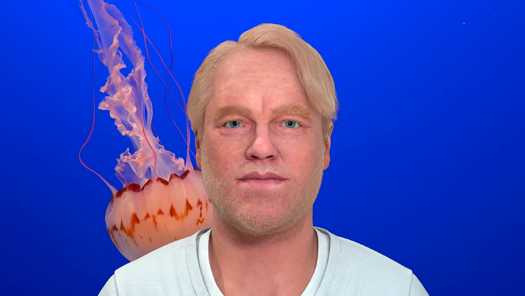
Figure 1 PHIL in Cécile B. Evans' Hyperlinks or it Didn't Happen, 2014. Copyright Cécile B. Evans. Reproduced with the artist's permission.
The difference between PHIL and Phil is a problem throughout the entirety of the video. PHIL makes statements like 'I'm full of him', 'I will always love him', and 'I have a certain wounded unfixable longing to be better for him'. His existence as a digital copy is not one of connection, but something in which the association between the two must be worked out after the 'original' has vanished, in spite of the 'fullness' PHIL claims to possess. About halfway through the piece, PHIL has a crisis of faith and mental clarity, which he discusses with a 'spambot' named AGNES:
PHIL: Do you think I could have a dissociative disorder?
AGNES: Oh, you mean like you really are the famous actor. But you're so traumatised that you just think you're a bad 3D rendering of him.
PHIL: Yeah sort of.
AGNES: I'm sorry PHIL, that only makes sense in a symbolic way.
PHIL: I kind of wish it were true.
AGNES: I bet you do, he was one of the greatest performers of all time.
PHIL: I feel like I know him, like he understood me.
AGNES: a lot of people do.
PHIL: How much of him do you think is in me?
PHIL is literally a troubled image, disquieted by the lack of reference to that which should exist. Even though PHIL knows that he is only Phil's image, he simultaneously wants to be more and is scared he might be more. Evans has explained that she 'conceived PHIL not as a ghost or an extension of the actor he is based on, but as a copy who is unsure of his position/responsibility towards the original (who has passed)'.31
PHIL's existence as a copy—even an agentic copy—performs the simple fact that the relation data has to any 'original' body may be as troubled as any link 'we' have to 'our data', and that sustaining any clear 'reality' requires the maintenance of reference. Following the video's title, we need hyperlinks to be sure of something's existence. Data becomes, at best, a synecdoche (interestingly enough, the name of a film starred in by the 'famous actor' of Hyperlinks). Yet, fully embracing this trope would suggest that PHIL is part of another, rather than thing that exits for itself. His existence is not just a part taken for a whole, a whole that is now deceased. He is, perhaps, closer to a metonymy, a substitution that stands in for another. But even then, this would still deny his existence as an independent thing, a representation searching for relation, even though the relation isn't clear or defined.
PHIL would seemingly fit into any number of arguments made by those associated with speculative realism or object-oriented ontology. He is a partial being, independent, and yet, in his relations with the 'vary famous actor' he corresponds to, the interiority of each is withdrawn towards the other. In their pairing, one cannot be correlated as a mirror—partial or otherwise—of the other. PHIL's partial animation shows us how he is not a true 'copy' of a human being but a kind of spectre, to use Timothy Morton's language. A spectre is not a 'ghost' in the sense of the spirit or soul left behind after a body dies, but 'the ghostly presence of beings not yet formatted according to Nature', which confounds the ability to declare something as real or unreal, living or deceased. 'Since the difference between life and non-life is neither thin nor rigid…we coexist with and as ghosts, specters, zombies, undead beings and other ambiguous entities, in a thick, fuzzy middle region excluded from traditional Western logic'.32 PHIL is, then, an animistic spirit that haunts Western technoculture, one that is neither 'magic', in the sense of an unexplainable metaphysics, nor the 'remainder' of a deceased person. Rather, he speaks of the banality of animisms perpetuated daily via digital media—where agencies act, but their interior motivations, existence, and being is forever beyond human knowledge: withdrawn, to use the language of object-oriented ontology.
Evans' choice to use a famous actor is significant, and not only because of digitally manipulated actors replacing 'real' actors (for instance, the suggestions that Hoffman himself would be replaced with a digital model in the final Hunger Games film given the timing of his death). An actor of Hoffman's prestige somehow belongs to more than just himself, even when alive. Mediated inscriptions of his body are more readily available than most bodies, given his time in front of the camera. And yet his performances are never really 'him', either, clouded as they are by the (in)authenticity of filmic and televisual performance.
PHIL explains, 'They say that grief isn't contagious, but that was just something they told people. They say that something happens when a disaster is captured on film. The people move on. The city rebuilds of course, but the information is traumatised forever'. Are we to see PHIL as traumatised data? Grief made manifest by refusing to let the traces of Phil go? Later in the work, as a clip of television show Inside the Actors Studio plays, PHIL explains, 'When the very famous actor died, the talk show host James Lipton said to the crying actress he was interviewing at the time “we have him forever, thank heaven”'. Lipton refers to Phil's legacy of stage and screen performances, not his digital recreation, but these comments speak to a felt infinitude when it comes to digital media. Even though digital data is never immaterial (having very real environmental impacts from the infrastructures that run it), there is something undeniably vampiric about the digital as a medium.33 Infrastructure and hardware may break down, but data seem as though they can live forever. PHIL certainly feels this way, telling us, the viewers, that 'I will always be here, lurking somewhere on this drive until they drag me to another, more acclimatised drive'. As Larissa Hjorth and Kathleen Cuminskey argue in this section, 'the ways in which the circulation of mediated images of trauma takes on new forms of powerful affective practices that haunt' creating a 'new kind of witnessing' that poses 'ethical, psychological, moral, and existential challenges' while offering 'new ways to understand death'.
As one of PHIL's introductory lines makes clear, his isn't the only data to consider, in spite of the public visibility of Philip Seymour Hoffman. He says, 'you must be thinking by now that this film is about me, but really, it's not, it's about all of us', in part, as Hjorth and Cuminskey suggest, because digital media produce 'new liminal spaces between how images inhabit lives, deaths, afterlives' that are, to follow Bruce Buchan's claims in this section, 'perpetually immanent' with uncertain temporalities. We see Marlon Brando's face being manipulated for inclusion in Superman Returns. A story taken from Reddit's 'r/NoSleep' subreddit, about a man whose girlfriend appears to haunt him via Facebook after her death in a car crash, plays a role in the video as well. Data as part of, yet separate from oneself is a constant theme, as PHIL discusses a YouTube star named Jemma Pixie Hixon, who suffers from agoraphobia and hasn't left her parents' home for over five years. She won an award in China for 'most viewed music video', PHIL explains, and with this viewing, 'this is the furthest distance she has ever travelled… I have a difficult time understanding people who can't reconcile her condition as a physical one…' For PHIL at least, Hixon has travelled to China, because her image via YouTube has travelled there. AGNES, the 'spambot' who appears throughout the video, and was originally conceived by Evans as a stand-alone work that lived on the server of the Serpentine Gallery in London, pops in to chat with PHIL at this moment, saying 'I read somewhere that jetlag is the experience of your soul trying to catch up with your body. Jemma has the reverse problem, her soul travels much too fast for her body'. Here, her soul and data both travel out before her and become indistinguishable.
AGNES doesn't have the same problems as PHIL, as she doesn't inhabit the image of anyone from the 'real' world, and so her data is, arguably, her own. ('I have no image', she explains. 'And no physical condition', PHIL retorts.) Because of this, AGNES helps PHIL with his struggle between data (soul) and Phil (body). Amusingly, she finds her all-too-human addiction to a mobile game (Kim Kardashian Hollywood, shown in the video but not directly mentioned)to be relevant:
AGNES: …In the app you own a store and the celebrity comes by to buy something, and you become friends, but then you have to pay to hang out with her, go to restaurants, wear the right clothes, face.
PHIL: In real life.
AGNES: What do you mean?
PHIL: Well, who are you really hanging out with?
AGNES: Oh, right, the celebrity in the app, which was created from the celebrity.
PHIL: And how is the celebrity in the app compared to the celebrity?
AGNES: She's terrified. She told me that she realised they're not really there to hang out with her, but to become her, and it's totally freaking her out.
PHIL: Shit, what can we do?
AGNES: Nothing, that's the point of the game.
PHIL: Crazy times. Can you ask the celebrity?
AGNES: I can't get a hold of her.
PHIL: Can you start a petition?
AGNES: That's how she makes money, so I don't think she'll stop.
PHIL: But aren't they the same person?
AGNES: Murky waters my friend—they're different, but the app's essence is destined by the celebrity's existence. There's too much of her in her.
'Too much of her in her' questions the boundaries between data and self—should there be a line? How much is too much to commit to your avatar?
Hyperlinks thus embraces and undermines a number of binaries that characterise digital culture without doing away with these forms of differentiation, be it self and representation (or image, or data), online and offline, soul and body, body and information. This extends to the fact that Hyperlinks is a video, rather than an interactive or generative simulation. PHIL's dialogue and image are programmed and determined by the narrative temporal logic of video, rather than something truly 'agentic' or 'animated' beyond the screen. Evans' inclusion of 'real' stories and dialogue (such as quotations from actual historical figures), interspersed with fictional narratives (such as the story from r/nosleep, or Ralph Ellison's Invisible Man, which features prominently throughout), likewise questions the logic upon which distinctions are made online—on what grounds can we evaluate what is 'true' or 'false'? Perhaps the very structures of the internet and digital media create 'trouble' on their own, undermining, rewriting, and reinventing the very possibilities to make coherent distinctions, coherent frames of reference, which would cloud the grounds upon which ethical relations come into being.
Hyperlinks uses an odd but specific form of the future anterior in its language. PHIL's final words to the viewer are, 'The notes of this paradox do not end here. But it seems to us that we may stop here. Most of you may know that everything you have just seen has already happened. Our end is just your old beginning…' PHIL's digital recording becomes, in this future anterior, similar to Barthes' description of the photograph. But with PHIL proclaiming that he will 'always be here', it becomes less 'he is dead and he is going to die' than 'he is dead and he is going to live forever', stuck, immobile, in the same repetitive, programmed loops—'perpetually immanent', to again use Buchan's words. The end of Hyperlinks puts this digital form of capture into its rightfully utopic and horrific logic. An 'invisible woman' appears in the distance, with a word bubble stating 'It goes on forever', as PHIL says 'Please stop, I ask you with all of my heart, it's time to stop, stop. Please'. The video then cuts to the anime character and vocaloid Yowane Haku performing 'Forever Young', her synthesised voice emotionlessly singing the lyrics to the Alphaville classic as she works robotically through carefully programmed choreography. As she gets to the titular line 'forever young', she falls to the ground, as if the weight of that prospect is just too exhausting, but then pulls herself to her feet to sing 'I want to be forever young', before sing-asking 'do you really want to live forever? Forever? And ever?'
'HD helps us come closer to the spiritual beings we long to meet'
Korakrit Arunanondchai's Painting with history in a room filled with people with funny names 3 uses much of this same non-linear logic in its form, but offers a less hopeless (if still dystopian) view of digital culture. Whereas Hyperlinks ends abruptly, with PHIL saying 'So now I'm going to have to tell you...', followed by a sudden cut to black before it restarts, Painting is purposefully cyclical. The beginning and end of the video loop naturally, as the first and last shots are identical. A character named Chantri explains via voiceover, 'the first image is of you covered in paint standing in a body of water', as the artist is shown doing just that. The final shot and line of the video is Chantri saying 'the last image is you covered in paint standing in a body of water', with the exact same image. (Both 'beginning' and 'end' of this work could be said to be somewhere in the middle of this shot.)
The way in which Chantri is introduced, and the role they play is important to our particular reading of this work. In Painting, there is a conversation happening between two characters, and while their identities are almost impossible to truly discern, for the sake of this essay, we will refer to them as 'Chantri' (voiced by a woman) and 'the Artist' (voiced by Arunanondchai). While each character speaks throughout the work in a combination of French and Thai, their words are written in English on the screen.The first section of Painting is a sort of music video devoted to the city of Bangkok. Towards the end of the 'music video' the camera shots get jerky, yet steady, in a way that is indicative of a drone camera. We then see a helicopter pad, on which the Artist and a group of diverse Thai youth are hugging and crowd-surfing. At the first moment an actual drone is shown, the music slows ominously (the singer's voice growing pitch-shiftedly lower). The drone flies over the crowd, as the music continues to slow, and we are shown shots from the drone's perspective interspersed with close headshots of various people. This turns exclusively to the drone's eye-view of the city as the music abruptly cuts out. We hear a loud and breathy humming, echoing as if coming from the central spot of the drone's own head, very much as if singing to itself as it looks down to where the 'music video' is still taking place–viewing it, but separate as it can only hear its own humming. We are then introduced to Chantri via the Artist's voiceover: 'Dear Chantri, I am a machine, boosting energy into the universe and you, you are the spirit in the wind around me, a thought turned into a vector, and projected into the air'. The drone/Chantri continues to hum over these words and then zooms down closer to the helicopter pad. We then hear a woman's voice (assumedly Chantri's): 'you said when you were five you saw a spirit inside this house', as the film cuts to the interior of a house, the woman continues, 'maybe I was the spirit?'
Our reading of Painting requires a detour to contextualise some of its themes. First, as Andrew Alan Johnson, an anthropologist who studies spirits and religion in Thailand, has argued, the distinction between city and countryside in English literature, chronicled by Raymond Williams, and modern urbanity, theorised by Georg Simmel, may seem to resonate with depictions of the urban in Thailand, but this is not the case. For Williams and Simmel, the city becomes a space of alienation, rationality, and individuality, while the country is about feeling, collectivity, and togetherness. Urban centres in Southeast Asia, Johnson argues, are instead linked with religious concepts of order and prosperity, of, in Thailand, watthanatham (which, translated as 'culture', is similar to how Raymond Williams discussed culture as 'cultivation'), and charoen (or 'progress' and 'prosperity'). Watthanatham, which is often articulated in a royalist sense, as flowing downward from the monarchy, results in the cultivation or inspiration of charoen.34 Urbanity, rather than differentiated from the countryside, is understood as correctly or incorrectly aligned with kinds of cultivation, which, Johnson argues, can be understood through how specific kinds of spirits inhabit particular buildings and places. A division between urban spaces and countryside, which can be seen in many discussions of cities in contemporary Thailand, is less about a distinction between these specific locations than the fact that 'progress' within urban centres has been articulated to neoliberal practices of speculation on real estate, resulting in empty buildings littering the skylines of Thailand's cities after the 1997 Asian financial crisis (or Tom Yum Goong crisis). While Thai Buddhism has long been associated with animism, Johnson argues that the presence of spirits in Thailand today should be framed not as a true 'return' to the past, but as a contemporary response that makes sense of globalised capital and finance, and especially how the kinds of 'progress' linked with financial capital and real estate are imagined as misaligning with other, often nationalistic notions of progress, which are themselves a result of modernity given the complex history of 'Thailand' as a geopolitical entity.
The presence of animist 'spirits' in Thai art, more broadly, is likewise something of a paradox. David Teh notes that, on one hand, the 'global contemporary' is a problem when talking about non-Western artists. In spite of the global flows of capital and artistic works that characterise Biennials and the contemporary art market, which often erode particular understandings of 'place' and 'locality', artists from Southeast Asia often are linked to their national heritage, as 'representatives' of the nation in spite of common global itineraries of travel and location. In contemporary Thai art, Teh suggests that theme of animistic haunting is likewise articulated to a peculiar frame that is simultaneously nationalistic and pan-Asian, a contradiction that positions animism as a 'driver of the creative economy' intended to generate global interest in contemporary Thai art—a global interest that both relies on and effaces historical and local specificity.35
These geographic framings additionally efface specific distinctions at play within Thailand. The 'traditionalism' of spirits is often associated with Northern Thailand (or Lanna) and Thailand's northeast (or Isaan), both of which were, historically, distinct from (and at times independent of and in conflict with) Siam, the region surrounding Bangkok that has come to define modern Thailand. The differentiation between these regions persists today, informing Thai nationalism. As Johnson notes, 'The image of a spiritually pure, if less cunning and savvy North juxtaposed with a worldly but impure Bangkok remains a common trope both in Northern self-stereotyping and in Central Thai depictions of Lanna'.36 Thai nationalism since the 1990s has positioned Lanna as a location of 'authentic' Thai identity. Yet, within Northern Thailand, there are further distinctions made between 'refined' or 'cultivated' city-dwellers and 'wild' or 'unrefined' forest dwellers, often signified by the term mueang, which refers to both 'city' and 'polity', but with a particularly spiritual significance: 'Mueang are animated sites: centers of civilization, refinement (to varying degrees), and spiritual antennae that radiate prosperity and wealth to the countryside'.37
These complexities are further compounded by the fact that charoen is, in many cases, the 'functioning ideology' of a great deal of Thai culture. Speaking of a performance of spirit mediumship in Northern Thailand, Johnson notes that the announcer for the performance directly equates the channelling of ancient spirits, Grandfather and Grandmother Sae, with the power of nanotechnology. As the announcer states, nanotechnology is '“something very small, so small that you can't see but [something that] will allow you to communicate with other worlds.”' As Johnson interprets it, charoen's 'trappings as technological or spiritual are less relevant than demonstrations of its effectiveness. In this way of seeing, the technological, the magical, and the religious fuse'.38
Reading the drone as Chantri, the spirit the Artist may or may not have seen in his youth, opens up a wealth of interpretations of the afterlife embodied through the digital. Drones appear as the material embodiment of spirits, as that which precedes and supersedes the present and observes from afar, as sentient beings. They fly alongside the Artist as he runs through jungles, the city of Bangkok, through temples and landfills. While Arunanondchai's own beliefs are not a central focus of the work, it is nonetheless steeped in—and complicates—the spiritual influence of his Thai heritage. Buddhist temples play a prominent role—especially Wat Rong Khun, or the White Temple, a Northern Thai temple that was renovated in 1997 by artist Chalermchai Kositpipat, and is filled with images of Western popular culture (including Michael Jackson, Hello Kitty, and Superman), nuclear war, and terrorist attacks, along with nāga serpents—subjects likewise addressed by Painting (figure 2). Needless to say, what Painting is 'painting with' are the varied complex articulations of Thai culture in a global frame, where distinctions between city and forest, spiritual and technological, animistic and 'modern', global and national, cannot be differentiated in ways that remain unproblematic.
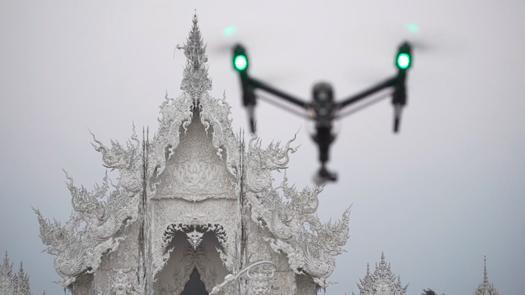
Figure 2 The drone and Wat Rong Khun in Korakrit Arunanondchai's Painting with history in a room filled with people with funny names 3, 2016. Copyright Korakrit Arunanondchai, reproduced courtesy of Carlos/Ishikawa, London.
In Painting, the future anterior seems more accepted than in Hyperlinks. At one point the voice of a reporter, speaking over images of deities created within Second Life and 3D architectural renderings of utopic Buddhist centres that will 'be like the U.N.', states that this is a place 'where the past is alive, and the present, the present is a part of the past, where both present and past are welcome'. Arunanondchai appears to take these concepts and update them to account for new technology and digital data, where perhaps we will commune with ancestors and dead loved ones not through prayer or meditation, but by running through the jungle with their drone-bodies. The Artist says, in voiceover, 'The time of Standard Definition video has ended, HD helps us come closer to the spiritual beings we long to meet', suggesting that the problem with communing with spirits is the resolution of the recording. He later states that, 'heaven is a simplified version of the world recorded in high definition. In this version, Chantri, you and I become the same thing, information becomes knowledge the spirit becomes a camera, and the best part about heaven?' Chantri then states, 'You said the best part about heaven is that it's an artwork…and for your people a metaphor to try and make sense of the inconsistencies of this world, in the name of this long-cherished aesthetics of the spirited land in solidarity with the teachings of Buddha, for future generations to watch and copy, this is how you've understood to be Thai'. Future generations will come, then go, but also remain, as Chantri remains—and so to think through them in the form of data, data connected to roving packs of drones which have cameras to record everything, and that act as their spirits, isn't a stretch.
But this still comes with much of the anxiety surrounding the divide between body, data, and spirit seen in Hyperlinks. The Artist asks Chantri, 'In this heaven we talk about, where information automatically becomes knowledge will these metaphors still work anymore?' He also says, in an earlier voiceover, 'The city scares me. The membranes connecting all things visible are the mystical monsters of the past, the zombies of the present, and the robots of the future'. The contemporary city, in Johnson's account, is filled with 'bad' spirits unable to rest, the victims of global, neoliberal capital, visible spectres of misguided forms of progress. Perhaps this is also the case in Painting. These anxieties are intensified when Chantri and the Artist discuss hell. The Artist says that hell is 'made up of mountains of broken harddrives, disorganised memories with no poetry…' Although PHIL may move from drive to drive, and Chantri can always upload to a newer drone-body, what will become of their hardware? The Artist jumps around a huge landfill full of hard drives and other technological garbage as he asks, 'Chantri, will we last forever, in a body made from carbon fiber and magnets and an entire jungle worth of souls?' Chantri's response is a wordless flash of text and colour saying YES / WE / WILL. She tells the Artist, 'Muscle memory becomes data. A tower of harddrives replace the body you're [sic] memory is what's left of you, join others in the sky, we share everything we see'. And so, the Artist tries, but his body cannot fly yet, he is made of flesh and bone, not carbon fibre and magnets. Nevertheless, he runs through the jungle alongside the low-flying Chantri-drone, he burns fires and kneels on his paintings as if to call her down from the sky, and when she comes, he touches her camera-spirit and says 'looking at you reaffirms my humanity'—the contact with the drone, or the contact with the spirit, echoes other forms of definition through differentiation (figure 3).
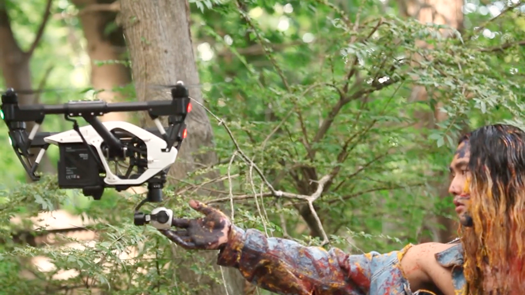
Figure 3 The drone and the Artist in Korakrit Arunanondchai's Painting with history in a room filled with people with funny names 3, 2016. Copyright KorakritArunanondchai, reproduced courtesy of Carlos/Ishikawa, London.
Conclusion
Midway through Painting, Chantri says to the Artist, 'you said imagine the near future, when our eyes have moved to the sky, we will be looking down at each other, a connectivity equal to an escape, a bond that forms democracy as strong as friendship. In the near future the projection of the sun functions as the sun, the projection will be our reality. And your life will slow down, until it almost stops. Nice dream we built together, right?' Over this dialogue we see footage from a drone flying over the Chao Phraya River, of the sun reflecting over the water. It slows down, and then becomes a still image. In analogue film, apparent stillness only happens with the multiplication of individual frames that pass by the light of the projector. The cinematic apparatus is constantly in motion, and the freezing of an image can only occur through the obscuring of movement. In digital images, however, the image is broken down into discrete, coloured pixels, many of which remain constant over time. The colour of individual pixels remains the same, and is thus not registered as a difference in the data that makes up a video file. What is projected on a computer screen, however, is constantly changing, flickering, as the image is refreshed at a rate faster than can be registered in human perception. That the file itself is not always changing at the same rate as the screen is refreshed can be observed in poorly compressed video, in which, on a dark or mostly black screen, kinds of 'halos' appear in which different gradations of the same colour become perceptible, in which a spectrum of colour becomes discrete, in which the 'ghosts' of video become visible.
Chantri's words here resonate with many Western—and especially Catholic—understandings of a future of digital media. Following those like Pierre Tielhard de Chardin, we become distributed outward, joining with others through the spirits liberated by media. We end, however, with questions about time and temporality, of fragmentation, not synthesis. The technologies of modernity have long thought to produce a fragmentation of the senses, or a fragmentation of the body into different senses. In Hyperlinks and in Painting, there is a fragmentation of the soul, in which our recordings seem to speed up and slow down at different rates than the body itself.
Perhaps these works lead us not to questions about death, per se, but that death is ultimately a question of temporality, and how we imagine and understand the role of the past, present, and future. As the Artist in Painting notes near the end (or beginning) of the work, 'the you of the future may collect the us in the present, maybe decide to call it a history, put it in a room filled with people give them all funny names'. We see, from above, the Artist painting, burning paintings, and then looking up from a painting as the camera descends towards him. Our view is that of the drone, which gets closer and closer to the Artist's face, and he closes his eyes. If Hyperlinks is, in part, about the anxiety of death, and the unclear relations recordings have with bodies, in which they serve as metonymy while acting as synecdoche, then Painting demonstrates how our recordings enable a constant rebirth, a circularity that never ends, in which our present is assembled in the future, repeatedly, each time anew.
But the concluding point here is that the distinction between these two videos is not about animism, but rather what a 'spirit' even is—a question not about agency or animation, but temporality. In spite of the fact that Painting appears to provide the 'meshing' of Thai traditions and digital afterlives, in spite of the 'Western' anxiety about bodies seen in Hyperlinks, both videos presume the possibility of agentic, spiritual technologies. This would mean that any turn to animism as an onto-ethical position is futile. We are already animists in digital culture. Perhaps the challenge is to (once again?) drive the spirit out of modern life, exorcise the spirit from the spirit sciences,39 becoming 'materialists' without recourse to an animating metaphysics, embracing an 'ethics' that emerges because of the withdrawal of the other, not in spite of the visibility of its agency.
Bibliography
Barthes, R., Camera Lucida: Reflections on Photography, trans. Richard Howard, Hill and Wang, New York, 1981. https://doi.org/10.1007/978-1-137-08886-4_6.
Bennett, J., Vibrant Matter: A Political Ecology of Things, Duke University Press, Durham, NC, 2010.
Bennetts, R. and J. Fernando, 'Screened Out, Man', Entropy, 2018, https://entropymag.org/screened-out/.
Berry, D. M. and M. Dieter (eds), Postdigital Aesthetics: Art, Computation and Design, Palgrave Macmillan, Basingstoke, UK, 2015. https://doi.org/10.1057/9781137437204_1.
Bhabha, H. K., The Location of Culture, Routledge, New York, 1994.
Bode, L., Making Believe: Screen Performance and Special Effects in Popular Cinema, Rutgers University Press, New Brunswick, NJ,2017.
Bode, L., 'No Longer Themselves? Framing Digitally Enabled Posthumous “Performance”, Cinema Journal, vol. 49, no. 4: 2010, pp. 46-70. https://doi.org/10.1353/cj.2010.0019.
Bollmer, G., Inhuman Networks: Social Media and the Archaeology of Connection, Bloomsbury, New York, 2016.
Bollmer, G., Theorizing Digital Cultures, SAGE, London, 2018
boyd, d., and K. Crawford, 'Critical Questions for Big Data', Information, Communication & Society, vol. 15, no. 5: pp. 662-679. https://doi.org/10.1080/1369118x.2012.678878.
Chesher, C., 'Layers of Code, Layers of Subjectivity', Culture Machine, vol. 5, 2003, http://culturemachine.net/index.php/cm/article/view/255/238.
Cubitt, S., Finite Media: Environmental Implications of Digital Technologies, Duke University Press, Durham, NC, 2017. https://doi.org/10.1215/9780822373476.
Daston, L., 'Speechless', in Lorraine Daston (ed), Things That Talk: Object Lessons from Art and Science, Zone, New York, 2004.
Deuze, M., 'Participation, Remediation, Bricolage: Considering Principle Components of a Digital Culture', The Information Society, vol. 22, no. 2: 2006, pp. 63-75. https://doi.org/10.1080/01972240600567170.
Didi-Huberman, G., 'The Index of the Absent Wound (Monograph on a Stain)', trans. Thomas Repensek, October, vol. 29, 1984, pp. 63-81. https://doi.org/10.2307/778307.
Doane, M. A., 'The Indexical and the Concept of Medium Specificity', differences, vol. 18, no. 1: 2007, pp. 128-152. https://doi.org/10.1215/10407391-2006-025.
Fabian, J., Time and the Other: How Anthropology Makes Its Object, Columbia University Press, New York, 2002.
Flusser, V. Towards a Philosophy of Photography, trans. Anthony Mathews, Reaktion Books, London, 2000.
Fusco, K., 'Voices from Beyond the Grave: Virtual Tupac's Live Performance at Coachella', Camera Obscura, vol. 30, no. 2: 2015, pp. 29-53. https://doi.org/10.1215/02705346-3078314.
Gibson, M., 'Automatic and Automated Mourning: Messengers of Death and Messages from the Dead', Continuum: Journal of Media & Cultural Studies, vol. 29, no. 3: 2015, pp. 339-353. https://doi.org/10.1080/10304312.2015.1025369.
Graham, C., M. Gibbs, and L. Aceti, 'Introduction to the Special Issue on the Death, Afterlife, and Immortality of Bodies and Data', The Information Society, vol. 29, no. 3: 2013, pp. 133-141. https://doi.org/10.1080/01972243.2013.777296.
Guinness, K., 'The Future is Already Here, It;s Just the End', KAPSULA, vol., 3: 2016, 8-15.
Haraway, D. J., Staying with the Trouble: Making Kin in the Chthulucene, Duke University Press, Durham, NC, 2016. https://doi.org/10.1215/9780822373780.
Harvey, G., 'Introduction', in Graham Harvey (ed), The Handbook of Contemporary Animism, Routledge, New York, 2013, pp. 1-12.
Hilderbrand, L., Inherent Vice: Bootleg Histories of Videotape and Copyright, Duke University Press, Durham, NC, 2009. https://doi.org/10.1215/9780822392194.
Hui, Y., On the Existence of Digital Objects, University of Minnesota Press, Minneapolis, 2016. https://doi.org/10.5749/minnesota/9780816698905.001.0001.
Johnson, A. A., Ghosts of the New City: Spirits, Urbanity, and the Ruins of Progress in Chiang Mai, University of Hawai'i Press, Honolulu, 2014. https://doi.org/10.21313/hawaii/9780824839390.001.0001.
Karppi, T., 'Death Proof: On the Biopolitics and Noopolitics of Memorializing Dead Facebook Users', Culture Machine, vol. 14, 2013, http://www.culturemachine.net/index.php/cm/article/view/513/528.
Levinas, E., Totality and Infinity: An Essay on Exteriority, trans. Alphonso Lingis, Pittsburgh, Duquesne University Press, 1969.
Maxwell, R., and T. Miller, Greening the Media, Oxford University Press, Oxford, 2012.
Morton, T., The Ecological Thought, Harvard University Press, Cambridge, MA, 2010.
Morton, T., Humankind: Solidarity with Nonhuman People, Verso, London, 2017.
Öhman, C., and L. Floridi, 'The Political Economy of Death in the Age of Information: A Critical Approach to the Digital Afterlife Industry', Minds and Machines, vol. 27, no. 4: 2017, pp. 639-662. https://doi.org/10.1007/s11023-017-9445-2.
Rodowick, D. N., The Virtual Life of Film, Harvard University Press, Cambridge, MA, 2007. https://doi.org/10.4159/9780674042834.
Sconce, J. Haunted Media: Electronic Presence from Telegraphy to Television, Duke University Press, Durham, NC, 2000. https://doi.org/10.2307/2700521.
Sterne, J. The Audible Past: Cultural Origins of Sound Reproduction, Duke University Press, Durham, NC, 2003. https://doi.org/10.1215/9780822384250.
Teh, D., Thai Art: Currencies of the Contemporary, MIT Press, Cambridge, MA, 2017.
Williams, J. R., The Buddha in the Machine: Art, Technology, and the Meeting of East and West, Yale University Press, New Haven, 2014. https://doi.org/10.12987/yale/9780300194470.001.0001.
Notes
1. Jane Bennett, Vibrant Matter: A Political Ecology of Things, Duke University Press, Durham, NC, 2010, p. 18.
2. Timothy Morton, The Ecological Thought, Harvard University Press, Cambridge, MA, 2010, p. 8.
3. Donna J. Haraway, Staying with the Trouble: Making Kin in the Chthulucene, Duke University Press, Durham, NC, 2016, pp. 88-89.
4. See Graham Harvey, 'Introduction', in Graham Harvey (ed), The Handbook of Contemporary Animism, Routledge, New York, 2013, pp. 1-12.
5. See Lisa Bode, 'No Longer Themselves? Framing Digitally Enabled Posthumous “Performance”', Cinema Journal, vol. 49, no. 4, 2010, pp. 46-70, and Making Believe: Screen Performance and Special Effects in Popular Cinema, Rutgers University Press, New Brunswick, NJ,2017.
6. Grant Bollmer, Inhuman Networks: Social Media and the Archaeology of Connection, Bloomsbury, New York, 2016, pp. 115-133.
7. Cf. Homi K. Bhabha, The Location of Culture, Routledge, New York, 1994; Johannes Fabian, Time and the Other: How Anthropology Makes Its Object, Columbia University Press, New York, 2002.
9. John R. Williams, The Buddha in the Machine: Art, Technology, and the Meeting of East and West, Yale University Press, New Haven, 2014, p. 1.
10. Cf. Emmanuel Levinas, Totality and Infinity: An Essay on Exteriority, trans. Alphonso Lingis, Pittsburgh, Duquesne University Press, 1969.
11. Russell Bennetts and Jeremy Fernando, 'Screened Out, Man', Entropy, 2018, <https://entropymag.org/screened-out/>
12. Cf. Lorraine Daston, 'Speechless', in Lorraine Daston (ed), Things That Talk: Object Lessons from Art and Science, Zone, New York, 2004, p. 17.
13. This is similar to arguments made by Yuk Hui, in On the Existence of Digital Objects, University of Minnesota Press, Minneapolis, 2016, and by Chris Chesher on the computer as 'invocational media', such as 'Layers of Code, Layers of Subjectivity', Culture Machine, vol. 5, 2003, <http://culturemachine.net/index.php/cm/article/view/255/238>
14. Roland Barthes, Camera Lucida: Reflections on Photography, trans. Richard Howard, Hill and Wang, New York, 1981.
15. On trace and deixis, see Mary Ann Doane, 'The Indexical and the Concept of Medium Specificity', differences, vol. 18, no. 1, 2007, pp. 128-152. On complicating analogue, see Grant Bollmer, Theorizing Digital Cultures, SAGE, London, 2018, pp. 59-81.
16. See Georges Didi-Huberman, 'The Index of the Absent Wound (Monograph on a Stain)', trans. Thomas Repensek, October, vol. 29, 1984, pp. 63-81.
17. See Jonathan Sterne, The Audible Past: Cultural Origins of Sound Reproduction, Duke University Press, Durham, NC, 2003, pp. 287-333; and Jeffrey Sconce, Haunted Media: Electronic Presence from Telegraphy to Television, Duke University Press, Durham, NC, 2000.
18. D. N. Rodowick, The Virtual Life of Film, Harvard University Press, Cambridge, MA, 2007.
19. See Bollmer, Inhuman Networks, pp. 115-133, 2016; and Katherine Fusco, 'Voices from Beyond the Grave: Virtual Tupac's Live Performance at Coachella', Camera Obscura, vol. 30, no. 2, 2015, pp. 29-53.
21. Tero Karppi, 'Death Proof: On the Biopolitics and Noopolitics of Memorializing Dead Facebook Users', Culture Machine, vol. 14, 2013, <http://www.culturemachine.net/index.php/cm/article/view/513/528>; Carl Öhman and Luciano Floridi, 'The Political Economy of Death in the Age of Information: A Critical Approach to the Digital Afterlife Industry', Minds and Machines, vol. 27, no. 4, 2017, pp. 639-662; cf. AUTHOR, 2016.
22. See Lucas Hilderbrand, Inherent Vice: Bootleg Histories of Videotape and Copyright, Duke University Press, Durham, NC, 2009, pp. 77-114.
23. Sean Cubitt, Finite Media: Environmental Implications of Digital Technologies, Duke University Press, Durham, NC, 2017; Richard Maxwell and Toby Miller, Greening the Media, Oxford University Press, Oxford, 2012.
24. See Connor Graham, Martin Gibbs, and Lanfranco Aceti, 'Introduction to the Special Issue on the Death, Afterlife, and Immortality of Bodies and Data', The Information Society, vol. 29, no. 3, 2013, pp. 133-141.
25. See, among others, Margaret Gibson, 'Automatic and Automated Mourning: Messengers of Death and Messages from the Dead', Continuum: Journal of Media & Cultural Studies, vol. 29, no. 3, 2015, pp. 339-353.
26. Bollmer, Inhuman Networks, pp. 115-133.
27. Karppi; Öhman and Floridi.
28. danah boyd and Kate Crawford, 'Critical Questions for Big Data', Information, Communication & Society, vol. 15, no. 5, p. 666. Cf. Vilém Flusser, Towards a Philosophy of Photography, trans. Anthony Mathews, Reaktion Books, London, 2000, pp. 78-79.
29. See David M. Berry and Michael Dieter (eds), Postdigital Aesthetics: Art, Computation and Design, Palgrave Macmillan, Basingstoke, UK, 2015.
30. See Mark Deuze, 'Participation, Remediation, Bricolage: Considering Principle Components of a Digital Culture', The Information Society, vol. 22, no. 2, 2006, pp. 63-75.
31. Email correspondence with the artist.
32. Timothy Morton, Humankind: Solidarity with Nonhuman People, Verso, London, 2017, p. 55.
33. Katherine Guinness, 'The Future is Already Here, It's Just the End,' KAPSULA, vol. 3, 2016, pp. 8-15.
34. Andrew Alan Johnson, Ghosts of the New City: Spirits, Urbanity, and the Ruins of Progress in Chiang Mai, University of Hawai'i Press, Honolulu, 2014, p. 68.
35. David Teh, Thai Art: Currencies of the Contemporary, MIT Press, Cambridge, MA, 2017, p. 54.
39. This is a reference to an aphorism of Friedrich Kittler, and the fact that the humanities in German are die Geisteswissenschaften, or 'the spirit sciences'.