‘Welcome to London’
Spectral Spaces in Sherlock Holmes's Metropolis
CHRISTINA LEE
CURTIN UNIVERSITY
ISSN 1837-8692
Cultural Studies Review 2014. © 2014 Christina Lee. This is an Open Access article distributed under the terms of the Creative Commons Attribution 4.0 Unported (CC BY 4.0) License (https://creativecommons.org/licenses/by/4.0/), allowing third parties to copy and redistribute the material in any medium or format and to remix, transform, and build upon the material for any purpose, even commercially, provided the original work is properly cited and states its license.
Citation: Cultural Studies Review (CSR) 2014, 20, 3195, http://dx.doi.org/10.5130/csr.v20i2.3195
There is, that is to say, nothing more solid, more ‘realistic’, and more fictional than 221B Baker Street.1
The mood is everything. To become possessed by that. To generate that.2
The body lies on the pavement—face down, limp and unmoving—on Giltspur Street in front of St Bartholomew's Hospital in Smithfield. It is positioned before a wooden bench not far from a red telephone box and a lonely bus stand. Onlookers have gathered in the parking lot across the road, one of whom is a doctor. They watch with stunned curiosity, with several muttering in morbid excitement about what they are witnessing. From their amateur forensic skills, they have deduced that the individual leapt from the rooftop of the building and death was immediate upon impact. Even when the sun shines in London, it is always grey.
The paragraph above describes the season 2 finale of the BBC's Sherlock (‘The Reichenbach Fall’) in which the titular character is seen to commit suicide by throwing himself from the rooftop of Barts, and also describes a scene I observed one summer's day in London in 2012.3 After a serendipitous encounter with an Australian Sherlockian, we embarked on a self-guided Sherlock Holmes walking tour which brought us to the medical establishment and, more interestingly, a fellow enthusiast from America who was re-enacting that climactic scene. A relative stood nearby taking photos as proof and souvenir of the city, foregoing hackneyed panoramic shots of the identifiable dome of St Paul's Cathedral in the background. These media tourists were undertaking a pilgrimage of sorts that sought to capture a ‘London’ that was meaningful. Other fans had already paid tribute at the site by marking a section of the building's exterior with notes and scrawls—‘I believe in Sherlock’, ‘Fight John Watson's war’ and ‘Moriarty was real’—that memorialised it for them. The sanctity of Barts as the metropolis's oldest standing hospital had been fortified by the (presumed) demise of a fictional character.
This opening anecdote illustrates one aspect of the Sherlock Holmes cultural phenomenon, that is, tourism of locations featured in the Sherlock Holmes narratives. The destinations are predominantly shooting locations for films and television programs, places cited in Sir Arthur Conan Doyle's canon, and landmarks that have become attractions in their own right (such as the Sherlock Holmes Museum on Baker Street, the bronze statue of the detective outside Marylebone tube station and the Sherlock Holmes pub in Northumberland Street, London). The purpose of this article is twofold: to reinforce the hypertextual nature of Sherlock Holmes-inspired tourism and the importance of paratexts in the production of meaning, and to explore the affective experiences of London (or, more aptly, ‘Londons’) that tourists seek out. A central premise is that Sherlock tourism stages the metropolis as seething with the spectral, destablising the modernist endeavour to render the world completely knowable and transparent. I argue that the embodied experiences and performances of the Sherlock fan-as-tourist are influenced and informed by multiple representations and narratives, constructing spectro-geographies in which the tourist revels in the pleasures of the imperceptible and the in-between.
ON THE TRAIL(S): SHERLOCK HOLMES TOURISM AS MULTI-MEDIATED EXPERIENCE
Today, VisitBritain increasingly uses the UK's world-renowned film and literary heritage … to raise awareness of the appeals of Britain and its destinations. Sherlock Holmes is known around the world as one of Britain's most iconic characters. Our partnership with Warner Bros. Pictures is a great way of helping people discover the secrets of our destinations and entice them into having a fantastic adventure here.4
Writing in 1997 (and then again in 2007), Roberta Pearson noted the paucity of scholarly attention to Sherlock Holmes fandom despite it being one of the oldest (the first official Sherlockian society, the Baker Street Irregulars, was established in New York City in 1934).5 Fast-forward to 2014 and the picture is quite different. Sherlock Holmes is now a massive multimedia concept with highly visible dedicated communities that have prompted critical inquiry. Arguably, the iconic figure has never really disappeared from the public eye or suffered from lack of interest. Numerous adaptations in theatre and onscreen have been produced each decade since the 1887 publication of A Study in Scarlet, and societies and individuals have been engaging in their own scholarship, producing texts (fan fiction, art and so on) and gathering at themed events for decades. However, recent manifestations of Sherlock Holmes have contributed to the character's cultural mainstreaming and the shift of fan production from the margins to the centre. The strong visual presence of the Warner Bros. film franchise (Sherlock Holmes (2009) and Sherlock Holmes: A Game of Shadows (2011)), the BBC series Sherlock (2010–) and CBS series Elementary (2012–) have been largely responsible for this.6 A new film adaptation titled A Slight Trick of the Mind (based on a novel by Mitch Cullin), featuring Sir Ian McKellen as the retired detective, is scheduled to commence production in 2014, further testifying to the current populist appeal of the Holmesian diegesis.7
One aspect of the Sherlock Holmes cultural phenomenon is the increasingly prevalent practice of visiting places associated with Holmes. Here, I adopt a cultural studies approach to understand how Holmes's London is staged for tourists and how tourists read and navigate these sites, drawing upon ethnographic techniques to gather preliminary data. As my focus is on London's affective spectro-geographies and the hypertextual nature of Sherlock tourism, this involves presenting my own observations and deductions that are admittedly impressionistic at times. Fieldwork was conducted in June and July 2012 in London. Two methods were employed to gather qualitative data: interviews (formal and informal) and participatory observation. Structured interviews were undertaken with three tour guides (from London Walks and London Horror Tours), a literary scholar from Cambridge University (who was presenting a lecture on Sherlock Holmes at the time of the fieldwork), four members of the Sherlock Holmes Society of London, and the proprietor of a Sherlock Holmes-affiliated establishment. Semi-structured interviews and informal discussions were conducted with individuals I encountered on organised walking tours and self-guided walks (plans to distribute questionnaires on the tours were abandoned due to lack of participant interest in the exercise).8 The interviews yielded insight into the design of tours, and tourists’ motivations for travelling, their experiences and perceptions of the city. Observation was carried out at locations such as the Sherlock Holmes Museum, St Bartholomew's Hospital and Speedy's Café to gauge how tourists engaged with their environments. I participated in three Sherlock-specific tours (two specialising in literary locations, one in onscreen locations) and two tours that explored Victorian London (one focusing on Jack the Ripper, the other on the city's ghosts).9 The tour subject parameters were expanded to understand how Sherlock tourism operates within, and consequently contributes to, the laden history, mythology and iconography of London. The tours lasted no longer than two hours, with groups ranging from approximately fourteen to forty-five members and spanning all ages. The cohorts were international, although there was a notably large British, American and Australian contingent.
While its origins are literary, Sherlock tourism now is symptomatic of a postmodern, hyperlinked culture referencing a vast reservoir of texts. Even on dedicated literary tours, guides would often refer to screen and theatre adaptations, whether self-initiated or prompted by tour members. The multi-mediated nature of Sherlock tourism has been facilitated by strategic alliances between media and tourism industries in the United Kingdom—a relationship that is becoming de rigueur in large-scale ventures—and technological advancements, which have enabled a proliferation of Sherlock-linked texts. For example, the launch of Guy Ritchie's Sherlock Holmes in 2009 saw VisitBritain, in partnership with Warner Bros. Pictures and Radisson Edwardian Hotels, welcome tourists to ‘Sherlock Holmes Britain—Past and Present’.10 The official website included itineraries inspired by the film adaptation, various television series and Conan Doyle's oeuvre. This lucrative media-tourism synergy provided an interactive experience for consumers, tapping into diverse audience bases, which has ensured the text's afterlife (post-theatrical release).
Certain locations featured in screen adaptations have become as important to the Sherlock Holmes legend as, say, the Criterion Bar where Dr John Watson first hears Sherlock Holmes's name in A Study in Scarlet. One of these is Speedy's Café in North Gower Street in Camden, which is next door to the relocated ‘221B Baker Street’. The establishment's interior and exterior was used extensively in the BBC series Sherlock (particularly season 2), and has become a prime destination for enthusiasts. Proprietor Chris Georgiou, whose café has received high exposure in online news stories, stated that ‘Speedy's is so famous in South Korea’ (quoting one of the fans) and was informed by a media presenter that the lunch bar ‘is probably the most famous café in China now’.11 While such locations may lack the cultural weight that comes with the appellation of ‘literary heritage’ or ‘literary classic’, they play a pivotal role in the tourist's experience. When asked why she was interested in Sherlock filming locations, Grace (a Melbourne Sherlockian) responded:
Well, why do you visit anything? You go to London because there's everything you recognise. You see Big Ben in newspapers and books, and you see Westminster Abbey at the royal wedding … I don't see why visiting movie sets are any different because they're just sets that we recognise, that we know and you go see them in person. It's the same thing as going to see any landmark.12
Grace's statement elucidates that points of reference were paramount to her experience of place, rather than any perceived valuation of a location based on its being factual or fictional. The identification of such ‘landmarks’ rendered the site meaningful.
Louisa Ellen Stein and Kristina Busse argue that Sherlock Holmes is ‘an evolving transmedia figure, at the center of myriad cultural intersections and diverse representational and fan traditions’.13 The multi-mediated nature of popular culture, overlapping fandoms, user-generated content and pervasive culture of adaptations (literature to screen and computer game; film to theme park, and so on) now mean it is increasingly difficult to contain categories such as ‘literary tourism’ or to fix a singular representation of Sherlock Holmes in a globalised context.14 The intersections of Sherlock-related texts and media platforms mean that 221B Baker Street today is as much 187 North Gower Street and the Sherlock Holmes Museum (which claims the famous street address) as it is the speculated location of ‘the empty house’ along Baker Street in Marylebone. Most of the Sherlock enthusiasts I met indicated their loyalties were not confined to any one text or medium; they drew from a spectrum of sources to inform their readings of sites. At Speedy's Café, informal discussions were held with individuals whose fannish inclinations were signalled by the act of taking photographs inside the establishment and their obvious directed attention to Sherlock-related paraphernalia (photographs of cast and crew, fan art). One fan from Dorset said that by coming to Speedy's he was simultaneously paying homage to Conan Doyle, Basil Rathbone (who portrayed Holmes in film and on radio, 1939–46) and Jeremy Brett (who portrayed Holmes for the Granada Television series, 1984–94). Two male fans had travelled from Somerset on a Sherlock pilgrimage and were avid about the Warner Bros. film franchise and the BBC series. Two female fans from Milan professed their enjoyment of the literature and Warner Bros. films, though they were reluctant to admit equal interest in the BBC series (possibly due to the embarrassment of appearing overly zealous). On a Sherlock film and television tour, one teenage participant from New Jersey stressed that she was equally invested in the novels and short stories as the BBC series. Their responses support the idea that ‘Sherlock Holmes has become far larger, and now means far more, than the letter of the texts that inspired it’.15
Here, I draw upon the paratext as a way of conceptualising the hypertextual, multi-mediated nature of Sherlock tourism. In writing about literary works, Gérard Genette proposes that a text is accompanied by other (official and unofficial) productions, such as the title, author's name and illustrations, that ‘surround it and extend it, precisely in order to present it, in the usual sense of this verb but also in the strongest sense: to make present, to ensure the text's presence in the world’.16 Understanding a text occurs in relation to the paratexts. Genette goes so far as to say that no text can exist without paratexts.17 A reader will have already come into contact with a multiplicity of paratexts before arriving at their primary text, such as reviews and trailers for an upcoming film. Paratexts prepare readers for other texts, informing their reading strategies and expectations.18
Applying Genette's concept to popular culture in the age of Web 2.0, we see the foregrounding of paratexts in the strategic production, promotion and circulation of cultural texts, whether by industry or consumers-as-producers. The earlier example of VisitBritain's tourism tie-in to the Warner Bros. film exemplifies this. Whereas paratextual relationships in literature may not be evident to the reader or be brought to the reader's attention according to Genette, it now appears multi-media(ted) paratexts overtly court the audience.19 One need only browse a text online to find prompts to a plethora of associated websites. If we take the example of Sherlockology.com—a website that describes itself as the ‘ultimate guide for any BBC Sherlock fan’—hyperlinks to the show's primary characters will direct one to the actors’ biographies and their other works; wardrobe and prop descriptions provide links to retailers who stock the items (sleuthing segues into shopping); location guides provide detailed travel itineraries and endorse establishments (melding pilgrimage with the leisure industry); and newsfeeds link to texts outside the Sherlock Holmes diegesis.20
Importantly, the paratext is not a hermetic border but signifies a threshold. According to Genette, it is an undefined fringe zone ‘not only of transition but also of transaction’ where ‘a convergence of effects’ takes place.21 The meaning of a text does not exist pre-determined, waiting to be retrieved like a static image from a repository, but is constructed in the moment of transaction. ‘Actualisation’ in the very act of reading is central to meaning. In a multi-mediated culture, Genette's ‘convergence of effects’ takes on even greater weight—a person can bring an infinite combination of paratexts to their reading. This partly accounts for why seemingly contradictory or incongruous representations of Sherlock Holmes at any one time can successfully co-exist and be accepted by audiences. For instance, Holmes the action hero in Victorian London (Robert Downey Jr in Sherlock Holmes), Holmes the genius with sociopathic tendencies in modern-day London (Benedict Cumberbatch in Sherlock), and Holmes the displaced consulting detective in contemporary New York City (Jonny Lee Miller in Elementary). This is not to refute dominant reading strategies, but it does indicate how other interpretations can transpire in the moment of transaction.
LONDONS LURKING: SPECTRAL SPACES OF THE CITY
We moderns, despite our mechanistic and rationalistic ethos, live in landscapes filled with ghosts. The scenes we pass through each day are inhabited, possessed, by spirits we cannot see but whose presence we nevertheless experience.22
In contending that Sherlock Holmes as cultural phenomenon is a hypertextual, multi-mediated construction, I now explore the staging of Holmes's London in tourism as a space of alterity and haunting presences informed by paratexts. Sherlock tourism is interconnected with other tourisms that perpetuate the notion of a city of spectral spaces. Here, it is important that I qualify my use of the term ‘spectral’. London's sustained history of violence and trauma (such as the impacts of the Great Fire of 1666 and devastation of World War II) and ongoing excavations of Roman artefacts are reminders that London is effectively built on the ruins of the past. Instead of a city of dead relics, I wish to pursue what Chris Wilbert and Rikke Hansen have described as London's spectro (spectral) geographies that confound linear temporality, thus disrupting the neat ordering of past and present.23 Memories and history are not inert and corpse-like but continue to exert their influence. In other words, the past has not passed. According to Alex Murray, constant displacement—a ‘perpetual terminological restlessness’—underpins spectrality and gives the sense of London as a site of alterity.24 The burgeoning body of work on the metropolis's psychogeography attests to this conceptualisation; that below the surface are unseen worlds in which the ghosts of the dead, the forgotten and the abject still hum with life. The writings of Iain Sinclair and Peter Ackroyd have been particularly influential in such representations. For instance, in London Under Ackroyd documents the crypts, vaults and burial grounds which house ‘communities of the dead buried beneath the earth’, the Fleet River which pulses underneath the city (‘It is not dead’), and abandoned underground tunnels whose ‘subterranean presence will endure as long as London itself’.25 Implicit in Ackroyd's account is that cities have ‘a shadowy density about them’, and in these shadows are dramatic presences that we often cannot see or rationalise, but can sense.26 The facades of the quotidian urbanscape cloak an altogether more opaque, sinister self/selves.
Spectrality reinforces that place is constituted of physical terrain and imagined topographies. As such, places are always ambivalent. In exploring ghostliness as a type of affect in the production of cities and how cities can haunt their citizens, Steve Pile avers that ‘we cannot understand social senses of space unless there is a place for feelings, emotions and affect’.27 This resonates with Michael Bell's figuration of ‘ghosts’ as a ‘felt presence—an anima, geist, or genius—that possesses and gives a sense of social aliveness to a place’.28 If we take the example of London's East End, it is comprised of the tangible environment (buildings, streets, graffiti, human traffic, and so forth), ‘echolalic’ presences and narrative.29 Amid the flurry of gentrification in the area, its violent history still lingers in the form of such bogeymen as Jack the Ripper and the Kray brothers. As a result, the East End signifies a space that has concurrently witnessed and been an accomplice to crimes and horrors that continue to actively define it. In fact, Robert Mighall argues that our cultural maps of London are shaped by the notion of criminality, which is a critical component of its (perceived) identity.30 This has certainly been evident in the spectrum of dark heritage tourisms that flourish in the capital, which Sherlock tourism is intertwined with. The panoply of ghost and murder tours underscore the fascination with thanatopsis, the intrigue and sordid mysteries of London—then and now. Although the broken bodies, buildings and bloodied crime scenes may have disappeared from sight (and site), we still experience a presence marked by a palpable absence. It exemplifies Emma McEvoy's argument that where there is no sign of material heritage then ‘Gothicization may take its place’; a process which involves conjuring ‘the various presents which have survived, and their relation to those pasts’.31
The invocation of spectral geographies—of other Londons lurking—is necessary for reasons of practicality on Sherlock tour ventures. The city has been reconstructed countless times and many original structures mentioned in the Conan Doyle stories have been torn down or altered to the point that they can no longer be (easily) identified. For example, Euston railway station (featured in short stories including ‘The Adventure of the Priory School’ and ‘The Adventure of the Blanched Soldier’) was demolished and rebuilt in the 1960s; and the Café Royal on Regent Street, outside of which Holmes was infamously attacked in ‘The Adventure of the Illustrious Client’, has been converted into the deluxe Café Royal Hotel. If ‘tourism is inherently geographical’ as George Hughes asserts, then what of incoherent geographies where the vista does not align with our cultural maps?32 How do we make sense of a modern office block or multistorey car park which now stands in place of a former structure of historical and narratological significance? Sherlock tourism requires paratexts and strategies of suggestion to help the tourist ‘fill in the blanks’. As with London's gothic tourism—ranging from thrill-kill theme rides at the London Dungeon to torture chambers of the Tower of London, from macabre sites of serial homicide in Whitechapel to resting places of the dead in Highgate Cemetery—Sherlock tourism must carefully negotiate between the (f)actual and imagined, the visible and imperceptible, the past and present. Regarding Jack the Ripper walks, tour guide Steve Newman stated, ‘It's in those little interludes where you talk about a suspect or you talk about something else. In other words, you draw people towards the story as opposed to the scenery’.33 Stratagems of play, conjuring and cheating are the sine qua non of the guide's arsenal in creating an atmosphere where narrative and mood become as imperative as the materiality and immediacy of place, if not more so. Such tourism directs attention to that felt presence described by Bell—the inarticulate sensation of something there.
Sherlock tourism is sutured into wider representations of London as a phantasmagoria in which imagined topographies merge with the physical terrain. Stories relayed by tour guides function like classified information which render the mundane—an unassuming doorway, a plain courtyard, an unremarkable footpath—into something extraordinary, imbuing them with value and function that others would be oblivious to. The guides’ commentaries reveal the secrets of various urban locations drawn from television, film, theatre and literature: ‘Here on Marylebone Lane is where Holmes was almost run over by a van sent by Moriarty’, ‘If you recall, by the Oxo Tower foreshore is where Sherlock studies the washed-up corpse’, ‘Beneath Somerset House is where Sherlock was imprisoned’. Echoing Holmes's declaration in ‘The Boscombe Valley Mystery’ that ‘There is nothing more deceptive than an obvious fact’, in Sherlock tourism all is not what it seems on the surface.34 This is palpable from the following comment by Lauren, an American Sherlockian, who participated in a Sherlock film and television tour:
I never would have noticed when we were walking over the bridge how the scene from ‘The Great Game’ was shot. Or I never would have noticed where Greg Lestrade and Sherlock and John stood on the beach. I wouldn't have picked up on that … I think this [tour] opens my eyes to see things that a normal tourist would walk by or maybe someone that lives here would never even notice.35
To experience Holmes's London(s) is to experience the in-between spaces, in which the act of walking the city recalls and activates its hidden stories. Its landscapes are suffused with competing narratives that unsettle any notion that the city's identity is fixed and graspable. In an interview with members of the Sherlock Holmes Society of London, Jean Upton and Roger Johnson emphasised that the ‘element of danger that existed in Victorian times’ still endures in contemporary depictions of Sherlock Holmes, creating a doppelganger effect of haunting equivalences ‘of the secrets of London of a hundred years ago’.36 This is supported by Catherine Wynne who states that the contemporary psyche in Britain is haunted by the Victorians, with Holmes—‘the detective who never died’—a fitting ghostly figure.37 This sense of the supernatural and incessant irrational fear of course runs counter to the basic premise of conventional detective fiction, which the Sherlock Holmes narratives fall under. Within that literary genre, the ratifying figure of the detective served to assure that the ominous modern metropolis could be brought to light, understood and controlled.38 One of the reasons Holmes was so revered among a Victorian readership was his ability to restore their faith in rationality in a time when ideological terror of mass urbanisation was rife.39 Holmes's almost preternatural skills of deduction allowed him to read the city and know it intimately.
I argue that Sherlock tourism operates on a different playing field. While the tourist also wishes to read and know the city, their objective is not to reach finality but to keep ‘the game’ in play and prolong the thrill of the chase. There is ‘a sense that [the tourist] might discover something that hasn't previously been noticed, they might find some sort of secret’.40 Each new paratext (for instance, object, location, adaptation, website) functions like an ‘additional piece of information [that] expands the realm of possibility’.41 The Sherlock enthusiast travels not only to confirm their knowledge, but to uncover the city of limitless possibilities. The fan's or tourist's enactment and embodied experience is a case of ‘playing things out and taking the text beyond its boundaries, seeing how far it can go’.42 This extends beyond tourism. Most famously, when Conan Doyle killed off Holmes in ‘The Final Problem’ in 1893 a public outcry followed, which prompted the character's revival in 1901. The ongoing popularity of Sherlock Holmes pastiches further affirms the continuation of the game. On literary mash-ups, Tony Lee (of the Sherlock Holmes Society of London) averred, ‘What if Sherlock Holmes had met Dracula; what if Sherlock Holmes had met any of H.G. Wells's characters. It's very much a symptom of a good character; people don't want him to end so he will carry on’.43 Fervent reception of, and response to, each reinvention of the consulting detective shows the desire to open up, rather than close off, the text.
It becomes impossible to experience the London of Sherlock Holmes without evoking the mood and affect of other Londons. I refer to Sherlock here to illustrate what I mean by this. The BBC television series is set within contemporary times and has a distinctly postmodern feel; for instance, props such as mobile phones are substituted for letters as modes of communication, there is the use of visual aesthetics and effects such as onscreen captions and graphics, and episodes are consciously self-reflexive. However, spectres of past Sherlock Holmes (in the form of intertextual references to the literary canon and subsequent adaptations) drift through the episodes, as does an antediluvian terror that has come to personify London.44 The latter is captured through cinematography in which the mise-en-scène is bleached of warm hues in favour of a cooler colour palette (blue, grey, white), rendering the landscape alienating and eerie (a technique also used in the Warner Bros. films). Despite its modern setting, London is still experienced as a strange site of furtive rendezvous, rookeries and dark thoroughfares, peopled by shady Others, in which the old Empire seeps through. The crossover of different temporalities and images create composite spaces that bear traces of something else. Richard Burnip, who conducts Sherlock tours (among others) for London Walks, asserts that the Sherlock series layers in ‘so many references to the original stories that you kind of lose count of them in a way’.45 Understandings of Holmes's London rest somewhere in between the multiplicity of topographies and representations.
In the following passage from ‘The Sign of the Four’, even Watson—a man of science—cannot negate the haunting ambience of the city:
The yellow glare from the shop-windows streamed out into the steamy, vaporous air, and threw a murky, shifting radiance across the crowded thoroughfare. There was to my mind something eerie and ghostlike in the endless procession of faces which flitted across these narrow bars of light ... I am not subject to impressions, but the dull, heavy evening, with the strange business upon which we were engaged, combined to make me nervous and depressed.46
This enduring impression arguably accounts for the ease of appropriation of Sherlock Holmes in different socio-historical contexts. Regardless of whether it is a reboot set in Victorian London, modern-day London or modern-day New York, the mood of the sinister city remains central to the narratives (although a certain ‘London-ness’ of the setting prevails).47 While Sherlock may present a ‘clean’ London that is devoid of the usual ‘“Holmesian” world of shadows and fog’, as claimed by Bran Nicol, I am more concerned with the feel and experience of the city.48 Returning to the opening anecdote, on that summer's day St Bartholomew's Hospital was envisioned by my fellow Sherlockian and I in, and with, a grim light. We entered the affective space of the baleful metropolis, complete with phantoms and menacing silhouettes, demonstrating that ‘[b]eing haunted draws us affectively, sometimes against our will and always a bit magically, into the structure of feeling of a reality we come to experience, not as cold knowledge, but as a transformative recognition’.49 The tourist following the Sherlock trail desires a mood complicit with the pleasures of the foreboding.
IN THE MOOD: EMBODIED EXPERIENCES OF THE SECRET CITY
Follow in the great detective's footsteps and discover Sherlock Holmes’ Britain for yourself. Head to London where Holmes and Watson lived at 221B Baker Street, dine at Simpson's on the Strand, Holmes’ favourite restaurant, and discover key filming locations for Guy Ritchie's movie.50
In his research on tourism based on detective television programs, Stijn Reijnders emphasises the centrality of the experience of place.51 Reijnders asserts that these ventures follow a similar premise to police investigations in that the tourist is constantly traversing through the landscape like the detective.52 On Sherlock tours and self-guided walks, I similarly noted that participants were engaged in topographical detection in which they followed clues to piece together their own narratives and, I would argue, essentially became characters in their own stories.53 Tour participants would regularly probe guides for information to construct a more complete picture, such as confirming the exact location of a specific event or visual marker from a narrative. Subsequent nods of heads and loud sighs of discovery and recognition indicated successful matches between imagined scenarios and the landscape before them—a case of the tourist as quasi-detective. Tour members were encouraged to put themselves ‘in the picture’ and become part of the scene.
Sherlock tourism is not just a matter of retracing the detective's footsteps but more crucially is an act of ‘place-making’. The individual does not merely seek a location but seeks to locate themself within it. As David Crouch writes:
In encountering place in tourism our bodies are important mediators of what happens and of what we comprehend to be ‘there’ … concrete components that effectively surround the body are literally ‘felt’. However, that space and its contents are also apprehended imaginatively, in series of combinations and signs.54
In Sherlock tourism the embodied experience actualises and activates the meanings of a space for the tourist. In that liminal zone of transaction between here (of the immediate place) and there (of the narrative), the space is transformed into a significant landmark. As Johnson stated, ‘It's something physical that links you with them’ and serves as reassurance of its reality.55 The design of escorted walking tours facilitates this. Participants are led through alleyways, backstreets and secluded locales that dramatise the labyrinthine, overwhelming metropolis to create a particular mood. It is a technique identified by Hansen and Wilbert on Jack the Ripper guided walks:
The tourists almost always lose any sense of orientation as the walks move around narrow streets, reverse on themselves, head down underpasses, or move through some of the few existing narrow alleyways. Here, the old and the new are mixed in ways where the new also points to the old.56
Guides on Sherlock tours devised similar opportunities for participants to connect to other spaces and times. All three guides interviewed in this study acknowledged this. Newman (who conducts tours for London Walks) explained that he wanted participants ‘to have a feeling … of immersing people in what it was like then’. Burnip wanted to recreate the feelings of characters and original readers, ‘Things like reading the second part of “The Illustrious Client” when, if you've queued to buy your copy, you're probably as excited to find out what's happened to Holmes as Watson was when he bought the newspaper’. John Pope of London Horror Tours attempted to create ‘an impression of [Victorian] London as it was’ (shrouded in mystery and steeped in danger) for those on his Sherlock Holmes and ghost walks.57 It was apparent that physical navigation of a site was crucial in actualising the landscape so that the ‘experience is one of space and (popular) narrative’.58
The Sherlock Holmes tourist aspires to re-experience a text and construct an intimate and corporeal relationship with it. This intensification between self and (con)text can be achieved using assorted means, such as implementing props (for instance, costumes) and mental simulations (taking on a character's persona and simulating that individual's experiences and emotions from a narrative). This demonstrates how the tourist ‘enters the hermeneutic circle in order to re-experience and reconstruct the filmic signs or objects in the real world’.59 On the walking tours, it was not uncommon for participants to linger at a site or to break away from the party (albeit briefly) for quiet reflection. One Sherlockian admitted that she listened to the Sherlock soundtrack on her iPod to create an ambience on her ambles around London. The Sherlock enthusiast described at the beginning of this article sought to literally embody the experience by placing her own body into the same position as Holmes when he lay (supposedly) dead on the sidewalk outside St Bartholomew's Hospital.
Sherlock locales function as access points for the tourist, signifying Genette's thresholds where transition and transaction occur. In the act of crossing over these thresholds, the tourist seeks out places with the potential for, and anticipation of, transformation of the self and environment. According to literary scholar Jenny Bavidge, the reader of detective fiction enters into a contract with the author/text ‘that they can be taken into a dark place’.60 Bavidge proposes that fan activity on Sherlock tours becomes ‘a different way of reading, a different way of experiencing the ideas in the text … it becomes an interpretation of the text’.61 If place is apprehended imaginatively, each person interprets and therefore experiences their own London. This does not exclude shared experiences. For example, tour participants as a select few will be privy to the knowledge that the British Academy in Carlton Terrace doubled as The Diogenes Club where Watson (Martin Freeman) was humorously gagged by staff in ‘The Reichenbach Fall’, and they may be in on the joke that one of the club members in the scene was played by Douglas Wilmer (famous for his portrayal of Holmes in the 1960s). Ultimately however, the tourist's experience is intensely private. The tourist's own cognitive schemas and personal cartographies contribute to the sense of an orphic city in which ‘the palimpsests of secret knowledge’ threaten to surface, even if momentarily.62
Sherlock tourism works by way of engaging one in and with interstitial spaces—between what is there and what is imagined, between the past and present. This echoes the remarks made by Steve McKenna, a journalist participating on a spy tour of London:
As we pass Her Majesty's Treasury, I overhear a couple talking in Russian—or is it Czech, or Finnish? They've got a London A–Z with them, and a camera, but I wonder—are they really just tourists? … I find myself surveying the capital's most famous streets with new, more suspicious, eyes.63
On this Intelligence Trail tour, fictional narratives amalgamate with historical events. The exploits of Agent 007 sidle up to scandals of high treason and the whereabouts of former spook hangouts. This example evinces how mood and atmosphere are paramount to the tourist's experience, rather than ‘authenticity’ and ‘realism’ per se. In fact, the very notions of authenticity and realism are so fraught with difficulties that it would perhaps be more useful to think in terms of the ‘construction of (touristic) reality’.64 As David Herbert suggests, ‘tourists may be less concerned with distinctions between fiction and reality than with what stirs their imaginations and raises their interests’.65 The appeal is the tourist's own re-imaginings of places. While McKenna is acutely aware that London's spy-soaked streets are a trope, he is nonetheless seduced into scanning the metropolis through ‘new, more suspicious, eyes’. He wills himself into a suspenseful experience of the capital's recondite life. Sherlock tourists are likewise aware of the fictional nature of the narratives and the cultural constructions of the spectral city, but this does not devalue their powerful affect on them. Tourists knowingly perform a role in their staged experience, though avoid acknowledging it openly because ‘such an admission would spoil the game’.66
CODA
In the first episode of Sherlock (‘A Study in Pink’), Holmes and Watson are led on a frenetic pursuit after a taxi through Westminster (in actuality Broadwick Street, Soho). Holmes maps out the area which is shown as a succession of intercuts of schematics, street signs and traffic lights, and rapid verbalisation of his thought processes: ‘Right turn, one way, roadworks, traffic lights, bus lane, pedestrian crossing, left turn only, traffic lights’.67 This locates the readable city and reiterates his exacting knowledge of it. But upon intercepting the taxi, the pair realise that they are mistaken. When asked by the clueless American passenger whether they are policemen, Holmes lies and then wryly says: ‘Welcome to London’. The moment is deliciously comic and satisfying because the game is still afoot. There is perhaps nothing quite so captivating as the fear and frisson of that which lies beyond what we know and observe, where other presences slip in and out to destablise our own assuredness. I am reminded of a quote by author Arthur Machen, ‘The unknown world is, in truth, about us everywhere, everywhere near to our feet; the thinnest veil separates us from it; the door in the wall of the next street communicates with it.’68 Despite our protestations, we moderns still revel in the spectral, in the unknown. While the tourist may follow Sherlock Holmes's footsteps to navigate the city, the imperceptible as possibility—the pleasures and compulsion of wanting to believe in the darkness—casts a seductive, shadowy presence even on a cloudless day.
Christina Lee is a lecturer in Communication and Cultural Studies at Curtin University. Her areas of research are in cultural memory, fandom and popular culture. She is the author of Screening Generation X: The Politics and Popular Memory of Youth in Contemporary Cinema (2010) and editor of Violating Time: History, Memory, and Nostalgia in Cinema (2012).
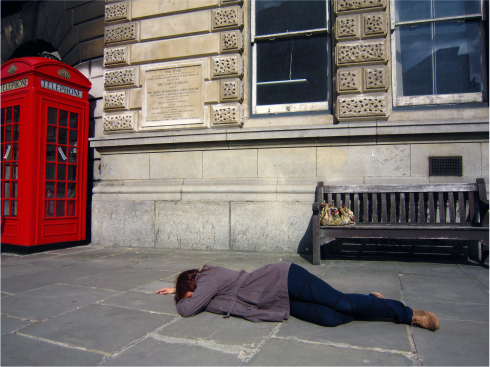
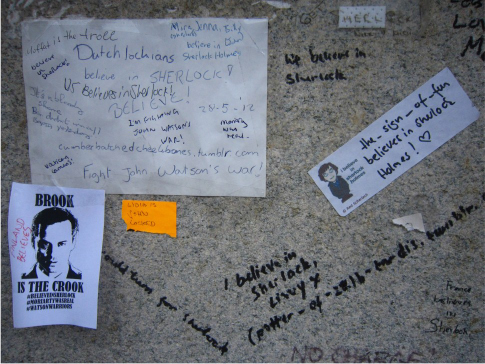
Figures 1 and 2:
Accessing the spectral spaces of St Bartholomew's Hospital, London (2012)
Photographs: Christina Lee.
ACKNOWLEDGEMENTS
Many thanks go to Jenny Bavidge, Chris Georgiou, the Sherlock Holmes Society of London, London Walks, London Horror Tours, and all the Sherlock fans I met during my field research for their generous time and support. I am also grateful to Helen Fordham and the reviewers for their invaluable feedback that helped to refine the scope and structure of the article.
NOTES
1. Jon Thompson, Fiction, Crime, and Empire: Clues to Modernity and Postmodernity, University of Illinois Press, Urbana and Chicago, 1993, p. 62.
2. Michael Taussig, The Magic of the State, Routledge, New York and London, 1997, p. 188.
3. ‘The Reichenbach Fall’, Sherlock (season 2, episode 3), directed by Toby Haynes, BBC, 2012.
4. Laurence Bresh (marketing director) cited in VisitBritain, ‘Sherlock Holmes: Official Website’, 2009, <www.visitbritain.com/en/campaigns/sherlock-holmes/Locations-itineraries/itineraries/index.aspx>.
5. Roberta Pearson, ‘“It's Always 1895”: Sherlock Holmes in Cyberspace’, in Trash Aesthetics: Popular Culture and Its Audience, eds Deborah Cartmell, I.Q. Hunter, Heidi Kaye and Imelda Whelehan, Pluto Press, London, 1997, p. 148; Roberta Pearson, ‘Bachies, Bardies, Trekkies, and Sherlockians’, in Fandom: Identities and Communities in a Mediated World, eds Jonathan Gray, Cornel Sandvoss and C. Lee Harrington, New York University Press, New York, 2007, p. 105.
6. Sherlock Holmes, motion picture, Warner Bros., 2009, directed by Guy Ritchie, starring Robert Downey Jr; Sherlock Holmes: A Game of Shadows, motion picture, Warner Bros., 2011, directed by Guy Ritchie, starring Robert Downey Jr; Sherlock, television series, BBC, 2010–, created by Mark Gatiss and Steven Moffat, starring Benedict Cumberbatch; Elementary, television series, CBS, 2012–, created by Robert Doherty, starring Jonny Lee Miller.
7. The Telegraph, ‘Sir Ian McKellen To Play Sherlock Holmes’, 5 September 2013, <http://www.telegraph.co.uk/culture/film/film-news/10288875/Sir-Ian-McKellen-to-play-Sherlock-Holmes.html>.
8. This was predominantly due to the unfavourable weather conditions (cold and/or raining) which meant the groups quickly dispersed at the conclusion of each walk.
9. London Ghosts tours, Jack the Ripper (JTR) tours and Sherlock Holmes tours run weekly. High demand for the former two mean that they are scheduled several times a week (daily in the case of JTR tours), and Sherlock tours generally once to twice weekly.
10. British Tourist Authority, VisitBritain and VisitEngland: Annual Report and Accounts, Crown Copyright, United Kingdom, 2010, p. 11, <www.official-documents.gov.uk/document/hc1011/hc01/0121/0121.pdf>.
11. Georgiou stated that business had almost doubled since the screening of the first series. Chris Georgiou, personal communication with the author, 2012.
12. Grace, personal communication with the author, 2012.
13. Louisa Ellen Stein and Kristina Busse, ‘Introduction: The Literary, Televisual and Digital Adventures of the Beloved Detective’, in Sherlock and Transmedia Fandom: Essays on the BBC Series, eds Louisa Ellen Stein and Kristina Busse, McFarland, Jefferson NC, 2012, p. 10.
14. Pearson noted that many individuals she met at Sherlockian gatherings were also members of other fandoms (‘Bachies, Bardies, Trekkies, and Sherlockians’, p. 102). In my own research the situation was similar. For instance, several interviewees professed to being Whovians (fans of Doctor Who) as well. This was in part because Mark Gatiss and Steven Moffat are producers and writers for both Sherlock and Doctor Who, and fans enjoyed the style and humour in both programs.
15. Alan Barnes, Sherlock Holmes On Screen: The Complete Film and TV History, Titan Books, London, 2011, p. 9.
16. Gérard Genette, Paratexts: Thresholds of Interpretation, Cambridge University Press, Cambridge, 1997, p. 1.
18. Jonathan Gray, Show Sold Separately: Promos, Spoilers, and Other Media Paratexts, New York University Press, New York, 2010, p. 25.
20. Sherlockology.com, ‘Sherlockology: The Ultimate Guide for any BBC Sherlock Fan’, n.d., <http://www.sherlockology.com/locations>.
22. Michael Bell, ‘The Ghosts of Place’, Theory and Society, vol. 26, no. 6, 1997, p. 813.
23. Chris Wilbert and Rikke Hansen, ‘Walks in Spectral Space: East London Crime Scene Tourism’, in Strange Spaces: Explorations into Mediated Obscurity, eds André Jansson and Amanda Lagerkvist, Ashgate, Surrey and Burlington, 2009, p. 189.
24. Alex Murray, ‘“This Light was Pale and Ghostly”: Stewart Home, Horror and the Gothic Destruction of “London”’, in London Gothic: Place, Space and the Gothic Imagination, eds Lawrence Phillips and Anne Witchard, Continuum, London and New York, 2010, pp. 65–7.
25. Peter Ackroyd, London Under, Vintage, London, 2012, pp. 26, 64, 111.
26. Steve Pile, ‘Spectral Cities: Where the Repressed Returns and Other Short Stories’, in Habitus: A Sense of Place, eds Jean Hillier and Emma Rooksby, Ashgate, Aldershot, 2002, p. 230.
30. Robert Mighall, ‘Crime and Memory in the Capital’, in London: From Punk to Blair, eds Joe Kerr and Andrew Gibson, Reaktion Books, London, 2003, p. 372.
31. Emma McEvoy, ‘“West End Ghosts and Southwark Horrors”: London's Gothic Tourism’, in London Gothic: Place, Space and the Gothic Imagination, eds Lawrence Phillips and Anne Witchard, Continuum, London and New York, 2010, p. 142.
32. George Hughes, ‘Tourism and the Semiological Realization of Space’, in Destinations: Cultural Landscapes of Tourism, ed. Greg Ringer, Routledge, Abingdon, 1998, p. 18.
33. Steve Newman, personal communication with the author, 2012.
34. Arthur Conan Doyle, ‘The Boscombe Valley Mystery’, in Tales of Sherlock Holmes, Grosset and Dunlap, New York, 1915, p. 211.
35. Lauren, personal communication with the author, 2012.
36. Jean Upton and Roger Johnson, personal communication with the author, 2012. Both Upton and Johnson also edit and contribute to The Sherlock Holmes Journal.
37. Catherine Wynne, ‘Introduction: From Baker Street to Undershaw and Beyond’, in Sherlock Holmes and Conan Doyle: Multi-Media Afterlives, eds Sabine Vanacker and Catherine Wynne, Palgrave Macmillan, Houndmills, 2013, p. 7.
39. Nicholas Freeman, Conceiving the City: London, Literature, and Art 1870–1914, Oxford University Press, Oxford, 2007, p. 158.
40. Jenny Bavidge, personal communication with the author, 2012.
41. Christina Lee, ‘“Have Magic, Will Travel”: Tourism and Harry Potter's United (Magical) Kingdom’, Tourist Studies, vol. 12, no. 1, 2012, p. 63.
43. Tony Lee, personal communication with the author, 2012.
44. Matt Hills provides a detailed analysis of how the BBC's Sherlock knowingly activates fan knowledge by intertextually reworking Conan Doyle's canon. See: Matt Hills, ‘Sherlock's Epistemological Economy and the Value of “Fan” Knowledge: How Producer-Fans Play the (Great) Game of Fandom’, in Sherlock and Transmedia Fandom: Essays on the BBC Series, eds Louisa Ellen Stein and Kristina Busse, McFarland, Jefferson NC, 2012, p. 32.
45. Richard Burnip, personal communication with the author, 2012.
46. Arthur Conan Doyle, ‘The Sign of the Four’, in Tales of Sherlock Holmes, Grosset and Dunlap, New York, 1915, p. 252.
47. The continued significance of London as the home of Sherlock Holmes is conveyed by Elementary creator Robert Doherty: ‘If you're going to transplant Sherlock Holmes to an American city it has to be New York … There's a texture to the place that's reminiscent of London and both have Victorian elements’. The centrality of London was further signalled by the season 2 premiere of Elementary (‘Step Nine’, 2013) which saw Holmes and (Joan) Watson travel to London to solve a mystery, functioning like a homecoming of sorts. Robert Doherty quoted in Chuck Taylor, ‘New CBS Drama “Elementary” Set in Brooklyn Heights, Filmed in Harlem’, 16 July 2012, <http://brooklynheightsblog.com/archives/44294>.
48. Bran Nicol, ‘Sherlock Holmes Version 2.0: Adapting Doyle in the Twenty-First Century’, in Sherlock Holmes and Conan Doyle: Multi-Media Afterlives, eds Sabine Vanacker and Catherine Wynne, Palgrave Macmillan, Houndmills, 2013, p. 134.
49. Avery Gordon, Ghostly Matters: Haunting and the Sociological Imagination, University of Minnesota Press, Minneapolis and London, 1997, p. 8.
50. VisitBritain, ‘Sherlock Holmes: Official Website’.
51. Stijn Reijnders, ‘Watching the Detectives: Inside the Guilty Landscapes of Inspector Morse, Baantjer and Wallander’, European Journal of Communication, vol. 24, no. 2, 2009, p. 176.
53. This topographical detection is not limited to tourism but is also evident in scholarship emanating from Sherlock Holmes societies. During an interview with Catherine Cooke, a member of the Sherlock Holmes Society of London and curator of the Sherlock Holmes Collection at Marylebone Library, Cooke explained the importance of visiting sites speculated to be those described in the Conan Doyle stories. As Cooke stated, there are:
various theories about where Baskerville Hall is because there is no one house in Dartmoor that is Baskerville Hall. There are a lot of good candidates but there's always something wrong with them. We can go down to Birling Gap there in Sussex where Holmes retired and there's theories about that, and go and look at the beach where the Lion's Mane was.
This investigative work treats the narratives of Sherlock Holmes as texts for critical inquiry and analysis. Catherine Cooke, personal communication with the author, 2012.
54. David Crouch, ‘Surrounded by Place: Embodied Encounters’, in Tourism: Between Place and Performance, eds Simon Coleman and Mike Crang, Berghahn Books, New York and Oxford, 2002, pp. 207, 208.
56. Rikke Hansen and Chris Wilbert, ‘Setting the Crime Scene: Aspects of Performance in Jack the Ripper Guided Tourist Walks’, Merge Magazine: Sound Thought Image, vol. 17, 2006, p. 19.
57. Burnip, Newman and John Pope, personal communication with the author, 2012.
59. Stefan Roesch, The Experiences of Film Location Tourists, Channel View Publications, Bristol, 2009, pp. 144, 130.
62. Phil Baker, ‘Secret City: Psychogeography and the End of London’, in London: From Punk to Blair, eds Joe Kerr and Andrew Gibson, Reaktion Books, London, 2003, pp. 324, 330.
63. Steve McKenna, ‘Spy on Spies in Secrets Capital’, The Weekend West: Travel, 5–6 May 2012, p. 5.
64. Erik Cohen, ‘A Phenomenology of Tourist Experiences’, Sociology, vol. 13, no. 2, 1979, p. 185.
65. David Herbert, ‘Literary Places, Tourism and the Heritage Experience’, Annals of Tourism Research, vol. 28, no. 2, 2001, p. 318.
67. ‘A Study in Pink’, Sherlock (season 1, episode 1), directed by Paul McGuigan, BBC, 2010.
‘Sir Ian McKellen To Play Sherlock Holmes’, The Telegraph, 5 September 2013, <http://www.telegraph.co.uk/culture/film/film-news/10288875/Sir-Ian-McKellen-to-play-Sherlock-Holmes.html>.
BIBLIOGRAPHY
Ackroyd, P., London Under, Vintage, London, 2012.
Baker, P., ‘Secret City: Psychogeography and the End of London’, in London: From Punk to Blair, eds Joe Kerr and Andrew Gibson, Reaktion Books, London, 2003.
Barnes, A., Sherlock Holmes On Screen: The Complete Film and TV History, Titan Books, London, 2011.
Bell, M., ‘The Ghosts of Place’, Theory and Society, vol. 26, no. 6, 1997, p. 813.
British Tourist Authority, VisitBritain and VisitEngland: Annual Report and Accounts, Crown Copyright, United Kingdom, 2010, p. 11, <www.official-documents.gov.uk/document/hc1011/hc01/0121/0121.pdf>.
Cartmell, D., I.Q. Hunter, H. Kaye and I. Whelehan (eds), Trash Aesthetics: Popular Culture and Its Audience, Pluto Press, London, 1997
Cohen, E., ‘A Phenomenology of Tourist Experiences’, Sociology, vol. 13, no. 2, 1979.
Coleman, S. and M. Crang (eds), Tourism: Between Place and Performance, Berghahn Books, New York and Oxford, 2002.
Conan Doyle, A., ‘The Boscombe Valley Mystery’, in Tales of Sherlock Holmes, Grosset and Dunlap, New York, 1915.
Conan Doyle, A., ‘The Sign of the Four’, in Tales of Sherlock Holmes, Grosset and Dunlap, New York, 1915.
Crouch, D., ‘Surrounded by Place: Embodied Encounters’, in Tourism: Between Place and Performance, eds Simon Coleman and Mike Crang, Berghahn Books, New York and Oxford, 2002.
Freeman, N., Conceiving the City: London, Literature, and Art 1870–1914, Oxford University Press, Oxford, 2007.
Genette, G., Paratexts: Thresholds of Interpretation, Cambridge University Press, Cambridge, 1997.
Gordon, A., Ghostly Matters: Haunting and the Sociological Imagination, University of Minnesota Press, Minneapolis and London, 1997.
Gray, J., C. Sandvoss and C. L. Harrington (eds), Fandom: Identities and Communities in a Mediated World, New York University Press, New York, 2007
Gray, J., Show Sold Separately: Promos, Spoilers, and Other Media Paratexts, New York University Press, New York, 2010
Hansen, R. and C. Wilbert, ‘Setting the Crime Scene: Aspects of Performance in Jack the Ripper Guided Tourist Walks’, Merge Magazine: Sound Thought Image, vol. 17, 2006.
Herbert, D., ‘Literary Places, Tourism and the Heritage Experience’, Annals of Tourism Research, vol. 28, no. 2, 2001.
Hillier, J. and E. Rooksby (eds), Habitus: A Sense of Place, Ashgate, Aldershot, 2002.
Hills, M., ‘Sherlock's Epistemological Economy and the Value of “Fan” Knowledge: How Producer-Fans Play the (Great) Game of Fandom’, in Sherlock and Transmedia Fandom: Essays on the BBC Series, eds Louisa Ellen Stein and Kristina Busse, McFarland, Jefferson NC, 2012.
Hughes, G., ‘Tourism and the Semiological Realization of Space’, in Destinations: Cultural Landscapes of Tourism, ed. Greg Ringer, Routledge, Abingdon, 1998.
Jansson, A. and A. Lagerkvist (eds), Strange Spaces: Explorations into Mediated Obscurity, Ashgate, Surrey and Burlington, 2009.
Kerr, J. and A. Gibson (eds), London: From Punk to Blair, Reaktion Books, London, 2003.
Lee, C., ‘“Have Magic, Will Travel”: Tourism and Harry Potter's United (Magical) Kingdom’, Tourist Studies, vol. 12, no. 1, 2012, p. 63.
McEvoy, E., ‘“West End Ghosts and Southwark Horrors”: London's Gothic Tourism’, in London Gothic: Place, Space and the Gothic Imagination, eds Lawrence Phillips and Anne Witchard, Continuum, London and New York, 2010.
McKenna, S., ‘Spy on Spies in Secrets Capital’, The Weekend West: Travel, 5–6 May 2012.
Mighall, R., ‘Crime and Memory in the Capital’, in London: From Punk to Blair, eds Joe Kerr and Andrew Gibson, Reaktion Books, London, 2003.
Murray, A., ‘“This Light was Pale and Ghostly”: Stewart Home, Horror and the Gothic Destruction of “London”’, in London Gothic: Place, Space and the Gothic Imagination, eds Lawrence Phillips and Anne Witchard, Continuum, London and New York, 2010.
Nicol, B., ‘Sherlock Holmes Version 2.0: Adapting Doyle in the Twenty-First Century’, in Sherlock Holmes and Conan Doyle: Multi-Media Afterlives, eds Sabine Vanacker and Catherine Wynne, Palgrave Macmillan, Houndmills, 2013.
Pearson, R., ‘“It's Always 1895”: Sherlock Holmes in Cyberspace’, in Trash Aesthetics: Popular Culture and Its Audience, eds Deborah Cartmell, I.Q. Hunter, Heidi Kaye and Imelda Whelehan, Pluto Press, London, 1997.
Pearson, R., ‘Bachies, Bardies, Trekkies, and Sherlockians’, in Fandom: Identities and Communities in a Mediated World, eds Jonathan Gray, Cornel Sandvoss and C. Lee Harrington, New York University Press, New York, 2007.
Phillips, L. and A. Witchard (eds), London Gothic: Place, Space and the Gothic Imagination, Continuum, London and New York, 2010.
Pile, S., ‘Spectral Cities: Where the Repressed Returns and Other Short Stories’, in Habitus: A Sense of Place, eds Jean Hillier and Emma Rooksby, Ashgate, Aldershot, 2002.
Reijnders, S., ‘Watching the Detectives: Inside the Guilty Landscapes of Inspector Morse, Baantjer and Wallander’, European Journal of Communication, vol. 24, no. 2, 2009.
Ringer, G. (ed.), Destinations: Cultural Landscapes of Tourism, Routledge, Abingdon, 1998.
Roesch, S., The Experiences of Film Location Tourists, Channel View Publications, Bristol, 2009
Sherlockology.com, ‘Sherlockology: The Ultimate Guide for any BBC Sherlock Fan’, n.d., <http://www.sherlockology.com/locations>.
Stein, L. E. and K. Busse (eds), Sherlock and Transmedia Fandom: Essays on the BBC Series, McFarland, Jefferson NC, 2012.
Taussig, M., The Magic of the State, Routledge, New York and London, 1997.
Taylor, C., ‘New CBS Drama “Elementary” Set in Brooklyn Heights, Filmed in Harlem’, 16 July 2012, <http://brooklynheightsblog.com/archives/44294>.
Thompson, J., Fiction, Crime, and Empire: Clues to Modernity and Postmodernity, University of Illinois Press, Urbana and Chicago, 1993.
Vanacker, S. and C. Wynne (eds), Sherlock Holmes and Conan Doyle: Multi-Media Afterlives, Palgrave Macmillan, Houndmills, 2013.
VisitBritain, ‘Sherlock Holmes: Official Website’, 2009, <www.visitbritain.com/en/campaigns/sherlock-holmes/Locations-itineraries/itineraries/index.aspx>.
Wilbert, C. and R. Hansen, ‘Walks in Spectral Space: East London Crime Scene Tourism’, in Strange Spaces: Explorations into Mediated Obscurity, eds André Jansson and Amanda Lagerkvist, Ashgate, Surrey and Burlington, 2009.
Wynne, C., ‘Introduction: From Baker Street to Undershaw and Beyond’, in Sherlock Holmes and Conan Doyle: Multi-Media Afterlives, eds Sabine Vanacker and Catherine Wynne, Palgrave Macmillan, Houndmills, 2013.