Commonwealth Journal of Local Governance
Issue 30
December 2025
BOOK REVIEW
Review: Social Protection in Botswana: Socio-Economic and Legal Perspectives
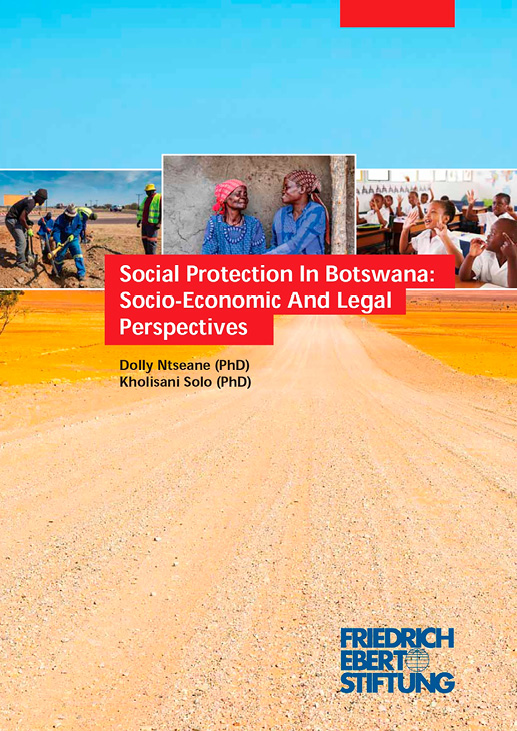
Social Protection in Botswana: Socio-Economic and Legal Perspectivesby Dolly Ntseane & Kholisani Solo
(2023 Friedrich-Ebert-Stiftung)
University of Botswana, Botswana, waronasekhomba@yahoo.com
DOI: https://doi.org/10.5130/6gcw1615
Article History: Received 23/05/2025; Accepted 04/11/2025; Published 31/12/2025
Citation: Sekhomba, J. W. B. 2025. Review: Social Protection in Botswana: Socio-Economic and Legal Perspectives. Commonwealth Journal of Local Governance, 30, 128–130. https://doi.org/10.5130/6gcw1615
© 2025 by the author(s). This is an Open Access article distributed under the terms of the Creative Commons Attribution 4.0 International (CC BY 4.0) License (https://creativecommons.org/licenses/by/4.0/), allowing third parties to copy and redistribute the material in any medium or format and to remix, transform, and build upon the material for any purpose, even commercial, provided the original work is properly cited and states its license.
Dolly Ntseane and Kholisani Solo’s Social Protection in Botswana: Socio-Economic and Legal Perspectives is a careful, well-regarded study of social protection in Botswana, anchored in its historical and socio-economic context. Over the years, Botswana’s coverage of and financial commitment to social protection have expanded, and currently 4.4% of Botswana’s GDP is used on social protection.
There has been considerable change between the pre-colonial period and the present day. The book reviews the existing international, regional and local legal instruments on social protection and their suitability for application in Botswana. This includes United Nations instruments that offer policy guidance that is supplementary to local instruments.
The authors suggest that social protection delivery systems are best understood by examining their institutions and administrative systems. These include state institutions, civil society, churches and development partners. The book includes an in-depth assessment of various social protection benefits in Botswana for children, families and communities in terms of their capacity to reduce poverty; and it evaluates strengths, weaknesses, threats and opportunities related to these programmes.
The book makes the case that vulnerable groups must be granted access to social protection, because they need it. Support should be widely defined to include both a legal safety net and preventive social protection measures to limit damage caused by climate change, COVID-19 and other disasters. The authors examine how Botswana’s social protection system currently responds to disasters, and general principles for well-targeted programming in response to disaster. They also report on safeguards available to informal workers, and what lessons and best practices have developed in other countries.
The authors are concerned that social protection in Botswana is not a right guaranteed by the constitution, and the government instead uses a human-rights based approach. Botswana has a commitment to providing a social safety net, but social protection is not yet entrenched in law. The country therefore uses the Human Rights-Based Framework for social protection developed by the United Nations General Assembly and the Human Rights Council.
The latter part of the book offers practical recommendations to improve Botswana’s social protection regime, and these will be of great use to policy-makers, administrators and those implementing social protection programmes. The book also serves as an effective textbook for students of social sciences and humanities. Further, it is a useful tool for advocacy groups like trade unions, which seek to empower workers and ensure decent working conditions.
The governance of social protection programmes is a key theme of the book, and is examined from several angles: coordination, decentralisation, and the role of local authorities in service delivery. The importance of community inclusion and public participation in the design and monitoring of social services is also emphasised, in order to both promote and monitor local responsiveness.
The authors note that social protection governance in Botswana is fragmented across different government institutions, which makes it difficult to deliver effective services since a harmonised administrative system is lacking. To address this issue, the book calls for a more comprehensive and coordinated system – as indeed was mandated by the National Social Protection Framework approved by Botswana’s cabinet in August 2020. The book also underscores the importance of local governance over the operational delivery and sustainability of social protection services. The authors recommend that, in order to enhance the effectiveness of social protection at the local level, the government should strengthen inter-governmental communication and reporting channels, augment local capacity, and institutionalise participating governance structures.
The book identifies several key areas where Botswana’s social protection programmes need improvement. These include tighter targeting, so that benefits only reach consumers who are in poverty, and that they cease after beneficiaries have been lifted out of poverty. It points out discrepancies between various government ministries and agencies in the social protection sphere, which sometimes have overlapping aims, leading to waste of resources. This underscores the need for a more coordinated system, as recommended by the National Social Protection Framework. Further, the book notes that monitoring and evaluation of social protection programmes is weak, which hinders assessment of their impact and performance. To address these challenges, the book advocates:
• fast-tracking the implementation of the National Social Protection Framework and the National Social Protection Recovery Plan
• establishing a Ministry of Social Development, bringing together all social protection programmes, which would reduce duplication and harness resources more efficiently
• establishing a proper complaints procedure, along with a monitoring, adjudication and enforcement structure, to ensure equal rights for all beneficiaries.
All in all, the book strongly recommends the design of a global social protection policy that is not only preventive, but also inclusive, participatory and integrative – and governed by an effective regulatory framework.
Declaration of conflicting interest
The authors declared no potential conflicts of interest with respect to the research, authorship, and/or publication of this article.
Funding
The author received no financial support for the research, authorship or publication of this article.