Commonwealth Journal of Local Governance
Issue 29
October 2024
BOOK REVIEW
Review: Decentralised Governance: Crafting Effective Democracies Around the World
Edited by Jean-Paul Faguet and Sarmistha Pal
Graham Sansom
Institute for Public Policy and Governance, University of Technology Sydney, Australia, graham.sansom@uts.edu.au
| Decentralised Governance: Crafting Effective Democracies Around the World Edited by Jean-Paul Faguet and Sarmistha Pal London: LSE Press. DOI: https://doi.org/10.31389/lsepress.dlg | 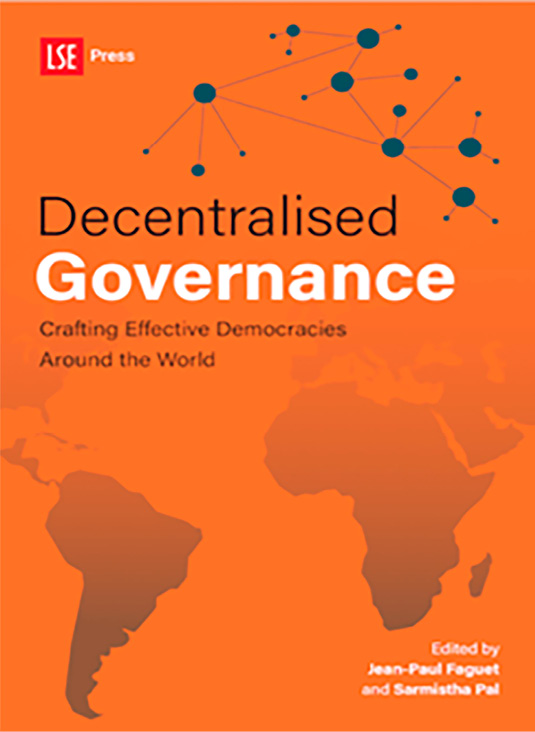 |
Corresponding author: Graham Sansom, Institute for Public Policy and Governance, University of Technology Sydney, Australia, graham.sansom@uts.edu.au
DOI: https://doi.org/10.5130/cjlg.vi29.9371
Article History: Received 28/09/2024; Accepted 01/10/2024; Published 09/10/2024
Citation: Sansom, G. 2024. Review: Decentralised Governance: Crafting Effective Democracies Around the World Edited by Jean-Paul Faguet and Sarmistha Pal. Commonwealth Journal of Local Governance, 29, 153–156. https://doi.org/10.5130/cjlg.vi29.9371
© 2024 by the author(s). This is an Open Access article distributed under the terms of the Creative Commons Attribution 4.0 International (CC BY 4.0) License (https://creativecommons.org/licenses/by/4.0/), allowing third parties to copy and redistribute the material in any medium or format and to remix, transform, and build upon the material for any purpose, even commercial, provided the original work is properly cited and states its license.
The premise for this book is that for more than six decades decentralisation, while not in itself a good or bad thing, has been one of the most powerful reform movements across the world, now underpinned by a broad consensus “that – under the right conditions – decentralised systems produce more effective public services and are more democratic” (p. 1, emphasis added). Through a ‘new generation of studies’ the book sets out to explore what those ‘right conditions’ might entail; how decentralisation operates under different political, institutional and social contexts; specific ways in which decentralisation can improve governance; and how it can go wrong – how reforms may have fallen short of expectations.
The first four of the book’s 12 chapters provide an overview of key issues and themes; seven of the remainder present a series of country-specific, but also thematic, case studies; and, strangely planted amongst those case studies, there is a fifth overview chapter focused principally on different ways to monitor and audit decentralised governance in developing countries as a means of combatting corruption.
Commonwealth countries feature in four of the seven case studies – Pakistan, Kenya, Ghana and Bangladesh. The chapter on Pakistan examines the practice of devolution under autocratic, military governments. It suggests that devolution has been used as a convenient way of legitimising military dictatorships, and of bypassing mainstream political parties, by cultivating alliances with local elites and powerbrokers. This led to a form of ‘democratic’ local government dominated by influential political clans and families, and patronage.
In the case of Kenya, the chapter focuses on the importance of maintaining effective parliamentary oversight over all levels of government in order to ensure transparency and accountability – seen as lacking in most developing countries. The authors find that partisanship and collusive behaviour between politicians in the national parliament and those in local governments weaken the role of oversight committees, circumvent the imposition of disciplinary sanctions and enable ongoing corruption. This undermines one of the critical intended benefits of decentralisation – downward accountability to local communities.
The Ghanaian study addresses gaps in measuring the performance of local government in decentralised systems. It asks whether there is adequate evidence to show that decentralisation processes have indeed led to more effective and responsive sub-national government. The authors review a wide range of actual and potential indicators, and identify gaps in performance data and reporting. Unsurprisingly, given those gaps, the research produced little in the way of definitive findings about variations in performance from one local government to another across Ghana. However, it does arrive at the somewhat depressing conclusion that districts in more affluent communities are more responsive to their citizens than those in areas with a high incidence of poverty.
The contribution from Bangladesh provides further insights concerning deficiencies in the local information needed to assess the effectiveness of decentralisation. It looks at the rate of birth registrations by union parishads, the lowest level of rural local government, and finds very large variations from one area to another. A likely explanation lies in differences in institutional capacity due to ‘supply side issues’ such as corruption, nepotism, inadequate infrastructural support, and inexperienced service providers. This is seen to have potentially important consequences for public policy responses in other key areas of administration.
These findings from the four Commonwealth countries fit nicely into the book’s broader themes and conclusions concerning the difficulty of making a rounded assessment of progress with the decentralisation agenda, and the need to view decentralisation more as a political act rather than continuing to focus principally on its technical dimensions. In terms of assessing progress, the book leaves an overriding impression that the available evidence is so patchy and disjointed, and so full of contradictions, that reaching firm conclusions about the value of pushing ahead with decentralised systems of governance is virtually impossible. The editors call for further research on several fronts, acknowledging that (p. 14): “we know little about whether decentralisation has strengthened the legitimacy of government as a whole and shifted social norms so that bureaucracies perform better”.
As highlighted in the overview chapters, most of the decentralisation reforms of recent decades have been only partial – in many instances creating or strengthening political entities at the local level has not been matched by fiscal devolution, meaning that newly enfranchised electors are all too often voting for local governments that have insufficient autonomy, resources and expertise to deliver promised change. At the same time, local politics often operate largely as a subset of national contests, whether between parties or between forms of democracy and autocracy, such that upward rather than downward accountability prevails. And local governance is likely to be characterised to a greater or lesser extent by elite capture, corruption or clientelism, accompanied by manipulation of budgets to favour preferred target groups – not necessarily a bad thing if the poor are favoured, but how often is that truly the case?
So, despite the breadth and depth of the book’s analysis, this reviewer emerged little wiser about what those ‘right conditions’ for crafting more effective public services and democracies might actually be. That is not to criticise the authors; rather to recognise that a few decades is far too short a timeframe to bring about the sweeping and fundamental changes in governance that the decentralisation agenda proposes, to realise the benefits it projects, and to make definitive judgements about what works and what doesn’t. Moreover, the circumstances in which decentralisation is being attempted, and the precise outcomes being sought, are so variable and so dynamic that no set of actions will be ‘right’ across the board. As the editors state clearly at the outset (pp. 4–5):
Done correctly … decentralisation can improve the democratic accountability and responsiveness of governments by changing the incentives that local officials face … But this ‘done correctly’ hides far more than it reveals. Countries have chosen to decentralise in very different ways, devolving, for example, different sets of powers over different public services to different levels of subnational government, with different revenue-raising powers and different degrees of subnational democracy.
All of which raises inevitable questions about how often decentralisation of some sort is the ‘right’ idea in the first place; how likely outcomes might be predicted in advance; and whether enough research is taking place to explore and define alternative approaches that might deliver as good or better results for the citizens of developing countries. Those of us living in the developed world that is now ‘exporting’ its models of decentralised governance would do well to reflect more deeply on the critical differences between our own systems of local and regional government, and the extent to which those systems are really delivering better quality of life and meaningful democracy. Perhaps that’s where useful lessons need to be learned.
Declaration of conflicting interest
The author declared no potential conflicts of interest with respect to the research, authorship, and/or publication of this article.
Funding
The author received no financial support for the research, authorship or publication of this article.