Commonwealth Journal of Local Governance
Issue 29
October 2024
BOOK REVIEW
Review: Solved: How the World’s Great Cities Are Solving the Climate Crisis
by David Miller
Zenshin Consulting, 22 Tower Hill, Brentwood, CM14 4TA, United Kingdom, randal63@gmail.com
| Solved: How the World’s Great Cities Are Solving the Climate Crisis by David Miller (2024 University of Toronto Press) | 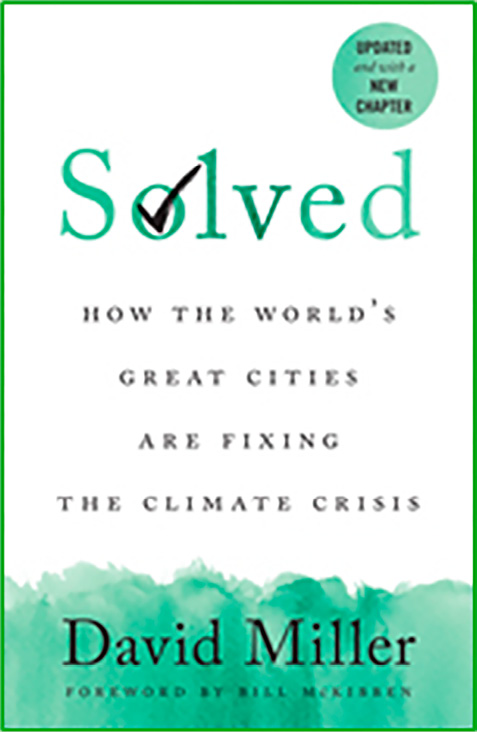 |
Corresponding author: Randal Smith, Zenshin Consulting, 22 Tower Hill, Brentwood, CM14 4TA, United Kingdom, randal63@gmail.com
DOI: https://doi.org/10.5130/cjlg.vi29.9367
Article History: Received 21/09/2024; Accepted 25/09/2024; Published 09/10/2024
Citation: Smith, R. 2024. Review: Solved: How the World’s Great Cities Are Solving the Climate Crisis by David Miller. Commonwealth Journal of Local Governance, 29, 157–159. https://doi.org/10.5130/cjlg.vi29.9367
© 2024 by the author(s). This is an Open Access article distributed under the terms of the Creative Commons Attribution 4.0 International (CC BY 4.0) License (https://creativecommons.org/licenses/by/4.0/), allowing third parties to copy and redistribute the material in any medium or format and to remix, transform, and build upon the material for any purpose, even commercial, provided the original work is properly cited and states its license.
By demonstrating that climate action works, city leadership can overcome the biggest challenges to solving the climate crisis: inertia, and the perception that measures to address climate change makes people’s lives more expensive, more difficult or worse.
David Miller, the author of Solved, is a former Mayor of Toronto (2003–2010). He knows a thing or two about leading a city. His leadership of Toronto can be described as favouring the pragmatic over the ideological. For example, when he came into office as a member of the left-leaning New Democratic Party Toronto faced a serious financial crisis. He chose a Conservative to take responsibility for financial planning.
This pragmatism in Miller’s political life is important to note because it underpins his argument throughout Solved – there are pragmatic solutions already out there that cities can implement to address the climate crisis. In Toronto Miller would go on to implement a range of climate-focused initiatives. Later, he became Director of C40, a global network of mayors from the world’s leading cities focused on tackling climate change.
This new, paperback edition of Solved is a re-issue of the original published in 2020, with an additional chapter updating the reader on the urgency for cities to contribute to tackling climate change.
The global climate crisis outstrips the actions of any one country and consequently there are numerous, clunky, compromised accords and conferences that take years to be translated into action on the ground. So Miller’s argument rests, essentially, on the theory of incremental gains. That is, when multiple small improvements are made in an iterative manner, big outcomes are the result. Simply put, it comes down to: Get on with what you can now and don’t wait for an all-encompassing solution that everyone agrees with. The planet is burning. Demonstrating that we can all play our part is the compelling argument of the book.
Miller sets out key areas that every city can look at and challenge itself with the question: Can we make our actions more attuned to the needs of combatting climate change? Potential initiatives encompass strategic planning, energy saving, design of existing and new buildings, public and personal transport, and waste. All larger cities in the Commonwealth have jurisdiction over several if not all of these issues. Even smaller towns are engaged in some, and all cities and towns provide their political leaders with a platform for change through strategic leadership – carrying the local institutions of all sectors and citizens towards a common goal.
The reader would do best to approach this book as a menu of possibilities to choose from and apply to their city. Miller has selected ideas that are supported by proven examples, and is successful in providing a positive and hopeful case for cities’ actions having a meaningful impact in the fight against the climate crisis. More than hope, however, Miller provides a vast range of resources for city administrators and politicians around the world to draw upon – and indeed for citizens to push under the noses of reluctant city leaders. The entire book has the latent challenge: Why not do this where you live?
Examples are provided of:
• Large scale interventions including decentralised energy. This is a means of combatting climate change and fuel poverty in one go – more efficient homes are better for the individual and better for the environment.
• District heating and cooling.
• Capturing waste heat and heat transfer systems (in new technology this may include server rooms and data centres – both eager to get rid of heat).
• Greening existing buildings – from insulation through to light bulbs.
What’s really important here is that Solved demonstrates with several case studies that retrofitting and building to higher standards repays very rapidly. Miller includes an important section in the chapter on Existing Buildings (which are responsible for over 40% of carbon emissions). Here he discusses the contradictions and market distortions that militate against efficiency opportunities. The most common in both commercial and private rental properties is that the tenant is responsible for energy bills, while the landlord is responsible for the cost of the retrofitting. This is known as the ‘split-incentive problem’.
So, what does this have to do with city leadership? In New York City, Mayor Bloomberg harnessed the power of the market to drive change: requiring building owners to publish energy efficiency scores meant that tenants began to factor in the cost of energy with the rents.
At the other end of the cost-scale, perhaps, is an example from Ljubljana in Croatia, where the city is leading on behaviour change and has an explicit strategy to help citizens ‘get used to re-using’. This includes among other initiatives a ‘library of things’ where tools, sports equipment and toys can be borrowed, and a ‘repair café’. Ljubljana is aiming to become a zero waste city by re-using and recycling.
If there is one weakness in this book it’s that perhaps it doesn’t help the reader understand the challenges that may come with some of the actions described, beyond stating that there are political pushbacks. Striking the right balance between: here are some great ideas you can use, and: careful, they may come with some serious challenges, is of course difficult. Nevertheless, priming the reader to be able to think around potential challenges and likely issues to be addressed, while maintaining a forward trajectory, should be a distinct possibility. Miller’s solution is: rely on the science, but the book would benefit from a complementary focus on: how to carry the public with you, offering guidance that city politicians can use. That may be embedded in the examples, but it didn’t surface clearly for this reviewer.
Ultimately, Miller’s call to action is: stop waiting for international treaties and central government to solve the crisis, draw on what cities have already done – roll it out, scale it up or scale it down, just make it happen.
Declaration of conflicting interest
The author declared no potential conflicts of interest with respect to the research, authorship, and/or publication of this article.
Funding
The author received no financial support for the research, authorship or publication of this article.