Commonwealth Journal of Local Governance
Issue 28
September 2023
Book Review
Review: The Winding Stair by Sir Rodney Brooke
Institute of Public Policy and Governance, University of Technology Sydney, PO Box 123, Broadway, NSW 2007, Australia, andy.asquith@uts.edu.au
| The Winding Stair by Sir Rodney Brooke (2022 Leeds: Scratching Shed Publishing) | 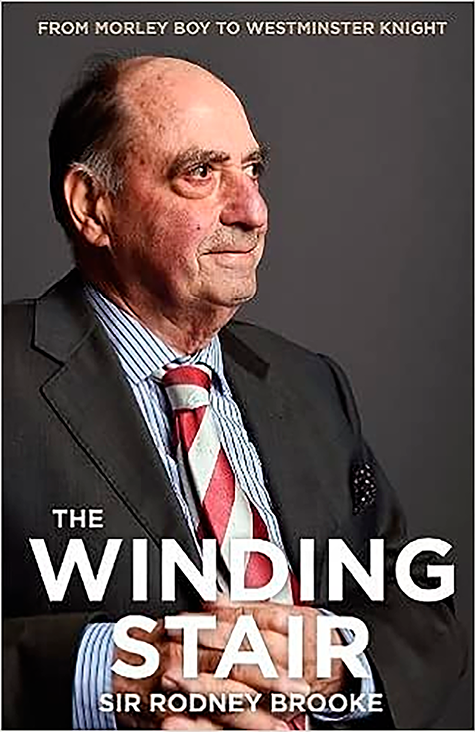 |
Corresponding author: Andy Asquith, Institute of Public Policy and Governance, University of Technology Sydney, PO Box 123, Broadway, NSW 2007, Australia, andy.asquith@uts.edu.au
DOI: https://doi.org/10.5130/cjlg.vi28.8767
Article History: Received 01/08/2023; Accepted 06/08/2023; Published 25/09/2023
Citation: Asquith, A. 2023. Review: The Winding Stair by Sir Rodney Brooke. Commonwealth Journal of Local Governance, 28, 155–157. https://doi.org/10.5130/cjlg.vi28.8767
© 2023 by the author(s). This is an Open Access article distributed under the terms of the Creative Commons Attribution 4.0 International (CC BY 4.0) License (https://creativecommons.org/licenses/by/4.0/), allowing third parties to copy and redistribute the material in any medium or format and to remix, transform, and build upon the material for any purpose, even commercial, provided the original work is properly cited and states its license.
In this autobiography Sir Rodney Brooke provides a variously funny, thoughtful, inciteful and depressing read as he takes us through his illustrious career of over 40 years in English local government. Alongside Brooke’s own climb up the stairway, he chronicles the greasy pole decline of local government as an institution in Britain, sprinkled with anecdotes that show the diversity and idiosyncrasies which make local government so fascinating, and at times entertaining.
Early in the book, the power and authority of County Clerks – modern day chief executives – is illustrated by two examples from the 1950s and 1960s. In one, we are regaled with the story of the Clerk of the West Riding of Yorkshire, who on visits to London would stay in a 5-star hotel and send his card to the Ministry of Local Government, effectively summoning the Permanent Secretary to visit the hotel to meet him!
In the second example, the councillors of two different counties – Kent and Cornwall which are almost 500km apart – only discovered at a chance meeting in London that they shared the same County Clerk. Apparently, the Clerk’s personal barber was employed by Kent and was known as ‘Deputy County Clerk’. The dual Clerk was able to effectively delegate much of his tasks in each authority, leaving himself free to live in London and pursue other interests!
From humble origins as a cub reporter on a local newspaper, Brooke began his local government career as an office boy in a small local council, where, by means of various side hustles, he financed his solicitor’s training and started to climb. Through a number of moves, his career progressed steadily until in 1973, at the tender age of 29, he was appointed Director of Administration of the West Yorkshire Metropolitan County Council (WYMCC), which in effect replaced the former West Riding. When he was later offered the chief executive’s job at the City of Birmingham – probably THE plum job in local government in England – the Leader of WYMCC summarily ‘retired’ the incumbent CEO to install Brooke and keep him at the County. One is left to ponder what might have been had he gone to Birmingham….
Brooke’s time at WYMCC came to a premature end when the Conservative Thatcher Government abolished the metropolitan counties in a catch-all political move to defenestrate the then Leader of the Greater London Council – Labour’s ‘Red Ken’ Livingstone. As soon as they became aware that Brooke would be on the job market, the head-hunters came calling. He ended up being offered the role of CEO at Westminster City Council where a newly elected Leader was determined to shake up what she perceived to be a somewhat Dickensian organisation and instil into it some managerial zeal.
The Leader – Dame Shirley Porter – saw herself as local government’s answer to Margaret Thatcher. Porter was a self-publicist who was determined to make her mark. She certainly did so, attempting to gerrymander council elections: Brooke refused to implement her policies and resigned in 1989. With hindsight Porter should have listened to Brooke and saved GBP 42.5 million (yes, you read the figure correctly!) in surcharges and fines later imposed after a lengthy legal battle. I interviewed Brooke as part of my PhD research. When I asked him about his Westminster experience he would only speak with the tape recorder turned off. Given what subsequently unfolded in the courts it was hardly surprising!
The Westminster fiasco did not harm Brooke’s career though. The untimely death of the Secretary (the equivalent of a CEO) of the Association of Metropolitan Authorities (AMA) opened up another opportunity which Brooke seized in 1990. He fulfilled the role with distinction until 1997, when the AMA merged into a single representative body for councils, the new Local Government Association. That marked the end of his formal local government career, except that he became a weekly columnist for the Local Government Chronicle, a position from which he could reflect on the continuing erosion of local authorities’ powers and autonomy.
An image emerges from the book of local government as a funnel. At the outset, you have a set of institutions which are respected by central government in Whitehall – the wide end at the top of the funnel. These institutions have wide ranging responsibilities, including provision of major utility services, and their leaders – notably the administrative ones, the Clerks – are figures of national importance. By the end of the book you have the narrow end of the funnel, with local government diminished and essentially hog-tied. Functions have been stripped away as finance has become increasingly centralised, and councils increasingly ignored. Brooke talks of Thatcher’s and Blair’s dislike of local government, and since their time more than a decade of austerity has taken its toll. The picture that Brooke eloquently describes is both depressing and bad for government and democracy. Unfortunately, I cannot offer an optimistic future for local government in Britain, as much as I would welcome a return to the heyday described at the outset of Brooke’s career – barbers masquerading as Deputy County Clerks excluded!
Declaration of conflicting interest
The author declared no potential conflicts of interest with respect to the research, authorship, and/or publication of this article.
Funding
The author received no financial support for the research, authorship or publication of this article.