Commonwealth Journal of Local Governance
Issue 28
September 2023
COMMENTARY

Kerala’s Celebrated Kudumbashree Scheme for Poverty Reduction: A Critical Look Through a Feminist Lens
Jindal School of Government and Public Policy, Gowreesapattom, Pattom PO-695004, Trivandrum, Kerala, India, shilpasbhavana@gmail.com
Corresponding author: Shilpa Santhosh, Jindal School of Government and Public Policy, Gowreesapattom, Pattom PO-695004, Trivandrum, Kerala, India. shilpasbhavana@gmail.com
DOI: https://doi.org/10.5130/cjlg.vi28.8683
Article History: Received 20/06/2023; Accepted 20/09/2023; Published 25/09/2023
Citation: Santhosh, S. 2023. Kerala’s Celebrated Kudumbashree Scheme for Poverty Reduction: A Critical Look Through a Feminist Lens. Commonwealth Journal of Local Governance, 28, 132–138. https://doi.org/10.5130/cjlg.vi28.8683
© 2023 by the author(s). This is an Open Access article distributed under the terms of the Creative Commons Attribution 4.0 International (CC BY 4.0) License (https://creativecommons.org/licenses/by/4.0/), allowing third parties to copy and redistribute the material in any medium or format and to remix, transform, and build upon the material for any purpose, even commercial, provided the original work is properly cited and states its license.
Introduction
This paper critically examines whether the microfinance model used by the Kerala government in its Kudumbashree scheme was successful in both reducing poverty and enhancing the social capital of women. This paper analyses various dimensions of women’s empowerment with respect to the scheme.
Though it is an established fact that providing credit is a powerful tool that can be used to eradicate poverty, many schemes fail to achieve that result. Moreover, while microfinance agencies play a crucial role in reducing poverty, the extent to which credit facilities can empower women is to be questioned. Kudumbashree was established by the Kerala government in 1997 as part of its State Poverty Eradication Mission (SPEM) and has multi-faceted aims. A key element is its microfinance facility to empower women and uplift the needy from poverty.
Kudumbashree is led by the state government, but the National Bank for Agriculture and Rural Development and the Indian government also play a crucial role in terms of the support they provide. Among the various approaches to microfinance found in India, Kudumbashree follows the Self Help Group model, whereby women form Ayalkootams or neighbourhood groups (NHGs) to participate in economic activities. Kudumbashree has three main microfinance components: Thrift and Credit Societies, Linkage Banking and the Kudumbashree Accounts and Auditing Service Society (KAASS). The Linkage Banking Scheme collected more than Rs 4 trillion (approximately USD 48 billion) during the financial year 2020–21, which was distributed to some 250,000 NHGs (Anon. 2022).
Poverty in Kerala: before and during Kudumbashree
As Amartya Sen has pointed out, poverty is not just the lack of money; it is not having the capability to realise one’s full potential as a human being (Sen 1985). Similarly, absolute poverty, as defined by the United Nations (1995) “is a condition characterized by severe deprivation of basic human needs, including food, safe drinking water, sanitation facilities, health, shelter, education and information”. It is a function not only of income, but also access to essential services and quality of life.
Kerala has made considerable progress in reducing the level of poverty over the past half-century. The Kerala State Planning Board (2016) has reported data showing that the incidence of poverty in the state fell from 59.7% of the population in 1973-74 to 11.3% in 2011-12. This compares to a reduction from 54.9% to 29.5% for India as a whole. The data makes it clear that Kerala was already well advanced on the trajectory of reducing poverty before the implementation of Kudumbashree in 1998, and it is arguable that the scheme has made little difference in that regard.
However, as noted earlier, Kudumbashree also focuses on empowering women. Before Kudumbashree, one out of every eight women did not have any personal source of income and the majority of the women relied on their husband’s income to carry out any sort of financial activity (Abhilashnath and Shareef 2019). With the implementation of Kudumbashree, more women found money in their hands. In a study conducted in the Malappuram district (see Figure 1), 100% of women in the sample population reported having been able to pay off their debts with funds from Kudumbashree (Abhilashnath and Shareef 2019).
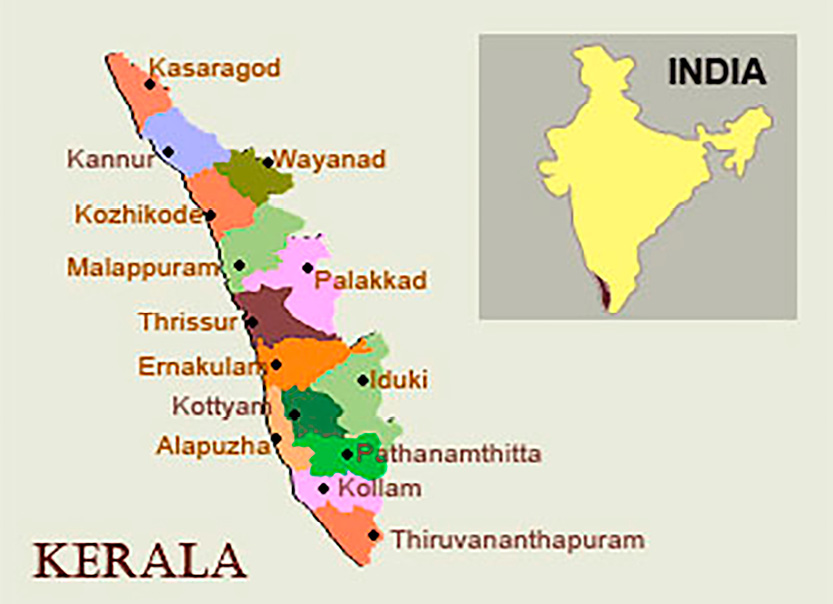
Source: Kerala Travel Map https://www.traveldealsfinder.com/kerala-maps.html
Kudumbashree: a feminist analysis of women’s empowerment
As mentioned earlier, Kudumbashree was successful as a microfinance agency by forming clusters (Ayalkootams) and facilitating economic activities. It has spawned many other microfinance agencies in Kerala, but more than that, it has broadened the financial understanding of women from all corners of the state (Nimmi and Ramachandran 2021). As of September 2021, Kudumbashree had a total membership of nearly 4.6 million women (Anon. 2022). However, while the Kudumbashree scheme has certainly become an agency for social change and women’s upliftment, the claim that it was successful in empowering women needs to be examined through various dimensions of feminism.
i) Feminism of decent employment and work: With the introduction of Kudumbashree, unemployed and uneducated women who were previously engaged solely in the household and care economies found themselves having a new platform to occupy types of employment that were more highly regarded in society. Engaging in credit-generating activities within Ayalkootams provided them with money and confidence (Kumar and Jasheena 2016).
Empirical studies point to Kudumbashree’s success in advancing the capacity building of women and their labour force participation (John et al. 2021). Kudumbashree was also an implementing agency for Swarna Jananti Shahari Rozgar Yojana (SJSRY), a central government-sponsored scheme established in 1997 to provide gainful employment for urban unemployed and under-employed poor, through promoting self-employment or increased provision of wage employment. SJSRY also supported the use of social networks to improve job opportunities for women, helping to put them on a par with their male counterparts, and encouraging them to take an active part in the economy.
ii) Feminism of collective advocacy: Economic growth alone cannot be the only means to pave the way for gender equality. Kudumbashree brings together women from all walks of life, creating awareness among them regarding their economic, social and personal rights. Collective advocacy plays a crucial role in increasing women’s understanding of their rights and leads to mobilisation of the masses to achieve greater social protections. It also gives rise to the formalisation of unions among women to fight for their labour rights (Oxfam Canada 2019).
One of Kudumbashree’s programmes is Community Counselling for women’s empowerment. Currently, there are 336 community counsellors drawn from 14 districts of the state (Figure 1). These counsellors form clusters of women within local government wards, and run a wide range of activities, including gender self-learning, crisis management, premarital and group counselling, addressing domestic violence issues, business counselling and more (Anon. 2022). In this way, Kudumbashree does indeed live up to the feminist essence of collective advocacy.
iii) Feminism of technology: Besides boosting confidence and general awareness, Kudumbashree has also led to improved communication skills for women (Ardra and Jenitha 2020). The combination of awareness and communication skills has led to an increase of women using digital appliances such as mobile phones to access information, network with people, and for entertainment. In a study based in the Kozhikode district of Kerala (Figure 1), 68% women were active social media users, with 35% of them using social media to access information, 27% for entertainment and 15% for networking. It was also found that 73% of women who were regularly utilising information technology were daily wage labourers1 (Ardra and Jenitha 2020).
iv) Feminism of entrepreneurship: With the collective formalisation of women allowing access to credit and participation in economic activities, marginalised2 and non-marginalised women found themselves to be emerging micro-entrepreneurs. A study in the Malappuram district (Figure 1) found that around 90% of women had received training in manufacturing and marketing, further boosting their confidence to promote their own enterprises (Abhilashnath and Shareef 2019). This has had a significant impact, with Kudumbashree micro-enterprise units such as Sanjeevani and JARMS,3 led by groups of five to eight Malappuram-borne women, now involved in the Amrutham Nutrimix initiative, a fortified food supplement for children (Local Self Government Department 2021). The emergence of such micro-enterprise units all over Kerala is a pioneering impact of the Kudumbashree scheme.
v) Feminism of financial inclusion: Kerala has the highest financial inclusion index among all Indian states and Kudumbashree has played a pivotal role in achieving that (Sethy and Goyari 2018). Also, it was found that the financial capacity of women had increased, with more than 87% of the women having access to credit, indicating Kudumbashree’s role in bringing about a stark increase in women’s financial capability and inclusion (John et al. 2021).
Fallacies of a feminist dream: where Kudumbashree fails
Kudumbashree’s microfinance and women’s empowerment agenda has helped lift more of Kerala’s people out of absolute poverty, but in terms of holistic development the scheme may be seen to fail on several levels. Although Kudumbashree was introduced in part to empower women, from a feminist perspective it not only fails to address some of the key challenges but also creates new concerns.
i) While it is commendable that a scheme like Kudumbashree focuses on providing a platform for marginalised and unemployed women to participate in economic activities, it does so within the context of women’s existing gendered setting. Rather than breaking away from the notion of women performing household chores, Kudumbashree provides opportunities in a way that double-burdens women with household chores and the work involved in achieving social upliftment. Economic participation has thus increased the relative burden on women. Both women and men agreed to the creation of these increased opportunities and responsibilities for women in both economic and social spheres (Nidheesh 2009), but a high proportion of women report that unchanged domestic duties hamper their participation in Kudumbashree activities (John et al. 2021).
ii) Kudumbashree’s microfinance component aims to promote the independence of women through economic empowerment. However, this approach can be seen to work contrary to itself by implying that women’s value comes from their monetary worth, and that for women’s voices to be heard, they must be financially independent. Along with this, many women have expressed doubts concerning the government’s commitment to continued support for programmes in the future, and this has created confusion as to how they should respond to Kudumbashree initiatives (Shehnaz and Suresh 2018).
iii) Although opportunities for women have increased under Kudumbashree, men have experienced little change in the status quo (Nidheesh 2009) and Kudumbashree has achieved only a marginal transformation of gendered spaces from homes to the community. Despite the fact that Ayalkootam (neighbourhood group) meetings gave women a greater understanding of financial and social realities and the skills required, they remained unable to occupy positions held by men in society due to the patriarchal social order, including in paid employment. Husbands of Kudumbashree women would be remarkably supportive in their homes, but often adopted a condescending approach towards women taking up positions that go against the gendered order of the extended community (Krishna and Jacob 2022).
iv) Lack of cooperation and tension in some Ayalkootams is another issue, albeit in only a small percentage of cases (Manoj 2012), reflecting pre-existing social divisions between women. Caste and class have been found to play a key role in who had a bigger say in fixing savings and lending rates. A study in Palakkad district (Figure 1) found upper caste women to be the prominent voices in Ayalkootams (Williams et al. 2012). Poorer women of lower castes often succumbed to the authority of superior caste figures and struggled to meet the required weekly savings amount due to their financial difficulties.
v) Credit generation from microfinance components of Kudumbashree did not improve health outcomes for women. Money received from Kudumbashree was often used to meet financial emergencies and no funds were allocated to healthcare. A study carried out in the Wayanad district (Figure 1) found that healthcare of Kudumbashree members was neglected and that participating in Kudumbashree activities could pose health risks for women, such as emotional stress and problems arising from poor posture while working (Mohindra et al. 2008). Although microcredit is a powerful tool to uplift marginalised people, it cannot offer a comprehensive solution to multi-faceted problems.
Conclusion
The evidence shows that Kudumbashree’s microfinance programmes were successful in helping to reduce poverty and bring about women’s empowerment. However, increased social capital was constrained within the limits of existing gendered positions. To grow the social capital of women beyond current cultural and societal norms, the state must become actively involved in social reconstruction alongside continuation of the Kudumbashree scheme. Currently, there is an absence of effort to change gendered positions in society. A structural review of Kudumbashree is necessary, and alterations must be made, to cement its fundamental objectives and close societal loopholes.
Declaration of conflicting interest
The author declared no potential conflicts of interest with respect to the research, authorship, and/or publication of this article.
Funding
The author received no financial support for the research, authorship or publication of this article.
References
Abhilashnath, V. and Shareef, A (2019) Role of Kudumbashree in ensuring the financial empowerment of women through entrepreneurship in Malappuram District. Shanlax International Journal of Commerce, 7 (4), 48–54. https://doi.org/10.34293/commerce.v7i4.538
Anon. (2022) Kudumbashree – an introduction. Available at: https://www.kudumbashree.org/pages/171
Ardra, E.P. and Jenitha, J.R. (2020) Uses and role of tradition and social media among Kudumbashree mission. Easy Chair Preprint No. 2513. Available at: https://easychair.org/publications/preprint_open/b9Fv
John, S.F., Nilufar, S.P. and Sheeja, R. (2021) Role of Kudumbashree in the economic upliftment of women. PalArch’s Journal of Archaeology of Egypt/Egyptology, 18 (4), 3073–3086. https://archives.palarch.nl/index.php/jae/article/view/6769/6535
Kerala State Planning Board. (2016) Economic Review 2016. Available at: https://spb.kerala.gov.in/economic-review/ER2016/chapter01_04.php
Krishna, S. and Jacob, S.P. (2022) Dynamics within the gendered space: the role of Kudumbashree in Kerala. Journal of the Department of Sociology of North Bengal University, 9, 75–89. https://ir.nbu.ac.in/bitstream/123456789/4647/1/Dynamics%20within%20the%20Gendered%20Space%20-%20The%20Role%20of%20Kudumbasree%20in%20Kereala.pdf
Kumar, A. and Jasheena, C.J. (2016) Kudumbashree: promoting the self help group model of empowerment through women entrepreneurship in Kerala. Prabandhan: Indian Journal of Management, 9 (6), 20–34. https://doi.org/10.17010/pijom/2016/v9i6/94959
Local Self Government Department. (2021) ISO certification for Nutrimix units. Government of Kerala. Available at: http://lsgkerala.gov.in/en/kudumbashree/featured-topics/kudumbashree-enterprises-produce-amrutham-nutrimix-take-home-ration
Manoj, P.K. (2012) Potential of micro enterprises in women empowerment: a critical study of micro enterprises run by women under the Kudumbashree programme in Kerala. International Journal of Business Policy and Economics, 5, 1–16. https://www.researchgate.net/publication/261614233_
Mohindra, K.S., Haddad, S. and Narayana, D. (2008) Can microcredit help improve the health of poor women? Some findings from a cross sectional study in Kerala, India. International Journal for Equity in Health, 7 (2), 1–14. https://doi.org/10.1186/1475-9276-7-2
Nidheesh, K.B. (2009) Study on the changing process of Kerala women through Kudumbashree in Kerala. International NGO Journal, 4 (8), 352–361. https://academicjournals.org/journal/INGOJ/article-full-text-pdf/1D4982F40306
Nimmi, C.R. and Ramachandran, K.K. (2021) The impact of microfinance on women empowerment in Palakkad District of Kerala. Turkish Online Journal of Qualitative Inquiry, 12 (3), 4266–4274 https://www.researchgate.net/publication/358233928
Oxfam Canada. (2019) A feminist approach to women’s economic empowerment. Feminist Aid and Foreign Policy Series. Ottawa: Oxfam Canada. Available at: https://www.oxfam.ca/wp-content/uploads/2019/01/a-feminist-approach-to-womens-economic-empowerment_FINAL.pdf
Sen, A. (1985) A sociological approach to the measurement of poverty: a reply to Professor Peter Townsend. Oxford Economic Papers, 37 (4), 669–676. https://doi.org/10.1093/oxfordjournals.oep.a041716
Sethy, S.K. and Goyari, P. (2018) Measuring financial inclusion of Indian states: an empirical study. Indian Journal of Economics and Development, 14 (1), 1–8. https://doi.org/10.5958/2322-0430.2018.00012.4
Shehnaz, S.R. and Suresh, S.K. (2018) Venturing beyond domestic walls – an enquiry into the role of Kudumbashree mission in translating women entrepreneurial passions into profitable micro enterprises. IOSR Journal of Business and Management, 20 (2), 47–52. DOI: 10.9790/487X-2002074752.
United Nations. (1995) World summit for social development: PAWSSD Chapter 2. Available at: https://www.un.org/development/desa/dspd/world-summit-for-social-development-1995/wssd-1995-agreements/pawssd-chapter-2.html
Williams, G., Thampi, V.B., Narayana, D., Nandigama. S. and Bhattacharyya, D. (2012) The politics of defining and alleviating poverty: state strategies and their impacts in rural Kerala. Geoforum, 43 (5), 991–1001. https://doi.org/10.1016/j.geoforum.2012.06.001
1 A daily wage worker is someone employed on a day-to-day basis, with pay accruing at the end of each day. Daily wage workers in India are protected and governed by the Minimum Wages Act of 1948.
2 ‘Marginalised’ here refers to women from an Adivasi (Indigenous) tribe), Scheduled Caste or Tribe, Dalit (previously ‘untouchables’) and other minority communities.
3 Sanjeevani and JARMS are the names of two of the micro-enterprise units in Malappuram. All such units have a unique name.