Commonwealth Journal of Local Governance, Issue 22, 2019
ISSN 1836-0394 | Published by UTS ePRESS | https://epress.lib.uts.edu.au/journals/index.php/cjlg
Gareth Wall
Stevenage Borough Council
Daneshill House
Stevenage
London
United Kingdom
Email: gareth.wall@stevenage.gov.uk
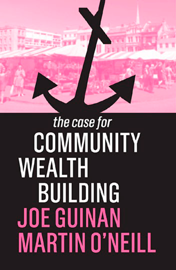
The case for Community Wealth Building by Joe Guinan and Martin O’Neill
https://community-wealth.org/content/case-community-wealth-building
DOI: https://doi.org/10.5130/cjlg.vi22.7442
Article History: Received 18/09/20; Accepted 23/09/20; Published 24/09/20
Citation: Gareth Wall 2020. The case for Community Wealth Building by Joe Guinan and Martin O’Neill. Commonwealth Journal of Local Governance 2019, 22, 7442, https://doi.org/10.5130/cjlg.vi22.7442
© 2020 by the author(s). This is an Open Access article distributed under the terms of the Creative Commons Attribution 4.0 International (CC BY 4.0) License (https://creativecommons.org/licenses/by/4.0/), allowing third parties to copy and redistribute the material in any medium or format and to remix, transform, and build upon the material for any purpose, even commercially, provided the original work is properly cited and states its license.
Drawing on innovative local government and community initiatives from the United Kingdom (UK) and the United States (US), Guinan and O’Neill’s The Case for Community Wealth Building is a timely and optimistically critical contribution to discussions on inclusive community-owned local economic development. This short thesis aimed at practitioners, policy-makers and theorists alike, looks at alternative models of local economic ownership, riding the wave of calls for greater local democratisation as an approach to address highly skewed and extractive power relations in our economies and the huge global challenges of economic exclusion and inequality, climate change and popularism. At just 116 pages, this accessible book, whilst drawing on a good if limited range of academic and case study literature, reads more in the tradition of a radical political pamphlet than a dense academic text.
The two main key takeaways for most councils are first, how local authorities, in partnership with other local anchor institutions in the wider public sector, such as hospitals, schools and universities, can significantly influence how more money can stay within the local economy through their own procurement policies. And the second is on how councils can also ensure more local economic activity through increasingly democratic forms of business ownership such as cooperatives & worker/customer-owned companies, community housing associations, municipal enterprises, neighbourhood corporations, community land trusts, credit unions, public banks, participatory budgeting, local food systems etc.
The first section of the book introduces the idea of Community Wealth Building (CWB) providing a counter to the common new public management models which in their drive to minimise costs in public sector budgets miss adding social value and social justice considerations to bottom-line budgeting. Whilst the chapter presents how the cities of Preston, UK and Cleveland, US have had some success in addressing economic stagnations and disinvestment through supporting local public sector procurement and cooperative ownership, it fails to acknowledge other compatriot innovative cases. For example, the case of Plymouth, UK who are looking to double their cooperative economy through their work with the UK’s Cooperative Councils Innovation Network, and ignores examples elsewhere across the Commonwealth such as in South Africa and India where innovations in local economic development see member-owned self-help groups and cooperatives take on significant work for municipal councils.
The second main section of the book skilfully argues why a CWB approach focused on the primacy of labour is good for progressive councils interested in their citizens’ economic wellbeing, and provides more detail on how CWB can remedy the kinds of local issues created by the predominant capital-led extractive economic model. Whilst the book presents this approach as a continuation of previous local and left-inspired approaches, it fails to acknowledge related legislation, often activity-led and locally inspired such as considerations on issues of modern slavery in supply chains etc, or employment programmes such as India’s National Rural Employment Guarantee Act 2005, which guides arguably the largest labour-focused community wealth building initiative in the world.
In the final section, which argues how CWB can be the foundation of a whole new democratic approach to national and global economic institutions, the authors firmly pin their colours to the mast of the UK opposition Labour Party’s former leadership. I look forward to reading how this section is thoroughly rewritten in the next edition, and no matter how the Democratic Party performs in the upcoming US elections, how the authors feel CWB experiences can help inspire and inform the emerging centre-left of these parties and platforms. Finally, it would be good for any future edition to draw more directly from the substantial left-inspired experimentations in local as well as national economic institutional infrastructure around the world and especially across the Commonwealth which can provided a wealth of lessons from which councils in the US, UK and elsewhere can learn.
Declaration of conflicting interest
The author(s) declared no potential conflicts of interest with respect to the research, authorship, and/or publication of this article.
Funding
The author(s) received no financial support for the research, authorship, &/or publication of this article.