RESEARCH ARTICLE
Investigating the Relationship between Occupational Stress and Work-Life Balance among Indian Construction Professionals
J Manivannan1, Santhosh Loganathan2,*, Kamalanabhan T J3 and Satyanarayana N Kalidindi4
1 Principal Consultant, Athera Business Enablers, India.
2 Joint PhD Candidate, Department of Civil Engineering, Indian Institute of Technology Madras, and School of Built Environment, University of Technology Sydney, Australia.
3 Professor, Department of Management Studies, Indian Institute of Technology Madras, India.
4 Professor, Department of Civil Engineering, Indian Institute of Technology Madras and Director, Indian Institute of Technology Tirupati, India.
Corresponding author: Santhosh Loganathan, Joint PhD Candidate, Department of Civil Engineering, Indian Institute of Technology Madras, and School of Built Environment, University of Technology Sydney, Australia; santomaills@gmail.com
DOI: https://doi.org/10.5130/AJCEB.v22i2.8052
Article History: Received: 09/01/2022; Revised: 08/04/2022 & 31/05/2022; Accepted: 04/06/2022;
Published: 20/06/2022
Abstract
The construction industry has long been recognized as a stressful industry, due to its complexity and management of a large number of stakeholders. Occupational stress causes a negative impact on both the work and personal life of professionals. Previous studies have established that occupational stress of construction professionals is strongly associated with low productivity, high absenteeism, and poor work performance. However, there is a lack of scientific studies that provide linkages between occupational stressors and the dimensions of work-life balance. The present research aims to study the perceived level of occupational stress and assess its relationship with the dimensions of work-life balance among construction professionals. Within an established theoretical framework, eight hypotheses were formulated to investigate the above relationship. A cross-sectional survey-based approach was adopted to assess the level of occupational stress and work-life balance. The survey was administered among construction project managers, project engineers, and site engineers in the Indian context. With 285 valid responses, relative importance index and multiple regression analysis methods were utilised to analyse the collected data. The findings revealed major stressors that contribute to high levels of occupational stress under work-related and organisation-related stressor categories. The top five identified stressors included job nature demands coordination with multiple stakeholders, tight time frame for work, unstable working hours, bureaucracy, and quantitative work overload. With regards to the relationship between the categories of occupational stress and work-life balance, the results indicate that work-related stressors are significantly and positively related to work interference to personal life (WIPL) and personal life interference to work (PLIW) and negatively relate to work enhancement of personal life (WEPL) and personal life enhancement of work (PLEW). In the case of organisation-related stressors, both organisation policy and organisation position-related stressors significantly and positively influence WIPL however, no significant relationship was noticed with PLIW, WEPL, and PLEW. While the existing studies have provided evidence that work-life imbalance causes occupational stress, one of the major contributions of the present study is that it provides valid scientific evidence that occupational stress significantly influences work-life life balance negatively. The study’s findings with regards to unveiling the relationship between the categories of occupational stressors and dimensions of work-life balance would help organisations derive relevant policies for creating a supportive work environment. To this end, the paper advances our collective understanding of occupational stress and work-life balance with multiple dimensions and perspectives.
Keywords
Occupational Stress; Work-Life Balance; Stressors; Construction Professionals; Indian Construction Industry
Introduction
The construction industry is one of the most people-dependent industries, regardless of numerous technological interventions, and it is highly fragmented in nature. Due to the complex nature of the sector, about 70% of construction professionals suffer from occupational stress in the form of anxiety, depression, low motivation, and morale (Campbell, 2006; Enshassi, El-Rayyes and Alkilani, 2015; Hampton, Chinyio, and Riva, 2019). An increase in occupational stress directly impacts the work-life balance of working professionals.
A recent review of the relevant literature around occupational stress among construction project professionals since 1989 revealed that occupational stress, in general, could be related to physical conditions, organisational culture, interpersonal conflict, work environment, and personal characteristics (Naoum, et al., 2018). While there is a good understanding of factors affecting occupational stress among construction professionals (Ng, Skitmore and Leung, 2005; Leung, Chan and Dongyu, 2011; Zawawi, Bahron and Amirul, 2014; Naoum, et al., 2018), there is however limited research conducted to understand the relationship between occupational stress and work-life balance in the construction industry. Also, the greatest number of studies have been conducted in the context of Hong Kong, Australia, and South Africa (Naoum, et al., 2018). At the time of writing, no reported scientific studies have been conducted in the Indian context.
The Indian construction industry is the second-largest employer, next to agriculture, in India, generating over 51 million employments and contributing about 10% to the country’s GDP (Invest India, 2022). Recently, the Government of India launched its National Infrastructure Pipeline between 2020 and 2025 with USD1.4 trillion of projected infrastructure investment in roads, railways, urban infrastructure, energy, and other real estate and infrastructure sectors (Make in India, 2022). Moreover, it is forecasted that about 40% of the population will live in Indian cities by 2030 (Make in India, 2022). While the prospects of the Indian construction industry are high, the issues concerning completing projects on time and within budgets are severe (MOSPI, 2017). A study by Narayanan, Kure and Palaniappan, (2019) on time and cost overrun in 30 Indian megaprojects indicates that the time overrun ranges from 10% to 256%, with an average of 127%. One of the major causes of significant time and cost overruns is improper management of onsite construction activities and workers (Narayanan, Kure and Palaniappan, 2019; Anandh and Gunasekaran, 2018). Also, given the labour-intensive nature of the Indian construction industry, with a significant proportion of workers being migrant in nature (Loganathan and Kalidindi, 2016), a high level of occupational stress is observed among construction site engineers and managers with regard to the management of workers onsite (Anandh and Gunasekaran, 2018). This includes low levels of productivity, significant safety issues, high absenteeism, high turnover, communication issues and lack of motivation of workers (Loganathan and Kalidindi, 2016; Johari and Jha, 2020; Johari and Jha, 2021). Along with issues related to the management of migrant construction workers onsite, lack of transparency and governance, lack of standardisation of construction work processes and procedures, low levels of technological interventions and insufficient training and development of professionals and workers, are issues that are specific to the Indian construction industry (Sawhney, Agnihotri and Paul, 2014). Previous studies have identified factors that affect construction professionals’ lifestyles, such as financial factors, organisational factors, quality, health and environmental factors, work-related factors, and social (personal and interpersonal) factors (Anandh, Gunasekaran and Mannan, 2020; Dubey and Jeswani, 2018). However, a deeper collective understanding of various sources of occupational stress and its relationship with work-life balance needs to be gathered for Indian conditions.
Hence, the present study first aims to understand the various sources of occupational stress among Indian construction professionals. Secondly, it seeks to investigate the relationship between occupational stress and work-life balance. In the following, the paper briefly reviews the relevant literature in the study area, then the methodology utilised is presented, followed by a discussion of the findings from the study.
Occupational Stress and Work-Life Balance
Occupational Stress among Construction Professionals
Occupational stress can be defined as ‘the harmful physical and emotional responses that occur when the requirements of the job do not match the capabilities, resources or needs of the worker’ (NIOSH, 1999). Work stress has been widely linked with adverse effects on employees’ psychological and physical well-being in many occupations (Kinman and Jones, 2005).
In the construction industry, the nature of work itself can be stressful such as physical conditions, overcrowding in the workplace, work overload, role-based factors (such as lack of power, role ambiguity, role conflict), lack of privacy, threats to career development and achievement (including the threat of redundancy, being undervalued and unclear promotion) may lead to occupational stress among construction professionals (Ng, Skitmore and Leung, 2005; Naoum, et al., 2018). Research efforts in the past have classified stressors into different categories. Independent research studies in different contexts identify stress and stressors that lead to occupational stress among construction professionals. For instance, Ng, Skitmore and Leung (2005) classified 33 different types of stressors under the categories of work nature-related, work time-related, organisation policy-related, organisation position-related, situational, and environmental-related, relationship-related, and personal-related stressors. Offia Ibem, et al. (2011) found that the principal sources of stress were the high volume of work, uncomfortable site offices, lack of feedback on previous and ongoing building projects, and variations/changes in the scope of work. Sharma (2013) identified fear of job redundancy, lack of job security, non-commensurate wages with levels of responsibility, under participation in decision making, office politics and conflicts, and interpersonal relations as important determinants of occupational stress.
Based on the critical review of existing studies on occupational stress in the construction management literature, it can be derived that there are various factors that cause occupational stress in the industry. These factors can be collectively termed stressors, which in turn cause occupational stress (Leung, Chan and Yu, 2012; Enshassi, El-Rayyes and Alkilani, 2015). Stressors emanating from construction projects are causative factors for occupational stress, which is inherent in the industry (Tijani, Jin and Osei-Kyei, 2020). The present study utilises the classification of occupational stressors as work-related stressors and organisational-related stressors, which was initially proposed by Ng, Skitmore and Leung, 2005. This classification of occupational stress is also more parsimonious in nature. The occupational stress that manifests due to work-related factors can be categorized as work-time-related and work-nature-related stressors (Ng, Skitmore and Leung, 2005). Occupational stress due to quantitative work overload, tight time frame for work and unstable working hours can be classified under work-time-related stressors (Ng, Skitmore and Leung, 2005). Occupational stress due to qualitative workload, over-specialized job nature, coordination with multiple stakeholders, and low job challenges can be classified under work-nature related stressors (Ng, Skitmore and Leung, 2005). The stress which manifests due to organisation-related factors can be termed organisation-related stressors. According to Sommerville and Langford (1994), stress arising due to organisational factors occurs due to how work is managed, the individual’s role with the organisation, the relationships within the organisation, personal and social relationships, and individual anxiety. Organisational-related stressors can further be classified as organisation-position-related stressors and organisation-policy-related stressors (Ng, Skitmore and Leung, 2005). Occupational stress manifests due to ambiguity on job requirements, inadequate authority/freedom for decision, dissatisfaction with salary, lack of career guidance, lack of promotion opportunity, and lack of job security can be classified under organisation-position related stressors (Ng, Skitmore and Leung, 2005; Naoum, et al., 2018). Occupational stress due to inadequate knowledge of project objectives, conflicts among different job demands, adaptability problems with the change of work nature, inadequate room for innovation and bureaucracy can be categorised under organisation-policy related stressors (Ng, Skitmore and Leung, 2005; Hampton, Chinyio and Riva, 2019).
Previous studies have also explored the relationship between occupational stress and job demands, job control, role conflict, organisational culture, job satisfaction and turnover intentions. A study by Bowen, Govender and Edwards (2014) explored the relationship between occupational stress and job demand, control, and support factors among construction professionals in South Africa. The study explored the effects of occupational stress, the coping mechanisms adopted by professionals in an attempt to mitigate the effects of stress, and the role of harassment and discrimination (Bowen, Govender and Edwards, 2014). With regards to organisational culture, researchers have examined the relationship between organisational culture and occupational stress (Newton and Jimmieson, 2006). They report that an employee’s fit with the organizational culture is important. For some employees, workplace events are seen as more of a challenge than stressful. These employees tended to identify themselves more closely with the organisation (Newton and Jimmieson, 2006). Studies have also determined that psychological, physiological, and sociological strain effects are the terminal consequences of occupational stress (Bowen, Govender and Edwards, 2014). Dodanwala and San Santoso (2021) evaluated the link between job satisfaction facets, job stress, and turnover intentions of construction project professionals in Sri Lanka. They determined that job stress is the most significant variable predicting construction employees’ turnover intentions. Regarding role conflict, a study by Domanial, Shrestha and San Santoso (2021) indicate that role conflict has a positive direct effect on job stress. They further emphasise that impact of role conflict on job stress is high for young employees in the construction industry, as young employees do not possess the necessary life skills or experience to cope with role conflict (Dodanwala and San Santoso, 2021). While the existing studies have also explored the relationship between occupational stress and job demands, job control, role conflict, organisational culture, job satisfaction, and turnover intentions, there is a lack of scientific studies that explore the relationship between occupational stress and work-life balance. The present study aims to fill that gap in knowledge.
Work-Life Balance
Work-life balance is a self-defined state of wellbeing achieved by an individual when they can effectively manage and integrate the varied responsibilities of work, home, family, community commitments and personal leisure time. Good work-life balance has been found beneficial for employees and organisations as it can improve productivity, reduce absenteeism, promote better job autonomy, improve employee retention, increase job satisfaction, improve employee attitudes and behaviours, and attract talents (Beauregard and Henry, 2009; Chimote and Srivastava, 2013; Lamane-Harim, Cegarra-Leiva and Sánchez-Vidal, 2021). Despite these benefits, poor work-life balance is evident in the construction industry (Yang et al., 2017).
The growing interest in studies in work-life balance in the construction industry has been magnified recently due to a surge in mental ill-health and suicide of construction professionals worldwide, to which work-life conflict is a major contributor (Bryson and Duncan, 2018; Kotera, Green and Sheffield, 2020). Poor work-life balance emanated from clusters of work and non-work factors (Turner and Lingard 2016). Numerous empirical studies have reported factors, which include long working hours, role conflict and family commitment as contributors to work-life conflict in the construction industry (Panojan, Perera and Dilakshan, 2019). Studies in the area of work-life balance in construction are focused on three major themes, which include causes of poor work-life balance, work-life balance interventions and work-life balance initiatives (Tijani, Osei-Kyei and Feng, 2020). Several studies have pointed out that the long working hours of professionals directly impact their relationship quality (Lingard and Sublet, 2002). For instance, empirical research on the work-life balance among the employees of a large Australian contracting organisation found that more weekly work hours were strongly correlated with employees’ perceptions that work interfered with their non-work-life in a negative way (Lingard and Francis, 2004). Also, it was indicated that site-based employees perceive high work interference to family life when compared to office-based employees (Lingard and Francis, 2004) as site-based employees work long hours. Studies have also shown that long working hours and strain-based issues (emotional exhaustion and distress) in the workplace are significant antecedents of work interference to family (WIF) and that WIF is a significant predictor of the quality of relationships within families. Also, WIF was found to be negatively related to family functioning, while family interference with work (FIW) was unrelated to job role performance or distress (Townsend et al., 2012).
Developing interventions for work-life balance in the construction industry is an important strategy to address the social and economic effects of poor work-life balance (Tijani, Osei-Kyei and Feng, 2020). Work-life balance interventions are proactive measures that mitigate or eliminate sources of poor work-life balance causing family dysfunction (Francis et al., 2013). Poor productivity negatively influences society and business performance (Tijani, Osei-Kyei and Feng, 2020). Existing studies indicated work flexibility and compressed work weeks as adequate interventions for WLB (Francis et al. 2013; Bryce, Far and Gardner, 2019). In developed countries such as the UK, the USA, Australia, and New Zealand, work flexibility eases the problem of work-family imbalance among the construction workforce (Tijani, Osei-Kyei and Feng, 2020). However, there is an absence of empirical studies that explore the flexibility of working time in developing countries such as China, India, and Sri Lanka, despite the prevalence of work-life imbalance among the construction workforce (Tijani, Osei-Kyei and Feng, 2020).
Work-life balance initiatives refer to organizational initiatives devised to reduce conflict between employees’ work and personal lives (Lingard and Francis, 2005). A systematic review of work-life balance initiatives by Tijani, Osei-Kyei and Feng, (2020) indicates that Australia and New Zealand are the only developed countries identified in the literature that investigated work-life balance initiatives to enhance work-life balance among construction workforces. Researchers from UK and US under-explored work-life balance initiatives (Tijani, Osei-Kyei and Feng, 2020). Also, it is important to note that there is an absence of studies in developing countries such as China, India, and Sri Lanka that investigated work-life balance initiatives in the construction industry. Studies also suggest that for workers in physically demanding jobs, work-life conflict may extend beyond a time-based, strain-based, and behaviour-based model and include a physical capacity component (Lingard and Turner, 2021). While studies in work-life balance have focused on issues related to root causes, interventions and initiatives, there is a lack of studies on the linkages between work-life balance and occupational stress, which the present study hypothesises as a significant factor that causes work-life imbalance.
Hence, as mentioned previously, while there is a good understanding of factors affecting occupational stress among construction professionals, there are no reported scientific studies in the Indian context. Given the large size of Indian construction, with about 51 million people employed (in both manual and managerial categories), it is significant to gather knowledge about work-life balance issues.
Additionally, based on the review of the literature, it was determined that while there is a growing interest in work-life balance issues in the construction management literature (Apraku, et al., 2020; Lingard and Turner, 2021), only limited research is conducted to understand the relationship between occupational stress and work-life balance in the construction industry. The present research hence aims to fill the above gap in knowledge. Therefore, the objectives of the present study include:
1. To identify the various sources of occupational stress among Indian construction professionals
2. To study the relationship between occupational stress and work-life balance among construction professionals
Measures of Occupational Stress and Work-Life Balance
To measure the components of occupational stress (i.e., work-related stressors and organisation-related stressors) and work-life balance (i.e., WIPL, PLIW, PLEW and WEPL), scales developed by previous studies were adopted. To assess work-related stressors and organisation-related stressors, the scale developed by Ng, Skitmore and Leung (2005) was adopted. Similar studies in the recent past also adopted Ng, Skitmore and Leung (2005) scale to study occupational stress in other contexts (Zheng, et al., 2021; Zhang and Bowen, 2021; Umer, Yu and Afari, 2022). To assess the components of work-life balance, a 24-item scale developed by Fisher, Bulger and Smith (2009) was adopted for the present study. Similar studies in the recent past also adopted Fisher, Bulger and Smith (2009) work-life balance item scale in other contexts (Matthews, Wayne and Ford, 2014; Irawanto, Novianti, and Roz, 2021; Berglund, et al., 2021). For both scales adopted by the present study, exploratory factor analysis has been conducted to ascertain the construct validity of the scales.
Hypotheses development
While objective – 1 aims to identify the various sources of occupational stress, to investigate the objective-2, a series of hypotheses were formulated to test the relationship between occupational stress and work-life balance among construction professionals. As shown in Figure 1, the various components of work-life balance act as a dependent variable. These include Work Interference to Personal Life (WIPL), Personal Life Interference to Work (PLIW), Personal Life Enhancement of Work (PLEW) and Work Enhancement of Personal Life (WEPL). The independent variables represent the work-related stressors and organisation-related stressors.
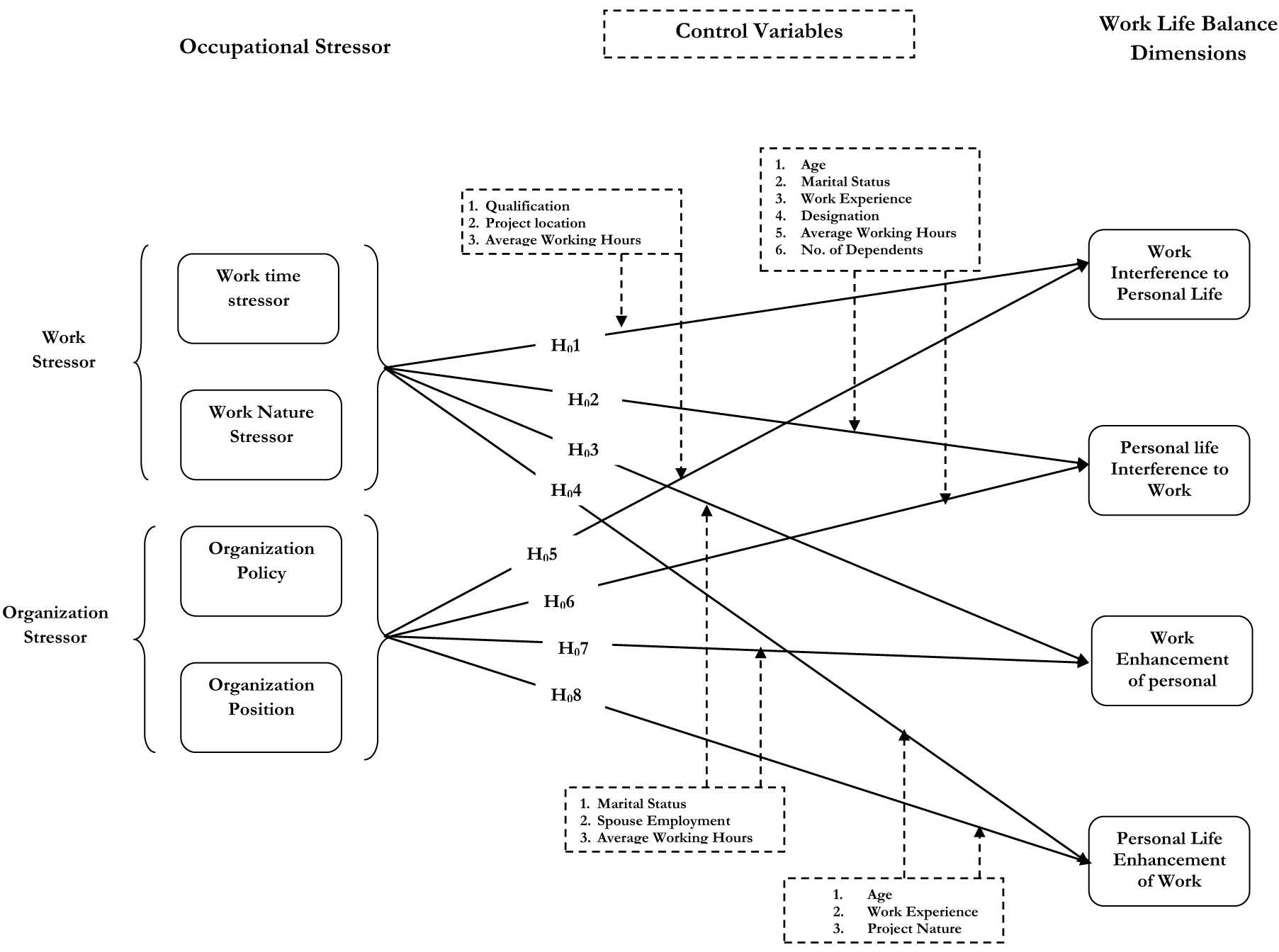
Figure 1. Hypothesis development
Hypothesis
H01 - There is no Significant and Positive Relationship between Work Stressors and Work Interference to Personal Life
H02 - There is no Significant and Positive Relationship between Work Stressors and Personal Life Interference to Work
H03 - There is no Significant and Positive Relationship between Work Stressors and Work Enhancement of Personal Life
H04 - There is no Significant and Positive Relationship between Work Stressors and Personal Life Enhancement of Work
H05 - There is no Significant and Positive Relationship between Organization Stressors and Work Interference to Personal Life
H06 - There is no Significant and Positive Relationship between Organization Stressors and Personal Life Interference to Work
H07 - There is no Significant and Positive Relationship between Organization Stressors and Work Enhancement of Personal Life
H08 - There is no Significant and Positive Relationship between Organization Stressors and Personal Life Enhancement of Work
Research Method
The present research has been administered using a cross-sectional survey-based approach (Ng, Skitmore and Leung, 2005; Leung, Chan and Yu, 2009). Respondents were approached using a random sampling approach. The survey has been administered in three different ways which included e-mail questionnaires, google forms, and offline questionnaires through field visits. The covering letter of the survey explained the purpose of the study, instructions for completing the questionnaire, and the demographic details of the respondents. Before administering the online survey questionnaire (e-mail and google forms), a detailed description of the nature and objective of the study along with survey questions have been sent to the human resources managers/senior management executives of the organisations. In offline surveys, respondents were briefed about the survey during the field visits by organizing short meetings. 550 construction professionals were approached for the survey of which 303 responses have been collected in total, attaining a response rate of 55%. Among them, 285 were completed with valid responses of which 122 responses were received through field visits (offline) and the remaining 163 have been received through online mode.
The current sample is representative of the population as the sample chosen for the present study exceeds the minimum sample (S) requirement of 271. This is derived from Cochran’s sample measure formula for an unknown population, at a 90% confidence interval (Z) and 5% margin error (e) (Cochran, 2007). The Cochran’s formula for an unknown population is given in Equation 1:
S = Z2P(1 − P)/e2
In the calculation made using Cochran’s sample measure formula, the population proportion (P) is assumed to be 0.5, providing the maximum sample size. Since the sample size for the present study is greater than the minimum requirement, it is considered that the sample chosen would sufficiently represent the population of the study. The data have been collected from 7 different construction companies across India. The size of the organisation is classified into three different categories, such as small organizations where the employee strength is less than 300 (Total response = 24.9%), medium organisation where the employee strength is 301- 1000 (Total response = 19.3%) and large organisation where the employee strength is 1001 and above (Total response = 55.8%). Also, the responses have been collected from the professionals working across different nature of projects and different locations of the project. In addition to this, 11 demographic variables have been collected in the survey. Statistically, through 285 samples the results can be generalized with a 90% confidence interval with a 5% margin of error (Newbold, Carlson and Thorne, 2007). Table 1 represents the demographics of the respondents who have participated in the study
Out of the total 285 valid respondents, 34.4% are single and 65.3% are married. Among the married respondents, 23.7% of employees’ spouses are working professionals and 76.3% are homemakers. In terms of educational qualification, 30.5% of respondents are Diploma holders, and 57.2% are graduates. and 8.1% are post-graduates. The average industrial experience of the employees is classified into 4 different categories, such as 0-7 years (41.8%), 8-13 years (15.8%), 14-20 years (40.7%) and 21 years and above (1.8%). Also, as can be seen in Table 1, most of the respondents were working onsite (91.2%) and most of them represented large construction contracting organisations (55.8%). This showed the relevant characteristics of the respondents who have participated in the survey – as comparing offsite employees,’ onsite employees undergo more stress and large organisations focus more on stress management and work-life balance policies than mid-size and small organisations.
Results and Discussions
Exploratory Factor Analysis for Stressors Scale
As mentioned before, to ascertain the construct validity of the scales selected for the present study, exploratory factor analysis has been conducted. The work stressor scale consists of eight items and the organisation stressor consists of 11 items (Ng, Skitmore and Leung, 2005). The constructs are measured, using a five-point Likert scale in which 5 = strongly agree and 1 = strongly disagree. Therefore, items with higher means indicate a high level of occupational stress and lower means indicate a low level of occupational stress.
Table 2 shows the results of the exploratory factor analysis. The table contains the factor scores of work stressor scales. The principal extraction method is employed with promax rotation, and the rotation converged in 3 iterations. Eigen values greater than 1 were retained in the analysis. Further, Table 2 contains the percentage of variance explained and the cumulative percentage of variance explained for the work stressor scale. Two components are extracted in the analysis, (i.e.) component 1 - work time stressor and component 2 - work nature-related stressor. Table 3 contains the percentage of variance explained and the cumulative percentage of variance explained for the organisation stressor scale. Two components are extracted in the analysis, (i.e.) component 1 - organisation position related stressor and component 2 – organisation policy-related stressor. The factor scores are used for multiple regression analysis. The assumption of normality and dispersion of data by using the factor scores is also verified.
Exploratory Factor Analysis for Work-Life Balance Scale
Work-life balance is measured with a 24-item scale adopted from an instrument reported by Fisher, Bulger and Smith (2009). The scale has been developed to capture the bidirectional interaction between work and personal life in terms of both the interference between the domains and the enhancement that can occur as a result of active participation in multiple domains. The 24-item scale consists of work interference of personal life (WIPL) (no. of items – 15), personal life interference to work (PLIW) (no. of items – 5), work/personal life enhancement (WEPL and PLEW) (no. of items – 4). The respondents were asked to indicate the frequency with which they have felt in a particular way during the past three months using a five-point time-related scale (e.g., 1 = Not at all, 3 = Sometimes, and 5 = Almost all the time). Time-based scale is appropriate as the respondents have the same time frame of reference for responding to the items. A higher value of response indicates that respondents have experienced the situation more frequently. In most cases, items with higher means are purported to indicate lower levels of work-life balance for WIPL and PLIW items. The WEPL and PLEW items are worded positively, and higher means indicate higher levels of perceived work-life balance. In addition to that, as mentioned before, exploratory factor analysis has been conducted to ascertain the construct validity of the scale. Table 4 shows the results of exploratory factor analysis for work-life balance scale.
| Work Life Balance scale | Component 1 | Component 2 | Component 3 | Component 4 |
|---|---|---|---|---|
| I struggle trying to juggle both my work and non-work responsibilities | 0.7 | |||
| I feel overwhelmed when I try to balance my work and personal life | 0.6 | |||
| I have difficulty scheduling vacation time because of my workload | 0.8 | |||
| I am unable to relax at home because I am preoccupied with my work | 0.8 | |||
| I am not happy with the amount of time I spend doing activities not related to work | ||||
| I often have to make difficult choices between my work and my personal life | 0.8 | |||
| I have to put aspects of my personal life "on hold" because of my work | 0.9 | |||
| I am not able to accomplish what I want in both in my personal and work life | 0.5 | |||
| I often neglect my personal needs because of the demands of my work | 0.8 | |||
| My Personal life suffers because of my work | 0.8 | |||
| I have to miss out on important personal activities due to the amount of time I spend doing work | 0.8 | |||
| I feel that I am not allocating appropriate amount of time to both work and non-work activities | 0.5 | |||
| I make personal sacrifices to get work done | 0.8 | |||
| I come home from work too tired to do things I would like to do | 0.7 | |||
| Because of my job, It is very difficult to maintain the kind of personal life I would like | 0.9 | |||
| My work suffers because of everything going on in my personal life | 0.9 | |||
| I am ineffective at work because of my personal life problems | 0.8 | |||
| I have difficulty getting my work done because I am preoccupied with personal matters at work | 0.8 | |||
| Because of my job, I am in a better mood at home | 0.5 | |||
| My job gives me energy to pursue activities outside of work that are important to me | 0.8 | |||
| I am in a better mood at work because of my personal life satisfaction | 0.8 | |||
| My personal life gives me the energy to do my job | 0.8 | |||
| Eigen Values | 9.04 | 2.17 | 1.64 | 1.06 |
| % of Variance Explained | 38 | 9 | 6.9 | 4.4 |
| Cumulative % of Variance Explained | 38 | 47 | 54 | 58 |
Exploratory factor analysis for work-related stressors resulted in two dimensionalities such as work time-related stressors and work nature-related stressors. Similarly, exploratory factor analysis for organization related stressors resulted in two dimensionalities, i.e., organisation policy-related stressors and organization position related stressors. The four-dimension items are confirmed to the work-life balance scale from the factor analysis. These are termed as, work interference with personal life, personal life interference with work, work enhancement of personal life and personal life enhancement of work. Once the dimensionalities of the instrument are verified, the internal consistencies of the scales have been checked with reliability analysis.
Reliability Analysis
The internal consistencies of the scales have been checked by conducting a reliability analysis. The Cronbach alpha of the work-related stressors scale (no. of items – 8) is 0.68 and the organisation-related stressors scale (no. of items – 11) is 0.82. The Cronbach alpha of the work-life balance components viz. work Interference of personal Life (no. of items – 15) is 0.926, personal life interference to work is (no. of items – 5) is 0.76, work/personal life enhancement (no. of items – 4) is 0.6. Thus, the Cronbach alpha of the work-life balance scale (no. of items – 24) is 0.88. As the Cronbach alpha of the scales used is more than 0.6, the condition of reliability or internal consistencies of the scales are satisfied (Konting, Kamaruddin and Man, 2009). These results indicate that the adopted scales on stressors and work-life balance can be utilised in the context of the present study.
Perceived Level of Occupational Stress
To identify the perceived level of occupational stress, the collected survey data were analysed using the relative importance index. Subsequently, the relationship between the categories of stressors and the various work-life components (i.e., WIPL, PLIW, WEPL, PLEW) is assessed using multiple regression analysis methods. The results of the analysis are presented and discussed in the following sections.
Table 5 shows the perceived level of occupational stress due to work-related and organisational-related stressors by the respondents. As can be seen in Table 5, the top five stressors included job nature demands coordination with multiple stakeholders, tight time frame for work, unstable working hours, bureaucracy, and quantitative workload experienced by the professionals. Among the top five, the top stressor is categorised under the work nature-related factor, three stressors are categorised under the work time-related factor, and one relates to organisation policy.
Construction professionals perceive a high level of occupational stress due to the job nature which demands multiple contacts and a high level of coordination with various project/organisation stakeholders. The results are consistent with previous studies from Hong Kong and Australia, where the role conflict and role ambiguity are the major sources of stress and poor role congruence is the other key stressor affecting the subjective and objective stresses of construction project managers (Leung, Chan and Yu, 2009; Love, Edwards and Irani, 2010; Naoum, et al., 2018). Recent studies in this area also conclude that there is a positive link between role conflict and job stress (Olafsen, et al., 2021, Dodanwala et al., 2021).
Construction professionals needed to coordinate between various departments (namely, quantity surveying, materials, plant and equipment, financial, and human resource management department) both within and outside (i.e., clients, contractors, subcontractors, designers, architects, consultants’ organisations) their project/organisational setup. And, in India, given the migrant nature of construction workers onsite (Loganathan and Kalidindi, 2016) the challenges of managing them are many. These also include language and cultural differences, communication, and coordination issues onsite. This was also pointed out by Loosemore, et al. (2010) and Loosemore, Alkilani and Hammad (2021) who argue that one of the major challenges affecting work and social relations on construction sites is language barriers which can cause communication problems. This applies largely to the migrant construction workforce.
A tight time frame for work is another major source of occupational stress in the construction industry. Meeting deadlines is one of the major responsibilities of construction managers (Gunduz and Yahya, 2018). Besides monetary penalties, companies may incur huge losses in credibility when they fail to complete their projects on time. In most cases, the project manager is directly recognized as the responsible person for delays and penalties (Prasad, et al., 2019). Time and cost overruns are major issues associated with the Indian construction industry (MOSPI, 2017). A study by Narayanan, Kure and Palaniappan (2019) on time and cost overrun in 30 Indian megaprojects indicates that the time overrun ranges from 10% to 256% with an average of 127%. As a result, time pressure emerges as a prominent source of stress experienced by project managers and engineers both in India and elsewhere (An, et al., 2018).
| Name of the stressor | Category | Relative importance index score | Rank |
|---|---|---|---|
| Job nature demands multiple contacts | Work nature | 0.787 | 1 |
| Tight time frame for works | Work time | 0.713 | 2 |
| Unstable working hours | Work time | 0.665 | 3 |
| Bureaucracy | Organisation policy | 0.633 | 4 |
| Quantitative work overload | Work time | 0.618 | 5 |
| Adaptability problem with change in Job nature | Organisation policy | 0.596 | 6 |
| Unsatisfied salary | Organisation position | 0.583 | 7 |
| Inadequate knowledge of project objectives | Organisation policy | 0.545 | 8 |
| Inadequate authority/Freedom for decision | Organisation position | 0.532 | 9 |
| Work under load | Work time | 0.531 | 10 |
| Inadequate room for innovation | Organisation policy | 0.528 | 11 |
| Lack of promotion opportunity | Organisation position | 0.507 | 12 |
| Lack of Job security | Organisation position | 0.504 | 13 |
| Lack of career guidance | Organisation position | 0.492 | 14 |
| Conflicts among different job demands | Organisation policy | 0.478 | 15 |
| Over specialized Job Nature | Work nature | 0.444 | 16 |
| Ambiguity on Job requirements | Organisation position | 0.402 | 17 |
| Low Job challenges | Work nature | 0.399 | 18 |
| Qualitative work overload | Work nature | 0.380 | 19 |
Time pressure also leads to unstable working hours and high quantitative work overload among the construction professionals, which are included in the top five identified stressors. When the workload does not match or exceed the capabilities, resources, or needs of the worker, stress is naturally generated (NIOSH, 1999). Overload and long hours are also identified as the major source of stress in Australia, Hong Kong, and South Africa (Cattell, Bowen, and Edwards, 2016; Leung, et al. 2015; Love, Edwards and Irani, 2010).
Bureaucracy is also identified as one of the major sources of occupational stress in the Indian context. Most of the projects in the urban sector require approval from numerous regulatory and administrative bodies. Delay in land acquisition, law and order problems, delay in forest clearance, and inadequate funding is identified as the most common causes of delay in the Indian context (Narayanan, Kure and Palaniappan, 2019). Bureaucracy also relates to the hierarchical nature of the construction industry (Ball, 2014). This bureaucratic and hierarchical nature of the industry also relates and leads to inadequate authority, freedom for decision making, inadequate room for innovation, lack of promotion opportunity, lack of clear reward system and job security issues which are other causes of occupational stress among construction professionals.
Relationship between Work-Related and Organisation-Related Stressors and Work-Life Balance
Before analysing the relationship between occupational stress and work-life balance, bivariate correlation analysis is carried out to determine the nature of the association between the variables whose relationship has been hypothesised. Table 6 shows the outputs of the bivariate correlation analysis between work-related stressors (i.e., work time stressor, WTS and work nature stressor, WNS) and organisation-related stressors (i.e., organisation policy stressor, OPS, and organisation position stressor, OPN) and work-life balance dimensions (i.e., WIPL, PLIW, PLEW and WEPL).
| Variables | WTS | WNS | OPS | OPN | WIPL | PLIW | PLEW | WEPL |
|---|---|---|---|---|---|---|---|---|
| Work time stressor (WTS) | 1.00 | |||||||
| Work nature stressor (WNS) | .27** | 1.00 | ||||||
| Organisation policy stressor (OPS) | .52** | .46** | 1.00 | |||||
| Organisation position stressor (OPN) | .43** | .41** | .37** | 1.00 | ||||
| Work interference to personal life (WIPL) | .65** | .17** | .5** | .38** | 1.00 | |||
| Personal life interference to work (PLIW) | .34** | .45** | .36** | .21** | .38** | 1.00 | ||
| Personal life enhancement of work (PLEW) | -.21** | -.23** | -.37** | -.15* | -.4** | -.29** | 1.00 | |
| Work enhancement of personal life (WEPL) | 0.04 | .16* | 0.11 | 0.01 | -0.08 | 0.05 | 0.02 | 1.00 |
**. Correlation is significant at the 0.01 level (2-tailed).
*. Correlation is significant at the 0.05 level (2-tailed).
The findings of bivariate correlation analysis provide support for the hypothesised relationships among the independent and the dependent variables. However, more rigorous test such as multiple regression analysis is required to derive further conclusions. There were significant and positive associations amongst independent variables, the correlation coefficients were less than 0.90.
Control Variables
The demographic data that was collected from the respondents were used as control variables to see their effect during the testing of the formulated hypothesis. As mentioned in Table 1, the demographic variables included age, educational qualification, work experience, current designation of the respondent, size of the organisation employed, marital status, number of dependents in the family, spouse employment, type of project currently involved with, project location, work location, stay with family.
There is a difference in perceiving work interference to personal life based on employees’ qualification (F (3,281) = 2.68, p << 0.01), project location (F (3; 281) = 7.25, p << 0.01), average working hours (F (18; 266) = 10.6, p << 0.001). Therefore, the above demographic variables are controlled while considering work interference to personal life as dependent variable.
There is a difference in perceiving personal life interference to work based on the age (F (3;281) = 4.2, p << 0.01), marital status (t (282;0:025) = 3.18, p << 0.001), work experience (F (3;281) = 4.9, p << 0.01), designation (F (3;281) = 7.48, p << 0.001), average working hours (F (18;266) = 2.94, p << 0.001) and number of dependents in the family (F (5;279) = 1.53, p << 0.05). Hence the above demographic variables are controlled while considering personal life interference to work as dependent variable.
There is a difference in perceiving work enhancement of personal life based on marital status (t (282; 0:025) = 2.01, p < < 0.05), spouse employment (t (185; 0:025) = 2.2, p<< 0.05) and average working hours (F (18; 266) = 2.66, p << 0.001). Hence the above demographic variables are controlled while considering work enhancement of personal life as the dependent variable. Similarly for age (F (3; 281) = 5.34, p << 0.001), work experience (F (3; 281) = 6.17, p << 0.05) and project nature (F (3; 281) = 2.61, p << 0.01) Hence the above demographic variables are controlled in the study.
Relationship between Work-Related Stressors and Work-Life Balance
Table 7 shows the output of the multiple regression analysis of the work-related stressors and organisation-related factors with work-life balance components.
| WLB Components Stressor | WIPL | PLIW | WEPL | PLEW |
|---|---|---|---|---|
| Work Time Stressor | 0.49*** | 0.2* | *0.01 | -0.15* |
| Work Nature Stressor | 0.25* | 0.3** | -0.15* | -0.14* |
| R | 0.72 | 0.52 | 0.23 | 0.34 |
| R Square | 0.52 | 0.27 | 0.05 | 0.15 |
| Adjusted R Square | 0.51 | 0.25 | 0.03 | 0.10 |
| Organisation policy | ||||
| Organisation position | 0.3*** | 0.25*** | 0.11 | -0.32** |
| R | 0.11** | 0.33 | -0.18 | -0.11 |
| R Square | ||||
| Adjusted R Square | 0.69 0.46 0.45 | 0.44 0.19 0.16 | 0.19 0.04 0.01 | 0.40 0.16 0.14 |
Note: * p < 0.05; * * p < 0.01; * * * p < 0.001;
Values in the table are standardized beta coefficients
Relating Figure 2 (hypotheses development) with Table 7, Hypotheses H01 and H02 state that work-related stressors significantly and positively relate to work interference to personal life (WIPL) and personal life interference to work (PLIW), and Hypotheses H03 and H04 state that work-related stressors significantly and negatively related to work enhancement of personal life (WEPL) and personal life enhancement of work (PLEW).
From Table 7, work-related stressors (i.e., both work time stressors and work nature stressors) are significantly and positively related to WIPL and PLIW, where 52% of the variance in WIPL and 27% of the variance in PLIW are explained by work-related stressors, subsequently, the null hypothesis proposed in Figure 2 is rejected and the alternate hypothesis is accepted. Thus, work-related stressors are a significant predictor of WIPL and PLIW.
Similarly, from Table 7, hypothesis H03 is partially supported, and it can be concluded that there is a significant and negative relationship between work nature stressors and WEPL and there is no significant relationship between work time stressors and WEPL. And similarly, there is a significant and negative relationship between work-related stressors (i.e., both work time stressors and work nature stressors) and PLEW as 34% of the variance in PLEW is explained by work stressors.
It can also be inferred from Table 7 that while work-related stressors significantly and positively influence WIPL and PLIW, it is significantly and negatively related to WEPL and PLEW. Within this case, work-related stressors significantly and negatively related to WEPL is partially supported. These results indicate that work-related stressors do not have any role neither in enhancing work-life or personal life. Research indicates that a high level of job stress increases work-life conflict among construction professionals (Leung, et al., 2015, Naoum, et al., 2018). As can be inferred from Table 5, among the top five identified stressors causing occupational stress among the construction professionals, four of them are work-related stressors. While studies in the past determine that tight time frames for works, long working hours, and quantitative work overload as major sources of occupational stress, the present study concludes that these identified stressors have a significant influence on the work-life balance of construction professionals.
Relationship between Organisation-Related Stressors and Work-Life Balance
From Table 7, organisation-related stressors (i.e., both organisation policy and organisation position) are significantly and positively related to WIPL, where 46% of the variance in WIPL is explained by organisation-related stressors, subsequently, the null hypothesis (H05) proposed in Exhibit 1 is rejected and the alternate hypothesis is accepted. Thus, organisation-related stressors are a significant predictor of WIPL.
Similarly, from Table 7, hypothesis H06 is partially supported, and it can be concluded that there is a significant and negative relationship between organisation policy stressors and PLIW and there is no significant relationship between organisation position stressors and PLIW. Thus, hypothesis H06 is partially supported by the results. And similarly, there is no significant and negative relationship between organisation-et related stressors (i.e., both organisation policy and organisation position) and WEPL. Hence, H07 cannot be rejected, and it can be concluded that organisation-related stressors are not a significant predictor of WEPL. Likewise, from Table 7, hypothesis H08 is partially supported, and it can be concluded that there is a significant and negative relationship between organisation policy stressors and PLEW and there is no significant relationship between organisation position stressors and PLEW. Thus, hypothesis H08 is partially supported by the results.
The results indicate that both organisation policy and organisation position-related stressors have a strong influence on WIPL. However, organisation-related stressors influence on PLIW, WEPL and PLEW are neither partially supported nor not supported. This is so because while work-life balance initiatives are of specific support and act as a recompense system to current employees and attract new employees, these initiatives should firstly be made aware to all employees, and secondly, it should be supported by top management (Holden and Sunindijo, 2018). While research in mainstream management literature in other industrial contexts indicates that the adoption of work-life balance policies has demonstrated a relationship between utilization of the policies support and decreased work-family conflict (Shin and Enoh 2020; Oludayo and Omonijo 2020), significant research needs to be conducted in construction context and by so doing quantitative results of the present research can be substantiated.
Conclusion
The present research aims to study the relationship between occupational stress and work-life balance among construction professionals. To do so, the study first aimed at identifying the perceived level of occupational stress under two major categories namely work-related and organisation-related stressors using the relative importance index. Subsequently, the relationship between the categories of stressors and the various work-life components (i.e., WIPL, PLIW, WEPL, PLEW) is assessed using multiple regression analysis. The population of the study included construction project managers, project engineers, and site engineers from Indian construction organisations.
The results indicate that the five major stressors that contribute to high levels of occupational stress included job nature demands coordination with multiple stakeholders, tight time frame for work, unstable working hours, bureaucracy, and quantitative work overload. With regards to the relationship between the categories of occupational stress and work-life balance, the results indicate that work-related stressors are significantly and positively related to WIPL and PLIW and negatively relate to WEPL and PLEW exempting for work time stressors showing no significant relationship to WEPL. In the case of organisation-related stressors, both organisation policy and organisation position related stressors significantly and positively influence WIPL however no significant relationship was noticed with PLIW, WEPL and PLEW. These were either partially supported or not supported. While the previous studies have broadly addressed the issue of work-life balance among construction professionals, the present study gathered a richer understanding of work-life balance by examining its constructs and associated variables. By so doing, an understanding of occupational stress and its relationship to work/personal life interference and enhancement is gathered. Even with some amount of unavoidable work stress, no enhancement of work/personal life is noted. Further, organisational stress also does not add any enhancement to work/personal life.
These results also indicate that while work-related stressors act as a significant predictor of work-life balance, substantial evidence is needed to conclude the same in the case of the organisation-related stressor. However, organisation-related stressors such as the bureaucratic nature of an organisation, adaptability problems with changing job nature, inadequate authority for decision making and unsatisfied salary indicate significant influence on the work-life balance of the professionals. While the existing studies have provided evidence that work-life imbalance causes occupational stress, one of the major contributions of the present study is that it provides valid scientific evidence that occupational stress significantly influences work-life life balance in a negative manner. The study’s findings with regards to unveiling the relationship between the categories of occupational stressors and dimensions of work-life balance would help organisations to derive relevant policies for creating a supportive work environment. Some of the organizations in the developed economies realised the need to address the issue of work-life balance and initiated programs for the same. For instance, Australia is one of the most productive construction industries in the world, some common initiatives to promote work-life balance followed by many Australian construction organisations include flexible work hours, accrued days in lieu for periods of excess overtime, office and site groceries, coffee accounts, child care facilities, wellness programs such as gym facilities and medical check-up programs, employee assistance programs such as financial consultation or counselling, and employee discounts (Holden and Sunindijo, 2018). Construction organisations should aim to formulate and adopt appropriate work-life balance policies considering their social and institutional context for creating sustainable employees. While the present pandemic, COVID-19, raises concerns about the future of work, the inherent nature of construction is physical, and so the significant component of the construction/EPC industry may remain physical with onsite activities and supporting office-based roles (Pirzadeh and Lingard, 2021) hence it is essential for organisations to relook and redefine their initiatives and programs for promoting better work-life balance and mitigating occupational stress among their employees and workers. The present study involves an investigation of occupational stress in the context of a developing country which is characterized by significant social differences and economic hardship. This further adds the contribution of the study’s findings to be appropriately adopted to other developing contexts where construction organisations have not prioritized the importance of addressing long-term issues related to occupational stress and its linkages to work-life balance. Also, the findings of the present study help organisations to design appropriate work-life balance initiatives. Organisational policies should be derived by gathering a scientific understanding of the prevailing issue. The study's findings would allow organisations to derive workable strategies and policies that would address the growing/upcoming issue of mental health and well-being in the industry.
The cross-sectional self-report survey approach can be considered one of the limitations of the study. To better understand the occupational stress pattern and work-life experience, a longitudinal approach can be adopted in scenarios. Future research includes conducting case studies by adopting qualitative approaches to substantiate the statistical claims and relationships established in the present study. The case studies can shed more light on why and how certain policies can improve work-life balance in a given geographical context. The relationship between occupational stress, work-life balance components, and job satisfaction also needs to be explored well. While the present study was conducted in the Indian context, the findings of the present study can be compared with other similar socio-economic contexts, especially in developing economies. In sum, the present study aimed to improve our collective understanding of occupational stress and work-life balance with multiple dimensions and perspectives.
References
Anandh, K.S. and Gunasekaran, K., 2018. An investigation on stress among the professionals in the Indian construction industry. In: Construction Research Congress 2018, New Orleans, Louisiana, April 2-4, 2018. pp. 1-7. https://doi.org/10.1061/9780784481288.001
Anandh, K.S., Gunasekaran, K. and Mannan, M.A., 2020. Investigation on the factors affecting lifestyle of professionals in the construction industries (Kerala and Tamil Nadu). International Journal of Integrated Engineering, 12(9), pp.246-52. https://doi.org/10.30880/ijie.2020.12.09.029
An, N., Qiang, M., Wen, Q., Jiang, H. and Xia, B., 2018. Contribution of project managers’ capability to project ending performance under stressful conditions. European Management Journal, 30, p.1e12.
Apraku, K., Bondinuba, F.K., Eyiah, A.K. and Sadique, A.M., 2020. Construction workers work-life balance: A tool for improving productivity in the construction industry. Social Work and Social Welfare, 2(1), pp.45-52. https://doi.org/10.25082/SWSW.2020.01.001
Ball, M., 2014. Rebuilding construction: Economic change in the British construction industry. London: Routledge.
Beauregard, T.A. and Henry, L.C., 2009. Making the link between work-life balance practices and organisational performance. Human resource management review, 19(1), pp.9-22. https://doi.org/10.1016/j.hrmr.2008.09.001
Berglund, E., Anderzén, I., Andersén, Å. and Lindberg, P., 2021. Work-life balance predicted work ability two years later: a cohort study of employees in the Swedish energy and water sector. BMC Public Health, 21(1), pp.1-12. https://doi.org/10.1186/s12889-021-11235-4
Bowen, P., Govender, R. and Edwards, P., 2014. Structural equation modeling of occupational stress in the construction industry. Journal of Construction Engineering and Management, 140(9), p.04014042. https://doi.org/10.1061/(ASCE)CO.1943-7862.0000877
Bryce, T., Far, H. and Gardner, A., 2019. Barriers to career advancement for female engineers in Australia’s civil construction industry and recommended solutions. Australian Journal of Civil Engineering, 17(1), pp.1-10. https://doi.org/10.1080/14488353.2019.1578055
Bryson, K. and Duncan, A., 2018. BRANZ Study Report: Mental health in the construction industry scoping study. [online] Available at: https://d39d3mj7qio96p.cloudfront.net/media/documents/SR411_Mental_health_in_the_construction_industry.pdf
Campbell, F., 2006. Occupational stress in the construction industry. Berkshire, UK: Chartered Institute of Building.
Cattell, K., Bowen, P. and Edwards, P., 2016. Stress among South African construction professionals: a job demand-control-support survey. Construction Management and Economics, 34(10), pp.700-23. https://doi.org/10.1080/01446193.2016.1203967
Chimote, N.K. and Srivastava, V.N., 2013. Work-life balance benefits: From the perspective of organisations and employees. IUP Journal of Management Research, 12(1), p.62.
Cochran, W.G., 2007. Sampling techniques. 3rd ed. New York: John Wiley & Sons.
Domanial, T., Shrestha, P. and San Santoso, D., 2021. Role Conflict Related Job Stress among Construction Project Professionals: The Moderating Role of Age and Organization Tenure. Construction Economics and Building, [e-journal] 21(4). https://doi.org/10.5130/AJCEB.v21i4.7609
Dodanwala, T.C. and San Santoso, D., 2021. The mediating role of job stress on the relationship between job satisfaction facets and turnover intention of the construction professionals. Engineering, Construction and Architectural Management, 29(4), pp.1777-96. https://doi.org/10.1108/ECAM-12-2020-1048
Dodanwala, T., Shrestha, P. and San Santoso, D., 2021. Role Conflict Related Job Stress among Construction Project Professionals: The Moderating Role of Age and Organization Tenure. Construction Economics and Building, 21(4), pp.21-37. https://doi.org/10.5130/AJCEB.v21i4.7609
Dubey, M.K. and Jeswani, H., 2018. Qualitative study on Stressors-Stresses-Absenteeism pattern among Indian construction professionals. International Journal of Engineering Technology Science and Research, 5(4), pp.76-83.
Enshassi, A., El-Rayyes, Y. and Alkilani, S., 2015. Job stress, job burnout and safety performance in the Palestinian construction industry. Journal of Financial Management of Property and Construction, 20(2), pp.170-87. https://doi.org/10.1108/JFMPC-01-2015-0004
Fisher, G.G., Bulger, C.A. and Smith, C.S., 2009. Beyond work and family: a measure of work/nonwork interference and enhancement. Journal of occupational health psychology, 14(4), p.441. https://doi.org/10.1037/a0016737
Francis, V., Lingard, H., Prosser, A. and Turner, M., 2013. Work-family and construction: Public and private sector differences. Journal of management in engineering, 29(4), pp.392-99. https://doi.org/10.1061/(ASCE)ME.1943-5479.0000154
Gunduz, M. and Yahya, A.M.A., 2018. Analysis of project success factors in construction industry. Technological and Economic Development of Economy, 24(1), pp.67-80. https://doi.org/10.3846/20294913.2015.1074129
Hampton, P., Chinyio, E.A. and Riva, S., 2019. Framing stress and associated behaviours at work: An ethnography study in the United Kingdom. Engineering, Construction and Architectural Management, 26(11), pp.2566-2580. https://doi.org/10.1108/ECAM-10-2018-0432
Holden, S. and Sunindijo, R.Y., 2018. Technology, long work hours, and stress worsen work-life balance in the construction industry. International Journal of Integrated Engineering, 10(2), pp. 13-18. https://doi.org/10.30880/ijie.2018.10.02.003
Invest India., 2022. Sector – Construction. [online] Available at: https://www.investindia.gov.in/sector/construction/ [Accessed 30 March 2022].
Irawanto, D.W., Novianti, K.R. and Roz, K., 2021. Work from home: Measuring satisfaction between work–life balance and work stress during the COVID-19 pandemic in Indonesia. Economies, 9(3), p.96. https://doi.org/10.3390/economies9030096
Johari, S. and Jha, K.N., 2020. Impact of work motivation on construction labor productivity. Journal of management in engineering, 36(5), p.04020052. https://doi.org/10.1061/(ASCE)ME.1943-5479.0000824
Johari, S. and Jha, K.N., 2021. Exploring the relationship between construction workers’ communication skills and their productivity. Journal of Management in Engineering, 37(3), p.04021009. https://doi.org/10.1061/(ASCE)ME.1943-5479.0000904
Kinman, G. and Jones, F., 2005. Lay representations of workplace stress: What do people really mean when they say they are stressed? Work & stress, 19(2), pp.101-20. https://doi.org/10.1080/02678370500144831
Konting, M.M., Kamaruddin, N. and Man, N.A., 2009. Quality Assurance in Higher Education Institutions: Exit Survey among Universiti Putra Malaysia Graduating Students. International Education Studies, 2(1), pp.25-31. https://doi.org/10.5539/ies.v2n1p25
Kotera, Y., Green, P. and Sheffield, D., 2020. Work-life balance of UK construction workers: Relationship with mental health. Construction management and economics, 38(3), pp.291-303. https://doi.org/10.1080/01446193.2019.1625417
Lamane-Harim, J., Cegarra-Leiva, D. and Sánchez-Vidal, M.E., 2021. Work–life balance supportive culture: a way to retain employees in Spanish SMEs. The International Journal of Human Resource Management, [e-journal] pp.1-31. https://doi.org/10.1080/09585192.2021.1878255
Leung, M.Y., Bowen, P., Liang, Q. and Famakin, I., 2015. Development of a job-stress model for construction professionals in South Africa and Hong Kong. Journal of Construction Engineering and Management, 141(2), p.04014077. https://doi.org/10.1061/(ASCE)CO.1943-7862.0000934
Leung, M.Y., Chan, I.Y.S. and Yu, J., 2012. Preventing construction worker injury incidents through the management of personal stress and organizational stressors. Accident Analysis & Prevention, 48, pp.156-66. https://doi.org/10.1016/j.aap.2011.03.017
Leung, M.Y., Chan, Y.S. and Yu, J., 2009. Integrated model for the stressors and stresses of construction project managers in Hong Kong. Journal of Construction Engineering and Management, 135(2), pp.126-34. https://doi.org/10.1061/(ASCE)0733-9364(2009)135:2(126)
Leung, M.Y., Chan, Y.S.I. and Dongyu, C., 2011. Structural linear relationships between job stress, burnout, physiological stress, and performance of construction project managers. Engineering, Construction and Architectural Management, [e-journal] 18(3), pp.312-28. https://doi.org/10.1108/09699981111126205
Lingard, H. and Francis, V., 2004. The work‐life experiences of office and site‐based employees in the Australian construction industry. Construction Management and Economics, 22(9), pp.991-1002. https://doi.org/10.1080/0144619042000241444
Lingard, H. and Francis, V., 2005. The decline of the ‘traditional’ family: work‐life benefits as a means of promoting a diverse workforce in the construction industry of Australia. Construction Management and Economics, 23(10), pp.1045-57. https://doi.org/10.1080/01446190500394308
Lingard, H. and Sublet, A., 2002. The impact of job and organisational demands on marital or relationship satisfaction and conflict among Australian civil engineers. Construction Management & Economics, 20(6), pp.507-21. https://doi.org/10.1080/01446190210156073
Lingard, H. and Turner, M., 2021. Exploring the relationship between bodily pain and work-life balance among manual/non-managerial construction workers. Community, Work & Family, [e-journal] pp.1-18. https://doi.org/10.1080/13668803.2020.1868409
Loganathan, S. and Kalidindi, S.N., 2016, Absenteeism and turnover of migrant construction workers in Indian projects—A survey-based study. In: Construction Research Congress 2016, Pureto Rico, 31 May – 2 June 2016. pp.1793-1802. https://doi.org/10.1061/9780784479827.179
Loosemore, M., Phua, F., Dunn, K. and Ozguc, U., 2010. Operatives’ experiences of cultural diversity on Australian construction sites. Construction Management and Economics, 28(2), pp.177-88. https://doi.org/10.1080/01446190903450087
Loosemore, M., Alkilani, S.Z. and Hammad, A.W., 2021. The job-seeking experiences of migrants and refugees in the Australian construction industry. Building Research & Information, [e-journal] 49(8), pp.1-18. https://doi.org/10.1080/09613218.2021.1926215
Love, P.E., Edwards, D.J. and Irani, Z., 2010. Work stress, support, and mental health in construction. Journal of Construction Engineering and Management, 136(6), pp.650-58. https://doi.org/10.1061/(ASCE)CO.1943-7862.0000165
Make in India., 2022. Sector – Construction. [online] Available at: http://www.makeinindia.com/sector/construction/ [Accessed 05 January 2022].
Matthews, R.A., Wayne, J.H. and Ford, M.T., 2014. A work–family conflict/subjective well-being process model: A test of competing theories of longitudinal effects. Journal of Applied Psychology, 99(6), p.1173. https://doi.org/10.1037/a0036674
MOSPI, Ministry of Statistics and Programme Implementation, 2017. Project Implementation Status Report of Central Sector Projects costing Rs. 150 crore and above. [online] Available at: http://www.cspm.gov.in/english/qr/Oct-Dec_2018.pdf [Accessed 25 February 2020].
Naoum, S.G., Herrero, C., Egbu, C. and Fong, D., 2018. Integrated model for the stressors, stress, stress-coping behaviour of construction project managers in the UK. International Journal of Managing Projects in Business, 11(3), pp.761-82. https://doi.org/10.1108/IJMPB-07-2017-0071
Narayanan, S., Kure, A.M. and Palaniappan, S., 2019. Study on Time and Cost Overruns in Mega Infrastructure Projects in India. Journal of The Institution of Engineers (India). Series A, 100(1), pp.139-45. https://doi.org/10.1007/s40030-018-0328-1
Newbold, P., Carlson, W. and Thorne, B.M., 2007. Statistics for business and economics, 6th ed. Upper Saddle River, N.J.: Prentice Hall.
Newton, C.J. and Jimmieson, N.L., 2006. A qualitative exploration of organizational culture and workplace stressors: A competing values approach. [online] Available at: http://eprints.qut.edu.au/5262/1/5262.pdf [Accessed 05 May 2022].
Ng, S.T., Skitmore, R.M. and Leung, T.K., 2005. Manageability of stress among construction project participants. Engineering, Construction and Architectural Management, 12(3), pp.264–82. https://doi.org/10.1108/09699980510600125
NIOSH, 1999. Report of the National Institute for Occupational Safety and Health (NIOSH) on Stress at work. Cincinnati. [online]. Available at: http://www.cdc.gov/niosh/docs/99-101/ [Accessed 17 January 2020].
Offia Ibem, E., Anosike, M.N., Azuh, D.E. and Mosaku, T.O., 2011. Work Stress Among Professionals in the Building Construction Industry in Nigeria. Australasian Journal of Construction Economics and Building, 11(3), p.45. https://doi.org/10.5130/AJCEB.v11i3.2134
Olafsen, A.H., Niemiec, C.P., Deci, E.L., Halvari, H., Nilsen, E.R. and Williams, G.C., 2021. Mindfulness buffers the adverse impact of need frustration on employee outcomes: A self‐determination theory perspective. Journal of theoretical social psychology, 5(3), pp.283-96. https://doi.org/10.1002/jts5.93
Oludayo, A.O. and Omonijo, D.O., 2020. Work-life Balance: Relevance of Social Support. Academy of Strategic Management Journal, 9(3), pp.1-10.
Panojan, P., Perera, B.A.K.S. and Dilakshan, R., 2019. Work-life balance of professional quantity surveyors engaged in the construction industry. International Journal of Construction Management, 22(5), pp.751-68. https://doi.org/10.1080/15623599.2019.1644759
Pirzadeh, P. and Lingard, H., 2021. Working from Home during the COVID-19 Pandemic: Health and Well-Being of Project-Based Construction Workers. Journal of Construction Engineering and Management, 147(6), p.04021048. https://doi.org/10.1061/(ASCE)CO.1943-7862.0002102
Prasad, K.V., Vasugi, V., Venkatesan, R. and Bhat, N.S., 2019. Critical causes of time overrun in Indian construction projects and mitigation measures. International Journal of Construction Education and Research, 15(3), pp.216-38. https://doi.org/10.1080/15578771.2018.1499569
Sawhney, A., Agnihotri, R. and Paul, V.K., 2014. Grand challenges for the Indian construction industry. Built Environment Project and Asset Management, 4(4), pp.317-34. https://doi.org/10.1108/BEPAM-10-2013-0055
Sharma, P., 2013. A study of organizational climate and stress of police personnel. International Journal of Advanced Research in Management and Social Sciences, 2(2), pp.212-30.
Shin, D. and Enoh, J., 2020. Availability and use of work–life balance programs: Relationship with organizational profitability. Sustainability, 12(7), p.2965. https://doi.org/10.3390/su12072965
Sommerville, J. and Langford, V., 1994. Multivariate influences on the people side of projects: stress and conflict. International Journal of Project Management, 12(4), pp.234-43. https://doi.org/10.1016/0263-7863(94)90048-5
Tijani, B., Jin, X. and Osei-Kyei, R., 2020. A systematic review of mental stressors in the construction industry. International Journal of Building Pathology and Adaptation, 39(2), 2021 pp.433-60. https://doi.org/10.1108/IJBPA-02-2020-0011
Tijani, B., Osei-Kyei, R. and Feng, Y., 2020. A review of work-life balance in the construction industry. International Journal of Construction Management, pp.1-16. https://doi.org/10.1080/15623599.2020.1819582
Townsend, K., Lingard, H., Bradley, L. and Brown, K., 2012. Complicated working time arrangements: construction industry case study. Journal of Construction Engineering and Management, 138(3), pp.443-448. https://doi.org/10.1061/(ASCE)CO.1943-7862.0000436
Turner, M. and Lingard, H., 2016. Work–life fit: identification of demand and resource typologies within a systems framework. Construction Management and Economics, 34(6), pp.377-392. https://doi.org/10.1080/01446193.2016.1200737
Umer, W., Yu, Y. and Antwi Afari, M.F., 2022. Quantifying the Effect of Mental Stress on Physical Stress for Construction Tasks. Journal of Construction Engineering and Management, 148(3), p.04021204. https://doi.org/10.1061/(ASCE)CO.1943-7862.0002243
Yang, F., Li, X., Zhu, Y., Li, Y. and Wu, C., 2017. Job burnout of construction project managers in China: A cross-sectional analysis. International Journal of Project Management, 35(7), pp.1272-87. https://doi.org/10.1016/j.ijproman.2017.06.005
Zawawi, I.A., Bahron, A., Amirul, S.R., 2014. Antecedents of occupational stress among the professionals in the construction industry: moderating role of self-efficacy. International Journal of Research in Management and Business Studies 1(2), pp.59–65.
Zhang, R.P. and Bowen, P., 2021. Work-family conflict (WFC)–Examining a model of the work-family interface of construction professionals. Safety Science, 144, p.105469. https://doi.org/10.1016/j.ssci.2021.105469
Zheng, J., Gou, X., Li, H., Xia, N. and Wu, G., 2021. Linking work–family conflict and burnout from the emotional resource perspective for construction professionals. International Journal of Managing Projects in Business, 14(5), pp.1093-1115. https://doi.org/10.1108/IJMPB-06-2020-0181