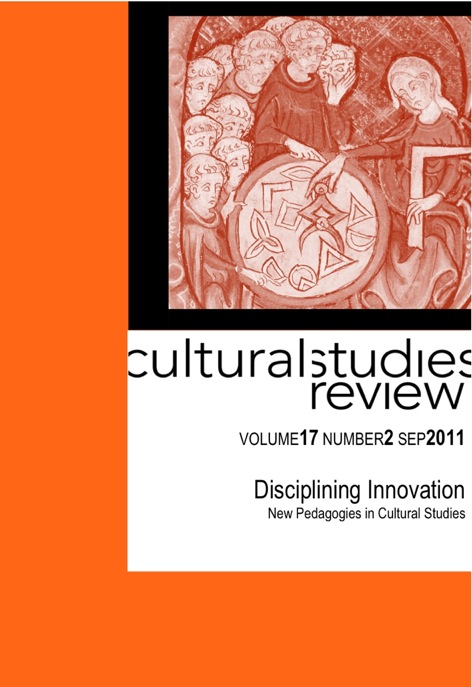
The themed section of this issue analyses the experience and future of pedagogical innovation in cultural studies, focusing on a variety of questions and issues. Has technological innovation allowed flexibility and an extension of the curriculum, or merely been used to reduce face-to-face teaching hours? Has the consistent demand to plan and report on teaching programs encouraged forward thinking or burdened academics with bureaucratic demands? Have universities truly internationalised their curriculums or merely exploited upwardly mobile international students? Has pedagogical innovation advanced or compromised the university’s ethical commitments: to social justice, equal access, human rights and environmental sustainability? What broader cultural developments does the consistent call to innovate in the classroom reflect?
The rest of the issue contains a wide range of innovative articles, new writing and reviews.
Table of Contents
| Editorial | |
| John Frow, Katrina Schlunke | 1–3 |
Disciplining Innovations
| Disciplining Innovations | |
| Nick Mansfield, Nicole Matthews | 4–10 |
| Teaching Illiteracy | |
| Nick Mansfield | 11–27 |
| Transition or Translation?: Thinking Through Media and Cultural Studies Students’ Experiences after Graduation | |
| Nicole Matthews | 28–48 |
| Going Places: Praxis and Pedagogy in Australian Cultural Studies | |
| Rebecca Rey, Golnar Nabizadeh | 49–70 |
| From Ethnocentrism to Transculturalism: A Film Studies Pedagogical Journey | |
| Helen Yeates, Margaret McVeigh, Tess Van Hemert | 71–99 |
| Brave New Worlds, Capabilities and the Graduates of Tomorrow | |
| Agnes Bosanquet | 100–14 |
| Economic Subjectivities in Higher Education: Self, Policy and Practice in the Knowledge Economy | |
| Sue Saltmarsh | 115–39 |
| Hired Hands: Casualised Technology and Labour in the Teaching of Cultural Studies | |
| Kieryn McKay, Kylie Brass | 140–64 |
New Writing
| Income Outcome: Life in the Corporate University | |
| Robyn Ferrell | 165–82 |
| The Shadow | |
| Lindsay Barrett | 183–97 |
Articles
| At the Table with Hungry Ghosts: Intimate Borderwork in Mexico City | |
| Jean Duruz | 198–218 |
| On Blowing Up the Pokies: The Pokie Lounge as a Cultural Site of Neoliberal Governmentality in Australia | |
| Fiona Nicoll | 219–56 |
| The Experience of Drugs: Utopian Imagination and Virtual Community in The Rose Seller | |
| Lizardo Herrera | 257–70 |
| Discursive Belonging: Surviving Narrative in Migrant Oral History | |
| Bryoni Trezise | 271–99 |
| Critical Incident Analysis and the Semiosphere: The Curious Case of the Spitting Butterfly | |
| Bob Hodge, Ingrid Matthews | 300–25 |
| Ravens at Play | |
| Deborah Bird Rose, Stuart Cooke, Thom van Dooren | 326–43 |
Reviews
| Common Pursuits | |
| Ben Clarke | 344–9 |
| Chip Power | |
| Gay Hawkins | 350–5 |
| The Aesthetic Revival | |
| Lachlan MacDowall | 356–60 |
| Ruins of (European) Modernity | |
| Mark Pendleton | 361–6 |
| Queer Counterpublics in Australia, Mexico and Brazil | |
| Kyja Noack-Lundberg | 367–75 |
| Peron's Cultural Influence | |
| Andrew King | 376–80 |
| The US Decentred: From Black Social Death to Cultural Transformation | |
| Saer Maty Ba | 381–91 |
| Consulting the Digital Natives | |
| Adam Stapleton | 392–8 |
| Convergence or Diffusion?: The Spread of Media History | |
| Jason Jacobs | 399–405 |
| The New World System and Worldview? | |
| Jonathan Marshall | 406–10 |
This work is licensed under a Creative Commons Attribution 3.0 License.
ISSN 1837-8692 (Online)