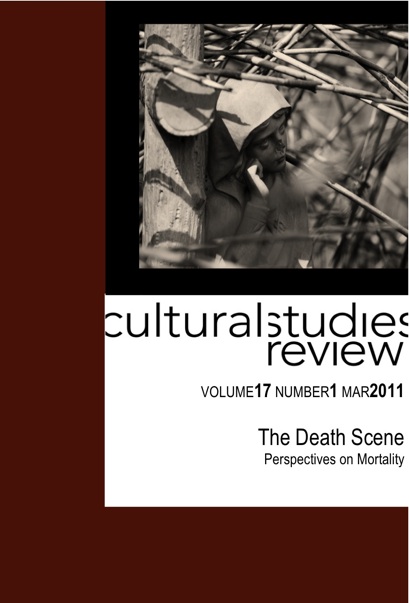
co-edited by Bruce Buchan, David Ellison and Margaret Gibson
This issue focuses on the interdisciplinary exploration and analysis of the scene of death, defined both in its privileged sense as the location of the end of life (with its associations of reflection, palliation, and confession) and in broader terms as a space of ethical contest (where ideas of the good death, or even the definition of death itself is open to debate). The varied articles explore how cultures frame the meaning and interpretation of human mortality in terms of representation, memorialisation, and the spacial and temporal location of moments of death.
Table of Contents
| Editorial | |
| John Frow, Katrina Schlunke | 1–2 |
The Death Scene
| Reflections on the Death Scene | |
| Bruce Buchan, Margaret Gibson, David Ellison | 3–14 |
| Whose Business is Dying? Death, the Home and Palliative Care | |
| John Rosenberg | 15–30 |
| Residential Aged Care Facilities: Places for Living and Dying | |
| Deborah Parker | 31–51 |
| A Jurisprudence of Ambivalence: Three Legal Fictions Concerning Death and Dying | |
| Kristin Savell | 52–80 |
| Embryo Disposition and the New Death Scene | |
| David Ellison, Isabel Karpin | 81–100 |
| Death is Swallowed Up in Victory: Scenes of Death in Early Christian Art and the Emergence of Crucifixion Iconography | |
| Felicity Harley McGowan | 101–24 |
| Death and Digital Photography | |
| Helen Ennis | 125–45 |
| Death and Grief in the Landscape: Private Memorials in Public Space | |
| Margaret Gibson | 146–61 |
| Obituary | |
| Polly Gould | 162–87 |
| Dying for Security | |
| Bruce Buchan | 188–210 |
Articles
| Plastic Surgery for the Monadology: Leibniz via Heidegger | |
| Graham Harman | 211–29 |
| Echo-Coherence: Moving on from Dwelling | |
| Stuart Cooke | 230–46 |
| Cultural Studies and Matters of Faith: The Case of DhammaWheel.com | |
| Edwin Ng | 247–69 |
| Dragon-slayers and Jealous Rats: The Gendered Self in Contemporary Self-help Manuals | |
| Rebecca Hazleden | 270–95 |
| Two Left Feet: Dancing in Academe to the Rhythms of Neoliberal Discourse. | |
| Colleen McGloin, Jeanette Stirling | 296–319 |
| In Threads and Tatters: Costume, Identification and Female Subjectivity in Mulholland Dr. | |
| Lynda Chapple | 320–38 |
Reviews
| Unhappy Families | |
| Sarah Cefai | 339–48 |
| The Dread of Sameness | |
| Rebecca Bishop | 349–54 |
| Aural Understanding | |
| Michelle Duffy | 355–61 |
| Festive Emplacements: Burning Man and Goa Trance | |
| Susan Luckman | 362–71 |
| Boys Boys Boys: Gender, Race and the English Music Question | |
| Timothy Laurie | 372–81 |
| Not Quite White | |
| Paul Oldham | 382–8 |
| Wiring the Wireless: Networking Early US Radio Broadcasting | |
| Vincent O'Donnell | 389–93 |
| Online Playgrounds and Transnational Gaming Cultures | |
| Jeffrey Wimmer | 394–7 |
| Still Waiting for the Barbarians | |
| Howard McNaughton | 398–402 |
| Out of Time: The Limits of Secular Critique | |
| Holly Randell-Moon | 403–9 |
| The Common Destiny of Un/common Cultures | |
| Vincenzo Romania | 410–14 |
| Making Students Think More Critically | |
| Nele Van Den Cruyce | 415–19 |
This work is licensed under a Creative Commons Attribution 3.0 License.
ISSN 1837-8692 (Online)